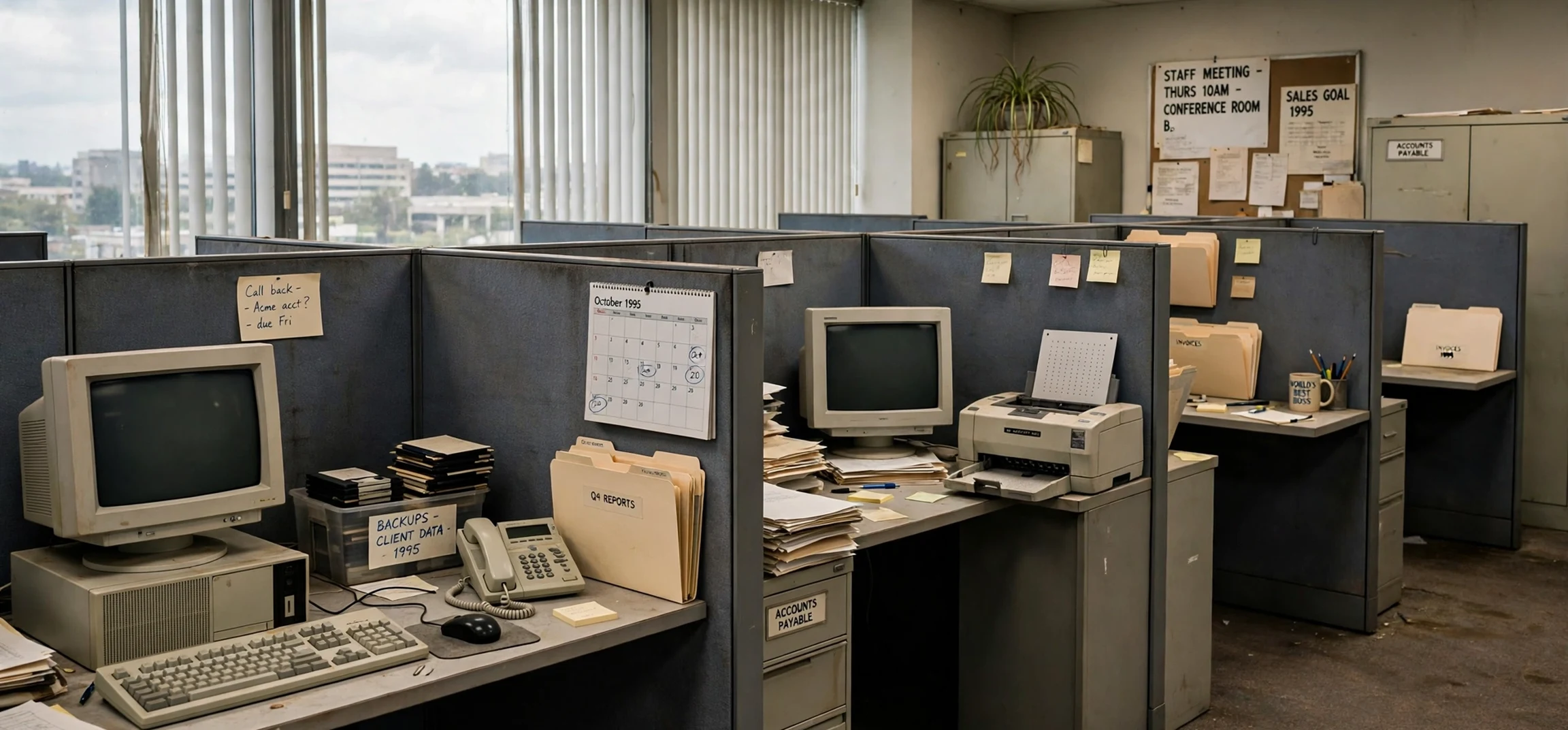
If you searched for the company from Office Space, you are asking about one of the most memorable fictional workplaces in comedy film history. The company from Office Space is Initech, a software firm where Peter Gibbons, Michael Bolton, Samir Nagheenanajar, and their colleagues endure cubicles, malfunctioning printers, and endless meetings. The company from Office Space is not a real employer, but it feels real to many viewers because its routines, jargon, and frustrations mirror everyday office life. This guide explains the name, what the firm supposedly does, who works there, and why the joke has lasted for more than two decades.
Initech is introduced as an ordinary technology company that has grown just large enough to feel impersonal. Its offices are filled with grey cubicles, flickering fluorescent lights, and motivational posters that no one really believes. Employees arrive, badge in, and settle into tasks that sound important but rarely feel meaningful. The humour comes from recognition rather than exaggeration alone. Many viewers have sat through a meeting that could have been a short message, waited for a printer that refused to cooperate, or listened to a manager repeat a slogan as if repetition would make it true.
The film, released in 1999 and written and directed by Mike Judge, follows Peter Gibbons, a programmer who stops caring about promotion, praise, or punishment and, paradoxically, begins to be treated as management material. Around him, the office becomes a small world with its own rules, rivalries, and rituals. Initech is the stage for that world. Without a believable company, the satire would not work. With Initech, every small annoyance becomes part of a larger comment on modern work.
What Is the Company From Office Space?
The company from Office Space is Initech, a fictional software company. In the story, Initech employs programmers, middle managers, consultants, and support staff. Its best-known project involves updating bank software for the year 2000 date change, a task that sounds technical and urgent but is presented as repetitive and poorly managed. The company from Office Space therefore represents a particular kind of workplace: profitable enough to survive, bureaucratic enough to frustrate, and distant enough that senior leaders seem unaware of daily reality.
Initech is not presented as evil in a dramatic sense. It is worse, in comic terms, because it is ordinary. The villains are not criminals plotting in secret. They are managers who love process, consultants who speak in vague improvement language, and systems that reward appearance over results. That ordinariness is why audiences still quote the film. The company feels familiar even to people who have never worked in software.
It is also worth noting that Initech shares a name pattern with real technology firms, but it remains a fictional creation. The similarity is part of the joke. A name that sounds plausible, corporate, and slightly bland helps the audience accept the office as a real place before the comedy begins. Once that acceptance happens, the film can push the details further without losing credibility.
What Does Initech Do?
Within the story, Initech works on software, including financial software that must handle dates correctly. Peter and his colleagues are programmers, and their daily work involves code, testing, and fixing problems created by rushed deadlines. The film does not spend much time explaining the technology itself. Instead, it focuses on how work is assigned, reviewed, and discussed. That choice is deliberate. The audience does not need to understand programming to understand a boss who asks the same question eight times.
The company also hires outside consultants, known in the film as the Bobs, to review staffing and efficiency. Their interviews become a memorable sequence because they expose how little formal job descriptions capture real work. Employees try to explain their value in language the consultants will accept, while the consultants listen for reasons to cut roles. The scene is funny because it is recognisable: many organisations have experienced reviews that measure what is easy to count rather than what actually matters.
Where Is Initech Located?
The film presents Initech as a suburban office park company, the kind of workplace reached by car, surrounded by parking lots, and divided into identical floors. The exact city is less important than the setting. Office parks, cubicles, and break rooms create a geography of work that many viewers know well. The building itself becomes a character: elevators, corridors, and meeting rooms shape how people interact, avoid each other, and waste time.
That setting also explains why small objects matter so much. A red stapler, a parking space, a favourite mug, or a working printer can feel like territory in an environment where employees control very little. When those small things are taken away, the reaction is larger than the object deserves, and that disproportion is the comedy.
Why the Company From Office Space Still Matters
The company from Office Space still matters because office culture has changed in form but not always in feeling. Remote work, video meetings, chat messages, and project dashboards have replaced some cubicles and paper memos, yet many of the same frustrations remain. Workers still receive vague instructions, attend meetings without clear purpose, and navigate software that fails at the worst moment. The company from Office Space therefore works as shorthand for any workplace where process matters more than people.
The film also captures a particular attitude toward work. Peter does not begin as a hero. He begins as someone exhausted by routine. His rebellion is quiet at first: he stops pretending to care, dresses more casually, and speaks plainly. The comedy arises when the company rewards that honesty, not because it values honesty, but because it mistakes confidence for leadership potential. That twist remains sharp because it questions how organisations recognise talent.
For viewers discovering the film today, Initech offers a useful contrast with modern startup culture. Startups often promise informality, purpose, and flexibility, while traditional firms promise stability and structure. Initech promises neither excitement nor security in a satisfying way. It promises a paycheck, a desk, and a set of rules. The joke is that many people accept that bargain and then wonder why they feel empty.
Main Characters at Initech
Peter Gibbons is the central programmer. He is skilled but disengaged, and his story follows what happens when he stops performing enthusiasm. Michael Bolton, who shares a name with a famous singer, is frustrated by the constant jokes about his name and by a system that treats him as interchangeable. Samir Nagheenanajar faces similar problems, including the regular mispronunciation of his name and the threat of job loss. Together, the three friends form the emotional core of the film.
Bill Lumbergh is the most quoted manager in the story. He speaks in a calm, drawn-out manner, asks employees to work weekends, and treats requests as if they were favours. His style is memorable because it is polite on the surface and inconsiderate underneath. He does not shout. He simply assumes compliance. That assumption, repeated often enough, becomes a symbol of bad management.
Milton Waddams is another important figure. He is quiet, overlooked, and repeatedly moved to smaller workspaces. His red stapler becomes famous because it represents the last thing he controls. The film treats Milton with both comedy and sympathy. His story warns that workplaces which ignore quiet employees may miss warning signs until frustration becomes impossible to ignore.
Other figures include the consultants, human resources staff, and senior managers who appear briefly but leave strong impressions. Each one represents a familiar workplace type: the efficiency expert, the rule enforcer, the distant executive, and the colleague who survives by agreeing with everyone. Together, they make Initech feel complete.
Initech and Office Culture
One reason Initech endures is that it collects many small workplace truths into one building. The film shows birthday cake in the break room, passive-aggressive notes, dress codes, parking disputes, and the strange importance of office supplies. None of these details alone would carry a film. Together, they create a world that viewers recognise immediately.
The film also explores language. Corporate phrases sound reassuring but often hide uncertainty. Employees learn to translate vague instructions into action, to nod during meetings, and to write messages that sound productive without committing to anything specific. That translation work is itself a job, and it can be exhausting. Initech makes that hidden labour visible.
Modern viewers may notice how much has stayed the same. A printer jam has become a frozen video call. A memo has become a long email thread. A surprise weekend request has become a late-night message marked urgent. The tools change, but the pattern remains: work expands to fill the time available, and urgency is often created by poor planning rather than real need.
| Element | What It Represents | Why Viewers Remember It |
|---|---|---|
| Initech | A fictional software company | It feels like many real offices |
| Cubicles | Limited privacy and control | They symbolise routine work |
| The printer | Unreliable office technology | It becomes a shared enemy |
| The consultants | Efficiency reviews | Their language sounds familiar |
| The red stapler | Small personal territory | It stands for dignity at work |
Lessons Viewers Take From Initech
The film is not a management textbook, but it offers useful observations. First, clarity matters. When goals are vague, employees spend energy guessing what leaders want. Second, respect matters more than perks. A break room with cake does not compensate for being ignored, moved, or threatened. Third, measurement matters. If an organisation only values visible activity, it may overlook quiet but essential work.
Another lesson concerns change. Initech tries to improve by hiring consultants and cutting staff, but it does not fix the underlying habits that create waste. Meetings remain long, instructions remain unclear, and managers remain distant. Real improvement would require listening to the people who do the work every day. The film suggests that efficiency cannot be imposed from outside without understanding daily reality.
For employees, the story is both cautionary and liberating. Peter finds a kind of freedom when he stops pretending, but his path is fictional and exaggerated. In real life, honesty at work works best when paired with clear communication, documented work, and respect for colleagues. The film is best enjoyed as satire, not as career advice.
The Company From Office Space in Popular Culture
The company from Office Space has become a reference point far beyond the film itself. When people describe a dull meeting, a pointless form, or a manager who confuses politeness with leadership, they may compare the situation to the company from Office Space. That comparison works because the name Initech is widely recognised, even by viewers who have only seen clips. The company from Office Space is therefore not just a plot detail. It is a cultural shorthand for a workplace that values routine over reason.
That shorthand also appears in discussions about remote work and office design. Writers and workers use the company from Office Space to ask whether a new tool, policy, or office layout genuinely helps people or simply moves an old frustration into a new format. The company from Office Space remains useful in that debate because it focuses attention on experience rather than slogans. If a change makes daily work clearer and kinder, it passes the test. If it only sounds efficient, it fails it.
Frequently Asked Questions
Is Initech a real company?
No. Initech is fictional. It was created for the film as a plausible software company. Any resemblance to real firms is part of the satire, not evidence that the company exists.
What film features Initech?
Initech appears in Office Space, the 1999 comedy written and directed by Mike Judge. The story follows programmers and office workers dealing with routine, management, and job insecurity.
Why is Initech so famous?
Initech is famous because it represents everyday office frustration in a clear and funny way. Cubicles, meetings, printers, and managers make the fictional firm feel familiar to a wide audience.
Who is the main boss at Initech?
Bill Lumbergh is the best-known manager. He supervises Peter and his colleagues and is remembered for calmly requesting weekend work and repeating instructions.
Conclusion
The company from Office Space is Initech, and its fame comes from how convincingly ordinary it feels. The company from Office Space is not remembered because it is strange, but because it is recognisable. Its cubicles, meetings, consultants, and small daily battles capture a version of work that many people know firsthand. For readers who want a simple answer, Initech is the name. For readers who want the larger point, Initech is a reminder that good workplaces need clarity, respect, and attention to the people who do the work. You can explore other classic television and film explainers on this site, including According to Jim TV show cast highlights and Bewitched TV show cast members, for more guides to memorable screen workplaces and casts.



