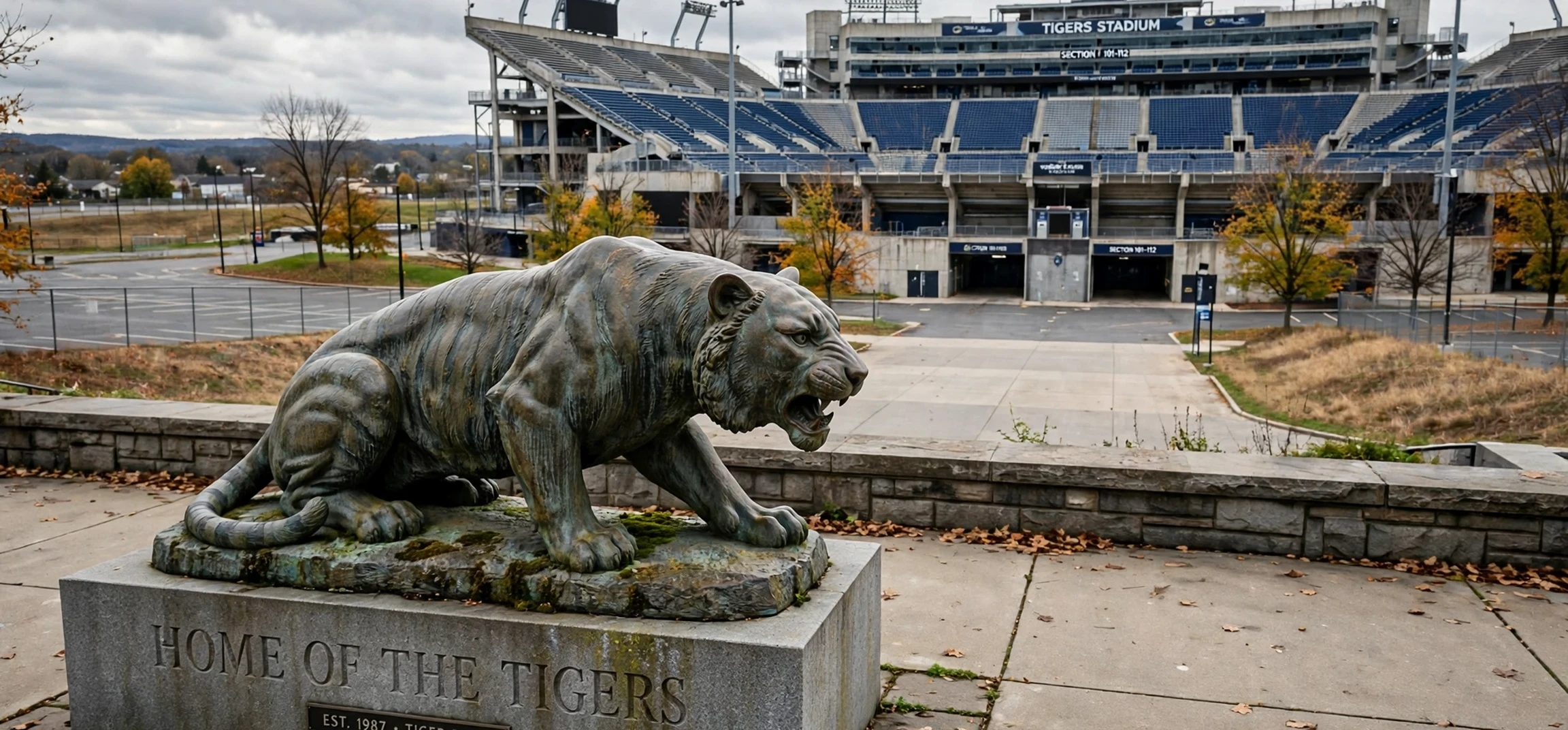
The LSU Tigers mascot history is one of the most recognisable traditions in American college sports, and it centres on a live Bengal tiger named Mike the Tiger alongside a costumed mascot who brings the same spirit to the sidelines. Louisiana State University, based in Baton Rouge, has used the Tigers nickname for well over a century, and the story of how a real tiger came to represent the school is tied to student pride, military heritage, and a long line of beloved animals. Anyone searching for the name of the LSU tiger mascot will quickly find the answer, Mike, but the fuller LSU Tigers mascot history explains why that name stuck, how the tradition began, and how it is cared for today.
LSU athletics are famous for noise, colour, and pageantry, from the roar of Tiger Stadium on a Saturday night to the marching band and the gold and purple that fill the stands. Within that spectacle, Mike the Tiger holds a special place. He is not a pet, a prop, or a novelty act. He is a live mascot whose habitat sits on campus, whose welfare is managed by veterinary professionals, and whose presence connects modern fans to generations of students who cheered for the Tigers long before them. Understanding the LSU Tigers mascot history means looking at both the animal and the idea: a symbol of strength that students chose, protected, and passed down. Indeed, the LSU Tigers mascot history is best understood as a living tradition, not a single event, because each generation of students has added its own chapter to the LSU Tigers mascot history.
How the LSU Tigers Mascot History Began
The Tigers nickname itself predates the live mascot by several decades. LSU teams took the name from a Civil War unit known as the Louisiana Tigers, a group celebrated for its toughness in battle. The university, which had strong military roots, adopted the name as a badge of fighting spirit. For years, the Tigers were represented only by the name, the colours, and the enthusiasm of the crowd. There was no animal on the sideline and no costumed character, just a nickname that carried weight.
That changed in the 1930s, when the idea of a live tiger mascot took hold. Students and supporters raised money to buy a tiger, and the animal arrived on campus in 1936. He was named Mike, in honour of Mike Chambers, the university athletic trainer who had championed the effort to bring a live mascot to LSU. From that first Mike onward, every live tiger mascot at LSU has carried the same name, creating an unbroken chain that is central to the LSU Tigers mascot history. The numbering system used today, Mike I, Mike II, and so on, helps fans follow that lineage across the decades.
The early years were modest compared with the modern habitat. The first tigers lived in a cage near the stadium, and care standards reflected the era. Over time, as knowledge of animal welfare grew and as the university invested more in the programme, the facilities and the veterinary care improved dramatically. What has not changed is the basic idea: a live tiger, named Mike, representing LSU with dignity and strength.
Meet Mike the Tiger in LSU Tigers Mascot History
Mike the Tiger is a Bengal tiger, and each Mike has been a distinct animal with his own personality, habits, and quirks. Some were playful and curious, others more reserved and watchful. Fans who visited the habitat often formed favourites, and campus stories about individual Mikes became part of university folklore. Yet the public role stayed consistent: Mike is an ambassador for LSU, a living link to tradition, and a source of pride for students, alumni, and supporters across Louisiana and beyond.
It is important to understand what Mike does and does not do. He does not travel to away games, he does not perform tricks, and he is not brought onto the field during games. In earlier decades, the mascot was sometimes taken to the stadium in a cage, but modern practice keeps him in his habitat, where visitors can see him in a setting designed for his comfort. On game days, the costumed mascot carries the energy into the stadium, while the live Mike remains at home in his enclosure, often watched by fans who stop by before kickoff.
The Costumed Mascot
Alongside the live tiger, LSU has a costumed mascot who also goes by Mike. This performer wears a tiger suit, leads cheers, poses for photographs, and entertains the crowd during games and campus events. The costumed Mike is the one fans high-five in the stands, and he plays a very different role from the live animal. Together, the two Mikes cover both sides of the tradition: one is a real animal honoured for his natural majesty, and the other is a performer who turns that majesty into crowd energy.
The Habitat on Campus
The modern Mike the Tiger Habitat, located near Tiger Stadium, is a landscaped enclosure with a pool, climbing structures, shaded areas, and viewing space for visitors. It is open to the public during daytime hours, and admission is free, which makes it one of the most visited spots on campus. The habitat was built with animal welfare in mind, giving Mike room to roam, swim, rest, and behave naturally. Veterinary staff monitor his health closely, and his diet, enrichment, and medical care follow professional standards for large cats in managed care.
Timeline of the LSU Tigers Mascot History
The LSU Tigers mascot history spans nearly nine decades of live mascots, and the timeline below summarises the major chapters. Each era brought its own characters, its own campus memories, and gradual improvements in how the mascot was housed and cared for.
| Era | Milestone | Why It Matters |
|---|---|---|
| 1890s | Tigers nickname adopted | The name traces back to the Louisiana Tigers and the university military heritage. |
| 1936 | First live Mike arrives | Students raise funds for a tiger, named Mike after trainer Mike Chambers. |
| Mid-1900s | Successive Mikes continue the line | Each new tiger keeps the name Mike, preserving one continuous tradition. |
| Later decades | Habitat and care modernised | Facilities, veterinary care, and welfare standards improve greatly. |
| 2000s to today | Modern habitat opens | A purpose-built, landscaped habitat becomes a free public attraction on campus. |
One of the most famous chapters in the LSU Tigers mascot history came with Mike VI, who lived from the mid-2000s into the mid-2010s and became widely known among fans. Later, Mike VII arrived as a young tiger donated from a rescue background, and his introduction drew national attention. Each transition between Mikes is handled carefully, with the university announcing the news, explaining the selection process, and giving fans a chance to welcome the new tiger. The numbering keeps the story clear, even as individual animals come and go.
Why the LSU Tigers Mascot History Still Matters
College mascots are often treated as simple logos, but the LSU Tigers mascot history shows why some traditions run deeper. Mike is tied to student initiative, because students raised the money for the first tiger. He is tied to memory, because alumni remember visiting the habitat as students and now bring their own children to see the current Mike. And he is tied to identity, because the tiger image appears on merchandise, uniforms, and campus landmarks, instantly signalling LSU to sports fans everywhere.
The LSU Tigers mascot history also sparks conversation about live mascots in modern college sports, and the LSU Tigers mascot history is often cited whenever universities discuss how such traditions should evolve. LSU has responded to that conversation by emphasising welfare, transparency, and professional care. The habitat publishes information about Mike health and daily life, veterinary oversight is a stated priority, and the tiger is not used as a game-day prop. Supporters argue that this approach honours the tradition responsibly, while critics of live mascots in general continue to debate the practice across college athletics. Either way, the LSU programme is among the most closely watched, precisely because it is so well known.
For visitors, the habitat offers something rare: a chance to see a Bengal tiger up close without visiting a zoo. Families, prospective students, and travelling fans often make it a first stop on a campus tour. The setting, with its greenery and viewing areas, invites quiet observation rather than spectacle, and that tone suits the modern understanding of the tradition. Mike is there to be respected, not to perform.
LSU Tigers Mascot History FAQ
What is the name of the LSU tiger mascot?
The live tiger mascot is named Mike the Tiger, and the costumed mascot also uses the name Mike. Every live tiger in the line has shared the name, distinguished by Roman numerals.
Why is the mascot called Mike?
The first tiger was named Mike in honour of Mike Chambers, the LSU athletic trainer who led the campaign to bring a live tiger mascot to campus in the 1930s.
Does Mike the Tiger attend football games?
No. The live tiger stays in his habitat on game days, while the costumed Mike entertains fans inside Tiger Stadium.
Can visitors see Mike the Tiger?
Yes. The habitat near Tiger Stadium is open to the public during daytime hours, and admission is free. Viewing depends on Mike daily routine, rest, and weather.
How many Mikes have there been?
There have been seven live Mikes in the official line, from Mike I in 1936 to Mike VII in the modern era, each continuing the same named tradition.
Conclusion
The LSU Tigers mascot history is a story of student spirit, a famous name, and a tradition that has adapted with the times. From a nickname rooted in military history to a live Bengal tiger named Mike, and from a simple cage to a modern landscaped habitat, the tradition has grown while keeping its core identity intact. Whether you are a lifelong Tigers fan, a prospective student planning a campus visit, or simply curious about one of college sports most famous mascots, the tale of Mike the Tiger offers a window into what makes LSU distinctive. To explore more mascot traditions, read our guide to the Stanford mascot name and our look at the meaning of tigers in dreams, and plan a stop at the habitat the next time you are in Baton Rouge.