The meaning of simmer is one of the most useful things a home cook can learn, because simmering sits between boiling and gentle warming and it is the technique behind soups, stews, sauces, and braises that taste deep and settled rather than rushed. To simmer means to cook a liquid just below boiling point, so that small bubbles rise gently and break on the surface, rather than rolling vigorously as they do in a full boil. This guide explains the meaning of simmer in full: what temperature it involves, how to recognise it, how it differs from boiling and poaching, and how to use it well in everyday cooking.
Simmering matters because heat changes food in different ways at different intensities. A rolling boil is fast and violent: it can toughen meat, break delicate ingredients apart, cloud a stock, and reduce a sauce too quickly. A simmer is patient: it coaxes flavour out of ingredients, tenderises tough cuts, melds spices into a sauce, and reduces a liquid slowly and controllably. Many recipes that taste “like they cooked all day” did not use a secret ingredient; they used time at a simmer, and that time is what this guide will help you control.
Meaning of Simmer: Definition
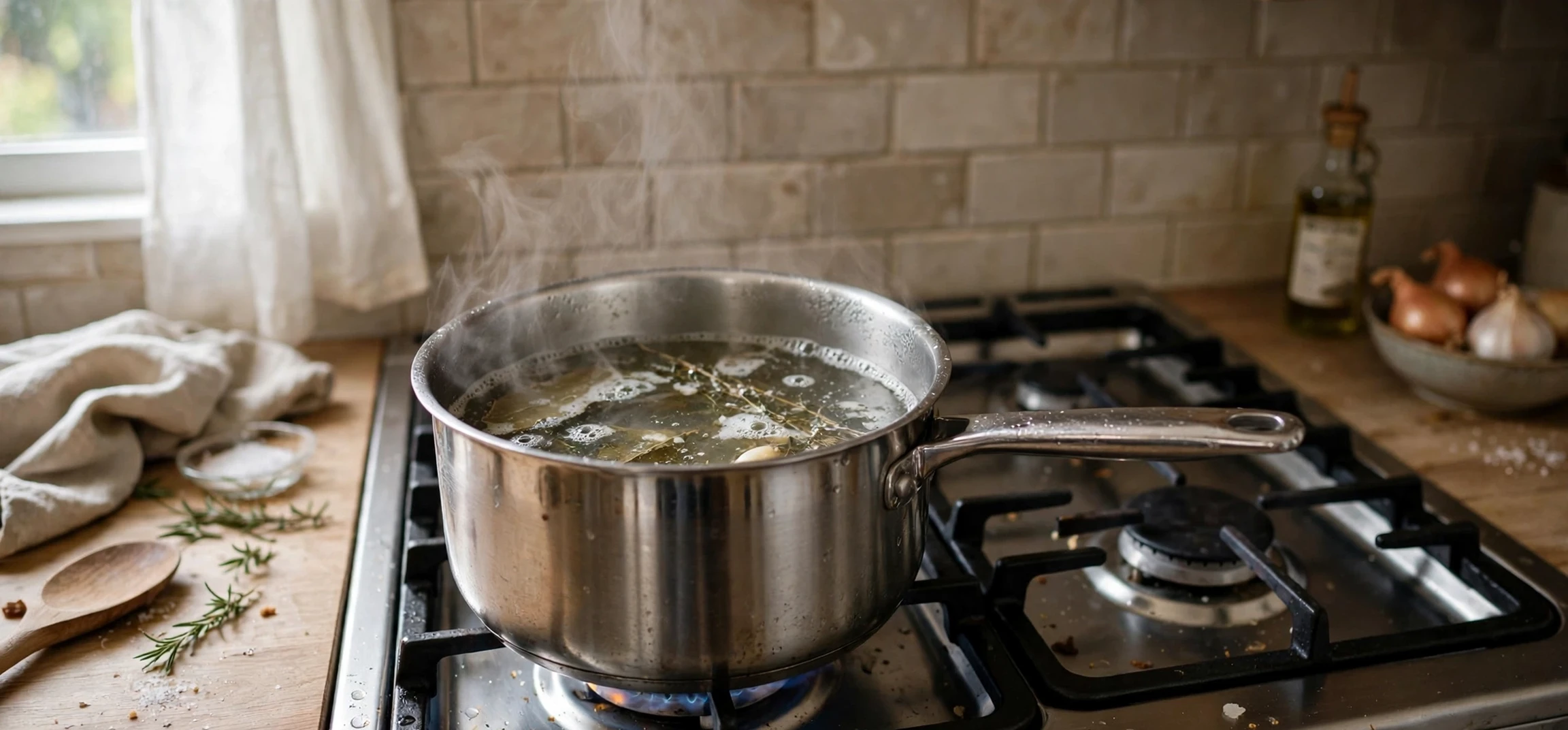
In cooking, the meaning of simmer is to maintain a liquid at a temperature just below boiling, usually around 85 to 95 degrees Celsius, or about 185 to 205 degrees Fahrenheit, so that bubbles form gently and infrequently. The surface should shimmer and tremble, with occasional small bubbles breaking, rather than churning. If your pot is roaring, rattling its lid, and throwing steam everywhere, you are boiling, not simmering. If nothing is moving at all, you are warming, not simmering. The simmer lives in that quiet middle zone, and learning to recognise it by eye is more useful than any thermometer, although a thermometer can help while you learn.
Recipes use the word simmer in several related ways. “Bring to a simmer” means heat until those gentle bubbles first appear, then hold the heat there. “Simmer for 30 minutes” means keep the liquid in that gentle state for that time, usually with the lid partly on or off depending on whether you want the liquid to reduce. “Simmer until reduced by half” means keep simmering until evaporation has concentrated the liquid to half its volume. In every case, the meaning of simmer stays the same: gentle, sustained, sub-boiling heat.
Meaning of Simmer Versus Boiling and Poaching
Boiling, simmering, and poaching form a scale of heat, and cooks use each for different jobs. Boiling, at 100 degrees Celsius at sea level, is for speed: cooking pasta, blanching vegetables, and reducing liquids quickly. Simmering, just below boiling, is for depth: soups, stews, stocks, curries, and sauces that benefit from time. Poaching, lower still, at around 70 to 85 degrees Celsius, is for delicacy: eggs, fish, and fruit that would break apart or toughen at higher heat. Knowing where simmer sits on that scale helps you choose the right technique rather than simply turning the heat up and hoping.
The differences show up in results. A stock that is boiled hard becomes cloudy, because fat and proteins are churned into the liquid; a stock that is simmered gently stays clearer and tastes cleaner. Meat that is boiled can become stringy and dry, because violent heat squeezes moisture out; meat that is simmered becomes tender, because gentle heat slowly converts tough connective tissue into gelatin. A sauce that is boiled can split or scorch; a sauce that is simmered thickens smoothly and evenly. The meaning of simmer is therefore not just a temperature; it is a promise about texture and flavour.
How to Simmer Step by Step
Start by bringing your liquid to a boil over medium-high heat, because it is easier to find the simmer by coming down from a boil than by creeping up to it. Once the liquid boils, reduce the heat to low or medium-low until the vigorous bubbling calms to gentle, occasional bubbles. Adjust the lid: a lid left ajar lets steam escape and the liquid reduce, while a closed lid keeps the liquid level steady and the heat even. Then leave the pot mostly alone, stirring occasionally to prevent sticking, especially for thick sauces and stews, and checking every ten or fifteen minutes that the simmer has not crept back up to a boil or died down to nothing.
Different hobs and pots behave differently, so your simmer setting will vary. A heavy pot holds heat more evenly than a thin one, and an electric hob may need a lower setting than a gas flame. If your smallest burner still boils too vigorously, a heat diffuser or a larger pot can help. If your simmer keeps dying, a slightly higher setting or a closed lid may be the answer. The skill is not in memorising a dial number; it is in watching the surface of the liquid and adjusting until it looks right, and that skill improves quickly with practice.
What to Simmer and for How Long
Soups and stocks are the classic simmering dishes. A vegetable soup may need only 20 to 30 minutes at a simmer, while a meat stock benefits from several hours, with scum skimmed from the surface early on. Stews and braises, where tough meat becomes tender, often simmer for one to three hours, depending on the cut, and the test for doneness is tenderness, not the clock. Sauces vary widely: a tomato sauce may simmer for 30 minutes to an hour to lose its raw edge, while a curry may simmer for 45 minutes to meld its spices. Rice and grains are sometimes simmered with a closed lid, where the gentle heat cooks them through without scorching.
Timing guidance in recipes is always approximate, because pot size, ingredient quantity, and hob strength all affect the result. Use the recipe time as a starting point, then taste and check texture. A stew is done when the meat yields easily, a sauce is done when it coats a spoon the way you like, and a soup is done when the flavours taste settled rather than separate. Learning to judge by taste and texture, rather than by the clock alone, is the real mark of a confident simmering cook.
Common Simmering Mistakes
The most common mistake is simmering too hot, which is really boiling in disguise. If your sauce spits, your stock clouds, or your meat toughens, turn the heat down and check the surface again. The second mistake is simmering too cool, so that food sits in warm liquid without really cooking, which can be a food-safety issue for meat dishes left too long at low temperatures. The third mistake is forgetting to stir thick dishes, which scorch on the bottom while the top stays cool. The fourth is reducing too far, because a simmer left unattended can turn a sauce into a paste or a stew into a dry pot, so set a timer even for long simmers.
Another mistake is confusing simmering with steaming or with slow-cooker cooking. A slow cooker simmers very gently over many hours, but it seals in moisture rather than reducing a liquid, so a slow-cooker stew and a pot simmered on the hob will taste different even with the same ingredients. Neither is wrong; they are different tools for different results. For another gentle cooking technique, see our guide to what braised means and our recipe guide from a healthy snack guide.
Simmering Guide at a Glance
| Technique | Temperature | Surface | Best for |
|---|---|---|---|
| Poaching | 70 to 85 C | Barely moving | Eggs, fish, fruit |
| Simmering | 85 to 95 C | Gentle, occasional bubbles | Soups, stews, sauces |
| Boiling | 100 C | Rolling, vigorous bubbles | Pasta, blanching, fast reduction |
Frequently Asked Questions
What is the meaning of simmer in cooking?
The meaning of simmer in cooking is to cook a liquid gently just below boiling point, at about 85 to 95 degrees Celsius, so that small bubbles rise occasionally rather than rolling vigorously.
Should I simmer with the lid on or off?
Use the lid ajar or off if you want the liquid to reduce and concentrate, and use the lid on if you want to keep the liquid level steady and cook evenly. Recipes usually specify, but you can adjust to taste.
How do I know if I am simmering and not boiling?
Look at the surface: a simmer shows gentle, occasional bubbles and a trembling surface, while a boil shows continuous rolling bubbles, rattling lids, and heavy steam. Turn the heat down until the rolling stops.
Meaning of Simmer in Recipes and Everyday Cooking
Recipe writers rely on the meaning of simmer because it is a precise instruction in a single word. When a recipe says “simmer gently”, the meaning of simmer tells you to lower the heat until bubbles barely break the surface, and to hold it there without rushing. When a recipe says “simmer uncovered”, the meaning of simmer plus the uncovered instruction tells you the liquid should reduce, while “simmer covered” tells you it should stay steady. Learning the meaning of simmer therefore unlocks hundreds of recipes, because you no longer need to guess what the writer intended: the meaning of simmer is the same in a soup, a stew, a sauce, and a curry, and once you recognise it by eye, you can follow any of them with confidence. Practice by simmering a simple tomato sauce and watching the surface change as you adjust the heat, and the meaning of simmer will become second nature within a single cooking session.
Conclusion
The meaning of simmer is simple to state and rewarding to master: gentle heat, just below boiling, held with patience until flavours meld and textures turn tender. Once you can recognise a true simmer by eye, adjust a lid to control reduction, and judge doneness by taste rather than by the clock, a whole range of dishes becomes easier and more reliable. Soups deepen, stews soften, sauces smooth out, and the kitchen smells like something has been cared for. That is the quiet power of simmering, and it is well worth learning.