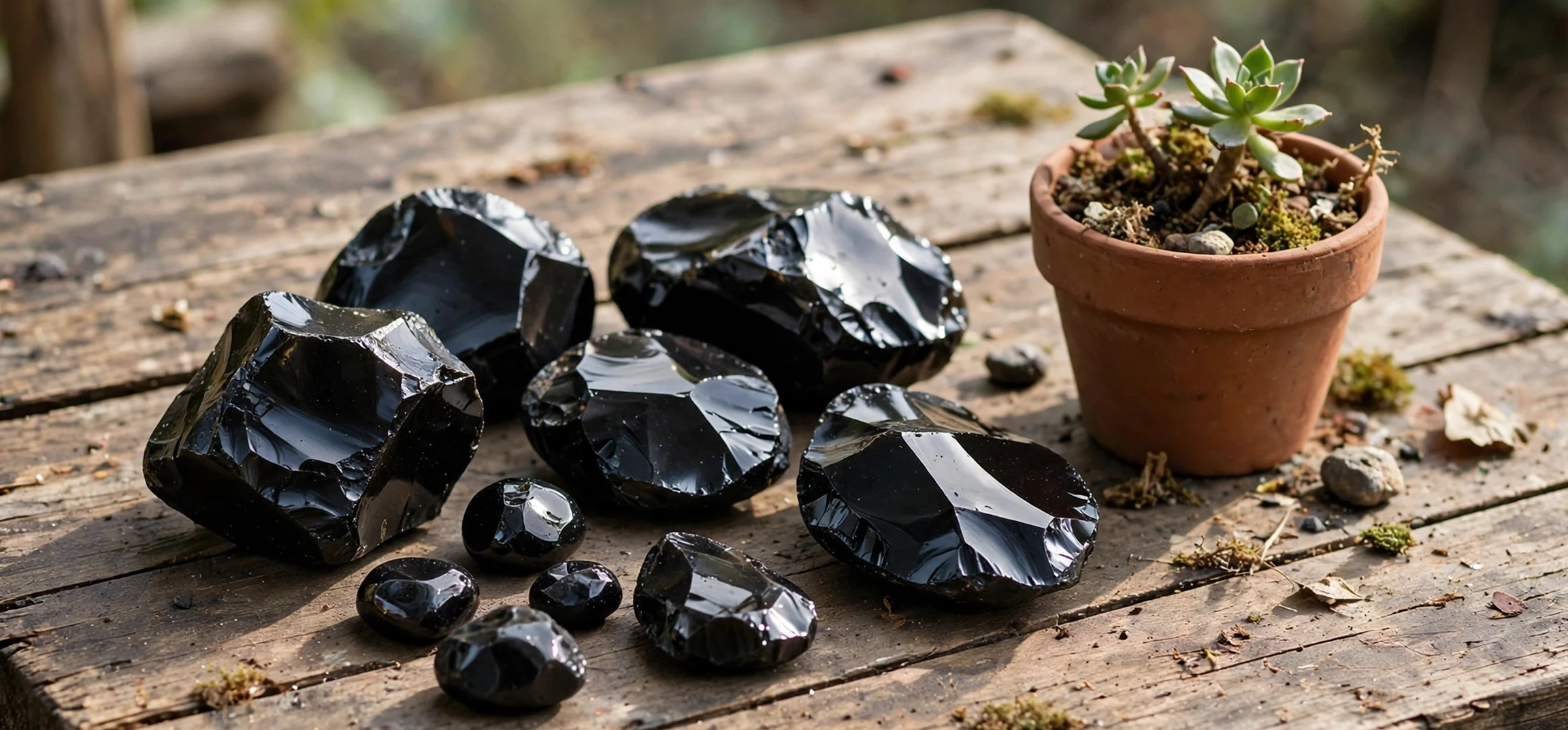
The search for obsidian rock meaning usually starts with a striking black stone: glossy, sharp-edged, and strangely glassy for something formed by nature. Black obsidian is volcanic glass, created when lava cools so quickly that crystals do not have time to form. The result is a smooth, dark material that humans have used for thousands of years as a tool, a mirror, a blade, and a symbol. This guide explains the obsidian rock meaning in geology, history, and modern spiritual practice, and separates well-established facts from symbolic interpretations so you can judge each claim for yourself.
Black obsidian looks dramatic, and that drama has shaped its reputation. In geology it is a natural glass, not a true mineral, because it lacks a regular crystal structure. In history it was prized for cutting edges sharper than steel. In modern crystal and wellness culture it is often described as a stone of protection, grounding, and truth. All three layers matter when you explore obsidian rock meaning, because the stone means different things in a laboratory, in an archaeological museum, and in a jewellery shop.
Obsidian Rock Meaning in Geology
In geological terms, the obsidian rock meaning is precise: obsidian is extrusive igneous rock, a volcanic glass formed from rapidly cooled, silica-rich lava. When lava erupts and cools in seconds or minutes rather than slowly underground, atoms do not organise into crystals. Instead they freeze in a disordered, glass-like arrangement. That is why obsidian breaks with a smooth, curved fracture called a conchoidal fracture, producing edges that can be extremely sharp.
Most obsidian is black or very dark brown, but it can also appear in shades of grey, green, red, brown, and even with golden or silvery sheen. Colour depends on impurities and tiny mineral inclusions. Snowflake obsidian, for example, contains white cristobalite patterns that look like snowflakes against black glass. Rainbow obsidian shows bands of colour caused by microscopic inclusions. Mahogany obsidian mixes black and reddish-brown swirls. These varieties share the same basic origin, even though they look quite different.
Obsidian is relatively hard but brittle. It rates around 5 to 5.5 on the Mohs hardness scale, similar to ordinary window glass, and it can chip or shatter if dropped or struck. Over very long geological timescales, obsidian can slowly change into more crystalline rock through a process called devitrification, which is one reason ancient obsidian is often found in particular volcanic regions rather than everywhere. Major sources include parts of Mexico, the western United States, Iceland, Italy, Greece, Turkey, Japan, and Armenia.
Black Obsidian Through History
Long before obsidian became a modern jewellery stone, it was one of humanity’s most valuable materials. Archaeologists have found obsidian tools dating back tens of thousands of years, including blades, scrapers, arrowheads, and spear points. Because obsidian fractures so predictably, skilled knappers could shape it into tools with edges far sharper than stone tools made from flint or other rocks. In fact, obsidian blades can be sharper than modern surgical steel at a microscopic level, and obsidian scalpels have even been used in some specialised modern surgical contexts.
Obsidian was also traded over long distances in the ancient world. Chemical fingerprinting allows researchers to match an obsidian artefact to its volcanic source, revealing trade routes that crossed mountains, seas, and continents. In Mesoamerica, obsidian was central to Aztec and Maya technology, ritual, and trade, used for weapons, tools, mirrors, and ceremonial objects. In the ancient Near East and Mediterranean, polished obsidian mirrors were prized luxury items, because a highly polished black surface can reflect an image surprisingly well.
Later, obsidian continued to appear in art, jewellery, and decorative objects. Its deep black colour and high polish made it attractive for beads, carvings, and inlays, and its association with volcanoes gave it a powerful, elemental image. That ancient prestige still influences how the stone is marketed today, even though modern buyers usually choose it for appearance and symbolism rather than for cutting tools.
Obsidian Rock Meaning in Symbolism and Spiritual Practice
In modern crystal healing, metaphysical, and spiritual communities, the obsidian rock meaning centres on protection, grounding, and self-truth. Black obsidian is commonly described as a shielding stone, said to absorb or deflect negative energy, to ground scattered thoughts, and to help the wearer face uncomfortable truths about themselves. It is also associated with the root chakra in some traditions, linked to stability, safety, and connection to the earth.
It is important to be clear about the status of these claims. They are cultural and symbolic interpretations, not established scientific findings. There is no reliable scientific evidence that a stone can absorb negative energy, heal illness, or change luck, and readers should be cautious about any seller who promises medical or financial results from a crystal. At the same time, symbolism itself has real cultural value: many people use stones as reminders, focus objects, or personal symbols, in the same way others use a meaningful piece of jewellery, a photograph, or a written affirmation.
Within that symbolic framework, black obsidian is often contrasted with lighter, softer stones. Where rose quartz is associated with love and amethyst with calm, obsidian is presented as direct and uncompromising, a stone for clarity and boundaries. Some practitioners say it is not a gentle beginner stone, because its reputation for revealing truth can feel intense. Others simply value its bold black appearance and its volcanic origin story. Either way, the symbolic obsidian rock meaning is best understood as a modern layer added to a very old material, not as a property measured in a laboratory.
Obsidian Rock Meaning for Protection and Grounding
Protection is the most common theme in descriptions of black obsidian. In crystal guides, it is said to act like a shield, blocking negativity from other people, stressful environments, or the wearer’s own rumination. Grounding is the second major theme: holding or wearing a heavy, dark stone is said to help a person feel rooted, present, and less overwhelmed, especially during stress, travel, or major life changes.
Psychologically, there is a plausible, non-magical explanation for why such objects can feel helpful. A tactile object can serve as a grounding cue, a reminder to pause, breathe, and refocus. A piece of jewellery chosen deliberately can also act as a boundary symbol, a private reminder of an intention such as saying no, staying calm, or protecting personal time. Those effects come from attention, ritual, and personal meaning, not from the mineral composition of the stone, but they can still matter to the person using it.
If you use black obsidian in this way, treat it as a supportive symbol alongside practical steps, not as a replacement for them. Real protection from stress comes from sleep, boundaries, supportive relationships, and, where needed, professional help. A stone can accompany those steps, but it cannot do the work alone. That honest framing keeps the obsidian rock meaning useful without overstating what any crystal can do.
Types of Obsidian Explained
Not all black obsidian looks identical, and sellers often use variety names that describe patterns, sheen, or colour. Understanding these types helps buyers avoid confusion and overpaying for a common variety sold under a dramatic name.
| Variety | Appearance | Common symbolic association |
|---|---|---|
| Black obsidian | Deep, glossy black glass | Protection, grounding, truth |
| Snowflake obsidian | Black with white, snowflake-like spots | Balance, calm during change |
| Rainbow obsidian | Black with rainbow bands in bright light | Hope, emotional healing, joy |
| Mahogany obsidian | Black mixed with reddish-brown swirls | Strength, vitality, confidence |
| Gold sheen obsidian | Black with a golden shimmer | Personal power, leadership |
| Silver sheen obsidian | Black with a silvery shimmer | Reflection, patience, insight |
Sheen obsidian gets its shimmer from tiny gas bubbles or inclusions aligned in the glass, which reflect light in a particular way. The effect is natural and beautiful, but it does not make the stone rarer in a scientific sense, and prices should reflect craftsmanship and quality of polish as much as variety name. Always check whether a piece is natural obsidian, dyed glass, or a synthetic imitation, especially when buying online.
How to Identify Real Black Obsidian
Real obsidian has several tell-tale features. It feels like glass, smooth and cool to the touch, and it is lighter than many people expect for a stone. Its fracture surfaces are curved and glassy, and thin edges may be slightly translucent, showing a dark brown or smoky edge when held to strong light. Genuine obsidian may contain tiny bubbles, flow lines, or mineral inclusions, while perfect, flawless black glass with no variation at all deserves a second look.
Common imitations include black glass, dyed chalcedony, and synthetic materials sold as obsidian. A simple hardness or appearance test is not conclusive, and reputable sellers should be transparent about origin and treatment. For expensive pieces, buy from a seller who identifies the material clearly, offers a return policy, and avoids medical or magical promises. If a listing claims a stone will cure disease, attract wealth, or guarantee protection, treat that as a marketing red flag, not as evidence.
Care is straightforward. Obsidian is brittle, so avoid dropping it, knocking it against hard surfaces, or exposing it to sudden temperature changes. Clean it with mild soap and lukewarm water, dry it softly, and store it separately from harder stones that could scratch or chip it. Avoid harsh chemicals and ultrasonic cleaners, which can damage polished surfaces. With gentle care, a well-made obsidian piece can last for decades.
Obsidian in Jewellery and Home Use
Today black obsidian is most often worn as bracelets, pendants, rings, and beads, or displayed as polished spheres, towers, palm stones, and carved figures. Its deep black colour pairs well with silver, gold, and other metals, and its high polish gives it a sleek, modern look that suits both casual and formal wear. Many buyers choose it simply because they like how it looks, without any interest in crystal symbolism, and that is a perfectly valid reason.
In home decor, obsidian spheres and towers are popular as statement pieces, often placed on desks, shelves, or meditation spaces. Some people use them as focus objects during journaling or quiet reflection. Others give obsidian as a gift for new beginnings, protection during travel, or support through a difficult period, with the symbolism explained in a card rather than assumed. The gift meaning is personal: what matters is the intention of the giver and the taste of the receiver, not a universal rule about the stone.
For readers exploring other symbolic meanings, a related guide to symbolic number meanings on this site shows how the same pattern works elsewhere: a symbol gains meaning through culture, story, and personal association, not through a single fixed definition. Obsidian follows the same logic, with geology providing the facts and culture providing the stories.
Obsidian Rock Meaning and Common Misconceptions
Several misconceptions surround black obsidian, and clearing them up helps readers make informed choices. First, obsidian is not a crystal in the mineralogical sense, even though it is sold in crystal shops. It is a glass, and that distinction matters in geology, even if shops use crystal as a general term for decorative stones. Second, obsidian is not indestructible. Its sharpness comes with brittleness, and a dropped sphere can crack or chip.
Third, colour alone does not prove authenticity or value. Very black, very shiny material can be ordinary glass, while genuine obsidian can look dull before polishing. Fourth, obsidian does not need to be charged, cleansed, or activated in any scientifically verified way, although some owners enjoy rituals such as placing a stone in moonlight or rinsing it as a personal reset. Those rituals are cultural practices, and they are harmless when understood as such, but they do not change the stone physically.
Finally, obsidian is not dangerous to own in a supernatural sense, despite dramatic stories in folklore and popular culture. Its real hazards are practical: sharp broken edges can cut, and small pieces can be a choking hazard for young children. Handle broken obsidian carefully, keep small pieces away from children and pets, and enjoy polished pieces with normal, sensible care.
Obsidian Rock Meaning: Search Summary
If you arrived here by searching for obsidian rock meaning, you now have the three layers that matter: geology, history, and symbolism. The geological obsidian rock meaning is volcanic glass formed by rapid cooling, while the historical obsidian rock meaning is a prized tool and mirror material traded across ancient worlds. The modern obsidian rock meaning adds protection, grounding, and truth as symbolic associations, which are cultural interpretations rather than laboratory facts. Readers who search for obsidian rock meaning often want all three layers at once, so that they can choose a piece for its look, its history, or its personal symbolism without being misled. Keeping the obsidian rock meaning in those separate layers is the honest way to enjoy a beautiful black stone.
Frequently Asked Questions
What is the obsidian rock meaning?
Geologically, obsidian rock meaning refers to volcanic glass formed by rapidly cooled lava. Symbolically, black obsidian is associated with protection, grounding, and truth in modern crystal culture.
Is black obsidian a real crystal?
Strictly speaking, no. Obsidian is a natural glass without a regular crystal structure, although it is commonly sold alongside crystals in jewellery and metaphysical shops.
Is obsidian good for protection?
Many people use it as a symbolic reminder of boundaries and calm, but there is no scientific evidence that it provides physical or supernatural protection. Treat symbolic claims as personal meaning, not as proven fact.
How do you care for obsidian?
Handle it gently, avoid drops and hard knocks, clean with mild soap and water, and store it separately from harder stones to prevent chips and scratches.
Conclusion
The obsidian rock meaning has three layers that fit together. Geologically, black obsidian is volcanic glass, born in eruptions and shaped by rapid cooling. Historically, it was a prized tool, mirror, and trade good, valued for edges sharper than steel. Symbolically, it is now a stone of protection, grounding, and honest self-reflection for many modern wearers. Understanding all three layers lets you appreciate the stone without being misled by exaggerated claims. Whether you choose black obsidian for its dramatic look, its ancient history, or its personal symbolism, you are holding a piece of volcanic earth history, polished into something both beautiful and meaningful. For a broader look at how symbols gain meaning, see this guide to encompassing meanings on this site, and choose your obsidian for the reasons that honestly matter to you.