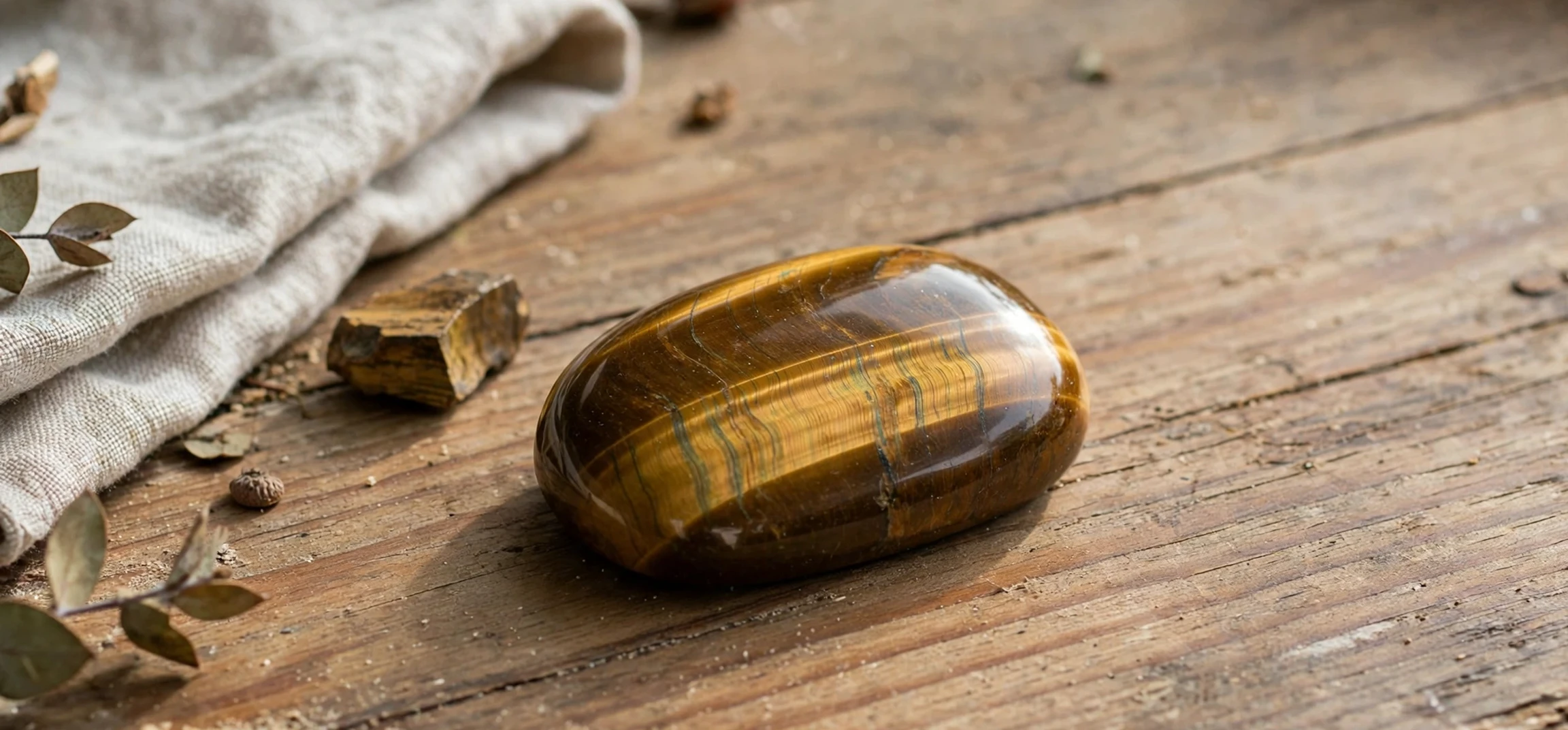
The search for tigers eye meaning and uses usually begins with a stone that seems to move as it catches the light: bands of gold, brown, and amber that shift across a polished surface like the eye of an animal. Tiger’s eye is a variety of quartz, best known for a shimmering effect called chatoyancy. This guide explains tigers eye meaning and uses across geology, history, jewellery, and modern crystal traditions, while keeping a clear line between established scientific facts and symbolic interpretations that people hold as beliefs rather than proven effects.
That distinction matters. Tigers eye meaning and uses have a fascinating geological story that can be verified in mineralogy references, and it also has a rich cultural story in which different traditions have attached meanings such as courage, protection, and focus to the stone. Both stories are worth understanding, but they are not the same kind of claim. The geological story describes how the stone formed and why it looks the way it does. The symbolic story describes what people have believed about it, and why those beliefs have endured. This article presents both, and it does not present symbolic or spiritual claims as medical or financial facts.
Tigers Eye Meaning and Uses in Geology
In geological terms, tigers eye meaning and uses start with quartz. Tiger’s eye forms when quartz replaces fibrous crocidolite, a mineral from the asbestos family, in a process called pseudomorphism. The quartz preserves the fibrous structure of the original mineral, and that structure is what creates the stone’s signature shimmer. When light hits the parallel fibres, it reflects in a moving band, an effect known as chatoyancy or the cat’s eye effect. The golden-brown colour comes mainly from iron oxide staining within the stone.
Tiger’s eye is a member of the quartz family, with a hardness of around 7 on the Mohs scale. That hardness makes it suitable for jewellery that is worn regularly, including cabochons, beads, rings, and pendants, although it is still best protected from hard knocks and harsh chemicals. Most tiger’s eye on the market is polished rather than faceted, because a smooth, domed cabochon cut shows the chatoyant band most clearly. A flat or poorly oriented cut can hide the effect, which is why experienced cutters orient the stone carefully before polishing.
Major sources of tiger’s eye include South Africa, Australia, India, Myanmar, and parts of the United States, among others. South African material has historically been well known, and Australian deposits have also produced attractive stones. Colour can vary from pale gold to deep brown, and some stones show reddish tones where the material has been heated or where natural iron content differs. Blue tiger’s eye, sometimes called hawk’s eye, is a related material in which the original blue-grey fibrous structure is preserved with less iron staining. Red tiger’s eye is often created by heating golden material, a common and accepted treatment in the gem trade when disclosed.
Tigers Eye Meaning and Uses in History
Historically, tigers eye meaning and uses are linked to ideas of watchfulness and strength. The stone’s eye-like shimmer invited comparisons with animals, especially tigers, and with the idea of seeing clearly or staying alert. In ancient cultures, eye motifs in jewellery and amulets were often associated with protection against misfortune, and stones that resembled eyes were natural candidates for that symbolism. Those associations were cultural rather than scientific, but they help explain why tiger’s eye has remained popular for so long.
In more recent history, tigers eye meaning and uses became widely available as a jewellery stone as a decorative and jewellery stone during the nineteenth and twentieth centuries, as mining and lapidary work expanded. It was used for men’s jewellery, including cufflinks, tie pins, and rings, as well as for beads, carvings, and ornamental objects. Its warm colour and bold pattern suited both formal and casual styles, and its relative affordability compared with precious gems made it accessible to a wide audience. That accessibility is part of its charm: it looks dramatic without requiring a precious-stone price.
Tigers eye meaning and uses also appear in folk and esoteric traditions in many parts of the world. In those traditions, the stone is often described as a grounding stone, a stone of courage, or a stone that supports clear thinking and decision-making. Those descriptions should be read as cultural beliefs, not as tested outcomes. People who value tiger’s eye for symbolic reasons often say they appreciate it as a reminder or a focus object, similar to the way a person might keep a meaningful object on a desk as a prompt to stay calm or confident. That personal, symbolic use is different from claiming that a stone changes health or wealth.
| Variety | Typical colour | Common uses |
|---|---|---|
| Golden tiger’s eye | Gold, honey, and brown bands | Rings, pendants, beads, and carvings |
| Blue tiger’s eye (hawk’s eye) | Blue-grey with silky shimmer | Cabochons, beads, and statement jewellery |
| Red tiger’s eye | Reddish brown, often heat-treated | Jewellery, beads, and decorative objects |
| Multi-colour tiger’s eye | Mixed gold, brown, and blue bands | Collector pieces and larger carvings |
Symbolic Meanings in Modern Crystal Traditions
In modern crystal traditions, the symbolic side of tigers eye meaning and uses is most often described in terms of confidence, protection, and balance. Practitioners commonly associate the stone with courage in difficult conversations, steadiness under pressure, and a clearer sense of personal boundaries. Some traditions link tiger’s eye to the solar plexus chakra, an energy centre in the body described in certain spiritual systems as connected to willpower and self-esteem. That association is part of a belief system; it is not a finding of anatomy or medicine, and it should not be presented as one.
Other symbolic associations in tigers eye meaning and uses include focus and practical decision-making. Because the stone’s pattern looks ordered and directional, people who use it symbolically often describe it as helpful for sorting priorities or for staying grounded when a situation feels chaotic. Again, the honest way to describe this is that the stone serves as a personal reminder or ritual object. A person who holds a tiger’s eye stone before a meeting and feels calmer may be responding to the ritual, the pause, and the intention, rather than to any physical property of quartz. Recognising that does not diminish the personal value of the practice; it simply keeps the claim honest.
Some sellers and writers also associate tiger’s eye with prosperity or financial success. Those claims deserve particular caution. There is no reliable evidence that owning or wearing a stone changes income, investment returns, or business outcomes. Financial decisions should be based on budgeting, research, professional advice where appropriate, and an understanding of risk, not on a crystal’s supposed properties. If a seller promises wealth, health, or protection as a guaranteed result, that promise should be treated as marketing, not as fact.
How People Use Tiger’s Eye Today
Today, the most common tigers eye meaning and uses are decorative and personal. People wear it as jewellery, place polished stones or carvings in a home or workspace, use beads in meditation or mindfulness routines, or collect specimens for their colour and pattern. Jewellery remains the largest use, because the chatoyant band is best appreciated when the stone moves with the wearer. Beads are popular for bracelets and necklaces, while larger cabochons suit rings and pendants that can be turned to catch the light.
In mindfulness and ritual contexts, some people use tiger’s eye as a focus object: holding it during a breathing exercise, placing it on a desk as a visual reminder, or including it in a collection of meaningful objects. Those uses are personal and symbolic, and they can be described without claiming a physical effect. The stone’s appeal in those contexts is understandable: it is warm, tactile, and visually striking, and a beautiful object can genuinely help a person pause and reflect, even if the mechanism is psychological rather than mineralogical.
Care and Cleaning
Tiger’s eye is relatively durable, and in tigers eye meaning and uses, sensible care keeps it looking its best. Clean it with lukewarm water, mild soap, and a soft cloth, then dry it thoroughly. Avoid ultrasonic cleaners for stones with cracks or treatments, avoid harsh chemicals and prolonged exposure to strong sunlight for dyed material, and store it separately from harder stones such as diamond or sapphire that could scratch it, and from softer stones it could scratch. Remove rings before heavy manual work, and check settings periodically, because a loose setting is a greater risk to a stone than everyday wear.
If a stone is described as natural, treated, dyed, or synthetic, that description should be clear at the point of sale. Natural tiger’s eye is quartz with a fibrous structure; glass imitations can mimic the pattern but usually lack the depth and the cool, hard feel of stone, and they may show bubbles or an unnaturally perfect band under magnification. Buying from a reputable seller, asking about treatments, and keeping a receipt are simple steps that protect a buyer far better than any claim about a stone’s powers.
Tigers Eye Meaning and Uses for Buyers
For buyers, tigers eye meaning and uses are best judged by appearance, craftsmanship, and price, not by promised outcomes. Look for a strong, well-centred chatoyant band that moves smoothly as the stone is tilted. Look for even polish, a pleasing colour balance, and a cut that suits the intended setting. A stone with a sharp, lively band and clean polish is generally more desirable than a dull or patchy stone, regardless of any symbolic description attached to it.
Price in tigers eye meaning and uses depends on size, quality, cut, and setting rather than on symbolic claims. Large, high-quality cabochons and well-made jewellery cost more than small beads or rough specimens, but tiger’s eye remains broadly affordable compared with precious gems. If a price seems far above comparable pieces, ask what justifies it: size, rarity of colour, craftsmanship, or a designer setting are legitimate reasons, while a claim of special power is not. Comparing several sellers, checking return policies, and reading independent reviews are practical steps for any gem purchase.
Collectors may also enjoy tigers eye meaning and uses for their geological interest. A rough specimen shows the fibrous structure before polishing, a polished slab shows the banding across a wider surface, and a carved animal or sphere shows how lapidaries work with the material. Those collecting interests are grounded in the stone’s real properties, and they offer a satisfying way to appreciate tiger’s eye without relying on unproven claims. Readers who enjoy symbolic meanings in other contexts may also like the guide to 888 tattoo meaning, which explores how numbers acquire cultural meaning, and the explainer on all-encompassing meaning, which shows how a single word can carry several layers of sense.
What Tiger’s Eye Does Not Do
A responsible guide to tigers eye meaning and uses should state limits plainly. Tiger’s eye does not diagnose, treat, or cure illness, and it should never replace medical advice, diagnosis, or treatment. Anyone with a health concern should consult a qualified health professional. Similarly, tiger’s eye does not guarantee financial success, protect a person from all harm, or change the outcome of a legal, academic, or professional process. Presenting those limits is not dismissive of cultural belief; it is the difference between respecting a tradition and misleading a buyer.
That honesty about tigers eye meaning and uses also protects the tradition itself. When symbolic practices are described as personal, cultural, and psychological, they can be appreciated on their own terms. When they are inflated into guaranteed physical effects, they invite disappointment and distrust. The most durable way to enjoy tiger’s eye is as a beautiful quartz, a piece of geological history, a jewellery stone, and, for those who wish, a personal symbol of courage and focus. Each of those roles is real, and none of them needs an exaggerated claim to be worthwhile.
Frequently Asked Questions
What is tiger’s eye made of? Tiger’s eye is a variety of quartz formed by the replacement of fibrous crocidolite, preserving a fibrous structure that creates its shimmering chatoyant band.
Why does tiger’s eye shimmer? The shimmer, called chatoyancy, comes from light reflecting off parallel fibres inside the stone. A domed, polished cabochon cut shows the effect most clearly.
What does tiger’s eye symbolise in crystal traditions? In modern crystal traditions it is commonly associated with courage, protection, grounding, and focus. Those are symbolic and cultural associations, not proven physical effects.
Can tiger’s eye improve health or wealth? There is no reliable evidence for such effects. Health decisions should be based on professional medical advice, and financial decisions on budgeting, research, and professional advice where appropriate.
How should I clean tiger’s eye jewellery? Use lukewarm water, mild soap, and a soft cloth, dry thoroughly, and store it separately from stones that could scratch it or be scratched by it.
Is red tiger’s eye natural? Red tiger’s eye is often produced by heating golden tiger’s eye. Heating is a common gem treatment and should be disclosed by the seller.
Conclusion
The appeal of tigers eye meaning and uses lies in the combination of a striking natural phenomenon and a long human habit of giving stones symbolic meaning. Geologically, in tigers eye meaning and uses, it is a quartz that preserves an ancient fibrous structure and turns light into a moving band of gold and brown. Culturally, it has been linked with watchfulness, courage, and steadiness across many traditions. Enjoyed as jewellery, as a collector’s stone, or as a personal reminder, tiger’s eye needs no exaggerated promise to be worth appreciating. Judge it by its beauty, its craftsmanship, and the meaning you choose to give it, and keep health and financial decisions grounded in professional advice and evidence.