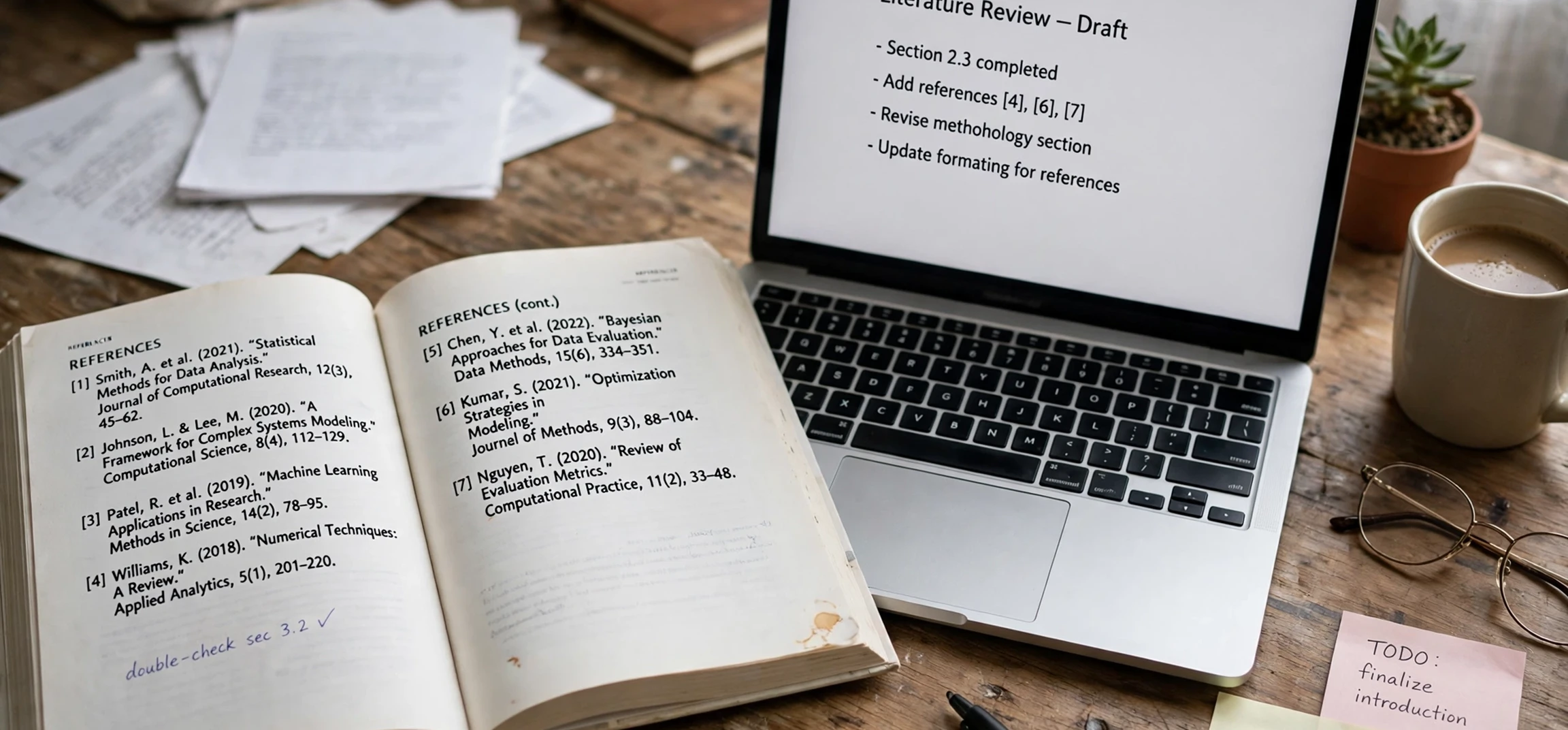
Learning an apa in text citation with two authors is one of those small academic skills that makes a big difference to how professional your writing looks. Get it right, and your reader can follow every claim back to its source without effort. Get it wrong, and even strong research can look careless. This guide explains the apa in text citation with two authors rule clearly, with examples for both parenthetical and narrative citations, so you can use it confidently in essays, reports, and dissertations.
The core rule is refreshingly simple. When a source has two authors, you name both authors every time you cite that source. You do not shorten it to the first author plus “et al.”, as you would for a source with three or more authors. That single distinction is the one most students get wrong, and it is the one this guide will keep returning to, because once it clicks, the rest of the apa in text citation with two authors pattern falls into place.
APA In Text Citation With Two Authors: The Basics
In APA style, an in-text citation has two common forms. In a parenthetical citation, the authors and the year sit inside brackets at the end of the clause, joined by an ampersand. In a narrative citation, the authors’ names are part of your sentence, joined by the word “and”, with the year in brackets straight after. Both forms are correct, and the choice depends on how you have built your sentence. What matters is that both authors appear, in both forms, every time.
For example, a parenthetical citation looks like this: (Smith & Jones, 2020). A narrative citation for the same source looks like this: Smith and Jones (2020) argued that… Notice the difference: the ampersand is used inside brackets, while the word “and” is used in running text. That is a consistent APA convention, and examiners notice it. It applies to every apa in text citation with two authors, regardless of the subject you are writing about.
Why Both Authors, Every Time?
APA keeps both names for two-author sources because the reader needs to be able to find the full reference quickly, and because credit matters. With three or more authors, the first name plus “et al.” is a practical shorthand, since a long list of names would clutter every sentence. With only two authors, there is no such problem, so the style asks you to give both names in full. It is a small courtesy to the authors and a big help to your reader, who can match the in-text citation to the reference list without guessing.
Parenthetical Versus Narrative Citations
Parenthetical citations are useful when the source supports a point but is not the focus of the sentence. For instance, you might write: “Regular practice improves recall over time (Smith & Jones, 2020).” The citation sits quietly at the end, doing its job without interrupting the flow. Narrative citations, by contrast, put the authors in the spotlight: “Smith and Jones (2020) found that regular practice improves recall over time.” That form works well when you are discussing a particular study, comparing two studies, or building an argument around one author’s findings.
Mixing the two forms is not only allowed, it is good writing. A paragraph that uses only parenthetical citations can feel flat, while a paragraph that names every author in the text can feel cluttered. Vary the form to suit the sentence, and keep the rule steady underneath: an apa in text citation with two authors always names both authors, whether the citation is inside brackets or woven into the sentence. If you add a page number for a direct quotation, it goes after the year, as in (Smith & Jones, 2020, p. 42) or Smith and Jones (2020, p. 42).
APA In Text Citation With Two Authors: Worked Examples
The table below shows the same source cited in the main situations you will meet. Use it as a quick reference while you are drafting, and check your own citations against it before you submit. The examples use invented author names and years purely to show the pattern; the pattern itself is what matters, and it stays the same whatever the real authors are called.
| Situation | Example |
|---|---|
| Parenthetical citation | (Smith & Jones, 2020) |
| Narrative citation | Smith and Jones (2020) |
| Parenthetical with page number | (Smith & Jones, 2020, p. 42) |
| Narrative with page number | Smith and Jones (2020, p. 42) |
| Two sources in one bracket | (Brown & Lee, 2019; Smith & Jones, 2020) |
| Same authors, different years | Smith and Jones (2019, 2020) |
When you cite two different sources in one bracket, list them alphabetically by the first author’s surname and separate them with a semicolon. When the same two authors have published in more than one year, you can group the years together, as in the last row. These small details are what separate a competent reference list from a polished one, and they are worth learning early, because they recur in almost every piece of academic writing.
Common Mistakes to Avoid
The most common mistake with an apa in text citation with two authors is shortening it to the first author plus “et al.” on the second and later citations. That rule applies to sources with three or more authors, not to two-author sources. If you catch yourself writing “Smith et al.” for a two-author paper, correct it to “Smith and Jones” or “(Smith & Jones, 2020)” straight away. It is a small fix, but it signals that you know the style.
Other frequent slips include using the ampersand in running text, using the word “and” inside brackets, and forgetting the comma before the year in a parenthetical citation. A useful proofreading habit is to search your draft for “&” and check each hit: if it is inside brackets, it is correct; if it is in the middle of a sentence, change it to “and”. Similarly, search for “et al.” and check that every source it follows really has three or more authors. Ten minutes of checking can remove a whole class of errors.
What the Reference List Entry Looks Like
An in-text citation is only half the job. The full reference in your reference list should give both authors’ surnames and initials, the year in brackets, the title, and the publication details, in that order. For a journal article, the pattern is: Smith, A. B., & Jones, C. D. (2020). Title of the article. Title of the Journal, volume number, page range. The ampersand appears here too, before the second author’s name, which is a helpful reminder of the two-author pattern. Always check the current APA guidance for the source type you are citing, since books, chapters, and websites have their own small variations.
APA In Text Citation With Two Authors: Frequently Asked Questions
Do I use “et al.” for two authors? No. Name both authors every time you cite a two-author source. “Et al.” is for three or more authors.
When do I use “&” and when do I use “and”? Use “&” inside brackets in a parenthetical citation, and use “and” when the authors’ names are part of your sentence in a narrative citation.
Does the rule change after the first citation? No. Unlike some older styles, APA does not shorten a two-author citation after its first use. Both names appear on every citation.
What if the two authors have the same surname? Include initials in the in-text citation to distinguish them, for example (J. Smith & R. Smith, 2020), and follow the current APA guidance for that situation.
Related Guides
Citation skills sit alongside other study and writing skills, and these guides cover topics that students often need at the same time. They are written in the same step-by-step style, with examples you can check your own work against.
For general writing advice, see our writing guide with four tips for published authors, and for education topics more broadly, see the educational guide. If you are working with learning platforms, the guide to LMS meaning explains a term you will meet often in course materials.
APA In Text Citation With Two Authors: A Quick Practice Drill
The fastest way to master an apa in text citation with two authors is to practise it deliberately, with a few invented examples, before you use it in a real essay. Take a pair of names and a year, and write the same sentence three ways: once as a parenthetical citation, once as a narrative citation, and once as a narrative citation with a page number. For example, with an apa in text citation with two authors, you would write (Smith & Jones, 2020), then Smith and Jones (2020), then Smith and Jones (2020, p. 42). Repeating that drill with different names builds the pattern into muscle memory, so you do not have to stop and think about it while you are drafting.
Then practise the checks that catch the common errors for an apa in text citation with two authors. Search your practice paragraph for “et al.” and confirm you have not used it for a two-author source. Search for “&” and confirm each one sits inside brackets. Search for the word “and” before a year in brackets, and confirm it belongs in a narrative sentence, not inside a parenthetical citation. Those three searches, applied to every draft, will remove almost every formatting error associated with an apa in text citation with two authors, and they take less than a minute once they become a habit.
Conclusion
An apa in text citation with two authors follows a simple, steady rule: name both authors every time, use “&” inside brackets and “and” in running text, and keep the year close to the names. Once you have practised that pattern a few times, it becomes automatic, and you can focus on your argument instead of your formatting. The worked examples and the table in this guide are there to be used while you draft, so keep them open beside your document until the pattern feels natural.
Before you submit any piece of work, run the quick checks described above: search for “et al.” and confirm each use really follows three or more authors, check every ampersand sits inside brackets, and make sure each in-text citation matches a full entry in your reference list. Those few minutes of proofreading protect the credibility of your research and show your reader that you take sourcing seriously. Master the apa in text citation with two authors now, and you will have one less thing to worry about in every essay, report, and dissertation that follows.



