Galvanising is one of those words that turns up in two very different places: in speeches about teams and movements, and in workshops about steel, and what does galvanising mean depends on which of those worlds the speaker is in. In its figurative sense, what does galvanising mean is answered like this: to stir people into sudden, energetic action, often after a period of drift or discouragement. In its technical sense, galvanising means coating iron or steel with zinc to protect it from rust. Both senses share a core idea of sudden energy or protection through a powerful process, and both trace back to the same scientific root, which makes the word a small lesson in how language travels from the laboratory into everyday speech.
The scientific root is the name of Luigi Galvani, an eighteenth-century Italian physician whose experiments with electricity and muscle movement fascinated Europe. Galvani showed that an electrical stimulus could make a muscle twitch, and his name became attached to electricity itself: galvanic, galvanism, and galvanise all descend from his work. From that scientific beginning, the word branched in two directions. Engineers kept the technical sense, using galvanising for the zinc-coating process that protects metal. Writers, speakers, and journalists took the figurative sense, using galvanising for anything that jolts people into action the way an electric shock jolts a muscle. This guide explains both senses, shows how to use the word well, and clears up the spelling difference between galvanising and galvanizing.
What Does Galvanising Mean in Figurative Language
In figurative language, what does galvanising mean is about people, not metal. A galvanising speech is one that wakes an audience up and moves it to act. A galvanising event is one that changes the mood of a group, turning apathy into energy or division into shared purpose. A galvanising leader is one who can supply that spark, often at a moment when a team, a community, or a movement has stalled. The word is stronger than motivating or encouraging: it implies a sudden charge, a jolt, a moment after which things move differently.
Journalists use the word often, because it captures a turning point in a single adjective. A match report might call a late goal galvanising for the losing team, meaning it changed the energy of the game. A political report might call a crisis galvanising for a campaign, meaning it united supporters who had been drifting. A business report might call a new product launch galvanising for a company, meaning it restored confidence and direction. In each case, the word does more than describe enthusiasm: it describes a change of state, from flat to charged, from passive to active, from scattered to focused.
Galvanising Versus Motivating and Inspiring
It helps to place galvanising beside its near neighbours. Motivating suggests giving someone a reason to act, which may work slowly over time. Inspiring suggests lifting someone’s imagination or ideals, which may not lead to immediate action at all. Galvanising suggests both speed and action: the person or event does not merely suggest a course, it triggers movement, and the movement is visible quickly. A manager can motivate a team over months with steady encouragement, but a galvanising moment is usually dated to a single speech, result, or event. That sharpness is why the word is so popular in reporting, and also why it should not be overused: if every meeting is described as galvanising, the word loses the very charge it is meant to convey.
What Does Galvanising Mean in Engineering
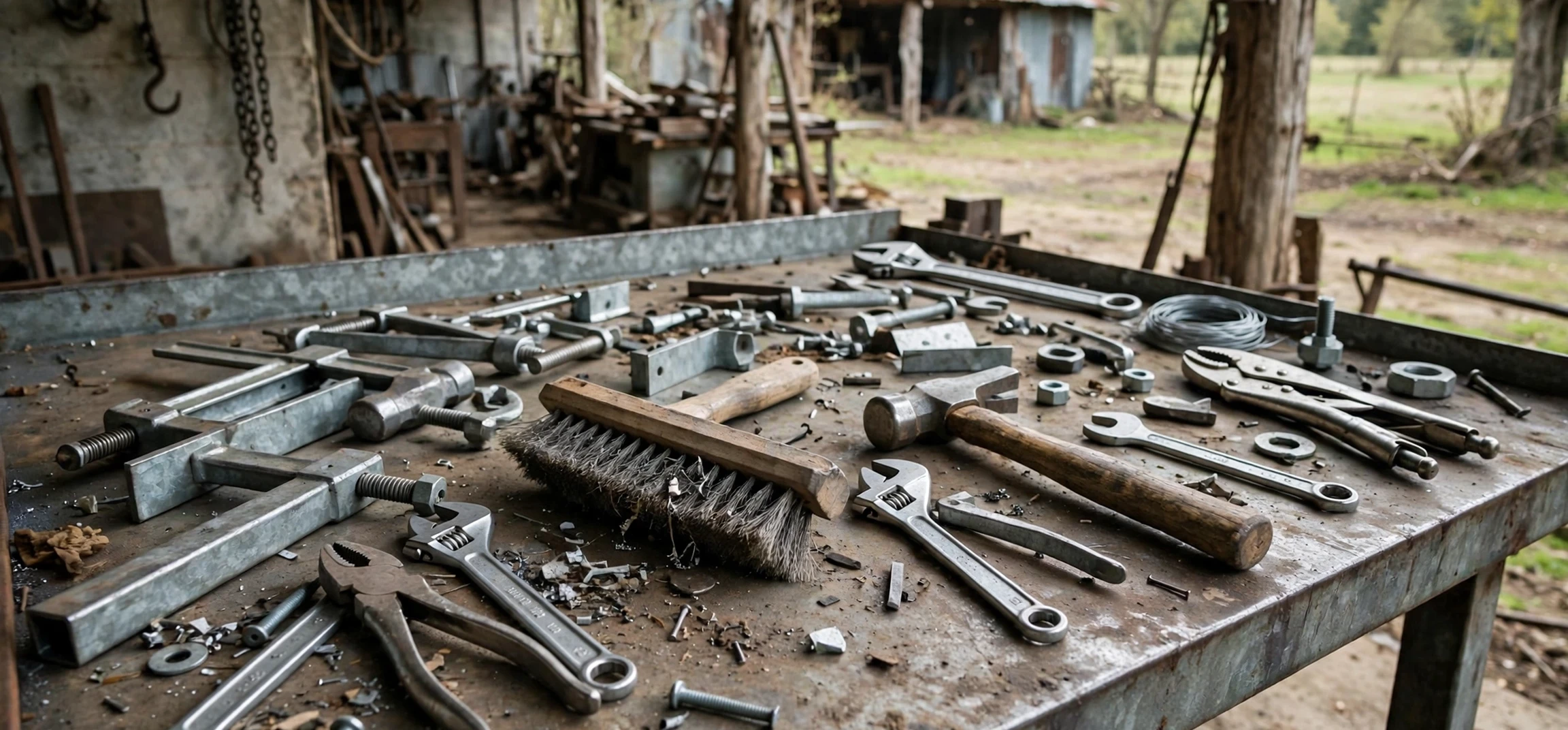
In engineering, what does galvanising mean has a precise, physical answer. Galvanising is the process of applying a protective zinc coating to iron or steel, most commonly by dipping the metal into molten zinc, a method called hot-dip galvanising. The zinc layer serves as a barrier against air and moisture, and it also protects the steel sacrificially: if the coating is scratched, the zinc corrodes in preference to the steel beneath, which slows rusting at the damaged spot. That double protection is why galvanised steel is used for structures that must last outdoors, such as fences, gates, lamp posts, bridges, roofing, and agricultural equipment.
The process itself is industrial and carefully controlled. Steel is cleaned, treated to remove rust and scale, dipped in molten zinc, and then cooled, leaving a coating that is bonded to the surface rather than simply painted on. The familiar spangled pattern seen on some galvanised surfaces comes from the way zinc crystals form as the coating cools. Galvanised coatings are measured by thickness, and different standards apply to different uses, from light coatings for indoor fittings to heavy coatings for structures exposed to harsh weather. The result is a material that combines the strength of steel with a much longer life in corrosive conditions, which is why the extra cost of galvanising is often repaid many times over in reduced maintenance.
Galvanising and Other Protective Coatings
Galvanising is one of several ways to protect steel, and comparing it with the alternatives shows why it remains popular. Painting protects by barrier alone, and once paint is breached, rust can spread underneath it. Stainless steel resists corrosion through its own alloy composition, but it costs considerably more than ordinary steel. Electroplating applies a thinner zinc layer through an electrical process, which suits small, precise parts but gives less protection than hot-dip coating for large outdoor structures. Galvanising sits in a practical middle ground: tougher and longer-lasting than paint, cheaper than stainless steel, and well suited to the bulky, outdoor items that need protection most.
Galvanising or Galvanizing: The Spelling Question
Readers often wonder whether the correct form is galvanising or galvanizing, and the answer is that both are correct, in different spelling traditions. Galvanising, with an s, is the standard form in British English, used in the United Kingdom, Australia, New Zealand, and many other countries that follow British spelling. Galvanizing, with a z, is the standard form in American English. The meaning is identical in both traditions, and the choice between them should follow the audience: a British publication uses galvanising, an American publication uses galvanizing, and a global publication picks one and stays consistent.
The same pattern applies to the whole word family: galvanise and galvanize, galvanised and galvanized, galvanisation and galvanization. The noun for the technical process is usually galvanization or galvanisation, while the figurative noun is often galvanising itself, as in the galvanising of a team. None of these variants changes the meaning, and readers should not be confused by meeting both forms in different sources. The verb is also sometimes used reflexively in older writing, but modern usage overwhelmingly treats galvanising as something done to a group, a team, or a metal, rather than something a group does to itself.
Using Galvanising Well in Writing
Because galvanising is a strong word, it works best when it is earned by the context. A speech that genuinely changed a campaign deserves the word; a routine announcement does not. A result that genuinely transformed a season deserves it; an ordinary win does not. Writers who save the word for real turning points keep its force intact, while writers who attach it to everything soon find that it reads as hype rather than description. The same advice applies to the technical sense: galvanised should be used for steel that has actually received a zinc coating, not as a vague synonym for strong or durable.
It is also worth noting the word’s grammar. Galvanising is most often used as a verb, as in the speech galvanised the crowd, or as an adjective, as in a galvanising victory. The passive form is common in the technical sense, as in galvanised steel, where the word describes the finished material. In the figurative sense, the passive form appears too, as in a team galvanised by defeat, where defeat supplied the spark. Both forms are standard, and both keep the word’s core sense of energy supplied from outside.
For readers interested in how other everyday words carry a precise meaning, our guides to word definitions offer useful comparisons. The explainer on the meaning of acceded shows how a formal verb works in context, while the meaning of all-encompassing looks at a descriptive compound. A third comparison, the meaning of animosity, explores a word for a very different kind of group feeling.
| Sense of galvanising | Typical subject | Example use |
|---|---|---|
| Figurative: to stir into action | A speech, event, leader, or result | A galvanising speech united the team |
| Figurative: to shock into movement | A crisis or defeat | The defeat galvanised the campaign |
| Technical: to coat with zinc | Iron or steel structures | Galvanised gates last longer outdoors |
| Adjective: full of sudden energy | A performance or victory | A galvanising performance lifted the crowd |
Frequently Asked Questions
What does galvanising mean in one sentence?
In one sentence, what does galvanising mean is this: to stir people into sudden, energetic action, or, in engineering, to coat iron or steel with zinc to protect it from rust.
Is it galvanising or galvanizing?
Both are correct. Galvanising with an s is British spelling, and galvanizing with a z is American spelling. The meaning is the same, so use the form that matches your audience and stay consistent.
Why is steel galvanised?
Steel is galvanised to protect it from rust. The zinc coating blocks air and moisture and corrodes in preference to the steel beneath, which greatly extends the life of outdoor structures such as fences, gates, and bridges.
Can galvanising be overused?
Yes. Because the word implies a sudden, dramatic change of energy, using it for routine events weakens it. Save it for genuine turning points, and use milder words such as encouraging or motivating for everyday cases.
What Does Galvanising Mean in Daily Speech
In daily speech, the question what does galvanising mean usually arises when someone hears the word in a news report or a speech and wants the plain sense behind the drama. A listener might ask what does galvanising mean after a commentator calls a late goal galvanising, or after a colleague describes a meeting as galvanising. The plain answer is that the goal or the meeting supplied a sudden charge of energy that changed how people acted afterwards, which is exactly the figurative sense this guide explains. The question what does galvanising mean is therefore less about a dictionary entry and more about recognising a turning point when one is being described.
The technical sense appears in daily speech less often, but it follows the same pattern: a builder or a farmer who asks what does galvanising mean in the context of a gate or a fence is asking about the zinc coating that keeps steel from rusting. Both senses reward the same habit, which is to check the context before settling on a meaning, since the word does two jobs and does them both well. Once that habit is formed, the question what does galvanising mean becomes easy to answer in either world, workshop or newsroom alike.
Conclusion
Galvanising is a word with a double life, and that double life is its charm. From Luigi Galvani’s experiments with electricity, it grew into a technical term for protecting steel and a figurative term for waking people into action, and both senses still carry the original idea of a sudden, powerful charge. The question what does galvanising mean is therefore answered best by naming the context: in a workshop, it means a zinc coating that keeps steel from rusting, and in a speech, a report, or a story, it means the spark that turns a flat, drifting group into a moving one. Used with that distinction in mind, and saved for moments that genuinely deserve its force, galvanising remains one of the most vivid verbs in the language. So whenever the question what does galvanising mean comes up, answer it by context, because what does galvanising mean in a workshop and in a newsroom are two halves of one vivid word.