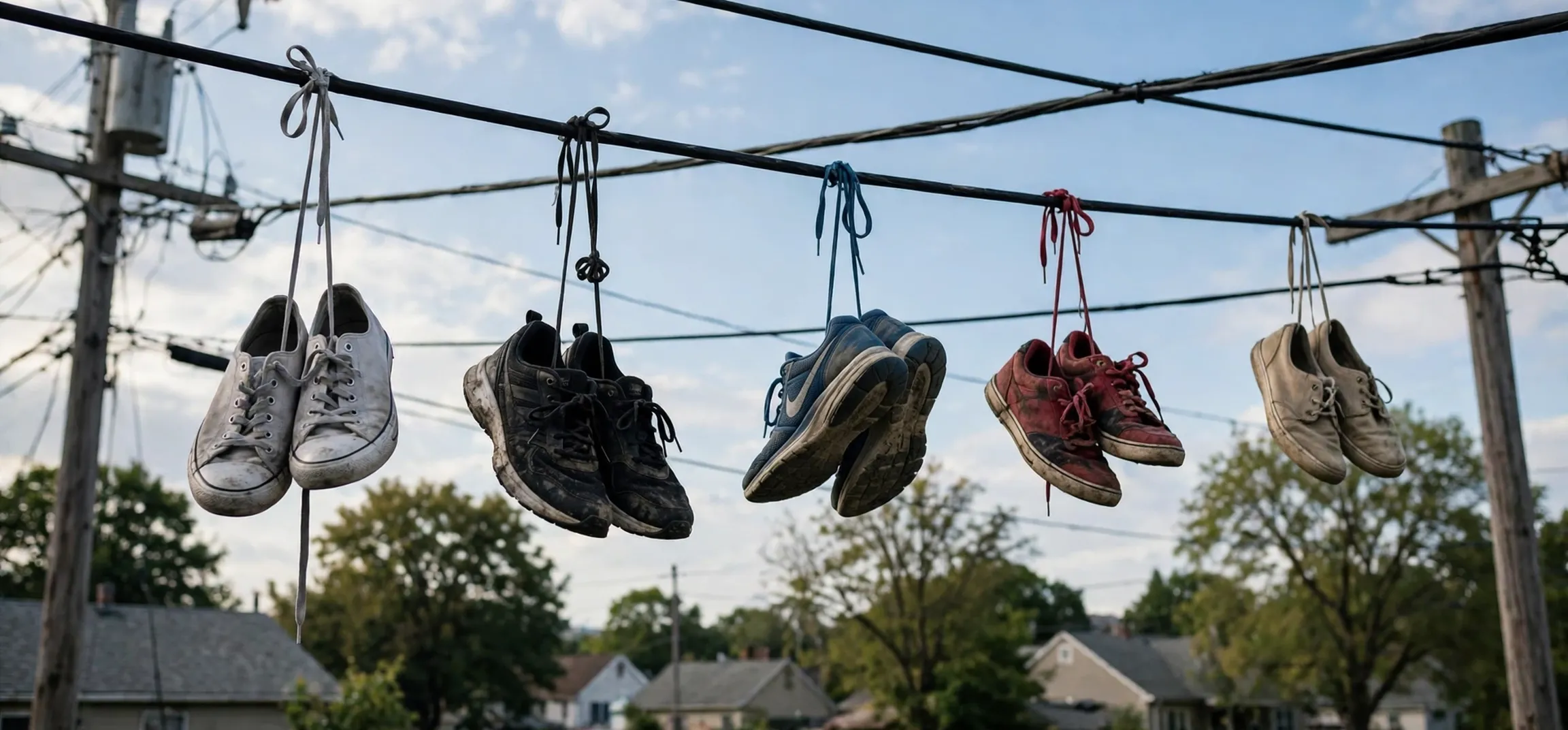
Shoes dangling from a power line are a familiar sight in many towns, and the question what does shoes over a powerline mean has produced almost as many answers as there are pairs of shoes. What does shoes over a powerline mean? The honest answer is that there is no single official meaning: the practice has been given many explanations, from gang territory to memorials to simple pranks, and the true reason varies by place, time and the people who threw the shoes. This guide explains the main theories, what researchers actually know, and why you should never throw anything at a power line yourself.
What Does Shoes Over a Powerline Mean? The Main Theories
The most repeated explanation for what does shoes over a powerline mean is that the shoes mark gang territory or a place where drugs are sold. This theory appears in films, songs and news reports, but researchers and police have found little consistent evidence for it. In many neighbourhoods with shoe-tossing, there is no gang activity at all, and in areas with gang activity, shoes are often absent. The theory persists because it is dramatic and easy to repeat, not because it has been proven.
A second theory is memorial: shoes are thrown to remember someone who died, left the area, or finished school. This explanation fits cases where shoes appear after a death or a graduation, and some communities do use shoe-tossing as a tribute. A third theory is celebration or rite of passage: finishing military service, graduating, or leaving home, marked by throwing away an old pair of shoes. A fourth is simple mischief: young people throw shoes because they can, because friends dared them, or because it looks funny. A fifth is practical disposal: in areas without easy waste collection, tossing old shoes out of sight was once a lazy way to get rid of them.
What Researchers Actually Know
Studies of shoe-tossing find that the practice is widespread, old and inconsistent, which is exactly what you would expect from a folk habit rather than a coded system. If shoes were a reliable gang signal, the meaning would need to be consistent across cities so that outsiders could read it, but it is not: the same sight means different things in different places, and often means nothing at all. Folklorists compare it to other urban legends, where a striking image attracts explanations that feel true even when evidence is thin.
Local knowledge matters more than any general theory. In one neighbourhood, a pair of shoes may mark a memorial that residents understand. In another, it may be a prank from last summer that nobody has removed. Utility companies, who remove the shoes, generally treat them as litter and a hazard rather than as messages, and they do not decode them. If you are curious about shoes in your own area, local history groups and long-term residents are better sources than internet lists of supposed codes.
How Films and Music Spread the Theories
Films and songs have done more than any other source to spread the gang-territory theory. A striking visual in a film becomes shorthand for danger, and audiences carry that shorthand into real life. Musicians have also used shoe-tossing as imagery for neighbourhood life, loss and growing up. Artistic use is not evidence, but it shapes what people believe they see, which is why the gang theory feels familiar even to people who have never lived near a pair of tossed shoes.
Why You Should Never Throw Shoes at Power Lines
Whatever shoes over a power line might mean, throwing them is dangerous and should not be copied. Shoes can damage power lines, cause outages, start fires, and create a risk of electric shock for anyone who tries to remove them. Utility workers must use specialist equipment and sometimes shut off power to clear them, which costs time and money and disrupts neighbours. In many places, interfering with power lines is also illegal.
If shoes are already on a line near your home, do not try to pull them down with poles, ropes or other objects. Contact your local utility company and report the location; they will arrange safe removal. If shoes are a memorial in your community, consider safer tributes, such as a plaque, a planted tree or a charity donation, which honour a person without endangering anyone.
| Theory | What it claims | Evidence |
|---|---|---|
| Gang territory | Shoes mark gang areas or drug spots | Weak and inconsistent |
| Memorial | Shoes honour someone who died or left | Plausible in specific local cases |
| Celebration | Graduation, service or leaving home | Plausible in specific cases |
| Prank or disposal | Mischief or lazy rubbish removal | Common and well documented |
Shoes on Lines in Culture and Art
Artists and photographers have used shoe-tossing as a symbol of urban life, youth, loss and transition. A pair of shoes on a wire can suggest someone who has moved on, a childhood ended, or a neighbourhood’s story told in objects rather than words. That symbolic use is legitimate art, and it explains why the image appears in music videos, album covers and gallery work. Art, however, is not a codebook: an artist’s meaning for the image does not prove that every pair of shoes on every wire carries the same message.
For more on how everyday sights gain meanings, see what simultaneously means, the meaning of goad and what CTE means.
What Does Shoes Over a Powerline Mean: Frequently Asked Questions
Do shoes on a power line mean gang activity?
Not reliably. The gang theory is widely repeated but poorly supported, and shoes appear in many areas with no gang presence.
Can shoes be a memorial?
Yes, in some communities shoes are thrown as a tribute after a death or departure, but that meaning is local, not universal.
Who removes shoes from power lines?
Your local utility company. Never attempt removal yourself; report the location to the utility instead.
Is throwing shoes at power lines illegal?
Interfering with power lines can be illegal and is always dangerous, because it risks outages, fires and electric shock.
Does shoe-tossing happen everywhere?
It has been reported in many countries, which supports the idea that it is a widespread folk habit with local meanings rather than a single coded system.
What Shoes on Lines Mean Locally
Because what does shoes over a powerline mean has no universal answer, local context is the only reliable guide. In some towns, residents know exactly which pair marks a memorial and which pair is a prank, because the stories circulate by word of mouth. In others, nobody remembers who threw the shoes or why, and the pairs simply remain until the utility company removes them. That variation is normal for folk customs, which grow organically rather than by rule.
If you move to a new area and notice shoes on lines, resist the urge to decode them from internet lists. Instead, notice whether the neighbourhood treats them as significant: a memorial pair may be accompanied by flowers or a plaque, while a prank pair hangs alone and unnoticed. Local newspapers, history societies and community groups sometimes document these customs, and their accounts are far more trustworthy than generic online claims. When in doubt, the safest interpretation is the simplest: someone threw shoes, and the reason left with them.
How Utilities Remove Shoes
Utility companies remove shoes using insulated tools, bucket trucks and, when necessary, planned power outages. The work is slower than people expect, because crews must prioritise faults and safety work over litter removal, and a single pair of shoes may wait months for a crew in the area. That delay is why shoes remain visible for so long, and why new pairs accumulate: the sight of existing shoes seems to invite more.
Some utilities run campaigns asking residents not to throw objects at lines, explaining the costs and risks. Those campaigns rarely mention gang theories or memorials, because the utility’s concern is safety and reliability, not symbolism. Their message is consistent and worth repeating: keep lines clear, report shoes rather than removing them, and find safer ways to mark occasions.
Talking to Children About Shoes on Lines
Children often ask what does shoes over a powerline mean, and the question deserves an honest, age-appropriate answer. Explain that nobody knows for every pair, that some pairs may be memorials or jokes, and that the important rule is never to throw anything at power lines or try to retrieve shoes. Framing it as a safety rule, like not climbing electricity poles, works better than a long explanation of theories.
For older children, the mystery itself can spark curiosity about folklore, urban legends and how stories spread. Discussing why dramatic explanations travel faster than boring ones is a useful media literacy lesson: a gang theory sounds exciting, so it spreads, while “someone threw shoes as a joke” sounds dull, so it does not. That lesson applies far beyond shoes on wires.
Conclusion
What does shoes over a powerline mean? There is no single answer, and that is the point. The shoes may be a memorial, a celebration, a prank or simple litter, depending on the place and the people involved. The gang theory is the most dramatic explanation and the least supported. Whatever the local story, the practical advice is the same: admire the mystery from the ground, do not add to it, and leave removal to the utility company.



