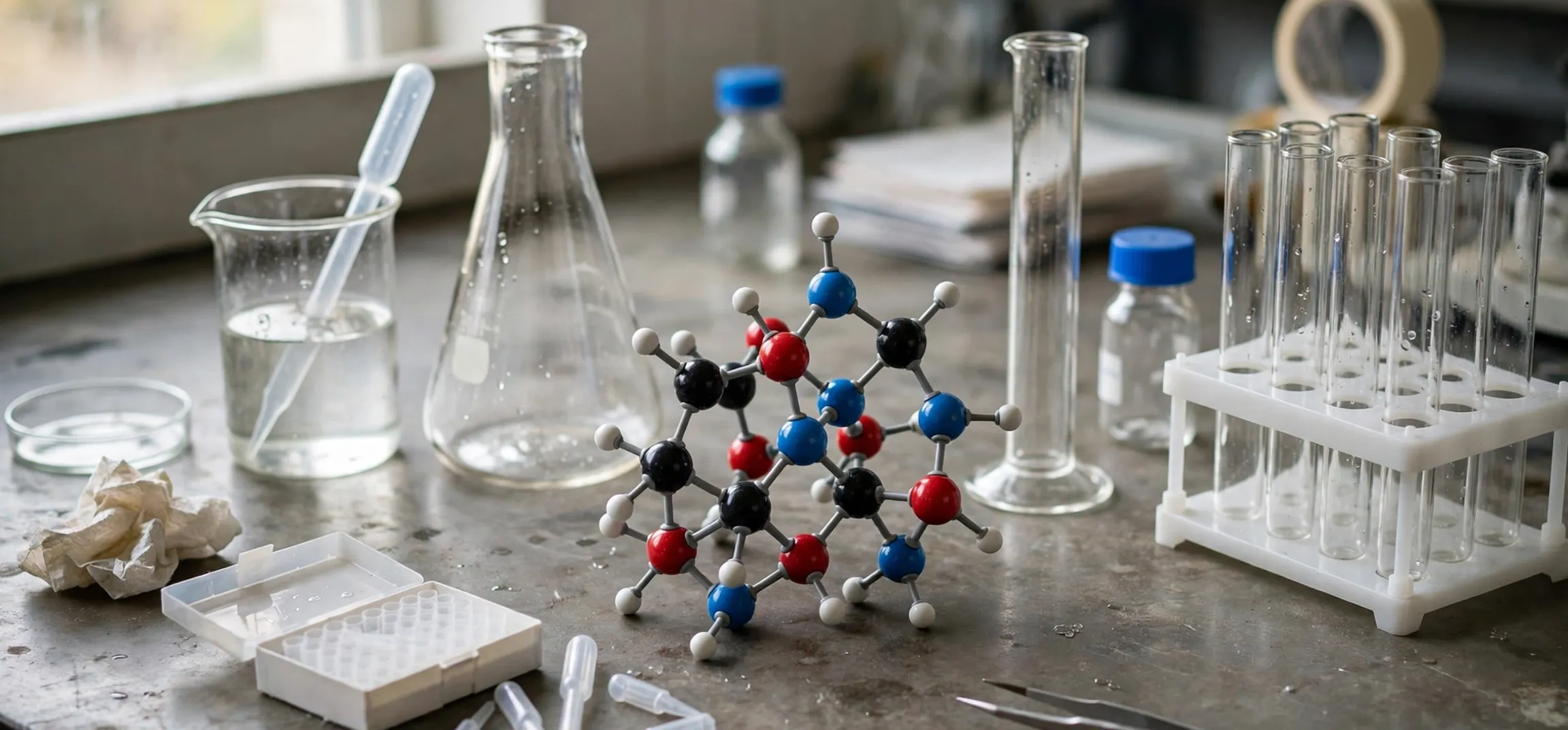
Everything around us, from the air we breathe to the screen you are reading on, is built from tiny particles called molecules. A clear molecule science definition is the foundation of chemistry: a molecule is a group of two or more atoms held together by chemical bonds, forming the smallest unit of a substance that can take part in a chemical reaction. Water, oxygen, sugar, and even the DNA in your cells are all made of molecules, and understanding them explains how matter behaves.
In this guide, we explain the molecule science definition in plain language, look at how atoms join to form molecules, explore the main types of molecules, and show why molecules matter far beyond the chemistry classroom.
Molecule Science Definition: What Is a Molecule?
A molecule is the smallest particle of a chemical compound that still has the chemical properties of that compound. It consists of two or more atoms bonded together. Those atoms may be the same, as in an oxygen molecule made of two oxygen atoms, or different, as in a water molecule made of two hydrogen atoms and one oxygen atom.
It helps to distinguish a molecule from an atom. An atom is the smallest unit of an element: a single hydrogen atom, for example, is just hydrogen. A molecule is what you get when atoms combine. A single atom of oxygen behaves differently from an oxygen molecule, and it is the molecule that we actually breathe. This distinction sits at the heart of the molecule science definition, and it is worth getting right before going further.
Molecules can be very small, containing just two atoms, or enormous, containing thousands. Proteins, plastics, and DNA are all made of very large molecules, sometimes called macromolecules. Despite their differences in size, they all follow the same basic rule: atoms joined by chemical bonds, acting as a single chemical unit.
How Atoms Join to Form Molecules
Atoms join together because they seek stability. Most atoms have outer shells of electrons that are not full, and they become more stable by sharing, gaining, or losing electrons. The forces that hold atoms together in a molecule are called chemical bonds, and the three main kinds are worth knowing.
Covalent bonds
In a covalent bond, atoms share pairs of electrons. This is the most common bond in organic molecules, and it holds together water, methane, sugars, and proteins. Covalent bonds are strong, which is why molecules built from them are stable.
Ionic bonds
In an ionic bond, one atom gives an electron to another, creating charged particles called ions that attract each other. Table salt, sodium chloride, is the classic example. In solid form it is a crystal rather than a set of separate molecules, but when dissolved in water it breaks into ions.
Metallic bonds
In metals, electrons are shared across many atoms at once, forming a kind of electron sea. This gives metals their conductivity and malleability. While metals are not usually described as collections of molecules, the same principle of atoms held together by shared electrons applies.
The type of bond affects a molecule’s properties: its melting point, its solubility, and how it reacts with other molecules. That is why the same atoms, bonded differently, can produce substances with very different behaviour. For a related look at how scientific terms are defined, see our guide to the mean definition in maths, where precision of language matters just as much.
Types of Molecules
Molecules can be grouped in several useful ways. One of the simplest divisions is between diatomic molecules, which contain two atoms, and polyatomic molecules, which contain more than two.
| Type | Description | Examples |
|---|---|---|
| Diatomic | Two atoms bonded together | Oxygen (O₂), hydrogen (H₂), nitrogen (N₂) |
| Triatomic | Three atoms bonded together | Water (H₂O), carbon dioxide (CO₂), ozone (O₃) |
| Organic | Contain carbon, usually with hydrogen | Methane (CH₄), glucose (C₆H₁₂O₆), ethanol |
| Inorganic | Generally do not contain carbon-hydrogen bonds | Ammonia (NH₃), sulphuric acid (H₂SO₄) |
| Macromolecules | Very large, with thousands of atoms | Proteins, DNA, starch, plastics |
Another useful division is between molecules of elements and molecules of compounds. A molecule of an element contains only one kind of atom, such as O₂. A molecule of a compound contains two or more kinds of atom, such as CO₂. Both are molecules, but only compounds have chemical properties that differ from those of their constituent elements.
Everyday Molecule Examples
Molecules are not abstract ideas; they are the stuff of daily life. Water (H₂O) is the most familiar molecule of all, and its bent shape gives it unusual properties, such as the ability to dissolve many substances and to expand when it freezes. Oxygen (O₂) is the molecule our bodies use to release energy from food. Carbon dioxide (CO₂) is the molecule plants take in during photosynthesis and we breathe out.
More complex molecules run our bodies. Glucose (C₆H₁₂O₆) is the sugar our cells burn for energy. Haemoglobin is a huge molecule in red blood cells that carries oxygen around the body. DNA is a double-helix molecule that stores the instructions for building and running a living organism. Each of these molecules works because of its particular shape and bonding, a principle chemists call structure determining function.
Even materials we take for granted depend on molecules. Plastics are long chains of repeating molecular units. Glass is a network of silicon and oxygen atoms. Medicines are molecules designed to fit particular targets in the body, like keys fitting locks. Understanding the molecule science definition therefore opens the door to understanding materials, medicine, and biology alike.
Molecules and States of Matter
The behaviour of molecules explains the states of matter. In a solid, molecules vibrate in fixed positions, held tightly by intermolecular forces. In a liquid, molecules move past one another while staying close together. In a gas, molecules move freely and spread out to fill their container. Heating a substance gives its molecules more energy, which is why solids melt and liquids evaporate.
Intermolecular forces, the attractions between molecules, are weaker than the chemical bonds within a molecule, but they matter enormously. They determine whether a substance is a gas, liquid, or solid at room temperature, and they explain phenomena such as surface tension and capillary action. Water’s strong intermolecular forces, caused by hydrogen bonding, are why it has such a high boiling point for so small a molecule.
Why the Molecule Science Definition Matters
Knowing what a molecule is matters well beyond examinations. It explains why different substances behave differently, why some dissolve and others do not, and why chemical reactions happen at all. A reaction, at its core, is molecules breaking apart and reforming into new molecules. Cooking, rusting, burning, digesting, and photosynthesis are all molecular rearrangements.
Modern technology is molecular technology. Drug designers build molecules to interact with specific proteins. Materials scientists design polymers with particular strengths and flexibilities. Environmental scientists track molecules such as carbon dioxide and methane to understand climate change. None of this work makes sense without a firm grasp of the molecule science definition.
For students, the concept also provides a bridge between physics and biology. Atoms belong to physics, living things belong to biology, and molecules sit between them, showing how the inanimate world builds the living one. That bridging role is one reason chemistry is often called the central science, and it is also why clear scientific vocabulary matters, as explored in our article on defining mean in maths.
Frequently Asked Questions
Is a single atom a molecule?
Strictly speaking, no. A molecule contains two or more atoms bonded together. A single atom, such as helium, is sometimes called monatomic, but it is not a molecule. Some definitions in older textbooks were looser, but the modern molecule science definition requires at least two atoms.
What is the difference between a molecule and a compound?
A molecule is a particle made of bonded atoms. A compound is a substance made of molecules (or ions) containing two or more different elements. All compounds are made of molecules or ions, but not all molecules are compounds: oxygen (O₂) is a molecule of an element, not a compound.
How big is a molecule?
Most small molecules are around a tenth of a nanometre to a few nanometres across, far too small to see with any ordinary microscope. Macromolecules such as DNA can be much larger, and a single DNA molecule in a human cell, if stretched out, would be about two metres long.
Can molecules be broken apart?
Yes. Chemical reactions break the bonds within molecules and form new ones. This takes energy, and it is what happens when fuel burns, food is digested, or water is split into hydrogen and oxygen by electrolysis.
Conclusion
The molecule science definition is simple to state and rich in consequences: a molecule is two or more atoms held together by chemical bonds, forming the smallest unit of a substance that keeps its chemical identity. From the water in a glass to the DNA in a cell, molecules are the building blocks of the material world. Once you understand what they are and how they join, the rest of chemistry, and much of biology and materials science, begins to fall into place.



