Academic writing lives or dies by its citations, and one of the most common questions students ask is how to handle sources with two authors. This guide to APA in text citation with two authors explains the rules clearly, with examples for every situation you are likely to meet, from a simple parenthetical citation to narrative citations, repeated citations, and tricky cases such as two sources by different author pairs with the same surname.
The rules here follow the seventh edition of the APA Publication Manual, which is the current edition used by most universities and journals. If your institution specifies a different edition or a local variation, follow its guidance, but the seventh-edition rules below are the standard starting point.
APA in Text Citation With Two Authors: The Basic Rule
The basic rule for APA in text citation with two authors is simple: name both authors every time you cite the work, joined by an ampersand in parenthetical citations and by the word “and” in narrative citations. This differs from works with three or more authors, where you use “et al.” after the first author. With two authors, there is no shortening: both names appear in every citation.
Here is the rule in action, using placeholder author names:
- Parenthetical citation: (Smith & Jones, 2020)
- Narrative citation: Smith and Jones (2020) found that…
The difference between the two forms matters. In a parenthetical citation, the authors’ names sit inside brackets, so APA uses the ampersand (&). In a narrative citation, the authors’ names are part of your sentence, so APA uses the word “and”, which reads naturally. Mixing these up is one of the most common APA errors, and it is easy to avoid once you know the rule.
Note also the punctuation: in a parenthetical citation, a comma separates the authors from the year, and the full stop goes after the closing bracket. In a narrative citation, the year follows the authors’ names in brackets, and the sentence continues normally.
Parenthetical vs Narrative Citations
Choosing between parenthetical and narrative citations is a matter of style and emphasis. A parenthetical citation puts the emphasis on the finding: “Regular exercise improves sleep quality (Smith & Jones, 2020).” A narrative citation puts the emphasis on the authors: “Smith and Jones (2020) found that regular exercise improves sleep quality.” Both are correct, and good academic writing uses a mix, varying the structure to keep the prose readable.
A useful habit is to use narrative citations when you want to discuss a particular study in detail, and parenthetical citations when you are supporting a general point with a source. Overusing either form makes writing monotonous, so variety helps. For more on citation mechanics in general, see our guide to APA in-text citation with multiple authors, which covers the rules for larger author groups.
APA in Text Citation With Two Authors: Repeated Citations
When you cite the same two-author work more than once in a paper, the rule stays the same: name both authors every time. There is no shortening on second or later citations for two-author works. This is a point students often get wrong, because they assume that, as with three or more authors, later citations can be shortened. They cannot.
Example of a repeated citation:
- First mention: Smith and Jones (2020) argued that sleep quality affects academic performance.
- Later mention: Smith and Jones (2020) also noted that the effect was strongest among first-year students.
Both mentions name both authors in full. The only thing that changes is the surrounding sentence, not the citation itself. This consistency helps readers track sources without confusion.
Citations in Tables, Figures, and Quotations
The same two-author rule applies in tables, figures, and captions, with one small variation: in tables and figures, where space is tight, APA allows the ampersand form even in what would otherwise be a narrative context, though consistency within a document matters most. If you cite a two-author work in a table note, write (Smith & Jones, 2020).
For direct quotations, add a page number or location after the year. In a parenthetical quotation citation, the format is (Smith & Jones, 2020, p. 45). In a narrative quotation citation, it is: Smith and Jones (2020) wrote that “sleep is the foundation of learning” (p. 45). If the source has no page numbers, such as a web page, use a paragraph number or section heading instead, following APA’s guidance for electronic sources.
Tricky Cases
Several tricky cases arise with two-author citations, and each has a clear APA solution:
| Situation | Solution | Example |
|---|---|---|
| Two authors with the same surname in different sources | Include initials to distinguish them | (J. Smith & Jones, 2020) vs (R. Smith & Brown, 2019) |
| Two works by the same authors in the same year | Add a, b after the year | (Smith & Jones, 2020a) and (Smith & Jones, 2020b) |
| Authors with hyphenated surnames | Keep the hyphen and cite the full surname | (Garcia-Lopez & Patel, 2021) |
| An organisation as one “author” plus a person | Cite both as written | (World Health Organization & Smith, 2019) |
| Two authors, one with a suffix such as Jr. | Include the suffix in the reference list; in-text, cite the surname only | (Smith & Jones, 2020) |
The same-surname case deserves emphasis, because it confuses many students. If you cite two different sources, each with a first author named Smith, readers cannot tell them apart from surnames alone. APA solves this by adding initials in every in-text citation for those sources, even when the surnames alone would normally suffice.
The Reference List Entry
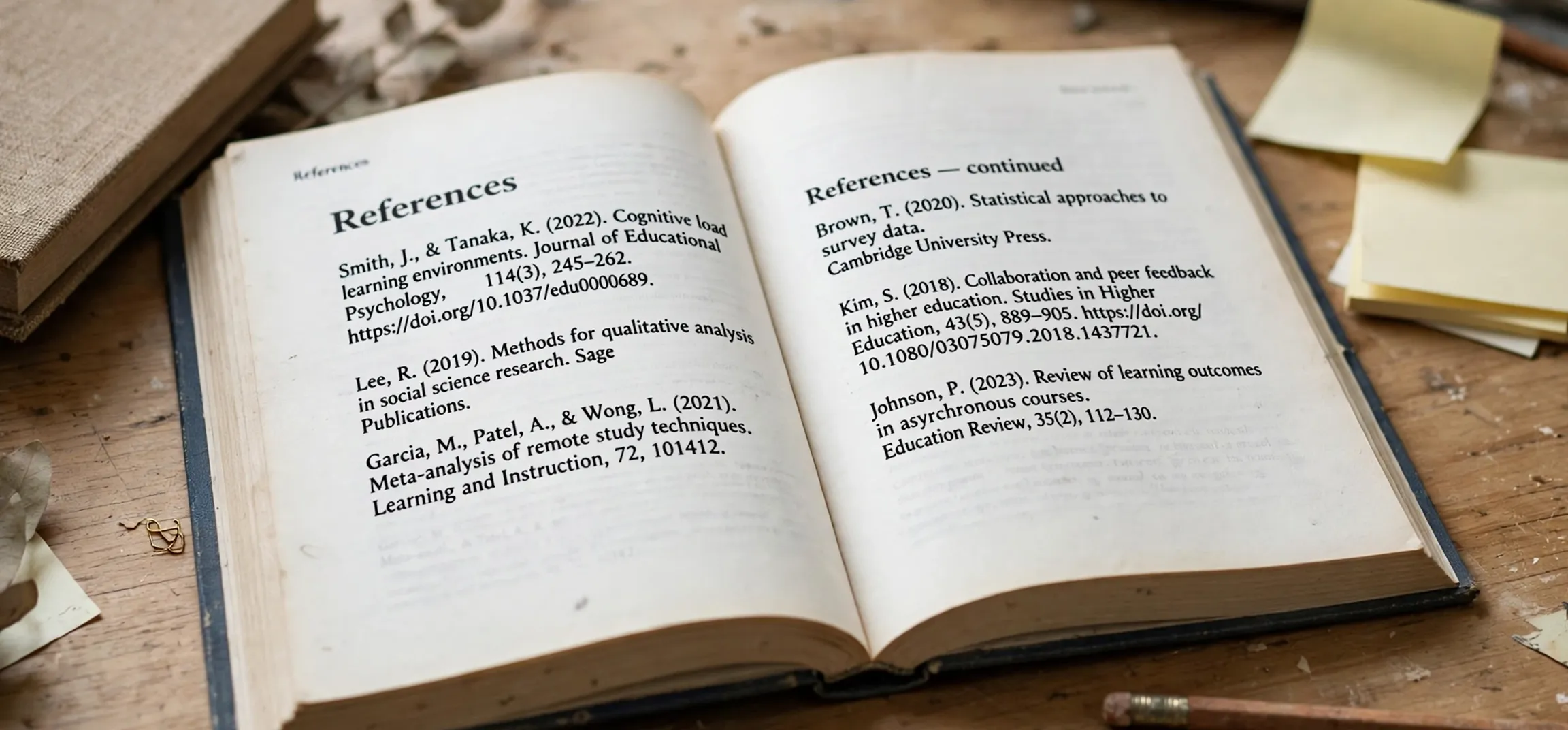
An in-text citation is only half the job; the full details belong in the reference list. For a two-author journal article, the seventh-edition format is:
Smith, A. B., & Jones, C. D. (2020). Title of the article in sentence case. Title of the Journal in Title Case and Italics, 15(3), 123–145. https://doi.org/xx.xxxx/xxxx
Note the details: authors’ surnames followed by initials, an ampersand before the final author, the year in brackets, the article title in sentence case, and the journal title and volume in italics. For books, chapters, and web sources, the pattern is similar, with the source-specific details changing. The key principle is consistency: every in-text citation must match exactly one reference-list entry, and every reference-list entry must be cited in the text.
For a second perspective on multi-author citations, see our guide to multiple authors in APA in-text citations, which walks through three or more authors and the “et al.” rule.
Common Mistakes to Avoid
- Using “et al.” for two authors. Never shorten a two-author citation to “Smith et al.” The “et al.” rule applies only to three or more authors.
- Using “&” in narrative citations. In a sentence, write “Smith and Jones (2020)”, not “Smith & Jones (2020)”. The ampersand belongs inside brackets only.
- Forgetting the comma in parenthetical citations. Write (Smith & Jones, 2020), with a comma before the year.
- Reordering the authors. Always cite authors in the order given in the source, not alphabetically. Author order reflects contribution and is part of the citation.
- Mismatching in-text and reference-list forms. The surnames and year in the text must match the reference list exactly, or readers cannot find the source.
APA in Text Citation With Two Authors in Literature Reviews
Literature reviews place special demands on APA in text citation with two authors, because they cite many sources in quick succession and group them by theme. When several two-author sources support a single point, they can be combined in one parenthetical citation, separated by semicolons and ordered alphabetically: (Brown & White, 2018; Smith & Jones, 2020). This grouping keeps the prose readable while showing the breadth of support. In narrative form, the same grouping is harder to manage, so literature reviews often alternate: narrative citations introduce key studies in detail, while parenthetical groupings support general claims. The key discipline is consistency within each paragraph and accuracy in matching every citation to the reference list, since a literature review with dozens of sources is where mismatches most often creep in. A final check, reading each citation against the reference list, is time well spent before submission.
Frequently Asked Questions
Do I name both authors every time for a two-author source?
Yes. In APA seventh edition, two-author works are cited with both authors’ names in every in-text citation, whether it is the first mention or a later one.
When do I use “&” and when do I use “and”?
Use “&” in parenthetical citations, where the names are inside brackets: (Smith & Jones, 2020). Use “and” in narrative citations, where the names are part of your sentence: Smith and Jones (2020).
What if the two authors have the same surname as authors of another source I cite?
Include their initials in every in-text citation for those sources, so readers can distinguish them: (J. Smith & Jones, 2020) and (R. Smith & Brown, 2019).
Does the two-author rule change in the reference list?
In the reference list, both authors are listed in full, with an ampersand before the second author, followed by the year, title, and source details. The reference list entry is complete, not abbreviated.
Conclusion
APA in text citation with two authors follows one clear rule: name both authors every time, with “&” inside brackets and “and” in your sentences. Master that rule, watch out for the common mistakes above, and make sure every in-text citation matches a full reference-list entry. With those habits in place, two-author citations become one of the simplest parts of academic writing, leaving you free to focus on your argument rather than your formatting.



