Learning apa in text citation with two authors is one of the most common early tasks in academic writing, and it is also one of the easiest to get wrong under deadline pressure. The American Psychological Association’s seventh edition, known as APA 7th, has a clear rule for works by two authors: cite both authors every time you refer to the work in the text, joining their surnames with “and” in narrative citations and with an ampersand in parenthetical citations. That single rule answers most questions, but students still stumble on details such as punctuation, the placement of the year, repeated citations, and the matching reference list entry. This guide explains apa in text citation with two authors step by step, with general examples using placeholder names, so you can apply the pattern confidently to your own sources.
APA In Text Citation With Two Authors: The Core Rule
APA 7th treats author numbers in bands. One author is cited by surname alone. Two authors are always cited together, on every occasion, in both narrative and parenthetical forms. Three or more authors use the first author’s surname followed by “et al.” from the first citation onwards. The two-author rule is therefore distinct: never shorten a two-author citation to the first author plus “et al.”, however often you cite the work. That distinction matters because examiners and markers notice it quickly, and because shortening changes the meaning, implying additional authors who do not exist. If you remember only one thing from this guide, remember that two means two, every time.
The two citation forms differ only in how the names are joined and where the year sits. In a narrative citation, the authors are part of your sentence, so you write their surnames in words, joined by “and”, followed by the year in parentheses. For example: Smith and Jones (2023) argued that study habits affect revision quality. In a parenthetical citation, the whole citation sits inside parentheses at the end of a clause or sentence, so you join the surnames with an ampersand and separate the names from the year with a comma. For example: Study habits affect revision quality (Smith & Jones, 2023). The information is identical; only the punctuation and the connector change. Choosing between the forms is a matter of sentence style. Narrative citations work well when you want to foreground the researchers, while parenthetical citations keep the focus on the finding itself.
APA In Text Citation With Two Authors: Worked Examples
Consider a general example with placeholder authors. Suppose you are citing a journal article by Patel and Garcia, published in 2022, about feedback in online learning. A narrative citation reads: Patel and Garcia (2022) found that timely feedback improved assignment scores. A parenthetical version reads: Timely feedback improved assignment scores (Patel & Garcia, 2022). If you cite the same work again later in the same paragraph, APA 7th allows you to omit the year in subsequent narrative citations within that paragraph, but only after the year has been given once in a narrative citation. So a second narrative sentence could read: Patel and Garcia also noted that feedback timing mattered more than feedback length. In parenthetical citations, however, the year is always included, even on repeat citations: Feedback timing mattered more than length (Patel & Garcia, 2022).
Direct quotations add a page or location element. If you quote Patel and Garcia directly, give the page number, or for sources without pagination, a paragraph number, section heading, or timestamp as appropriate. A narrative quotation reads: Patel and Garcia (2022) stated that “timely comments helped students revise more effectively” (p. 45). A parenthetical quotation reads: “Timely comments helped students revise more effectively” (Patel & Garcia, 2022, p. 45). Note the placement of the full stop: in the parenthetical form, it comes after the closing parenthesis, because the citation is part of the sentence. For a quotation of forty words or more, APA requires a block quotation, indented and without quotation marks, with the citation after the final punctuation. Block quotations should be used sparingly; paraphrasing in your own words, with a citation, is usually better academic practice.
Tricky Cases: Same Surnames and Multiple Works
Two complications arise regularly. The first is when two different cited works share a first author’s surname, or when two authors in your reference list share a surname. APA 7th says to include initials in the in-text citation to distinguish them, even if the years differ. For example, if you cite works by J. Smith and Jones (2023) and by A. Smith and Patel (2021), the initials prevent confusion. The second complication is citing multiple works by the same two authors in the same parentheses. Order them by year, earliest first, separated by semicolons: Several studies support this pattern (Patel & Garcia, 2020, 2022). If the same two authors published two works in the same year, add a lowercase letter after the year, assigned by alphabetical order of title in the reference list: (Patel & Garcia, 2022a, 2022b). These letters must match the reference list exactly.
A further complication is multiple works by different authors cited together. List them alphabetically by first author’s surname, separated by semicolons, as in: (Garcia & Lee, 2021; Patel & Garcia, 2022). Note that the ordering is alphabetical, not chronological, when the authors differ. Also be careful with authors who have hyphenated surnames, particles such as “de” or “van”, or suffixes such as “Jr.” Cite them exactly as they appear in the source, and check the APA manual or your institution’s guide for names from cultures with different naming conventions. Consistency and fidelity to the source matter more than forcing every name into a single template.
The Matching Reference List Entry
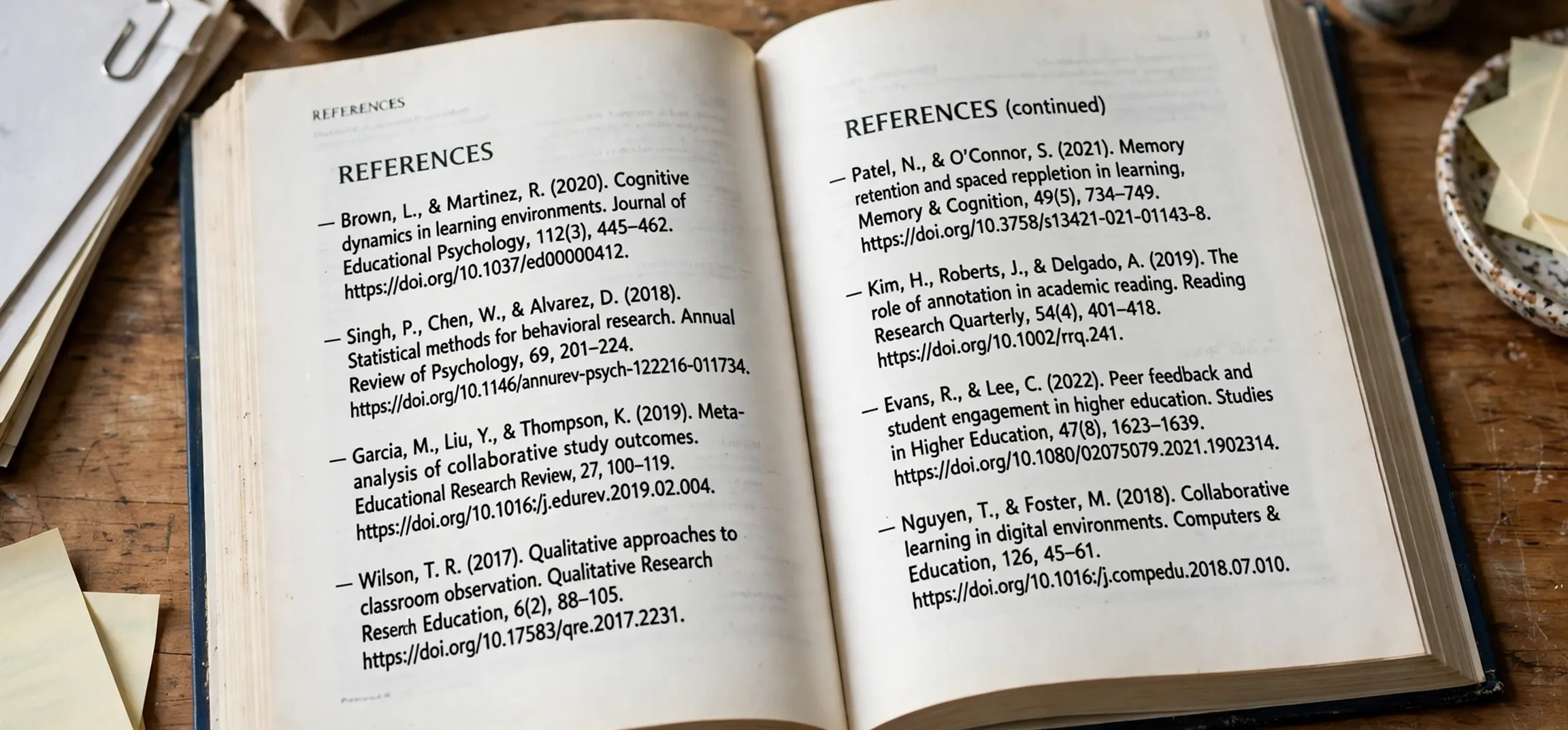
Every in-text citation must match a full entry in the reference list, and every reference list entry must be cited in the text, with two standard exceptions: personal communications, which are cited in text only, and general mentions of whole websites or classical works in some cases. For a two-author journal article, the reference list entry follows this pattern: Surname, Initials, & Surname, Initials. (Year). Title of the article in sentence case. Title of the Journal in Title Case and Italics, volume number in italics(issue number), page range. DOI or URL where available. A general example reads: Patel, A. R., & Garcia, M. L. (2022). Feedback timing in online learning. Journal of Educational Practice, 18(3), 40-58. where a DOI is available. The ampersand before the second author, the sentence-case article title, and the italicised journal title and volume are all required details. In the reference list, use initials rather than full first names, unless the source itself gives full names in a way your institution asks you to preserve.
Book and chapter entries follow the same author pattern with different title and publisher details. A two-author book entry reads: Surname, Initials, & Surname, Initials. (Year). Title of the book in sentence case and italics. Publisher. A chapter in an edited book adds the editor and page range: Surname, Initials, & Surname, Initials. (Year). Title of the chapter. In Initials. Surname (Ed.), Title of the book (pp. xx-xx). Publisher. The key habit is to build the reference entry from the source itself, ideally as soon as you first cite it, rather than reconstructing it from memory at the end. Reference managers can help, but always proofread their output, because imported records frequently contain capitalisation and punctuation errors.
Common Mistakes to Avoid
The most frequent mistake is reducing two authors to “et al.” That rule belongs to works with three or more authors. The second is using “and” inside parentheses, or an ampersand in narrative text; keep “and” for sentences and “&” for parentheses, including in tables and figure notes where APA also uses the ampersand. The third is omitting the year in a parenthetical repeat citation. The fourth is mismatching in-text and reference list details, such as a different spelling, a different year, or a missing second author in the reference entry. The fifth is citing a secondary source as if it were primary: if you read about Patel and Garcia’s work in a book by another author, cite the secondary source properly and name the original work in your sentence, rather than pretending you read the original. Finally, remember that APA style is about clarity and retrievability. If a reader cannot find your source from your citation, the citation has failed, however tidy it looks.
Students looking for broader writing support may find our guide to APA in-text citations for multiple authors useful for the three-or-more-author rule, our multiple authors APA guide for further examples, and our writing guide with four tips from a published author for general drafting habits. Used together, these cover the most common citation patterns you will meet in undergraduate and postgraduate work.
| Situation | Narrative form | Parenthetical form |
|---|---|---|
| First citation | Smith and Jones (2023) | (Smith & Jones, 2023) |
| Repeat narrative, same paragraph | Smith and Jones (year may be omitted) | (Smith & Jones, 2023) — year always included |
| Direct quotation | Smith and Jones (2023) stated “…” (p. 12) | “…” (Smith & Jones, 2023, p. 12) |
| Two works, same authors | Smith and Jones (2021, 2023) | (Smith & Jones, 2021, 2023) |
| Same year, same authors | Smith and Jones (2023a, 2023b) | (Smith & Jones, 2023a, 2023b) |
Frequently Asked Questions
Do I ever use et al. for two authors in APA 7th?
No. Two-author works are cited with both surnames on every occasion. The “et al.” form is for works with three or more authors.
Is it “and” or “&”?
Use “and” when the authors’ names are part of your sentence, and “&” when the citation is inside parentheses. The same distinction applies in tables, captions, and reference list entries, where the ampersand is used.
What if I cite the same work twice in one paragraph?
After a narrative citation that includes the year, later narrative citations in the same paragraph may omit the year. Parenthetical citations always include the year, even on repeat citations.
Does the reference list entry also name both authors?
Yes. The reference list entry names both authors in full, surname first with initials, joined by an ampersand, followed by the year, title, and publication details.
APA In Text Citation With Two Authors: Quick Recap
To recap, apa in text citation with two authors follows one rule above all: name both authors every time. Whether you are learning apa in text citation with two authors for a first essay or checking apa in text citation with two authors under deadline pressure, the pattern is the same: “and” in narrative citations, an ampersand in parenthetical citations, and the year included in parenthetical citations on every occasion. Getting apa in text citation with two authors right also means resisting the temptation to shorten the citation to “et al.”, which belongs only to works with three or more authors, and checking that apa in text citation with two authors matches the reference list entry exactly.
A final habit makes apa in text citation with two authors much easier: build the reference entry when you first cite a source, then proofread both forms together before submission. When apa in text citation with two authors is handled this way, quotations, repeat citations, and same-year works all fall into place, because the underlying record is accurate. Keep this apa in text citation with two authors pattern beside you while drafting, and citation worries will take far less of your writing time.
Key Takeaways
- APA in text citation with two authors: name both authors every time, never “et al.”.
- APA in text citation with two authors in narrative form uses “and”: Smith and Jones (2023).
- APA in text citation with two authors in parenthetical form uses “&”: (Smith & Jones, 2023).
- APA in text citation with two authors on repeat parenthetical citations always includes the year.
- APA in text citation with two authors must match a two-author entry in the reference list.
Conclusion
Mastering apa in text citation with two authors is straightforward once the pattern is fixed in mind: both surnames, every time, “and” in narrative citations, “&” in parenthetical citations, year included except for repeat narrative citations in the same paragraph, and a matching two-author entry in the reference list. Avoid the common traps of “et al.”, swapped connectors, missing years, and mismatched reference details, and handle quotations, same-year works, and shared surnames with the rules above. With those habits in place, your citations will be accurate, retrievable, and consistent, and you will be free to focus on the argument itself, which is where your marks are really earned.



