Two-author sources are among the most frequently cited in academic writing, and they are also among the most frequently formatted incorrectly. This companion guide to APA in text citation with two authors focuses on the advanced cases: what to do when citations collide, how to handle quotations and secondary sources, and how to keep your reference list consistent. It assumes you know the basic rule, both authors named every time, with “&” in brackets and “and” in sentences, and builds from there.
As with all APA guidance here, the rules follow the seventh edition of the APA Publication Manual, the edition used by most universities and journals today.
APA in Text Citation With Two Authors: Why Two Authors Are Special
APA treats author counts differently for a reason. With one author, citation is simple. With three or more authors, “et al.” shortens the citation after the first mention, saving space. With exactly two authors, neither simplification applies: both names appear in every citation, from first mention to last. This makes two-author citations longer than others, but also clearer, since the reader always knows exactly whose work is meant.
The rule exists because two names are short enough to repeat without burdening the reader, while three or more would become cumbersome. Understanding that reasoning helps you remember the rule: if there are two authors, repeat both, always. No shortening, no exceptions, in the text. For the contrasting rules for larger groups, see our guide to multiple authors in APA in-text citations.
Quotations from Two-Author Works
Quoting a two-author work follows the standard APA quotation rules, with the two-author citation included. For a short quotation, under forty words, incorporate it into your sentence with quotation marks:
Smith and Jones (2020) argued that “sleep quality is the single most overlooked factor in student performance” (p. 78).
For a longer quotation, forty words or more, use a block quotation: indent the whole passage, omit quotation marks, and place the citation after the final full stop. The author and year appear in the introductory sentence, and the page number appears at the end of the block.
A common error is omitting the page number from quotations. APA requires a page number, or a paragraph number or section heading for sources without pagination, for every direct quotation. Paraphrases do not require page numbers, though including them is encouraged when it helps the reader locate the passage.
Secondary Sources: Citing a Source You Found Inside Another
Sometimes you read about a study in another author’s work, without reading the original study itself. APA calls this a secondary source, and it has a specific format. Suppose you read Smith and Jones (2020), who discuss an earlier study by Brown and White (2015), which you have not read. In the text, you cite both, making clear which you actually read:
Brown and White (2015), as cited in Smith and Jones (2020), found that…
Only Smith and Jones (2020), the source you actually read, appears in the reference list. Brown and White (2015) does not, since you did not consult it directly. This rule prevents reference lists from claiming sources the writer never read, and it is an important matter of academic honesty. Secondary citation should be used sparingly; wherever possible, read and cite the original source directly.
Same Authors, Same Year, Different Works
When the same two authors publish two works in the same year, and you cite both, APA distinguishes them with lowercase letters after the year, assigned alphabetically by title in the reference list. In the text, you write (Smith & Jones, 2020a) and (Smith & Jones, 2020b), and the reference list entries carry the same letters.
The letters are assigned by the order of the titles, not by the order in which you cite the works. If “Sleep and learning” comes before “Sleep and memory” alphabetically, the first is 2020a and the second is 2020b, regardless of which you mention first. This system ensures that every in-text citation points to exactly one reference-list entry, without ambiguity.
Authors with the Same Surname
When you cite two different sources whose first authors share a surname, initials are added to every in-text citation for those sources, even when the co-authors differ. For example, if you cite works by J. Smith and Jones (2020) and by R. Smith and Brown (2019), the initials J. and R. appear in every citation, so readers can tell the Smiths apart.
This rule applies even if the two Smiths never appear in the same paragraph. APA applies it document-wide: once a surname collision exists anywhere in your paper, initials are used everywhere for those authors. It is a small detail, but it prevents a real source of reader confusion.
| Problem | APA solution | Example |
|---|---|---|
| Two works, same authors, same year | Add a, b after the year | (Smith & Jones, 2020a) |
| First authors share a surname | Add initials to every citation | (J. Smith & Jones, 2020) |
| Quoting a two-author work | Add page or paragraph number | (Smith & Jones, 2020, p. 45) |
| Citing a source found inside another | “As cited in” form; only the read source in the reference list | Brown and White (2015), as cited in Smith and Jones (2020) |
| Two-author work in a table or figure | Use the parenthetical form | (Smith & Jones, 2020) |
Keeping the Reference List Consistent
Every in-text citation must match a reference-list entry, and the match must be exact: surnames spelled identically, year identical, and, where letters are used, letters identical. A mismatch, such as citing (Smith & Jones, 2020) in the text but listing the work under 2019 in the reference list, is one of the most common APA errors, and it frustrates readers who try to find the source.
A practical habit is to build the reference list as you write, adding each entry when you first cite it, rather than assembling the list at the end from memory. Reference management software can help, but it is not foolproof: imported entries often contain errors in capitalisation, italics, or author order, so a final manual check remains worthwhile.
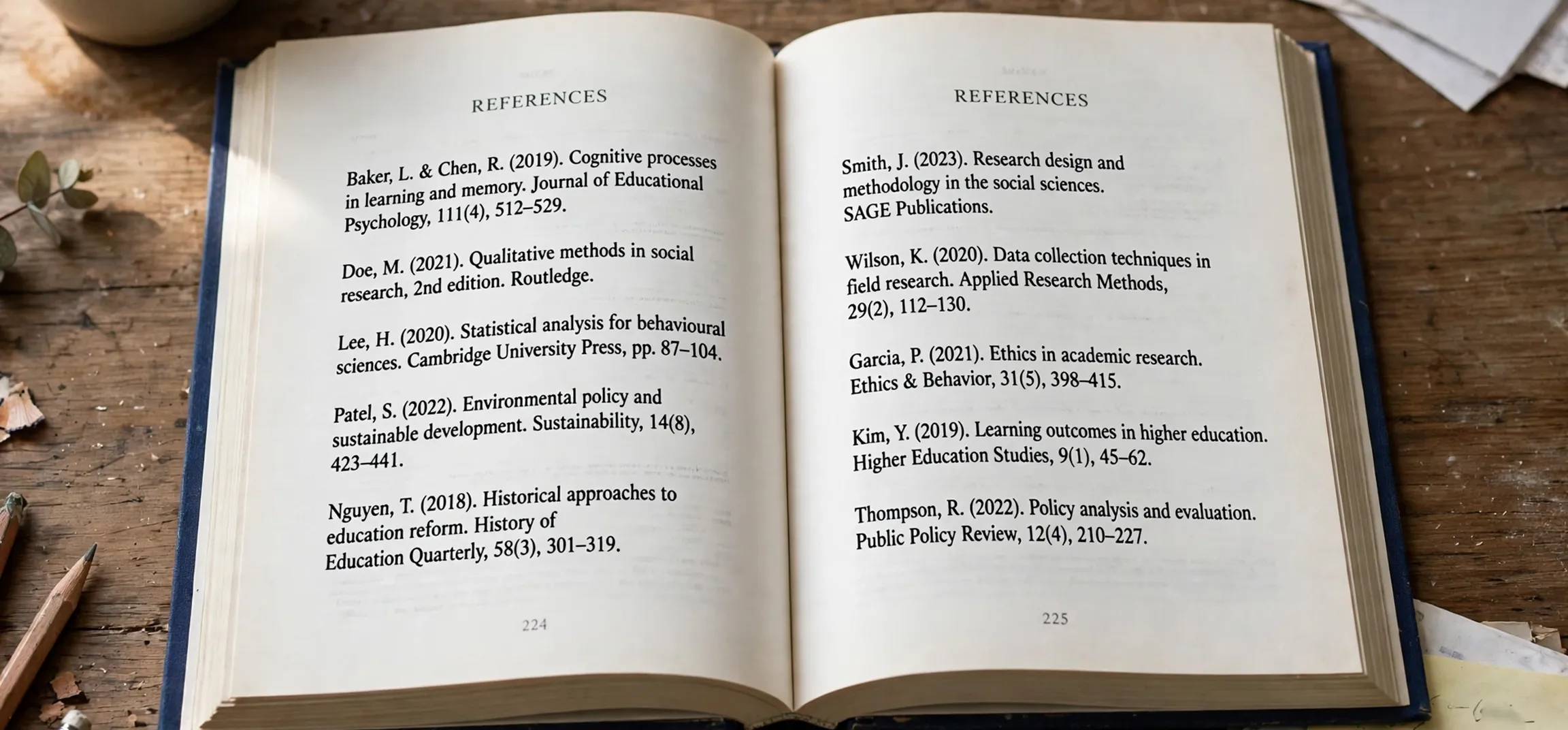
For a two-author journal article, the reference-list format is: Smith, A. B., & Jones, C. D. (2020). Title of the article in sentence case. Title of the Journal, 15(3), 123–145. https://doi.org/xx.xxxx/xxxx. Note the ampersand before the second author, the sentence-case article title, and the italicised journal title and volume number. Books, chapters, and web sources follow the same author pattern with source-specific details. For the companion basic guide, see our article on APA in-text citation with multiple authors.
APA in Text Citation With Two Authors: Checklist
Before submitting any paper with two-author sources, run through this checklist:
- Both authors named in every in-text citation, never shortened to “et al.”
- “&” inside brackets, “and” in sentences, consistently applied.
- Commas correctly placed: (Smith & Jones, 2020), not (Smith & Jones 2020).
- Page numbers included for every direct quotation.
- Same-year works distinguished with a, b, matching the reference list.
- Initials added where first-author surnames collide.
- Secondary sources cited with “as cited in”, with only the read source in the reference list.
- Every in-text citation matched to exactly one reference-list entry, and vice versa.
APA in Text Citation With Two Authors: Reference Software Tips
Reference management software can handle APA in text citation with two authors reliably, but only if the underlying data is correct. When importing a two-author source, check that both authors are entered separately, in the correct order, with surnames and initials in the right fields. A common import error merges two authors into one field, producing citations that name only one author or that garble both names. Another common error is an incorrect year, imported from a preprint rather than the published version. Before submitting, generate the reference list and scan it visually: author order, ampersands, years, and italics are all worth a manual check, even when software has done the heavy lifting. Software is a tool, not a substitute for understanding the rules, and the checklist in this guide remains the final safeguard.
Frequently Asked Questions
Can I ever use “et al.” for a two-author work?
No. In APA seventh edition, “et al.” is used only for works with three or more authors. Two-author works always name both authors in every in-text citation.
How do I cite a two-author work I found quoted in another source?
Use the secondary-source form: name the original authors, then “as cited in” followed by the source you actually read. Only the source you read appears in the reference list.
What if two different author pairs share a first author’s surname?
Add initials to every in-text citation for those sources, so readers can distinguish them, for example (J. Smith & Jones, 2020) and (R. Smith & Brown, 2019).
Do I need page numbers when paraphrasing a two-author work?
Page numbers are required for direct quotations and encouraged, but not required, for paraphrases. Including them for paraphrases is good practice when it helps readers locate the passage.
Conclusion
APA in text citation with two authors is governed by a simple core rule and a set of clear solutions for advanced cases. Name both authors every time, use “&” in brackets and “and” in sentences, add page numbers to quotations, distinguish same-year works with letters, add initials where surnames collide, and handle secondary sources honestly. With those habits, and a final consistency check between text and reference list, two-author citations become a strength of your academic writing rather than a source of errors, leaving your argument, not your formatting, as what readers remember.



