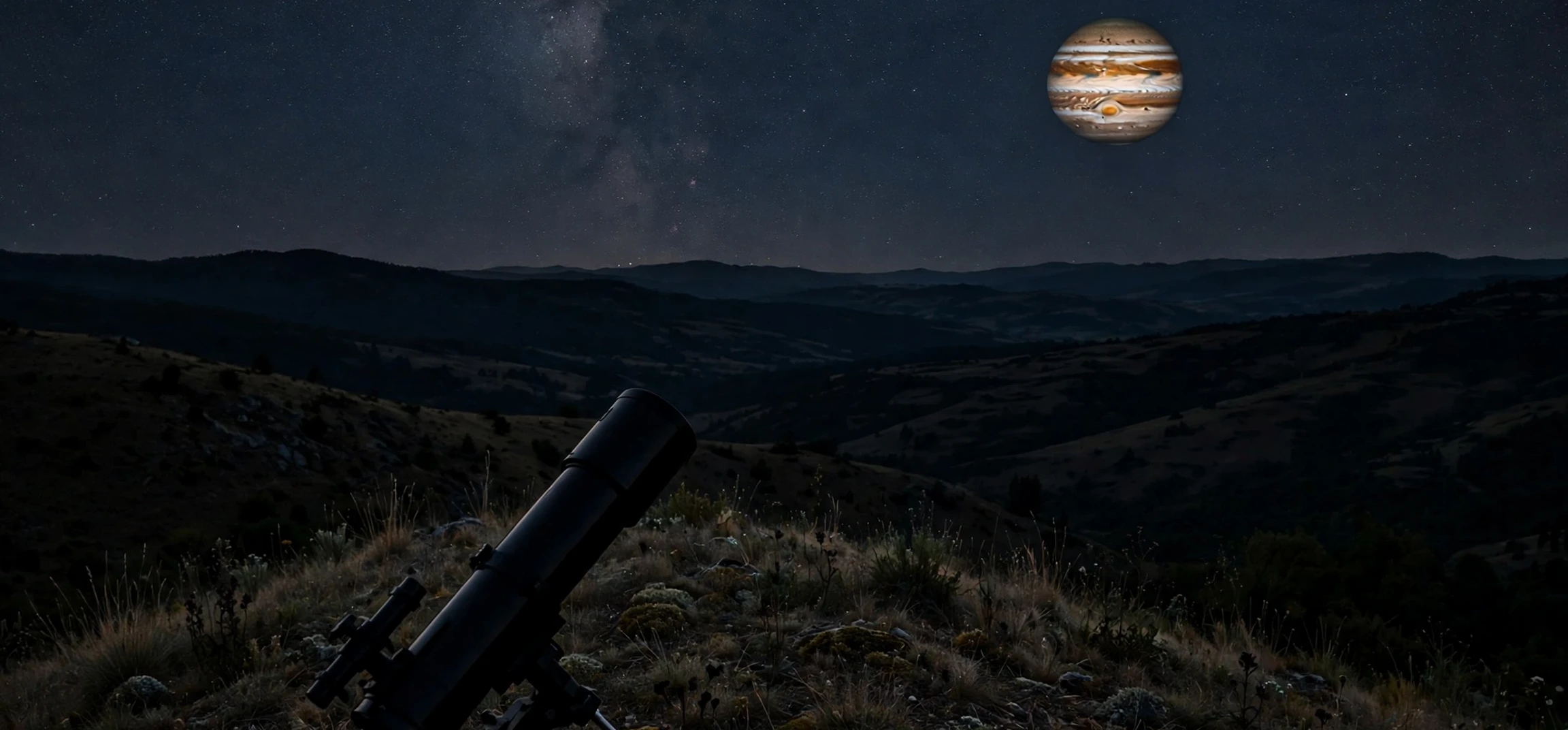
Jupiter dominates the night sky, outshining every other planet except Venus, and it has fascinated observers for thousands of years. So it is natural to ask: jupiter how did it get its name? The question jupiter how did it get its name has a short answer: Jupiter is named after the king of the gods in Roman mythology, a figure the Greeks knew as Zeus. But the longer story is more interesting, because it connects ancient skywatching, Roman religion, and the way astronomers still name planets today. This guide traces that story, explains what Jupiter’s name tells us about how ancient people saw the planet, and looks at the planet itself.
Jupiter has been visible to the naked eye since long before telescopes existed. Ancient Babylonian, Greek, and Roman observers all tracked its slow movement against the stars, noting that it took roughly twelve years to complete a circuit of the sky. That stately pace, combined with its brilliance, made it seem regal and powerful. It is no accident that cultures gave their brightest wandering star the name of their chief god. The name stuck through the Roman period, through the Middle Ages, and into modern astronomy, where it remains the planet’s official name.
Jupiter How Did It Get Its Name?
The planet Jupiter takes its name from Iuppiter, the supreme god of the Roman pantheon. Jupiter was the god of the sky, thunder, and lightning, the ruler of gods and men, and the protector of the Roman state. Roman writers and priests associated the brightest planet with this most powerful deity, just as the Greeks before them had associated the same planet with Zeus, their own king of the gods. When Roman culture absorbed Greek mythology, the two figures were treated as equivalents, and the Roman name eventually became the standard one in Western astronomy.
The word “Jupiter” itself comes from an older phrase meaning “sky father”, combining elements that refer to the sky and to fatherhood. That etymology fits the god’s role perfectly: he was the father figure of the pantheon, the authority who governed from above. The planet’s name therefore carries a double meaning. It honours a god, and it describes a quality ancient observers saw in the planet itself: dominance, brightness, and a commanding presence in the heavens.
It is worth noting, for anyone asking jupiter how did it get its name, that Jupiter was not named by a single person on a single date. Planet names in the ancient world grew out of shared cultural practice over centuries. By the time Roman astronomy was written down systematically, the association between the planet and the god was already well established. Later astronomers, including those of the Renaissance who revived classical learning, kept the Roman names for the five planets visible to the naked eye: Mercury, Venus, Mars, Jupiter, and Saturn.
Jupiter How Did It Get Its Name in Greek and Roman Tradition?
In Greek tradition, the planet was called Zeus, or sometimes Phaethon, meaning “shining one”. Greek astronomers and poets described the planet’s steady, majestic progress across the sky and linked it to the character of Zeus: powerful, watchful, and supreme. When Rome adopted much of Greek mythology, Zeus became Jupiter, and the planet’s name changed with him in Latin writings. This is why older Greek texts speak of Zeus where modern English texts speak of Jupiter, even though they refer to the same planet.
The Babylonians, who kept some of the earliest systematic records of planetary movement, associated Jupiter with Marduk, their chief god. The pattern is consistent across cultures: the brightest and most impressive planet was given to the most important god. That cross-cultural agreement tells us something important about how humans have always read meaning into the sky. A planet that outshines almost everything else invites a name that conveys authority.
Roman religion also gave Jupiter a civic role. Temples to Jupiter stood at the heart of Roman cities, oaths were sworn by Jupiter, and military victories were celebrated in his honour. Naming the greatest planet after him was therefore not just a poetic choice; it was a statement about order, power, and the place of Rome in the world. The name survived the fall of Rome because Latin remained the language of learning in Europe for more than a thousand years afterwards.
Why Roman Names Survived Into Modern Astronomy
When Uranus was discovered in 1781, and Neptune in 1846, astronomers deliberately continued the Roman tradition by naming the new planets after Roman gods. That decision confirmed the classical naming system rather than replacing it. The International Astronomical Union, which now oversees the naming of planets, moons, and other bodies, continues to draw on mythological names, keeping a link between modern science and ancient storytelling.
Jupiter’s moons follow a related tradition. The four large moons discovered by Galileo in 1610, Io, Europa, Ganymede, and Callisto, are named after figures associated with Zeus and Jupiter in mythology. Later discoveries have continued that pattern, with moons named after lovers, descendants, and associates of the god. The system gives astronomers a memorable, organised way to refer to dozens of moons, and it keeps the mythological theme of the parent planet alive.
The planet’s symbol also reflects its mythological past. The familiar glyph for Jupiter is traditionally said to represent either the god’s thunderbolt or the Greek letter zeta, the initial of Zeus. Like the name itself, the symbol is a reminder that astronomy began as a blend of observation, religion, and storytelling, long before it became a science based on telescopes and spacecraft data.
The Planet Behind the Name
Modern science has revealed a planet that lives up to its grand name in sheer scale. Jupiter is the largest planet in the solar system, more than twice as massive as all the other planets combined. It is a gas giant composed mainly of hydrogen and helium, with no solid surface to stand on. Its Great Red Spot, a storm larger than Earth that has raged for centuries, is one of the most famous features in the solar system, and its powerful magnetic field is the strongest of any planet.
Jupiter also plays a protective role in the solar system. Its enormous gravity influences the orbits of asteroids and comets, and astronomers have long debated how far that influence shields the inner planets, including Earth, from impacts. Spacecraft such as Pioneer, Voyager, Galileo, and Juno have transformed our understanding of the planet, revealing complex weather systems, deep atmospheric layers, and a diverse family of moons, including Europa, whose subsurface ocean is one of the most promising places to search for life beyond Earth.
For observers on Earth, Jupiter remains one of the easiest and most rewarding planets to find. It appears as a brilliant, steady point of light, unlike the twinkling stars around it, and even a small telescope reveals its banded clouds and its four largest moons as tiny points of light in a line. That accessibility is part of why it captured ancient imaginations so completely, and why it continues to inspire new generations of skywatchers today.
| Planet | Roman namesake | Greek equivalent |
|---|---|---|
| Mercury | Messenger of the gods | Hermes |
| Venus | Goddess of love | Aphrodite |
| Mars | God of war | Ares |
| Jupiter | King of the gods | Zeus |
| Saturn | God of agriculture and time | Cronus |
How Jupiter Is Observed Today
Modern skywatchers can find Jupiter with the naked eye for much of the year, and its position changes slowly from month to month as Earth and Jupiter move around the Sun. Astronomy apps and planetarium websites now do the work that ancient observers did by hand, predicting exactly where the planet will appear on any given night. For anyone curious about the night sky, Jupiter is an ideal first target: it is bright, easy to identify, and rewarding even through binoculars, which may reveal its four largest moons as small points of light beside it. Schools and astronomy clubs often begin observing sessions with Jupiter for exactly this reason, because a single look connects a beginner with the same sense of wonder that gave the planet its name in the first place.
Frequently Asked Questions
Was Jupiter named after Zeus or Jupiter?
Both, in a sense. The Greeks called the planet Zeus, and the Romans called the equivalent god Jupiter. Modern English uses the Roman name, following the tradition of Latin astronomical writing, but the two names refer to the same mythological figure and the same planet.
What does the name Jupiter mean?
The name derives from an ancient phrase meaning “sky father”, reflecting the god’s role as ruler of the sky and father of the gods. It is a fitting name for the largest and brightest planet in the solar system.
Do all planets have Roman names?
The eight planets of the solar system all carry Roman god names, a tradition that began with the five planets visible to the naked eye and was deliberately continued when Uranus and Neptune were discovered. Dwarf planets and moons follow related mythological naming conventions.
Conclusion
Jupiter got its name because ancient observers saw in the brightest, most commanding planet a fitting symbol for the king of their gods. The Greeks called that god Zeus, the Romans called him Jupiter, and the Roman name endured through Latin learning into modern astronomy. Today, the answer to jupiter how did it get its name connects a gas giant of staggering scale with thousands of years of human storytelling, reminding us that the planets were named not in a laboratory, but under open skies by people looking up in wonder. If you enjoyed this guide to names and stories behind the screen and the sky, explore our guide to the meaning of Bildungsroman, our educational guide for young learners, and our light-hearted chain guide.



