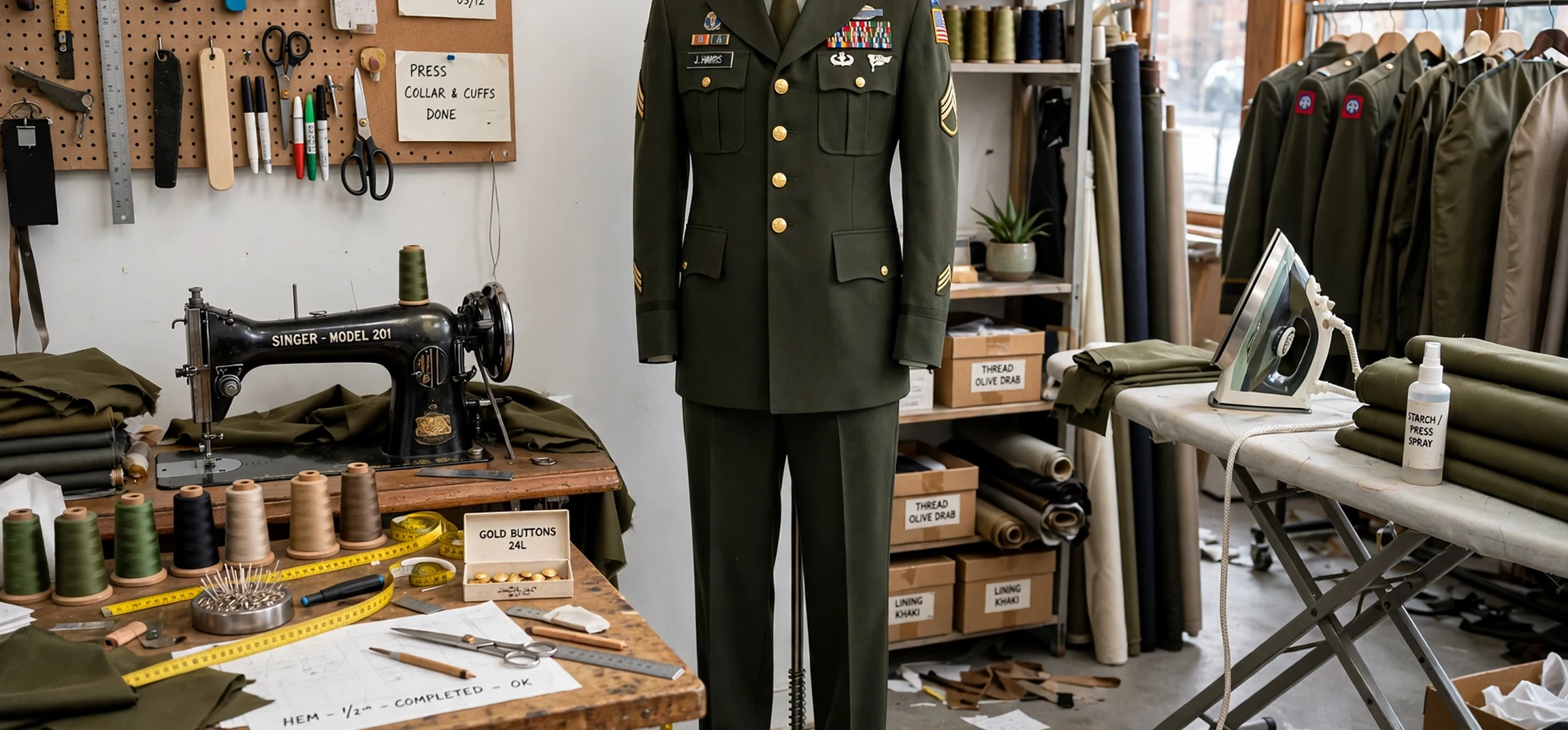
Getting the fit right matters more in uniform than in almost any other clothing, and this agsu measurement guide enlisted explains how enlisted soldiers take the measurements needed for the Army Green Service Uniform (AGSU). The AGSU is the Army’s everyday service uniform — the modern successor to the classic “pinks and greens” — and a sharp fit depends on accurate, unhurried measurements taken over the right underlayers, in the right posture, with a flexible tape. This guide covers every measurement you need, how to take each one, common mistakes, and how to check the fit once the uniform arrives.
One important note before you start: this agsu measurement guide enlisted is a general educational guide to standard uniform measuring practice. Your unit, your clothing issue facility, or your tailor may have specific instructions, and official Army uniform regulations are the final authority on wear and appearance. If a measurement here conflicts with guidance from your chain of command or your issue facility, follow their guidance. Measurements also change over time, so re-measure whenever you order a new uniform rather than reusing old numbers. Following this agsu measurement guide enlisted from the start — helper, flexible tape, undershirt only — gives the issue facility numbers it can trust first time.
AGSU Measurement Guide Enlisted: Before You Start
Preparation makes the difference between a uniform that fits and one that needs alterations. Measure over the undergarments you will actually wear with the AGSU — typically a standard undershirt — not over bulky clothing, a jacket, or a hoodie. Extra layers add centimetres that do not belong in the measurement, and the uniform will arrive too large. Stand upright in a natural, relaxed posture: feet shoulder-width apart, arms at your sides, breathing normally. Do not suck in your stomach, puff out your chest, or stand at attention with exaggerated rigidity, because the uniform is worn in a natural stance, not a posed one.
You will need a flexible tailor’s tape measure, not a metal construction tape, and ideally a second person to help. Self-measurement is possible for many measurements, but back length, shoulder width, and neck are much more accurate with a helper. Keep the tape snug but not tight: it should lie flat against the body without compressing it, and you should be able to slip a finger under it at most points. Write each measurement down immediately, in the unit your issue facility uses, and measure twice — if the two readings differ, take a third and use the middle value.
It also helps to know your height and weight before you begin, since issue facilities often use height and weight alongside tape measurements to confirm sizing. Have a pen and a simple measurement sheet ready, with a line for each measurement in this guide. Working through the list in order — neck, chest, waist, hips, sleeves, inseam, and coat length — keeps this agsu measurement guide enlisted process tidy and makes it easy to spot a missed entry before you leave.
AGSU Measurement Guide Enlisted: Upper Body Measurements
Start with the neck, which sets the shirt collar size. Wrap the tape around the base of the neck, where the collar will sit, keeping it level all the way around and leaving enough ease for one finger between tape and neck. Record the result to the nearest half unit. A collar that is too tight will be uncomfortable all day and will show at the neckline; a collar that is too loose will gape under the tie and look unfinished.
Next, measure the chest at its fullest point, usually across the shoulder blades and the chest, with the tape level and the arms relaxed at the sides. Breathe out naturally and read the tape without pulling it tight. The chest measurement drives the coat size, so accuracy here matters most, and it is the measurement this agsu measurement guide enlisted returns to most often because so many fitting problems trace back to it. Then measure the waist at the natural waistline — usually at the navel or just above it, where uniform trousers will sit — again with the tape level and snug but not compressing. If your natural waist and your trouser waist differ, note both and tell your issue facility which is which.
Shoulder width comes next, and it is best taken with a helper: measure from one shoulder point (the bony edge where the arm meets the shoulder) across the back to the other shoulder point, keeping the tape straight. Shoulder fit determines how the coat hangs: too narrow and the coat pulls across the back, too wide and the shoulder seam droops past the arm. Finally, measure the coat length — the back length from the base of the neck (the prominent bone at the back of the neck) down to the point where the coat should end, which for the AGSU is generally around the level of the hands with arms relaxed, covering the seat. Your issue facility or tailor can confirm the regulation length for your height.
AGSU Measurement Guide Enlisted: Sleeve and Trouser Measurements
Sleeve length is measured with the arm slightly bent, as it is when standing naturally. With a helper, measure from the centre of the back of the neck, over the shoulder point, and down the arm to the wrist bone. Some facilities instead measure from the shoulder point to the wrist; either method works as long as you tell the facility which one you used. The finished coat sleeve should show a small amount of shirt cuff — roughly a finger’s width — when the arm hangs relaxed. A sleeve that covers the hand or rides above the wrist will both look wrong, so this measurement deserves a second check.
For trousers, measure the waist as described above, then the hips at their fullest point, as set out in this agsu measurement guide enlisted,, with the tape level and the feet together. Then measure the inseam: standing straight in the shoes you will wear with the uniform, measure from the crotch seam point down the inside of the leg to the bottom of the ankle bone, or to the point where the trouser should break over the shoe. Trouser length is a matter of regulation as well as appearance — the AGSU trouser should have a slight break over the shoe, not pool around it and not ride above it — so measure in uniform shoes if you can, and note the shoe type.
Also record your outseam if your facility asks for it: the distance from the waistline down the outside of the leg to the same trouser-bottom point. Outseam and inseam together let a tailor confirm the rise and the length independently, which catches errors that a single measurement would miss. As with every other entry, take each trouser measurement twice and write it down straight away.
| Measurement | Where to take it | Common mistake |
|---|---|---|
| Neck | Base of the neck, one finger of ease | Measuring too high or pulling the tape tight |
| Chest | Fullest point, tape level, arms relaxed | Measuring over a jacket or holding breath in |
| Waist | Natural waistline where trousers sit | Measuring over bulky layers or too low on the hips |
| Shoulder width | Shoulder point to shoulder point across the back | Measuring with shoulders hunched or raised |
| Sleeve length | Centre back of neck, over shoulder, to wrist bone | Measuring with the arm straight and stiff |
| Inseam | Inside leg, crotch to ankle, in uniform shoes | Measuring barefoot or in different shoes |
AGSU Measurement Guide Enlisted: Checking the Fit
When the uniform arrives, try it on completely — coat, shirt, tie, trousers, belt, and shoes — and check the fit in a mirror, front, side, and back. The coat should close without pulling, the lapels should lie flat, and the shoulder seams should sit on the shoulder points. The shirt collar should close comfortably with the tie in place, without gaping when the top button is fastened. The trousers should sit at the waist without a belt doing all the work, and the break over the shoe should be slight and even on both legs.
Move in the uniform: sit down, raise your arms, walk a short distance, and salute. A well-fitted AGSU allows all of this without binding across the back, without the coat riding up excessively, and without the trousers pulling at the waist or crotch. Minor adjustments — a sleeve shortened slightly, a trouser hem adjusted — are normal and are part of the tailoring process, not a sign that the measurements were wrong. Major problems, such as a coat that will not close or trousers far too long, usually point to a single mis-recorded measurement, and your issue facility can usually identify it by re-measuring that one point.
Between fittings, keep the uniform clean and pressed according to its care labels, and store it on a proper hanger so the coat keeps its shape. Pressing and care are part of the AGSU’s appearance standard: even a perfectly fitted coat looks poor if it is wrinkled or misshapen from storage. For general guidance on getting measured for fitted clothing, see our fitting guide for safety equipment, and for preparation and packing around uniform issue, see our travel preparation guide, which covers the same habit of measuring, listing, and double-checking before you go.
Common Measurement Mistakes to Avoid
The most frequent mistake is measuring over the wrong layers. A hoodie, a fleece, or a thick sweater can add several centimetres to a chest or waist reading, and the resulting uniform will hang loose in a way that tailoring cannot easily fix. Measure over an undershirt only, and if you normally wear a particular undershirt with the AGSU, wear that one for measuring.
The second mistake is posture: standing rigidly, holding your breath, or sucking in your stomach. All three distort the reading, and the uniform will feel tight in normal wear. Stand as you normally stand, breathe normally, and let the helper read the tape. The third mistake is a twisted or sagging tape. Keep the tape level, flat, and snug, and check in a mirror that it has not slipped at the back, where you cannot see it. A tape that dips at the back adds length that does not exist.
The fourth mistake is rounding carelessly or converting units mid-list. Record each measurement in the unit your facility uses, to the precision they ask for, and do not convert between inches and centimetres from memory. If you must convert, use a calculator and write the converted figure alongside the original. Finally, never reuse old measurements without re-measuring. Bodies change with training, diet, and time, and a uniform ordered on last year’s numbers is a common cause of an avoidable refit.
Before you hand your sheet to the issue facility, run through it once more against this agsu measurement guide enlisted checklist: neck, chest, waist, hips, shoulder width, sleeve length, inseam, and coat length, each measured twice and written in the facility’s unit. A complete sheet means the facility can process your order without follow-up questions, and it gives you a record to compare against if the finished uniform needs adjustment. Keep a copy of the sheet with your uniform records; it is the reference you will use when re-measuring for your next order.
Frequently Asked Questions
Can I measure myself for the AGSU?
Many measurements can be taken alone, but neck, shoulder width, back length, and sleeve length are much more accurate with a helper. If you must measure alone, use a mirror and measure each point twice.
What should I wear while being measured?
The undershirt you will wear with the uniform, and uniform shoes for trouser length. Avoid bulky layers, which inflate every reading.
How often should I re-measure?
Every time you order a new uniform, and after any significant change in weight or build. Old measurements are a common cause of poor fit.
What if my uniform does not fit after issue?
Minor adjustments are normal tailoring. For major problems, return to the issue facility with your measurement sheet so the faulty measurement can be identified and corrected.
Conclusion
This agsu measurement guide enlisted comes down to a simple discipline: measure over the right layers, in a natural posture, with a flexible tape and a helper, twice for every point, and write each number down immediately. Neck, chest, waist, hips, shoulders, sleeves, and inseam together define the fit of the AGSU coat and trousers, and a careful half-hour of measuring saves weeks of alterations and refits. Follow your unit’s and issue facility’s specific instructions where they differ, check the finished fit in full uniform, and re-measure for every new order. A uniform fitted using this agsu measurement guide enlisted looks sharp, feels comfortable through a long day, and lets the wearer focus on the duty rather than the clothing.



