The first names of the Wright brothers were Orville and Wilbur. Orville Wright and Wilbur Wright were the two American brothers whose careful experiments with gliders and powered aeroplanes changed transport for ever. When people ask about the first names of the Wright brothers, they are usually trying to settle a simple point of identification: which brother was which, and how their names appear in history books, museum displays, and school lessons. Wilbur was the elder brother, born in 1867, while Orville was born in 1871. Together they are remembered as the Wright brothers, but their individual first names matter because each man brought different strengths to their shared work, and later accounts often credit one brother more than the other for particular breakthroughs.
Understanding the first names of the Wright brothers also helps readers follow the story in the correct order. Wilbur tended to lead the theoretical work and the early correspondence, while Orville was closely involved in the practical building, testing, and operation of their machines. That division was never rigid, and the brothers worked as a genuine partnership, but knowing who was who makes it easier to understand letters, photographs, and records from their bicycle shop in Dayton, Ohio, and from their testing grounds at Kitty Hawk in North Carolina. This guide explains their full names, their family background, their path from bicycles to flight, and why their achievement remains so widely taught today.
First Names of the Wright Brothers: Who Were They?
The Wright brothers were Wilbur Wright and Orville Wright, sons of Milton Wright, a bishop, and Susan Catherine Koerner Wright. They grew up in a household that valued reading, discussion, and practical skill. Their father often brought home toys and books, and one childhood toy helicopter, powered by a rubber band, is frequently mentioned as an early spark for their interest in flight. It would be wrong to treat that single toy as the whole explanation, however. Their later success came from years of observation, reading, argument, and methodical testing, rather than from one moment of inspiration alone.
Before they became famous for aviation, the brothers ran a bicycle business. Bicycles mattered to their story for two reasons. First, the business gave them workshop skills, tools, and an income that helped fund their experiments. Second, bicycles taught them a great deal about balance, control, and lightweight construction. A bicycle rider must constantly adjust to stay upright, and the Wright brothers carried that idea into their thinking about aircraft control. They were not simply trying to build a machine with enough power to leave the ground; they were trying to build a machine that a pilot could steer safely once it was in the air.
First Names of the Wright Brothers Explained
To state the answer plainly, the first names of the Wright brothers were Wilbur and Orville. Wilbur Wright was born on 16 April 1867 near Millville, Indiana, and Orville Wright was born on 19 August 1871 in Dayton, Ohio. Wilbur is therefore the elder brother, by a little more than four years. Their surname, Wright, is the family name they shared, and it is why they are collectively known as the Wright brothers rather than by a company name or a single inventor’s name. In formal writing, the full forms are Wilbur Wright and Orville Wright, and both forms should be used when first introducing them in an essay or article.
Some readers confuse the brothers with other early aviators, or mix up their initials, so a clear naming habit helps. Wilbur is sometimes shortened in informal writing, but his full first name is Wilbur, not Will, in formal historical records. Orville is likewise Orville, not a shortened nickname, in the standard record. Teachers often ask pupils to remember the pair in birth order — Wilbur first, then Orville — because that order also matches the order in which they appear in many timelines of the brothers’ early life. Keeping that order in mind prevents the common error of describing Orville as the elder brother.
First Names of the Wright Brothers: Wilbur Wright
Wilbur Wright was the thinker and organiser of the partnership in its early years. He read widely about earlier attempts at flight, studied the work of pioneers such as Otto Lilienthal, and wrote to the Smithsonian Institution in 1899 asking for published material on aeronautics. That letter is an important document because it shows a careful, research-led approach. Wilbur did not begin by building a large powered machine and hoping for the best. He began by learning what had already been tried, what had failed, and why control had proved so difficult for earlier experimenters.
Wilbur also played a leading role in developing the idea of wing warping, a method of twisting the wings to control roll. The brothers noticed how birds adjusted their wings in flight, and they tested the idea first with a small kite and then with gliders. Wilbur’s patience with repeated trials, careful notes, and gradual improvement became a hallmark of their method. He later travelled to Europe to demonstrate their aircraft, helping to convince sceptical audiences that controlled, powered flight was real and repeatable, not a single lucky hop in favourable wind.
First Names of the Wright Brothers: Orville Wright
Orville Wright was the younger brother, and he was the pilot of the first powered flight on 17 December 1903 at Kitty Hawk. On that morning, with Wilbur running alongside and then watching, Orville flew the Flyer for twelve seconds over a distance of about thirty-six metres. The flight was short, but it was controlled and powered, and it was followed by three further flights that day, with the brothers taking turns. The longest flight that day, by Wilbur, lasted fifty-nine seconds. Those details matter because they show that the achievement was not a single accident; it was a repeatable result achieved four times in one day.
Orville was skilled in the workshop and in the practical side of building and maintaining machines. He worked closely with the brothers’ mechanic, Charlie Taylor, on the lightweight engine that powered the 1903 Flyer, and he remained involved in aviation and in preserving the story of their work after Wilbur’s death in 1912. Orville lived until 1948, long enough to see aviation grow from fragile wooden machines into a global industry. His later years were spent partly in Dayton, where he helped protect the historical record and supported museums and educational work about early flight.
How the Wright Brothers Learned to Fly
The Wright brothers learned to fly in stages, and that gradual method is one of the most useful lessons from their story. They began with kites, moved to manned gliders, and only then built a powered machine. At Kitty Hawk, they chose a location with steady winds, soft sand for landings, and open space for testing. Between 1900 and 1902, they tested gliders there, learning how wings produced lift, how wind affected control, and how a pilot could steer by shifting position and adjusting the wings. Their 1902 glider, with a movable rudder and improved wing design, gave them the control system they needed for powered flight.
They also built their own wind tunnel to test wing shapes. This was a significant step because it let them gather reliable data without risking a pilot on every test. Many earlier experimenters had relied on published lift tables that turned out to be inaccurate. By testing small wing models themselves, the Wright brothers corrected those errors and designed wings that performed as predicted. That combination — careful data, practical workshop skill, and repeated outdoor testing — explains why their 1903 success followed so logically from their glider work, rather than appearing from nowhere.
The 1903 Flyer and Why It Matters
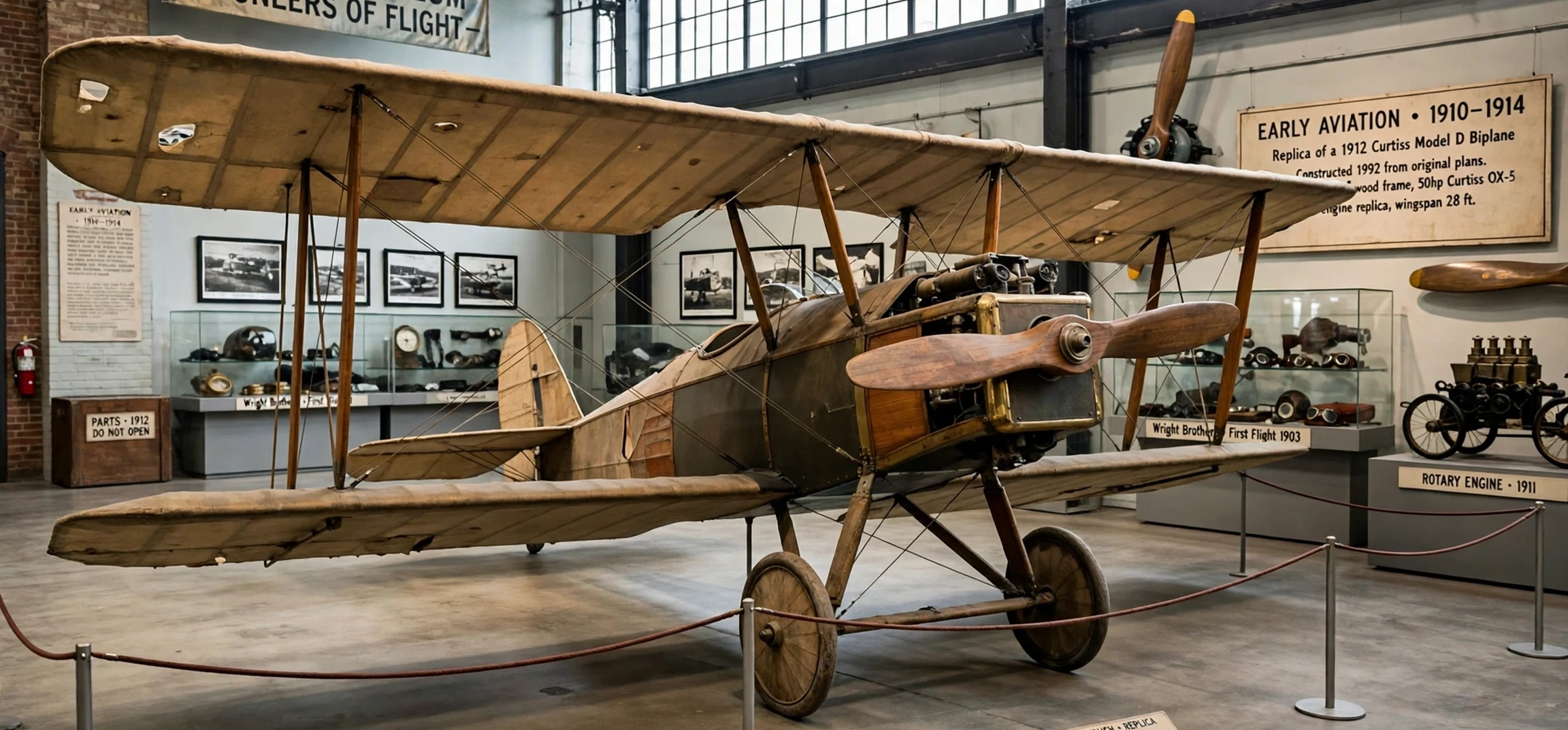
The machine flown in December 1903 is usually called the Wright Flyer, or Flyer I. It was a biplane with a wingspan of about twelve metres, a lightweight petrol engine, and two propellers driven by chains. The pilot lay on the lower wing and controlled the machine using a hip cradle for wing warping and a lever for the elevator. By modern standards it looks fragile, but its control system was the real breakthrough. Earlier powered machines had sometimes left the ground briefly, but they could not be steered reliably. The Flyer could be controlled in three axes — roll, pitch, and yaw — which is why it marks the beginning of practical powered aviation.
The importance of the Flyer extends far beyond one morning at Kitty Hawk. Within a few years, the brothers were flying longer distances, turning, and demonstrating their aircraft in the United States and Europe. Their work encouraged governments, businesses, and other inventors to take aviation seriously, and it set the pattern for later aircraft design: a powered machine must be controllable, not merely airborne. Museums preserve the original 1903 Flyer today, and its image has become one of the most recognisable symbols of invention, patience, and teamwork in modern history.
Common Questions About Their Names
One common question is whether there was a third Wright brother involved in the flights. The brothers had siblings, including a sister, Katharine Wright, who supported their work, helped manage correspondence, and later accompanied Wilbur on a European trip. Katharine was an important part of the family story, but the flying partnership itself was Wilbur and Orville. Another question is whether the brothers used middle names in everyday life. Wilbur’s full name is usually given simply as Wilbur Wright, and Orville’s as Orville Wright, in standard historical references, and those are the forms readers should use unless a source gives a fuller form for a specific document.
Readers also ask why the brothers are sometimes listed in different orders. Some sources list Orville first because he piloted the first flight, while others list Wilbur first because he was elder and led much of the early research. Neither order is wrong on its own, but birth order — Wilbur, then Orville — is the clearest convention for introductions. For more on how personal names are recorded in history, see Abraham Lincoln’s middle name and the origin of the name Anton. For another story of early invention, see the first colour television.
| Brother | First name | Born | Role in the partnership |
|---|---|---|---|
| Elder brother | Wilbur | 16 April 1867 | Research, theory, and early demonstrations |
| Younger brother | Orville | 19 August 1871 | Workshop building and pilot of the first flight |
| Shared achievement | Wilbur and Orville | — | First controlled, sustained, powered flight, 17 December 1903 |
Frequently Asked Questions
What were the first names of the Wright brothers?
The first names of the Wright brothers were Wilbur and Orville — Wilbur Wright, the elder brother, and Orville Wright, the younger brother.
Who was older, Wilbur or Orville Wright?
Wilbur Wright was older. He was born in 1867, while Orville Wright was born in 1871.
Who flew first in 1903?
Orville Wright piloted the first powered flight on 17 December 1903 at Kitty Hawk. Wilbur and Orville then took turns for three further flights that day.
Did the Wright brothers work alone?
No. They worked with their mechanic Charlie Taylor on the engine, and their sister Katharine Wright supported their correspondence and public work, but the flying partnership was Wilbur and Orville.
When students revise this topic, the question about the first names of the Wright brothers often appears as a straightforward recall question, but it also opens a wider discussion. Asking about the first names of the Wright brothers prompts learners to distinguish Wilbur from Orville, to place each man in birth order, and to connect each name with a role in the partnership. Teachers who ask about the first names of the Wright brothers are therefore testing more than memorisation: they are checking whether pupils can follow a historical partnership, read sources accurately, and avoid mixing up two brothers whose surname is far more famous than either first name alone. That is why the first names of the Wright brothers deserve a clear answer at the start of any account, and why this guide returns to the first names of the Wright brothers throughout, rather than leaving them as a single fact in the introduction.
A final naming note is worth keeping: whenever a source mentions the first names of the Wright brothers, check whether it lists Wilbur before Orville or the other way round, and note the reason. Sources that list the first names of the Wright brothers in birth order are usually giving a biographical introduction, while sources that list Orville first are usually emphasising who piloted the first flight. Both are accurate in context, but birth order remains the clearest default for the first names of the Wright brothers in general writing.
Conclusion
The first names of the Wright brothers were Wilbur and Orville, and remembering them in that birth order gives readers a firm starting point for the whole story of early flight. Wilbur brought research, theory, and persistence; Orville brought workshop skill and the piloting of that first short flight. Together, through gliders, wind-tunnel tests, and a carefully designed control system, they turned a long-standing human dream into a practical machine. Their names remain paired in history for a good reason: neither brother’s achievement makes full sense without the other, and their partnership remains a clear example of how careful method, teamwork, and patience can solve a problem that had defeated many earlier experimenters.



