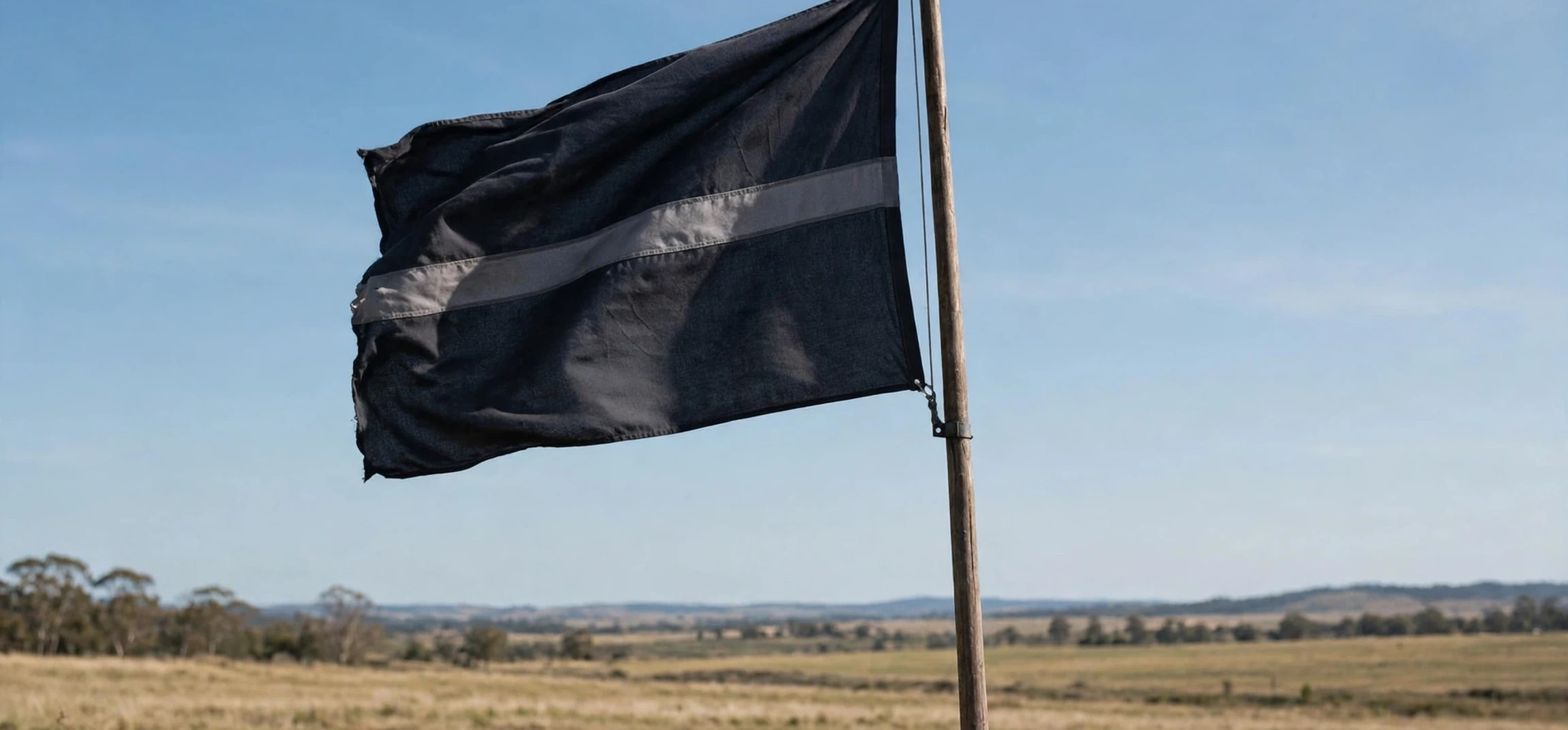
If you searched for “flag with blue stripe”, you have probably seen a version of the United States flag that does not look quite like the familiar red, white and blue design. Instead of thirteen red and white stripes and a blue canton filled with stars, the flag in question is usually shown in black and white, with a single bright blue stripe running horizontally across the middle. That one change in colour makes the design stand out, and it also raises an obvious question: what is it meant to represent, and is it an official flag at all? This guide explains the meaning and symbolism of blue-stripe flags in general, describes the most widely recognised designs, and explains how context, placement and accompanying symbols change how such a flag is understood. It does so in neutral, factual terms, because the same design can be described differently by different people, and the safest way to understand any flag is to look closely at the design itself and at the setting in which it is displayed.
The official flag of the United States has thirteen horizontal stripes, alternating red and white, and a blue canton in the upper left corner containing fifty white stars. A flag that replaces those colours with black, white and a single blue stripe is therefore not the official national flag. It is a variant design, based on the layout of the national flag but recoloured for a particular purpose. That distinction matters. When people talk about the meaning of a blue-stripe flag, they are usually talking about a variant or tribute design, not about a change to the official flag itself. The variant keeps the familiar shape of stars and stripes so that viewers recognise the reference, while the change in colour signals that the flag is being used to express a specific idea, affiliation or message rather than simply to represent the country as a whole.
What a Flag With Blue Stripe Means
The most widely recognised flag with blue stripe design is the black-and-white version of the United States flag with a single blue stripe across the centre. In general use, this design is commonly described as a symbol of support for law enforcement. Supporters of the design often explain the blue stripe as representing police officers, with the black background understood as a mark of remembrance for officers who have died in service, and the single stripe standing out against the darker field. That explanation is the one most often given in descriptions of the design, in product listings for flags and related items, and in public displays where the flag appears alongside other emblems of police and emergency services. It is important to present that meaning as the commonly given explanation, rather than as a meaning fixed by law, because no official body has adopted this variant as a national symbol, and its interpretation can vary with the viewer and the occasion.
At the same time, a single blue stripe does not always carry the same meaning. Colour symbolism in flags is rarely fixed in isolation. A blue stripe on a different flag, in a different arrangement, or in a different country can mean something entirely different. Blue is a common flag colour around the world, and it has been used to represent the sea, the sky, peace, loyalty, justice and national identity in many different traditions. That is why a careful reading of any flag looks beyond one stripe. The number of stripes, their order, the background colour, the presence or absence of stars or other emblems, and the country or organisation associated with the design all help to narrow down what is being shown. A flag with blue stripe wording in a search can therefore lead to several different designs, and the design in the photograph or video is a better guide than the search phrase alone.
Symbolism and Colour in Flag Design
Flag designers have long used colour to carry meaning quickly, because a flag must be recognised at a distance and understood without words. Red is often linked with courage or sacrifice, white with peace or honesty, and blue with loyalty, justice or vigilance, although these associations are conventional rather than universal. When a familiar flag is recoloured in black and white, the contrast itself becomes part of the message. The removal of red and white stripes draws the eye to the one stripe that keeps its colour, and that visual emphasis is deliberate. The blue stripe becomes the focal point of the whole design, which is why viewers tend to ask about that stripe first, rather than about the stars or the overall layout, which remain familiar.
Monochrome versions of national flags are also used in other contexts, such as memorial displays, commemorative merchandise and stylised artwork, where a muted palette is chosen to convey solemnity or respect. In those settings, a single coloured stripe can function as a highlight, drawing attention to one group, value or idea within a wider tribute. That broader tradition helps to explain why the black-and-white design with a blue stripe feels both familiar and distinct. It borrows the authority and recognition of the national flag, while using colour to narrow the focus to a particular theme. Readers who want to compare this approach with other flag colour traditions can find useful background in related guides, including a guide to what the colours of the Mexican flag mean, which shows how different nations assign different meanings to similar colours.
How a Flag With Blue Stripe Differs From the Official United States Flag
The differences between the official flag and the common blue-stripe variant are easy to list once they are set side by side. The official flag uses red stripes, white stripes and a blue canton with white stars. The variant most often photographed uses black and white stripes, a black canton with white or grey stars, and a single blue stripe in the centre. The layout, proportions and star arrangement are usually kept close to the original, so the two flags are clearly related, but the colour change is not a minor detail. It is the feature that turns a national flag into a variant design with a narrower, more specific association. Anyone describing the variant should therefore avoid calling it the official flag, and should describe it as a variant, tribute or modified design based on the national flag.
There are also practical differences in how the two flags are used. The official flag is flown by government buildings, schools, military installations and private citizens according to established flag etiquette, and there are long-standing customs about how it should be displayed, raised, lowered and retired. Variant designs are generally flown or displayed by individuals, groups and businesses that wish to express a particular affiliation or message, rather than by official bodies acting in an official capacity. That does not make the variant unimportant, but it does mean that its status is different. It is a form of public expression, using a familiar symbol in a modified form, rather than a replacement for the national flag. Understanding that distinction helps readers avoid confusion when they see the design at a parade, on a vehicle, on clothing or in an online image.
Stars, Stripes and Layout
In most versions of the blue-stripe variant, the stars remain in the canton, although they may appear in white, grey or a muted tone against a black background. The stripes usually remain thirteen in number, matching the official flag, with the central stripe coloured blue instead of red or white. Some manufactured versions simplify the design further, reducing detail for printing on fabric, clothing or small items, which can make counting stripes or stars difficult in a photograph. When a design is simplified in that way, it is still recognisable as a variant of the United States flag, but small details should not be over-interpreted. A faded print, a low-resolution image or a flag seen at a distance can all make a blue stripe look darker, lighter or wider than it is in the original product. Checking a clear image, or the description given by the person or organisation displaying the flag, is a more reliable guide than guessing from a single blurred photograph.
Common Designs That Include a Blue Stripe
Not every flag with a blue stripe is a variant of the United States flag. Several national flags use blue stripes as a central part of their design, and these are sometimes found by the same search phrase. The flag of Greece, for example, uses alternating blue and white horizontal stripes with a blue canton bearing a white cross. The flag of Israel uses two horizontal blue stripes on a white field, with a blue Star of David in the centre. The flag of Argentina uses light blue and white horizontal bands. Each of these designs has its own history and official status, and none of them should be confused with the black-and-white variant described above. The table below sets out the main differences in plain terms, so that readers can compare designs without relying on colour alone.
| Design | Main colours and layout | Usual description |
|---|---|---|
| Black-and-white United States variant with blue stripe | Black and white stripes, black canton with stars, one central blue stripe | Variant or tribute design, commonly described as expressing support for law enforcement |
| Official United States flag | Red and white stripes, blue canton with fifty white stars | Official national flag |
| Flag of Greece | Blue and white stripes, blue canton with white cross | Official national flag with its own historical symbolism |
| Flag of Israel | White field, two blue stripes, blue Star of David in the centre | Official national flag with its own historical symbolism |
| Other blue-stripe variants | Varies by design, including single-stripe tribute flags for other services | Meaning depends on the specific design and context |
The final row of the table deserves a brief explanation. Once the idea of a single coloured stripe on a monochrome flag became familiar, similar designs appeared using other colours to represent other groups, such as emergency medical services, firefighters and other public services. Those designs follow the same visual logic: a familiar flag layout, recoloured in black and white, with one stripe kept in colour. They are not the same flag as the blue-stripe version, and the colour is the key difference. A red stripe, a green stripe or a gold stripe in the same layout would point to a different association. That is why colour, rather than layout alone, is the most useful clue when identifying a monochrome variant flag. Readers who are interested in how blue shades themselves are named and described may also find the guide to names of different blue colours helpful background, since the exact shade of blue can vary between manufacturers.
How to Read a Blue-Stripe Flag in Context
Context is often the clearest guide to meaning. A blue-stripe flag displayed at a memorial service, a police station event or a charity fundraiser for officers and their families is likely to be used in the sense described above, as a mark of support or remembrance. The same design printed on a commercial product, such as a badge, a sticker or an item of clothing, may be used in a more general sense, as a decorative or affiliative symbol chosen by the buyer. A design appearing in a news photograph, a film or a social media post may be included simply because it was present at the scene, rather than because the photographer or publisher intended to make a statement about it. In each case, the surrounding information matters more than the stripe alone. Captions, event descriptions, accompanying emblems and the identity of the organisation displaying the flag all help to clarify the intended message.
It is also worth remembering that symbols can be viewed differently by different audiences. A design that one group regards as a straightforward tribute may be viewed by another group as a political statement, and debates about such symbols are a matter of public discussion. A factual guide cannot settle those debates, and it should not try to do so. The neutral approach is to report the commonly given explanation, to note that the design is a variant rather than an official flag, to distinguish it from national flags that also use blue stripes, and to encourage readers to consider context before drawing conclusions. That approach respects both the people who display the flag and the people who interpret it differently, and it keeps the focus on accurate identification rather than on argument.
Questions to Ask When You See One
When you encounter a flag with a blue stripe and want to understand it, a few simple questions will usually resolve most of the uncertainty. First, is the background black and white, or does it use the full red, white and blue of the official flag? Second, how many blue stripes are there, and where are they placed? Third, does the canton contain stars, a cross, another emblem, or nothing at all? Fourth, where is the flag being displayed, and by whom? Fifth, is there any accompanying text, logo or caption that explains the display? Answering those questions in order will usually distinguish the common law-enforcement tribute variant from a national flag, a different service tribute, or a purely decorative design. If the answers remain unclear, the most accurate description is simply to describe what can be seen, rather than to assign a meaning that cannot be confirmed from the image alone.
For readers who have seen a closely related design and want to compare wording and explanations, a companion guide on what a United States flag with blue stripes means covers similar ground from a different angle, and it can be useful to read the two guides together. Taken together, they show how a single search phrase can cover several related designs, and why careful visual comparison is more reliable than relying on a short description alone.
Frequently Asked Questions About a Flag With Blue Stripe
Is a flag with a blue stripe the official flag of the United States?
No. The official flag uses red and white stripes and a blue canton with white stars. A black-and-white version with a single blue stripe is a variant design based on the official flag, not a replacement for it. It is best described as a modified or tribute design.
What does the blue stripe usually represent?
In the most widely recognised variant, the blue stripe is commonly described as representing law enforcement, with the black background often described as a mark of remembrance. That is the explanation most often given by supporters and sellers of the design, although interpretations can vary with context and audience.
Could a blue stripe belong to a different national flag?
Yes. Several national flags use blue stripes, including the flags of Greece, Israel and Argentina, each with its own layout and history. The number and placement of the stripes, the background colour and any central emblem are the clues that distinguish these flags from the monochrome variant.
Where is the blue-stripe variant most often seen?
It is most often seen at memorial events, public-service gatherings, fundraisers and on personal items such as clothing, stickers and vehicle displays. The setting usually gives the clearest indication of the intended message, so captions and event details are worth checking.
Conclusion
A flag with blue stripe design is best understood by starting with what can actually be seen: the layout, the colours, the number of stripes and the setting in which the flag appears. The most familiar version is a black-and-white variant of the United States flag with a single central blue stripe, commonly described as a symbol of support for law enforcement and remembrance. It is not the official national flag, and it should not be confused with national flags that also use blue stripes, such as those of Greece or Israel. By comparing designs carefully, noting the difference between a variant and an official flag, and reading the context of the display, readers can identify a blue-stripe flag accurately and describe its commonly given meaning fairly, without overstating what a single stripe can prove on its own.



