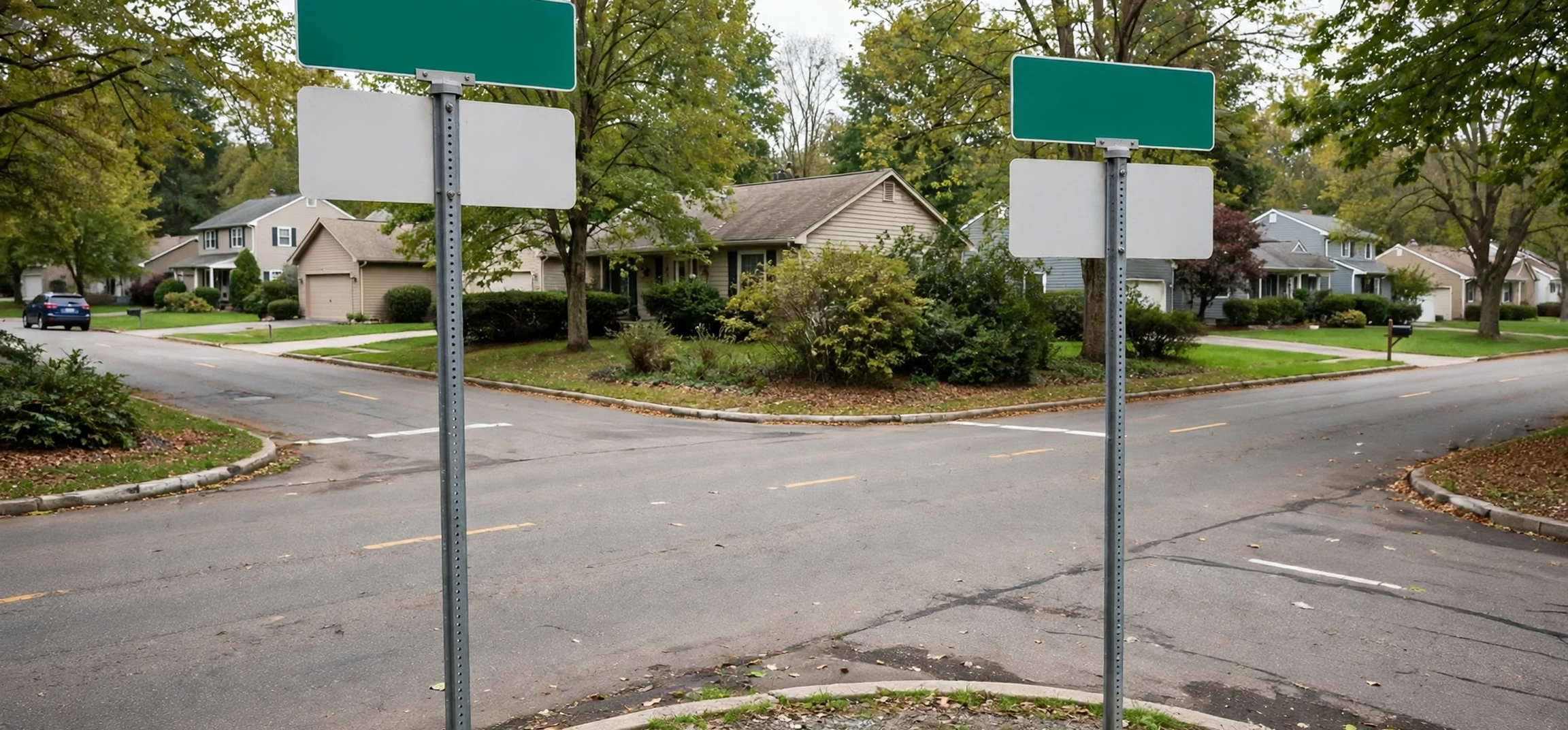
If you searched for “street sign types”, you are looking for a clear way to make sense of the signs you pass every day: why some are red and round, why others are yellow and diamond-shaped, and why a blue rectangular sign feels different from a triangular warning sign. Street signs are a visual language, and like any language, they become much easier to read once you understand their categories. This guide explains the main street sign types, what their shapes and colours usually mean, how to read them safely, and why the details vary between countries. It also explains the difference between official road signs and novelty or parody signs, which are made for decoration rather than for the road.
Road signs exist for a simple reason: they give drivers, cyclists, and pedestrians essential information quickly, often at speed and in poor weather. A sign must be understood in a second or two, without the reader stopping to study it. That is why sign systems rely on consistent shapes, colours, and symbols rather than on long sentences. A red border usually signals a restriction or a warning, a particular shape often identifies a category, and a symbol can cross language barriers more easily than words. Once those patterns are learned, reading signs becomes almost automatic, which is exactly what road safety requires.
The Main ‘street sign types’ at a Glance
Most national sign systems divide signs into a small number of broad categories. Regulatory signs tell road users what they must or must not do, such as stopping, giving way, or observing a speed limit. Warning signs alert road users to a hazard ahead, such as a bend, a junction, or a pedestrian crossing. Guide and information signs help road users find their way, identifying places, routes, distances, and facilities. Temporary signs cover roadworks, diversions, and short-term changes, while other categories, such as parking and local direction signs, address specific everyday needs. Knowing which category a sign belongs to is often enough to understand its general message before reading its details.
These categories are not identical in every country, and the same message may be shown with a different shape or colour in different places. In the United States, for example, warning signs are often yellow and diamond-shaped, while in the United Kingdom and much of Europe, warning signs are often triangular with a red border. Regulatory signs also differ: a stop sign is a familiar red octagon in many countries, but other restrictions may use round signs in one system and rectangular signs in another. Travellers should therefore learn the local system rather than assuming that signs work exactly as they do at home.
Regulatory ‘street sign types’ Explained
Regulatory signs carry instructions that road users are expected to obey, and they are among the most important signs on any road. Stop signs, give-way signs, speed-limit signs, no-entry signs, and one-way signs all belong to this category. Their designs are deliberately bold and simple, so that they stand out from other street furniture. A speed-limit sign, for instance, usually shows a number inside a clear border, while a no-entry sign uses a strong colour contrast to make the prohibition obvious even from a distance. Ignoring a regulatory sign can have legal consequences, as well as safety consequences, so these signs deserve particular attention.
Within the regulatory category, there are useful sub-groups. Some signs impose a requirement, such as a direction that traffic must proceed a certain way. Others impose a prohibition, such as a ban on turning, parking, or entering. A third group gives priority instructions at junctions, telling one stream of traffic to stop or give way to another. Learning to distinguish requirements from prohibitions, by shape and colour as well as by symbol, helps road users respond correctly without hesitation. Official highway guidance for the relevant country gives the authoritative version of each sign, and it is the best reference for learners and new drivers.
Warning Signs and Hazard Awareness
Warning signs give advance notice of something ahead that requires extra care. They may warn of a sharp bend, a steep hill, a narrow bridge, a school zone, a level crossing, or animals crossing the road. The key feature of a warning sign is that it looks forward: it describes a condition that has not yet been reached, giving the road user time to slow down, change position, or prepare to stop. That advance warning is essential, because many hazards cannot be seen clearly from a distance, particularly at night or in rain.
Warning signs use symbols heavily, because a picture of a bend, a pedestrian, or a bicycle can be understood faster than a sentence. The symbols are standardised within each national system, so that the same picture means the same thing wherever it appears in that country. Some warning signs also include a supplementary plate below the main sign, giving a distance, a time period, or an additional condition. Reading the main sign and any supplementary plate together is important, because the plate can change the meaning, for example by limiting a warning to certain hours or to a specific distance ahead.
Guide, Direction, and Information Signs
Guide signs help road users navigate. They show place names, route numbers, distances, and directions at junctions, and they identify motorways, major roads, and local routes. Their colours often indicate the type of route: in many systems, motorway signs use one colour scheme, primary routes use another, and local directions use a third. That colour coding helps drivers to distinguish a long-distance route from a local turn at a glance, which is particularly useful in unfamiliar areas.
Information signs cover a wider range of messages, from parking and hospitals to tourist attractions, rest areas, and public transport stops. These signs are generally less urgent than regulatory or warning signs, but they are still important for smooth journeys. A hospital sign, for example, can save valuable time in an emergency, while a parking sign can prevent a driver from entering a restricted area unknowingly. Information signs often use blue or green backgrounds with white symbols or text, which makes them visually distinct from the red-bordered signs used for warnings and restrictions.
Shapes and Colours: How to Read Signs Quickly
Shape and colour are the fastest clues to a sign’s meaning, and they are worth learning as a system rather than one sign at a time. An octagon is strongly associated with stopping, a triangle often signals a warning, a circle often signals a regulatory instruction, and a rectangle often carries information or direction. Colour reinforces the message: red draws attention to a restriction or a hazard, yellow or amber draws attention to a warning, blue often signals information or a positive instruction, and green often signals direction or a permitted route. Together, shape and colour allow a road user to grasp the category of a sign before reading any words or symbols on it.
It is important to remember that these associations are general patterns, not universal rules. Different countries use different combinations, and some signs break the pattern for historical reasons. The octagonal stop sign is unusually consistent across countries, but many other signs vary. For that reason, shape and colour should be treated as a helpful first clue, not as a substitute for learning the official signs of the country in which you are travelling. Official highway codes and driver handbooks, published by the relevant authority, remain the authoritative reference.
Temporary Signs, Roadworks, and Diversions
Temporary signs form a distinct category because they override the normal arrangement of a road for a limited period. Roadworks signs warn of workers, lane closures, and changed layouts, while diversion signs guide traffic around a closure. These signs often use a distinctive colour, such as yellow or orange backgrounds, to signal that they are temporary and should take precedence over permanent signs that might otherwise apply. Road users should pay particular attention to temporary signs, because the road layout they describe may differ from what a map or a familiar route suggests.
Temporary signs also illustrate why attention matters more than familiarity. A driver who knows a road well may be tempted to rely on habit rather than on the signs, but a diversion or a lane closure can change the safe course of action completely. Slowing down, following the signed route, and watching for workers and temporary markings are simple habits that reduce risk in these situations. Temporary signs are removed when the work is finished, so a route that looks different one week may return to normal the next.
Street Name Signs and Local Signs
Street name signs are a separate, everyday type of sign that is easy to overlook. They identify the name of a street, usually at a junction, and they help pedestrians, drivers, and delivery services to navigate local areas. Their design varies by locality: some are simple plates on walls or posts, others are larger signs with distinctive local styling. Although they do not carry traffic instructions, they are an important part of the street environment, and their consistency within an area helps people to find their way and to describe locations clearly.
Local signs also include neighbourhood notices, parking zone signs, and signs for local facilities such as libraries, parks, and community centres. These signs are usually managed by a local authority, and their design may reflect local history or character. A visitor to a new town may notice that street name signs look different from those at home, even though they serve the same purpose. That local variation is normal, and it is one reason why navigation apps and maps are often used alongside physical signs rather than instead of them.
Parody and Novelty Signs: Decoration, Not Direction
Parody-style signs imitate the look of official road signs but carry humorous, personal, or decorative messages instead of traffic instructions. They are popular as gifts, home decoration, and novelty items, and they often copy the shape and colour of a familiar sign while changing the words. A parody stop sign, for example, might carry a joke or a family name instead of the word stop. These items are made for indoor display or for private property, not for use on a public road, and that distinction is essential.
Placing a parody sign where it could be mistaken for an official sign on a public road would be misleading and potentially dangerous, and it may also be unlawful. Road users rely on signs to make safety-critical decisions, and a fake sign could cause confusion, hesitation, or an incorrect manoeuvre. For that reason, novelty signs should be kept clearly in a decorative context, such as inside a home, a garage, or a themed room, where no road user could mistake them for an instruction. Enjoyed in that context, they are a harmless piece of humour; used on a public road, they would be a serious problem.
| Sign type | Usual purpose | Typical clue |
|---|---|---|
| Regulatory | Must or must not do something | Bold border and clear instruction |
| Warning | Hazard ahead | Triangle or diamond shape |
| Guide and information | Direction and facilities | Rectangular, often blue or green |
| Temporary | Roadworks and diversions | Distinctive yellow or orange background |
Frequently Asked Questions
What are the main street sign types?
The main categories are regulatory, warning, guide and information, and temporary signs, plus street name and local signs.
Why do warning signs differ between countries?
Each country standardises its own sign system, so shapes and colours for the same message can differ. Always learn the local system when travelling.
Are parody signs legal on a public road?
No, a parody sign must not be placed where it could be mistaken for an official sign. Novelty signs are for decoration in a private or indoor setting only.
How can I learn signs for a driving test?
Use the official highway code or driver handbook for your country, which gives the authoritative meaning of every sign in that system.
Conclusion
In conclusion, “street sign types” become much easier to understand once they are grouped by purpose: regulatory signs give instructions, warning signs give advance notice of hazards, guide signs help with navigation, and temporary signs cover short-term changes. Shape and colour provide fast clues, but the authoritative meaning always comes from the official system of the country concerned. And while parody signs can be fun as decoration, they belong indoors or on private property, never where a road user might mistake them for a real instruction. Learning the categories is a small investment that makes every journey safer and less stressful.
For related guides, see our colour guide and our safety fitting guide.



