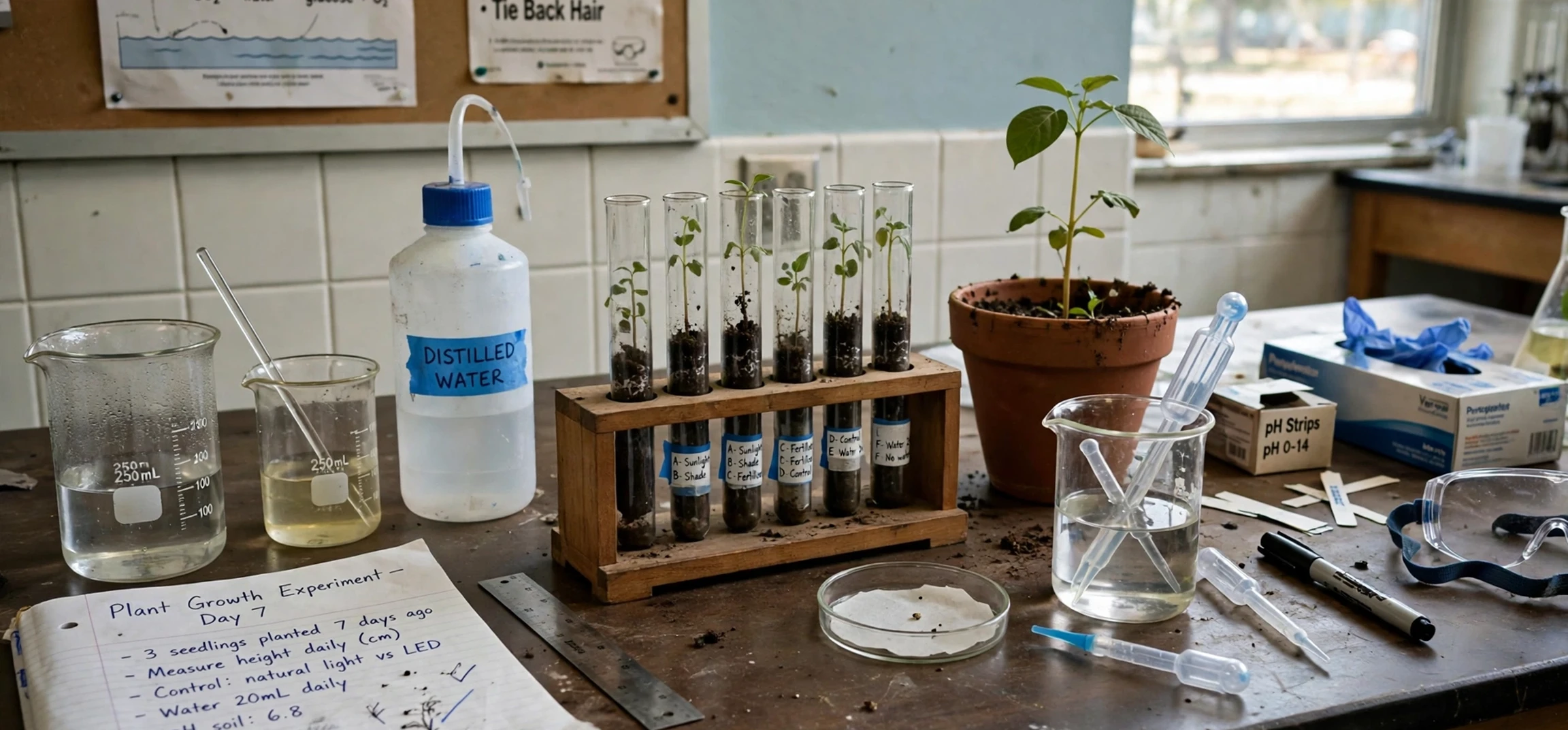
If you searched for “variables in biology”, you are asking about one of the most important ideas in scientific investigation: the factors that can change in an experiment, and how scientists control, measure, and interpret them. In biology, a variable is anything that can take different values or forms, such as temperature, light intensity, the amount of water given to a plant, or the concentration of a substance. Understanding variables in biology is essential for designing fair experiments, reading research honestly, and telling the difference between a result that proves something and a result that merely suggests it.
Biology studies living things, and living things are complicated. A plant’s growth depends on light, water, soil, temperature, and its own genetics, all at once. An animal’s behaviour depends on age, health, environment, and experience. If a scientist changes several things at the same time, it becomes impossible to know which change caused the result. That is why the language of variables exists: it gives investigators a disciplined way to change one thing, keep the rest steady, and measure what happens. This guide explains the main types of variables, shows how they work in real biological examples, and explains the common mistakes that make experiments unreliable.
Variables in Biology: The Three Main Types
Most school and university biology courses teach three main types of variable, and they form the backbone of experimental design. The independent variable is the factor that the investigator deliberately changes. The dependent variable is the factor that is measured to see whether it changes in response. Controlled variables, sometimes called control variables, are the factors that are kept the same throughout the experiment so that they do not confuse the result. A clear experiment names all three before it begins.
Consider a simple plant experiment. A student wants to know whether light intensity affects the growth of seedlings. The independent variable is light intensity, because that is what the student changes, for example by placing seedlings at different distances from a lamp or by using lamps of different brightness. The dependent variable is growth, measured perhaps as the height of the seedlings after two weeks, or as the number of leaves. Controlled variables include the type of seed, the amount of water, the type of soil, the temperature of the room, and the length of time the plants are grown. If any of those controlled variables differed between groups, the student could not be sure whether light or something else caused any difference in growth.
Another example comes from studying the effect of temperature on an enzyme. Enzymes are biological catalysts, and their activity often changes with temperature. Here, the independent variable is temperature, set by the investigator using water baths at different temperatures. The dependent variable might be the time taken for a reaction to complete, or the amount of product formed in a fixed time. Controlled variables include the concentration of the enzyme and its substrate, the pH of the solution, and the volume used. Without those controls, a faster reaction at a higher temperature could be due to more enzyme rather than temperature at all.
Variables in Biology: Other Kinds You Will Meet
Beyond the three main types, biology students meet several other distinctions that help describe experiments more precisely. A continuous variable can take any value within a range, such as height, mass, temperature, or time. A discrete variable, also called a categorical variable in some contexts, takes only separate categories or whole numbers, such as the number of petals on a flower, blood group, or eye colour. A categoric variable names groups rather than measurements, such as the type of soil or the species being studied. Knowing which kind of variable you are dealing with matters, because it affects how results should be displayed: continuous data suit line graphs, while categoric data suit bar charts.
Two further ideas are worth understanding. A confounding variable is an unwanted factor that varies alongside the independent variable and could explain the result instead. For example, if seedlings near a window receive both more light and more warmth, warmth is a confounding variable, because it is impossible to separate its effect from that of light. An extraneous variable is any other factor that could affect the dependent variable but is not the focus of the study. Good experimental design tries to control extraneous variables and eliminate confounding variables, often by randomisation, replication, or careful standardisation.
Replication is closely linked to variables. Repeating an experiment, or using many individuals in each group, helps to show that a result is not a fluke caused by one unusual plant, animal, or sample. If only one seedling is grown in each light condition, a single unhealthy seed could distort the whole conclusion. Using several seedlings in each condition, and averaging their growth, gives a more trustworthy picture. Sample size, therefore, is not a technical detail; it is part of handling variables responsibly.
Variables in Biology: Worked Examples
Worked examples make the abstract language concrete. Imagine an investigation into whether exercise affects heart rate. The independent variable is the level of exercise, for example resting compared with walking and running. The dependent variable is heart rate, measured in beats per minute. Controlled variables include the age and fitness of the participants, the time of day, the room temperature, and the method of measuring heart rate. Even the time allowed for recovery between measurements should be standardised, or earlier exercise could affect later readings.
Consider also a field study, where control is harder. A biologist studying how grazing affects wildflower diversity in a meadow cannot control the weather or the soil across the whole site. Instead, they might compare grazed and ungrazed plots that are as similar as possible in soil, slope, and aspect, and record those factors as carefully as they can. In field biology, variables are often observed rather than manipulated, and the investigator’s skill lies in recording them honestly and accounting for them in the analysis, rather than pretending they do not exist.
In microbiology, variables appear in growth experiments. A researcher testing whether a disinfectant inhibits bacterial growth might vary the concentration of the disinfectant as the independent variable, and measure the diameter of the clear zone around a disc on an agar plate as the dependent variable. Controlled variables include the bacterial species and strain, the incubation temperature and time, the volume of disinfectant, and the type of agar. A change in any of those could alter the result, so each is written into the method.
For readers who enjoy clear explanations of scientific ideas, our guide to what a blood test result means shows how measured values are interpreted in a health context, and our article on a mathematical term explained in plain English illustrates how precise definitions matter across science and mathematics alike.
| Variable Type | Role in the Experiment | Biology Example |
|---|---|---|
| Independent variable | Changed deliberately by the investigator | Light intensity for seedlings |
| Dependent variable | Measured to see the effect | Seedling height after two weeks |
| Controlled variable | Kept the same throughout | Water volume, soil type, temperature |
| Continuous variable | Can take any value in a range | Height, mass, temperature |
| Discrete or categoric variable | Takes categories or whole numbers | Number of petals, blood group |
| Confounding variable | Unwanted factor that could explain the result | Extra warmth near a sunny window |
Common Mistakes With Variables in Biology
The most common mistake is changing more than one independent variable at a time. A student who gives one group of plants more light, more water, and better soil, and then reports faster growth, has not shown that light caused the growth. Any of the three changes, or their combination, could be responsible. The remedy is simple in principle, even if it requires patience in practice: change one factor, keep the rest constant, and repeat the experiment for each factor you wish to test.
A second mistake is measuring the dependent variable inconsistently. If plant height is measured from the soil in one group and from the pot rim in another, the comparison is meaningless. If heart rate is counted for fifteen seconds in one trial and for a full minute in another, the numbers cannot be compared directly. Standardising the measurement method, and writing it down, is as important as controlling the experimental conditions.
A third mistake is confusing correlation with causation. If two variables change together, it does not automatically follow that one caused the other. For example, ice cream sales and sunburn cases both rise in summer, but neither causes the other; both are linked to warm, sunny weather. In biology, this trap appears whenever an observational study finds an association. A careful scientist reports the association, considers alternative explanations, and designs a controlled experiment before claiming a causal link.
A fourth mistake is ignoring variables that cannot be fully controlled. In studies of people or wild animals, genetics, diet, prior experience, and environment all vary. Pretending that these factors do not matter makes a study look cleaner than it is. Honest research names the uncontrolled variables, discusses how they might have affected the result, and treats conclusions as provisional rather than absolute. That honesty is a strength, not a weakness, and it is what separates good science from overclaiming.
Frequently Asked Questions About Variables in Biology
What is the difference between independent and dependent variables?
The independent variable is what you change. The dependent variable is what you measure. A useful memory aid is that the dependent variable depends on the independent variable.
Can an experiment have more than one independent variable?
Advanced experiments can, but they require careful design and analysis to separate the effects of each factor. For school and introductory work, one independent variable at a time is the safest rule.
What is a control group?
A control group is a group that does not receive the experimental treatment, or receives a standard treatment, so that results can be compared against a baseline. It is related to controlled variables, but it is not the same thing: controlled variables are factors kept constant, while a control group is a comparison group.
Are variables only relevant in experiments?
No. Variables also matter in observational studies, surveys, and fieldwork, where they are recorded and analysed rather than manipulated. The same language helps researchers describe what varied and what was accounted for.
How do variables affect graphs?
By convention, the independent variable is plotted on the horizontal axis and the dependent variable on the vertical axis. Following this convention makes graphs easier to read and compare.
Conclusion
Variables in biology are the language that turns a curious question into a testable investigation. The independent variable is changed, the dependent variable is measured, and controlled variables are held steady so that the result can be trusted. Continuous and categoric variables describe different kinds of data, while confounding and extraneous variables remind investigators of the factors they must watch. Whether you are designing a classroom plant experiment, reading a health study in the news, or planning fieldwork, asking “what was changed, what was measured, and what was kept the same?” will help you judge the evidence fairly. For a related science explainer, see our guide to a medical abbreviation explained in plain English.



