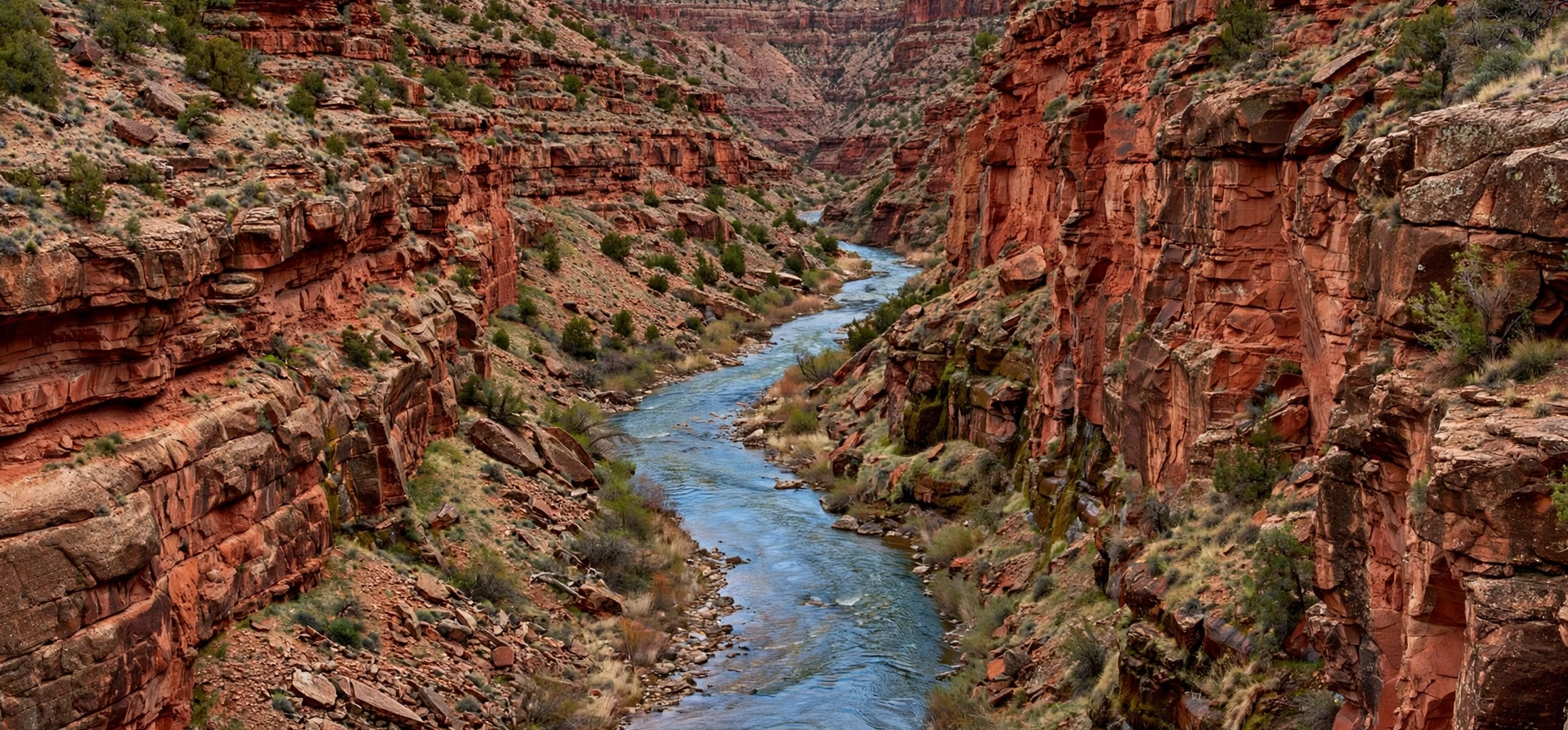
The definition of a canyon is a deep, narrow valley with steep sides, usually carved by a river cutting downward through rock over a very long time. When people ask for the definition of a canyon, they are usually picturing a dramatic gorge with towering walls, a river far below, and layers of coloured rock exposed like pages in a history book. That picture is accurate, but it is only part of the story. Canyons vary enormously in size, shape, climate, and age. Some are wide enough to hold a town, while others are so narrow that you can touch both walls at once. Some were carved by powerful rivers, while others were shaped by rain, wind, ice, and the slow uplift of the land itself. Understanding what makes a valley a canyon, rather than just any dip in the landscape, helps you read maps, plan hikes, and make sense of some of the most spectacular scenery on Earth.
A canyon is not simply a low place between hills. The defining features are depth, steepness, and a clear sense of enclosure. The walls rise sharply from the valley floor, often in cliffs or a series of rocky steps, and the floor itself is much narrower than the distance from rim to rim. In many cases a river still flows along the bottom, continuing the work that created the canyon in the first place. In others, the river has dried up, changed course, or been dammed, leaving a dry canyon that still shows the unmistakable signature of water erosion. Geologists also distinguish canyons from related landforms such as gorges, ravines, and valleys. A gorge is often used as a near synonym, though it tends to be smaller and narrower. A ravine is smaller still, often formed by a stream. A broad valley, by contrast, has gentle slopes and a wide floor shaped by many processes over time. A canyon sits at the dramatic end of that spectrum: deep, steep, and carved with unusual force.
What the definition of a canyon Means in Plain Language
In plain language, the definition of a canyon comes down to three tests. First, is it deep compared with its width? Second, are its sides steep, rocky, or cliff-like rather than gently rolling? Third, was it mainly carved downward by erosion, especially by flowing water? If the answer to all three is yes, you are almost certainly looking at a canyon. This simple test is useful because it separates true canyons from other valleys that merely look impressive in photographs. A wide river valley with farms on its floor and wooded hills on either side may be beautiful, but it is not a canyon. A slot canyon, on the other hand, may be only a few metres wide yet hundreds of metres deep, and it qualifies easily because its walls are near-vertical and its depth is extreme relative to its width.
The word itself comes from the Spanish word cañón, meaning a tube or pipe, which captures the enclosed, channel-like character of these landforms. Early Spanish explorers in the Americas used the term for the deep river gorges they encountered, and English adopted it for similar features worldwide. Today the term is used by geographers everywhere, from the canyon systems of the American West to the gorges of Africa, Asia, Australia, and Europe. Local names vary — gorge, ravine, barranca, wadi, and kloof can all describe similar features — but canyon remains the standard term in geography for a deep, steep-sided valley cut by erosion.
definition of a canyon: How Canyons Form, Step by Step
Most canyons begin with a river flowing over land that is slowly rising. As tectonic forces lift a plateau or mountain region, the river must cut downward to maintain its course to the sea. This process, called downcutting, is slow but relentless. Over millions of years, a river can saw through hundreds of metres of rock, especially when it carries sand and gravel that act like sandpaper on the channel bed. Floods accelerate the work, because fast, sediment-laden water has far more erosive power than a gentle stream. The result is a channel that deepens faster than the surrounding slopes can wear away, leaving steep walls behind.
Rock type matters enormously. Hard, resistant layers form cliffs, while softer layers erode into slopes, ledges, and benches. That is why many canyon walls look stepped rather than smooth: each step marks a different rock layer with a different resistance to erosion. Cracks and joints in the rock also guide erosion, allowing water to pry blocks loose and widen the canyon in places. Weathering plays a supporting role. Freeze-thaw cycles split rock, rain dissolves certain minerals, and wind-blown sand polishes exposed surfaces. Gravity then does the rest, pulling loosened blocks down to the canyon floor in rockfalls and landslides, where the river eventually carries the debris away.
Why Some Canyons Are Narrow and Others Are Wide
Narrow slot canyons usually form in uniform, relatively soft rock such as sandstone, where a flash flood can scour a deep, tight channel in a short geological time. Wide canyons, by contrast, often form where the river has had longer to work, where side streams and slope erosion have widened the valley, or where the rock layers vary so that softer beds collapse outward. Climate matters too. In arid regions, sparse vegetation leaves slopes exposed, and rare but violent floods do most of the carving. In wetter regions, vegetation stabilises slopes and rivers may meander, producing broader valleys instead. The Grand Canyon, for example, is both deep and wide because the Colorado River has cut downward for millions of years while weathering and tributary streams have steadily widened its upper reaches.
Rivers, Uplift, and Time
Without uplift, a river tends to meander across a plain and deposit sediment rather than cut a deep canyon. Without a river, uplift alone produces mountains, not canyons. It is the combination — land rising while a river keeps cutting down — that creates the classic canyon. Time is the third ingredient. A canyon that looks timeless to a visitor may be only a few million years old in geological terms, which is young compared with the ancient rocks exposed in its walls. Those walls are a record in themselves: the lowest layers are usually the oldest, and fossils, ancient river deposits, and volcanic ash layers within them allow geologists to reconstruct landscapes that vanished long before humans appeared.
Types of Canyons You May Encounter
Not all canyons look alike, and recognising the main types makes travel and study much more rewarding. River canyons are the most familiar, carved by a perennial river that still flows at the bottom. Slot canyons are a dramatic subtype: extremely narrow, winding passages carved by flash floods, often only wide enough for one person, with smooth, sculpted walls and shafts of light from above. Submarine canyons are their underwater cousins, cut into continental slopes by turbidity currents — dense flows of sediment and water that rush downslope like underwater avalanches. Box canyons have steep walls on three sides and only one entrance, a shape that once made them useful as natural corrals. Dry canyons, sometimes called arroyos in the American Southwest, carry water only after rain but retain the steep walls and flat floors of their wetter past.
Some canyons are defined by what carved them besides rivers. Glacial valleys can resemble canyons, though they are usually U-shaped rather than V-shaped, because ice scours broadly instead of cutting a narrow channel. Volcanic canyons may form when lava flows dam a river, or when explosive eruptions carve channels that later rivers deepen. Whatever the agent, the result must still pass the basic test: deep, steep-sided, and carved downward into the landscape. Learning these distinctions helps you avoid a common mistake — calling every steep valley a canyon — and sharpens your eye for the processes that shaped the ground beneath your feet.
| Type of canyon | How it forms | What it looks like |
|---|---|---|
| River canyon | A river cuts downward as land rises | Deep valley with a river at the bottom |
| Slot canyon | Flash floods scour soft sandstone | Very narrow, winding, smooth-walled passage |
| Box canyon | Erosion leaves walls on three sides | Dead-end valley with one entrance |
| Submarine canyon | Sediment flows cut the continental slope | Deep channel on the ocean floor |
| Dry canyon or arroyo | Intermittent floods carve an arid valley | Steep walls with a dry, flat floor |
Famous Canyons Around the World
The Grand Canyon in Arizona is the most famous example, and for good reason: it is up to 29 kilometres wide, about 446 kilometres long, and more than 1,800 metres deep in places, exposing nearly two billion years of rock history. The Fish River Canyon in Namibia, the Yarlung Tsangpo Grand Canyon in Tibet, the Colca Canyon in Peru, and the Blue Mountains canyons of Australia each tell a different story about rivers, uplift, and climate. Some are deeper than the Grand Canyon; others are narrower, greener, or more remote. What they share is the unmistakable canyon form: a landscape cut open so that visitors can walk, in a single day, through layers of time that would otherwise remain buried.
Canyons also matter far beyond scenery. They are reservoirs of biodiversity, sheltering plants and animals adapted to shade, seepage, and microclimates that do not exist on the exposed plateau above. They preserve archaeological sites, from cliff dwellings to rock art, protected for centuries by their inaccessibility. They shape human settlement too: rivers at canyon bottoms provide water and transport, while rims offer viewpoints, farmland, and defensive positions. For a deeper look at how rivers shape landscapes, see this guide to river country and its fishing guides, and for a mountain landscape shaped by uplift and erosion, see this note on a town near Steens Mountain. Both show, in different settings, how water and rock interact over time.
Visiting and Studying Canyons Safely
If you visit a canyon, preparation matters more than fitness alone. Temperatures at the rim and the floor can differ sharply, shade is scarce, and the climb back out is always harder than the descent. Carry more water than you think you need, check flash-flood forecasts before entering any slot canyon, and never enter a narrow canyon when rain is forecast upstream, even if the sky above you is clear. Stay on marked trails, keep a safe distance from edges, and remember that rockfalls are a real hazard, especially after rain or freeze-thaw weather. For learners, a canyon visit is a field lesson in geology: look for the stepped walls, note where the rock colour changes, and try to spot the river terraces — flat benches above the present river — that mark where the river flowed in the past.
Canyon Vocabulary Worth Knowing
A few terms make canyon descriptions much easier to follow. The rim is the top edge of the canyon. The inner gorge is the steepest, deepest section near the river. A tributary canyon is a smaller side canyon joining the main one. A mesa is a flat-topped hill left standing when erosion wears away the surrounding rock, while a butte is a smaller, isolated version of the same feature. Knowing these words turns a scenic overlook into a readable landscape: you can point to a butte, trace a tributary, and understand why one wall is a sheer cliff while the opposite slope is a staircase of ledges.
Frequently Asked Questions About Canyons
What is the simplest definition of a canyon?
A canyon is a deep, narrow valley with steep sides, usually carved by a river cutting down through rock over a long period. Depth, steepness, and downward erosion are the three features that set it apart from an ordinary valley.
How long does it take for a canyon to form?
Most large canyons take millions of years to form, because rivers cut downward only a fraction of a millimetre per year on average. Slot canyons in soft rock can form much faster, especially where flash floods repeatedly scour the same channel.
Are gorge and canyon the same thing?
The words overlap heavily and are often used interchangeably. In general, a gorge tends to be smaller and narrower than a canyon, but there is no sharp scientific boundary between them, and local usage varies from place to place.
Can a canyon exist without a river?
Yes. Many canyons are dry for most of the year, carrying water only after rain, and submarine canyons on the ocean floor are carved by sediment flows rather than rivers. In every case, though, downward erosion by a flowing agent was the main shaping force.
Conclusion
The definition of a canyon is simple to state and endlessly rewarding to explore: a deep, steep-sided valley carved downward, usually by a river, through rock over immense spans of time. From slot canyons you can walk through in an afternoon to systems so vast they contain their own weather, canyons reveal how patiently water, uplift, and time can reshape a continent. Next time you stand on a rim and look down at a river glinting far below, you will know what you are seeing — not just a beautiful view, but a work in progress, still being carved one flood, one grain of sand, and one rockfall at a time.



