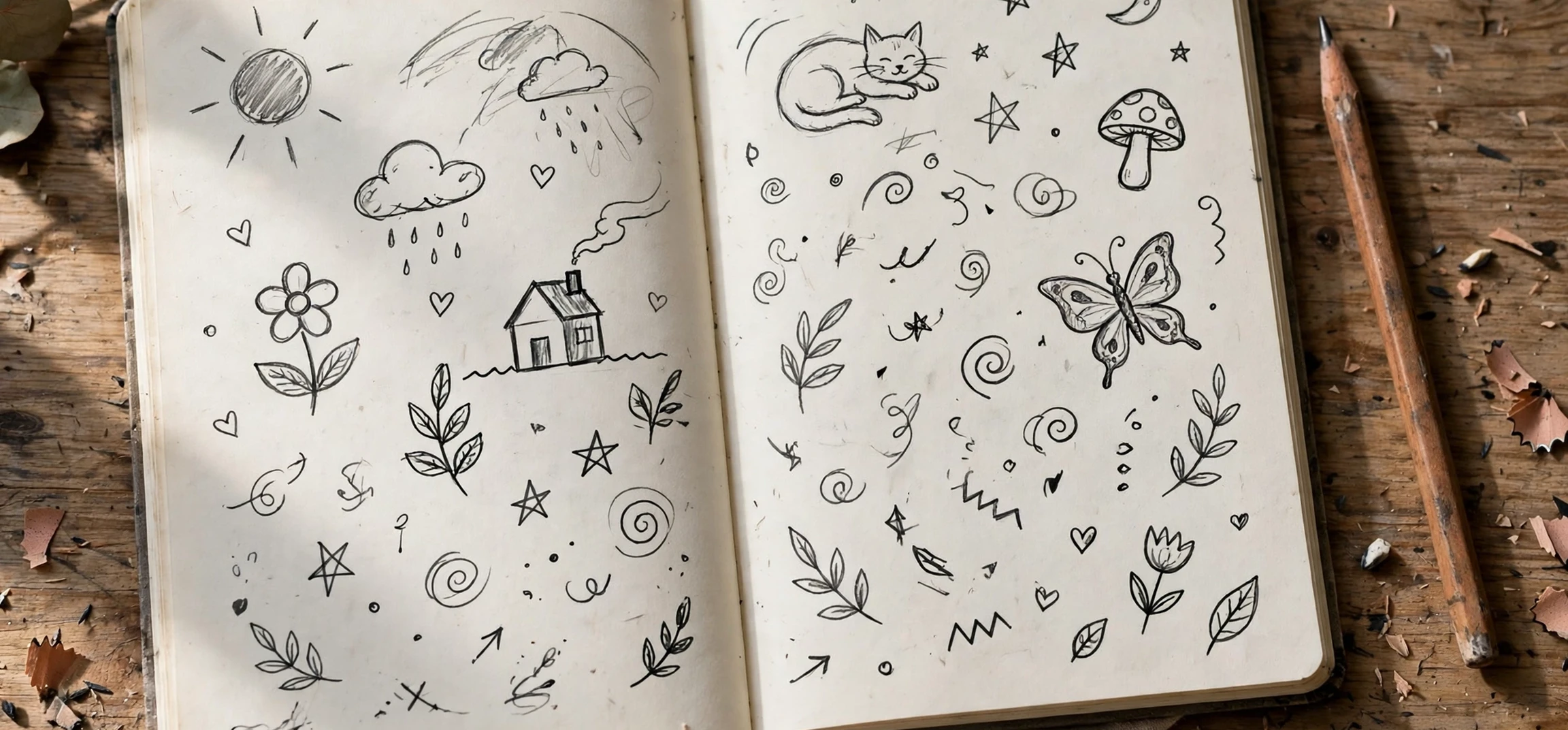
When people ask about doodling meaning, they usually mean one of two things: what the word doodling itself means, and what the little drawings people make in margins might reveal about them. The short answer to the first question is simple. Doodling meaning begins with the verb to doodle, which means to draw or scribble idly, often while your attention is partly elsewhere, during a phone call, a lecture, or a long meeting. The drawings are usually spontaneous, unfinished, and made without any plan to exhibit them. This guide covers the definition, the history of the word, the psychology researchers have actually studied, and the many everyday uses of doodling, from classrooms to design studios, without overstating what a scribble can prove about a person.
The word behind doodling meaning has a winding history. Doodle was once a term for a fool or a simpleton, and it survives in the song Yankee Doodle, where the joke originally ran in the opposite direction to modern American pride in it. By the twentieth century, the verb had settled into its current sense of idle drawing, and the noun a doodle came to mean the drawing itself. That shift matters, because it shows how a word for foolishness became a word for something most people do without thinking twice. Nobody calls a meeting-room flower sketch foolish today; it is simply what hands do while minds are busy elsewhere.
Doodling Meaning in Plain English
In plain English, the doodling meaning is drawing without a destination. Unlike sketching for a finished artwork, doodling has no audience in mind and no standard of success. The marks may be geometric patterns, spirals, boxes, arrows, stars, faces, names written in fancy lettering, or half-finished creatures that trail off when attention returns to the conversation. The hand moves on a kind of autopilot, and the result is often repetitive, because repetition is soothing and requires little decision-making. That low-stakes quality is exactly the point: the drawer is not trying to produce art, and the absence of pressure is what lets the habit flourish.
It is also worth distinguishing doodling meaning from its neighbours. Sketching usually aims at observation or a future finished piece. Zentangle and similar structured methods use deliberate, patterned drawing as a mindful activity, with named techniques and a finished tile as the goal. Mind mapping uses drawings and words to organise ideas on purpose. Doodling overlaps with all of these, but its defining feature is idleness: it happens alongside something else, not instead of it. When a designer deliberately fills a page with pattern ideas for a client, that is closer to sketching; when the same designer fills the margin of a meeting agenda with spirals, that is doodling.
What Counts as a Doodle
Almost any spontaneous mark counts toward doodling meaning, and that breadth is part of the charm. Repeated shapes such as cubes, grids, and waves are common, as are arrows, underlining, and words rewritten in different styles. Faces, eyes, and stick figures appear frequently, as do flowers, suns, and hearts. Some people doodle only in the margins of notebooks, while others cover whole pages during calls. Digital doodling has added a new home for the habit: stylus notes, tablet sketch apps, and the whiteboard feature in video calls all collect the same idle marks, now in pixels instead of ink. The medium changed; the impulse did not.
| Type of doodle | What it often looks like | Where you see it |
|---|---|---|
| Geometric | Spirals, grids, cubes, waves, concentric shapes | Meeting notes, lecture margins |
| Figurative | Faces, eyes, animals, stick people | Phone-call notepads, journals |
| Lettering | Names, words in bubble or block letters | School books, planners, posters |
| Abstract flow | Loops, vines, shading, cross-hatching | Sketchbooks, tablet notes, whiteboards |
Doodling Meaning in Psychology
Psychologists have studied doodling meaning most seriously as a question about attention, not personality. The best-known finding comes from a 2009 experiment in which participants who doodled while listening to a dull recorded message remembered more of the details afterwards than participants who simply listened. The researchers suggested that doodling may help maintain arousal during boring tasks, preventing the mind from drifting further away, rather than distracting from the task as teachers often assumed. Later studies have been more mixed, with some finding benefits for recall and focus and others finding no effect or a small cost, depending on the task and how the doodling was defined. The honest summary is that doodling seems to help some people stay with tedious listening tasks, but it is not a proven memory technique, and it will not rescue attention during work that genuinely requires full concentration.
The personality claims around doodling meaning are where caution is most needed. Popular books and websites assign fixed meanings to doodle content: stars mean ambition, arrows mean direction, eyes mean watchfulness, and so on. These interpretations are entertaining, but they rest on very little controlled evidence, and the same symbol can mean different things to different people, in different cultures, and at different moments. A spiral drawn by an anxious person and a spiral drawn by a bored person look identical, and no responsible psychologist would diagnose either from the page alone. Treat doodle symbolism as a parlour game, not a test. If a drawing habit ever reflects real distress, the useful response is a conversation with the person, not an interpretation of their margins.
Why People Doodle: The Doodling Meaning in Daily Life
People doodle for reasons that are mostly practical and mostly harmless. Boredom is the classic trigger: the hand seeks occupation while the mind waits. Stress and restlessness are close behind; repetitive marks give nervous energy somewhere to go, much like tapping a pen or pacing, but quieter. Some people doodle to think, finding that a low-demand hand activity lets ideas settle without the pressure of staring at a blank page. Others doodle to listen, using the movement to anchor themselves to a speaker’s voice. Artists and designers doodle to warm up, loosening the hand before serious work, the way a musician plays scales before a performance.
There is also a social dimension to doodling meaning that is easy to miss. In shared notebooks and meeting rooms, doodles become small, deniable acts of personality: a joke only the drawer notices, a private reaction to a dull agenda, a tiny rebellion against a formal document. Colleagues sometimes recognise each other’s margin styles, and a familiar doodle on a shared page can feel like a signature. That social life is part of why doodling persists in workplaces that officially discourage it. Banning the habit rarely stops it; it only moves it to a less visible page.
Doodling in Learning and Work
Teachers and managers have gradually softened their view of doodling meaning, and the research on attention is one reason, but the practical benefits matter too. Allowing doodling during long listening sessions can reduce fidgeting and phone-checking, both of which are more disruptive than a quiet pen. In brainstorming, quick doodles let people externalise half-formed ideas without committing to polished drawings, which lowers the barrier to contributing. In design and product work, rough doodles are often the first draft of an icon, a logo mark, or a layout, and several well-known brands began as margin sketches before they were refined by professionals. The path from idle mark to finished design is real, even if most doodles never travel it.
For students, the useful version of doodling meaning is structured rather than random. Annotating notes with small diagrams, arrows showing cause and effect, and simple icons for key ideas combines the calming repetition of doodling with genuine study value. Drawing a quick cycle, timeline, or labelled sketch forces the drawer to decide what matters, which is a form of active learning. Purely decorative doodling during a lecture may still help some students listen, as the attention research suggests, but it is the annotated kind that reliably supports revision afterwards. Readers interested in how word meanings are explained elsewhere on this site may enjoy our guides to name meanings and rhetorical terms, which take the same plain-language approach.
Doodling as Art and Culture
The doodling meaning has also grown into a recognised art form in its own right. The most visible example is the search-engine doodle, the playful variation of a company logo that marks holidays, anniversaries, and notable birthdays, which turned a private habit into a public art format seen by millions. Independent artists build whole careers from doodle-style illustration, with dense, playful linework covering posters, products, and murals. Social media has accelerated this, since a style that looks spontaneous and approachable photographs well and invites imitation. The boundary between doodle and illustration is therefore a matter of intent and finish, not of style: the same wobbly line can be an idle mark in a notebook or a deliberate choice in a gallery piece.
Culture has also given the doodling meaning a second life as a word. Dog breeders use doodle as a suffix for poodle crosses, such as the labradoodle and the goldendoodle, a usage that has nothing to do with drawing but everything to do with a friendly, informal sound. Software and games use doodle for casual drawing tools and titles. These offshoots can confuse searchers, which is why context matters: a page about doodling meaning in art and psychology is a different destination from a page about a breed of dog, even though both use the same cheerful word.
Frequently Asked Questions About Doodling
Does doodling mean you are not paying attention? Not necessarily. Research suggests it can help some people stay focused during dull listening tasks, though it is no substitute for attention during demanding work.
Can doodles reveal personality? No reliable test says so. Popular symbol dictionaries are entertainment, and the same drawing can have many explanations.
Is doodling good for children? Generally yes, as a low-pressure creative habit, especially when combined with drawing what they are learning. It supports fine motor control and confidence, since there is no wrong result.
How can I doodle more deliberately? Keep a small notebook for idle drawing, try repeating one shape until it feels automatic, and occasionally pick a favourite doodle to develop into a finished illustration.
Conclusion
The doodling meaning that matters most is the simple one: drawing idly while attention is partly elsewhere, without plan, audience, or judgement. Around that definition sits a more interesting story about attention, stress, learning, and art, in which doodling sometimes helps focus, often relieves restlessness, and occasionally becomes the seed of a finished design. What it does not do, on current evidence, is disclose a hidden personality from the margin of a notebook. Enjoy the habit for what it is: a small, human, and surprisingly useful way for busy hands to keep busy minds company.



