To explain 20/30 vision in plain English, start with the number itself: it is a way of describing how clearly a person can see detail at a distance, compared with a standard reference. In the Snellen system, the first number is the testing distance, usually 20 feet, and the second number is the distance at which a person with standard vision could read the same line. So 20/30 vision means that you need to be 20 feet away from something to read clearly what a person with standard vision could read from 30 feet away. It does not mean that your eyesight is 30 per cent worse, nor does it mean that you see only two-thirds of the world. It is simply a shorthand for a particular level of distance sharpness, and it is best understood as one measurement among many, not as a complete verdict on your eyes.
Many people search for this phrase after an eye test, a school screening, or a routine check, and they leave with a number but very little explanation. That is understandable, because eye charts look simple while the ideas behind them are not always explained well. This guide aims to explain 20/30 vision clearly, without diagnosing anyone or suggesting what any individual should do about a result. It covers what the fraction means, how it compares with 20/20 vision, why small differences matter more in some situations than others, and what usually happens at an eye examination. If you have concerns about your own sight, the sensible next step is to book an eye test and talk to a qualified optometrist, who can assess your eyes in person and explain your own results in context.
Explain 20/30 Vision: The Basics of the Snellen Fraction
When we explain 20/30 vision, the most important point is that the fraction compares two distances. The top number, 20, is where you stand. The bottom number, 30, is where a person with standard distance vision would stand to read the same letters. A larger bottom number means the letters must be larger, or closer, for you to read them. That is why 20/40 vision is less sharp at distance than 20/30 vision, while 20/25 vision is sharper than 20/30 vision. The scale is not a percentage, and it is not a school grade. It is a practical comparison based on letter size on a chart.
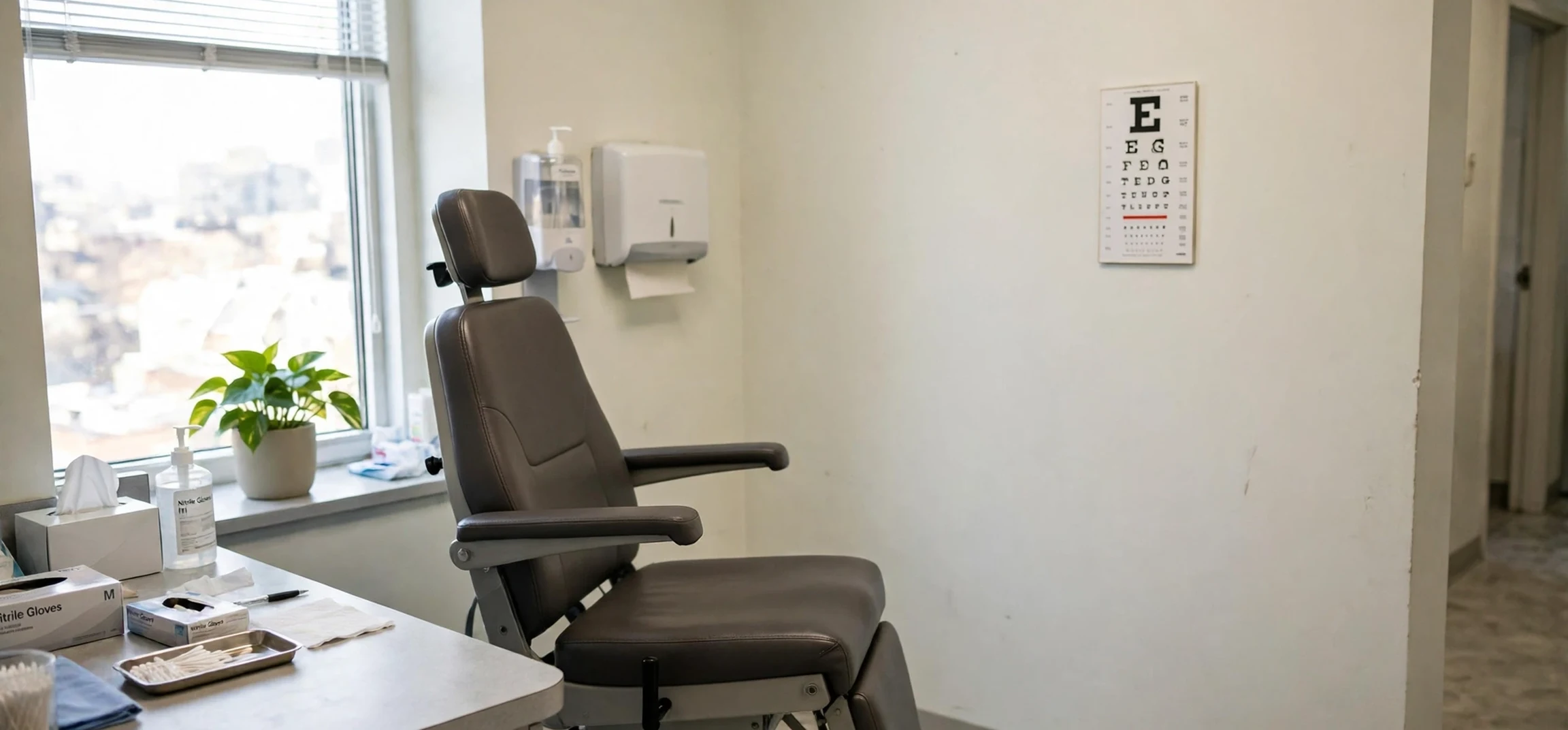
Charts are designed so that each line represents a different letter size. The familiar chart with a large letter at the top and progressively smaller letters below is called a Snellen chart. During a test, you are usually asked to read letters with one eye covered, then the other, and then both eyes together. The smallest line you can read reliably gives your result for that eye. Results can differ between eyes, and they can differ with and without glasses or contact lenses. That is why a result is normally recorded per eye, and why a single phrase such as 20/30 vision should not be treated as a full description of how someone sees in everyday life.
It is also worth remembering that distance sharpness is only one part of vision. Colour perception, peripheral vision, depth perception, focusing at near distances, eye movement, and how comfortably your eyes work together all matter too. A person can have 20/30 vision and still read a book comfortably, recognise faces across a room, and manage most daily tasks without difficulty. Another person with the same measurement might notice more difficulty in specific situations, such as reading distant road signs, watching a presentation from the back of a room, or seeing clearly in low light. Context matters, and that is another reason why general information cannot replace an individual assessment.
What the numbers do not mean
One common misunderstanding is to treat 20/30 vision as a score out of some total. It is not. There is no 100 in this system, and you cannot convert the fraction into a percentage by simple division in any meaningful way. Another misunderstanding is to assume that 20/30 vision automatically means glasses are required. Whether correction is helpful depends on your symptoms, your daily tasks, your other measurements, and the professional judgement of the person examining you. Some people with this level of distance sharpness are offered glasses for specific tasks, such as driving or classroom work, while others are simply advised to have regular checks. General guides cannot make that call.
A third misunderstanding is to think that a small change on the chart means a dramatic change in life. Moving from 20/20 to 20/30 vision is a modest step on the chart. For many people it is barely noticeable in a familiar room, and it becomes more noticeable only when detail is small and far away. That is why people sometimes first notice a change when they struggle with subtitles on a distant television, a departure board at a station, or a number plate at a distance. Again, noticing a change is a good reason to book an eye test, not a reason to worry in advance about what the outcome will be.
Explain 20/30 Vision Compared With 20/20 and Other Levels
To explain 20/30 vision properly, it helps to compare it with neighbouring levels. The reference level, 20/20 vision, means that you can read at 20 feet what a person with standard vision can read at 20 feet. It is often described as normal vision, but that phrase can be misleading. It does not mean perfect vision, and it does not mean that no other visual issue exists. It simply means that distance sharpness meets the standard reference. Some people see better than 20/20 vision, for example 20/15 vision, which means they can read at 20 feet what a person with standard vision would need to be 15 feet away to read.
By contrast, 20/30 vision sits just below the reference level. It is sharper than 20/40 vision, which is a threshold used in many driving standards, and it is less sharp than 20/25 vision. In many everyday settings, the difference between 20/20 and 20/30 vision is subtle. Letters on a chart are crisp, high-contrast symbols in good lighting, whereas real life involves varied lighting, movement, glare, and lower contrast. That is why a chart result is a useful starting point, but not a complete picture of functional vision. If you want to understand your own result, ask the optometrist to explain what it means for the activities that matter to you, such as reading, working on a screen, driving, or playing sport.
| Snellen result | Plain-English meaning | How it compares with 20/30 vision |
|---|---|---|
| 20/15 vision | Sharper than the standard reference at distance | Sharper than 20/30 vision |
| 20/20 vision | Meets the standard reference at distance | Sharper than 20/30 vision |
| 20/25 vision | Slightly below the standard reference | Sharper than 20/30 vision |
| 20/30 vision | Reads at 20 feet what standard vision reads at 30 feet | The level explained in this guide |
| 20/40 vision | Reads at 20 feet what standard vision reads at 40 feet | Less sharp than 20/30 vision |
| 20/60 vision | Reads at 20 feet what standard vision reads at 60 feet | Noticeably less sharp than 20/30 vision |
The table above is a general educational summary, not a diagnostic tool. Different countries and different clinics may use metres rather than feet, for example 6/9 vision in the metric system is roughly equivalent to 20/30 vision, because 6 metres is approximately 20 feet and 9 metres is approximately 30 feet. If your record uses metric notation, your optometrist can translate it for you. The underlying idea is the same: a comparison of distances for reading the same sized detail.
Explain 20/30 Vision: Why Results Can Vary From Day to Day
Eye test results are not fixed like a height measurement. Tiredness, dry eyes, lighting, concentration, and even how familiar you are with the chart can influence a result slightly. A person might read one line better on a good day than on a day when their eyes feel strained after long screen use. That does not mean the test is unreliable, but it does mean that small differences should be interpreted with care. Clinicians therefore look at patterns over time, repeat measurements where needed, and consider other tests alongside the chart.
Refractive error is the usual reason for a distance result below 20/20 vision. In simple terms, this means the eye does not focus light precisely on the retina without help. Nearsightedness, farsightedness, and astigmatism are common forms of refractive error, and they are routinely assessed during an eye examination. This guide does not diagnose any of these conditions, and it does not suggest that any particular result means you have one of them. Only an in-person examination, including a refraction and a health check of the eyes, can establish what is happening for an individual.
Age also plays a role in how vision changes. Children, adults, and older adults have different visual needs, and focusing at near distances often becomes harder with age, even when distance vision remains good. That near-focusing change is separate from a distance measurement such as 20/30 vision, although both can be present at the same time. Again, the practical message is simple: if you notice changes, if reading or distance tasks feel harder, or if you have not had a check for a while, book an eye test and discuss your concerns with an optometrist.
What 20/30 Vision Can Mean in Everyday Life
In everyday life, 20/30 vision often means that most tasks remain comfortable, while fine detail at a distance requires a little more effort. You might still enjoy television, conversation, cooking, walking, and reading, but find that distant signs, small print on a faraway board, or the details of a presentation are less crisp. Some people compensate naturally by moving closer, increasing text size, improving lighting, or taking breaks from screens. Those habits can help comfort, but they are not a substitute for professional advice if you have persistent difficulty.
Driving is one area where people rightly ask careful questions. Driving standards vary by country and region, and they usually involve more than a single Snellen number, including visual field and other requirements. This guide does not state whether any particular result meets a driving standard, because standards differ and individual circumstances differ. If driving is part of your life, raise the question directly with your optometrist and, where relevant, with the licensing authority in your area. They can give advice based on your full assessment, not on a single number read online.
For children, a result such as 20/30 vision is often discussed with parents in terms of classroom seating, reading, and whether follow-up is needed. For adults, it is often discussed in terms of work tasks and screen use. In both cases, the conversation matters more than the number alone. A good eye examination should leave you understanding what was measured, what it means for you, and when to return. If you leave an appointment confused, it is perfectly reasonable to ask for a simpler explanation, or to contact the practice afterwards for clarification.
Explain 20/30 Vision: What Usually Happens at an Eye Test
A standard eye test usually begins with questions about your history, your symptoms, your work, and any family history of eye conditions. The clinician then measures distance and near vision, checks how your eyes focus, examines the health of the front and back of the eyes, and checks eye pressure and visual fields where appropriate. The Snellen chart is only one part of this process. You may also be asked to look through different lenses while reading letters, a process that helps determine the most comfortable correction if one is needed.
After the examination, you should receive an explanation of your results and a recommendation about follow-up. That might be a routine interval for your next check, glasses for certain tasks, a referral, or simply reassurance and advice about eye comfort. Keep a note of your results if you find that helpful, especially if you move practices or need to compare results over time. If you notice a sudden change in vision, new flashes or floaters, pain, redness, or a sudden loss of vision in one eye, seek prompt professional care rather than waiting for a routine appointment. Those symptoms are not discussed as diagnoses here, but they are the kind of changes that warrant urgent attention from a clinician.
For readers who want to explore related general topics, our guide on what it means when your left eye jumps looks at another common eye-related question in plain language, while our article on medical abbreviations and meanings explains how shorthand terms are used in health contexts. Both are general information only and are not a substitute for professional advice.
Frequently Asked Questions
Is 20/30 vision bad?
It is better described as slightly below the standard reference for distance sharpness, rather than as good or bad. Many people with this measurement manage everyday tasks comfortably, while others notice difficulty with distant detail. An optometrist can explain what it means for you personally.
Does 20/30 vision mean I need glasses?
Not necessarily. Whether glasses help depends on your symptoms, your tasks, and your full examination results. Some people are advised glasses for specific activities, while others are advised regular monitoring. Only a clinician who has examined you can advise on this.
What is 20/30 vision in metric notation?
It is roughly equivalent to 6/9 vision, because 6 metres is about 20 feet and 9 metres is about 30 feet. Clinics in countries using metric measurements commonly record results in the 6/x format.
Can 20/30 vision improve on its own?
Results can vary slightly between tests for reasons such as tiredness or dryness, but this guide makes no promise about improvement. If you are concerned about a change, book an eye test and discuss it with an optometrist.
How do you explain 20/30 vision to a child?
To explain 20/30 vision to a child, use the distance comparison: you can read from 20 feet away what most people can read from 30 feet away. That simple comparison helps to explain 20/30 vision without percentages, grades, or worrying language, and it keeps the focus on distance sharpness only.
Why do people search to explain 20/30 vision after a test?
People often search to explain 20/30 vision after a test because the result is given as a number with little context. A clear explanation of 20/30 vision helps them understand the comparison, ask better questions at their next appointment, and avoid misreading the fraction as a percentage.
Conclusion
To explain 20/30 vision once more in a single sentence: it means you read at 20 feet what a person with standard vision can read at 30 feet, which is a modest step below the 20/20 reference for distance sharpness. It is a useful measurement, but it is not a complete description of your eyes, your comfort, or your ability to enjoy daily life. Treat it as a prompt to understand your own results better, to ask clear questions at your next appointment, and to book an eye test if you have concerns or have not been checked recently. A qualified optometrist can place the number in context, explain what matters for your work and leisure, and advise on follow-up. That personal explanation is worth far more than any general guide, including this one.



