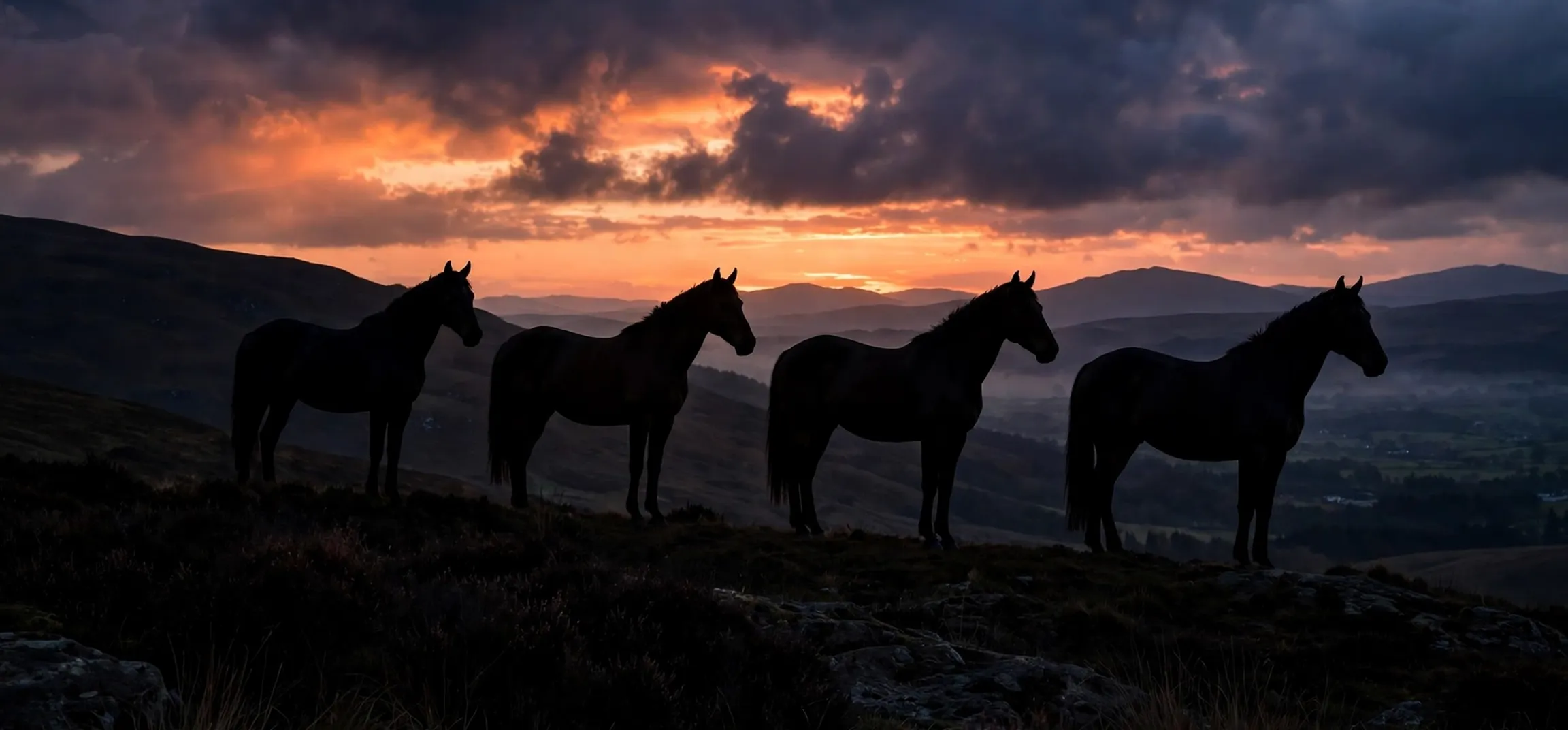
The four horsemen names have fascinated readers, artists, scholars and storytellers for centuries. They come from the Book of Revelation, the final book of the Christian New Testament, where four riders appear in sequence, each mounted on a horse of a different colour and each bringing a different kind of upheaval to the world. Even people who have never read Revelation in full usually recognise the image: four figures riding out across history, signalling conquest, conflict, scarcity and death. This guide explains the four horsemen names clearly, where they come from, what each rider is traditionally understood to represent, and why the image has lasted so long in art, literature, film and everyday language.
It is worth saying at the outset that this is a religious and cultural overview, offered in a respectful tone. Different Christian traditions, and scholars of different persuasions, interpret the passage in different ways. Some read it as prophecy about the future, some as symbolic writing about the world of its own time, and some as a mixture of both. This article sets out the most widely shared traditional identifications, notes where interpretations differ, and avoids taking a sectarian or sensationalist line. The four horsemen names themselves, however, are a matter of common agreement in popular usage, even when their precise meanings are debated.
Where the Four Horsemen Names Come From
The four horsemen names originate in Revelation chapter 6, in a vision in which the Lamb opens the first four of seven seals on a scroll. With each seal, a living creature calls out, “Come!”, and a rider appears. The passage is brief and highly visual: it gives the colour of each horse, something each rider carries, and a short statement of what is given to each rider to do. It does not, in most translations, give the riders personal names in the way a novel would. Instead, the four horsemen names used today are the traditional labels drawn from what each rider represents: Conquest, War, Famine and Death.
There is one exception to that pattern, and it is an important detail. The fourth rider is explicitly named in the text itself: “his name was Death”. The other three riders are identified by description rather than by a spoken name, which is why commentators have always had to describe them by their roles. Over time, those roles hardened into names, so that we now speak quite naturally of the four horsemen names as if they were a fixed cast list. In paintings, stained glass and popular culture, the four are usually shown together, riding in a group, even though the biblical passage presents them one after another.
The Book of Revelation was written in a time of persecution and political tension for early Christian communities, and its language is deliberately symbolic. Horses, colours, crowns, scales and swords all carried associations for ancient readers that a modern reader might miss. White could suggest victory or purity, red suggested bloodshed, black suggested mourning and scarcity, and pale or sickly green suggested disease and decay. Understanding those colour associations helps to make sense of why each rider looks the way he does, and why the four horsemen names have proved so durable as a shorthand for catastrophe.
The Four Horsemen Names in Full
For easy reference, here is the traditional list. Each rider is given in the order in which he appears in Revelation 6, together with the colour of his horse and the emblem most often associated with him.
| Order | Traditional name | Horse colour | Emblem or attribute |
|---|---|---|---|
| First | Conquest (sometimes called Pestilence in popular culture) | White | A bow and a crown |
| Second | War | Red | A great sword |
| Third | Famine | Black | A pair of scales |
| Fourth | Death | Pale | Followed by Hades, or the grave |
That table reflects the most common traditional presentation. The note about the first rider matters, because it is the main source of confusion about the four horsemen names. In the biblical text, the first rider carries a bow, receives a crown, and goes out “conquering and to conquer”. Many older commentaries therefore call him Conquest. In some modern popular culture, however, the first rider is called Pestilence, and the four become Conquest replaced by disease. That version is widespread in films, games and novels, but it is not the identification found in the passage itself. Readers who come across both versions should know that Conquest is the traditional reading and Pestilence is a later popular variation.
Four Horsemen Names: The First Rider, Conquest
The first of the four horsemen names is Conquest. He rides a white horse, carries a bow, and is given a crown. The white horse is the detail that most often misleads newcomers, because white is also associated in Revelation with purity and with Christ, who appears later in the book on a white horse as well. Scholars have debated for centuries whether the first rider is a positive figure, a parody of a victorious ruler, or a symbol of imperial conquest in general. What is not in doubt is the imagery of military and political expansion: a bow is a weapon of war, and a crown is a symbol of rule.
In historical readings, Conquest has often been linked to the expansion of empires, and in particular to the Roman Empire of the first century, whose armies and emperors dominated the world in which Revelation was written. In more general readings, he stands for any force that spreads by domination, whether military, political or ideological. Some interpreters read him positively, as the spread of the gospel or of righteous rule, while others read him as a warning about the seductive power of victory. The disagreement itself is instructive: the same image can represent triumph to one reader and tyranny to another, depending on whose side of the conquest they stand.
The popular renaming of this rider as Pestilence probably comes from a desire for symmetry. War, Famine and Death are all disasters, and disease fits neatly alongside them. Conquest, by contrast, can sound almost neutral. Yet the traditional list keeps Conquest, and that is the version used in most scholarly and reference works. When you see the four horsemen names listed as Pestilence, War, Famine and Death, you are seeing a modern cultural adaptation rather than the older traditional list.
Four Horsemen Names: The Second Rider, War
The second rider is War, and his identification is the least disputed of the four horsemen names. He rides a red horse, the colour of blood, and he carries a great sword. He is given power to take peace from the earth, so that people kill one another. Where the first rider suggests conquest from outside or from above, the second suggests conflict breaking out between peoples, neighbours and nations. The sword is large and unmistakable, and the red horse leaves little room for ambiguity about what this rider brings.
War has often been read alongside Conquest as a pair. Conquest may arrive with ceremony, crowns and claims of legitimacy, while War is the violent reality that follows or accompanies it. In art, the second rider is frequently shown brandishing his sword above a scene of battle, and his red horse stands out sharply against the other three. The image has been used, in every era, to describe wars that seemed to contemporaries to be not merely local conflicts but signs of a wider unravelling. That is part of why the four horsemen names survive as a figure of speech: people reach for them when a war feels larger than ordinary politics.
It is also worth noting that War, in this passage, is not presented as a single battle or a single nation. He is a condition, a removal of peace, and that breadth is what makes the symbol flexible. Historians sometimes warn against reading Revelation as a simple prediction of specific modern wars, because the passage was written for a particular ancient audience using symbolic language. As a cultural image, though, War remains instantly recognisable, and his place among the four horsemen names is secure.
The Third Rider, Famine, and the Scales
The third rider is Famine. He rides a black horse and carries a pair of scales, the instrument used for weighing out grain in a market. A voice announces the price of wheat and barley, and adds the instruction not to harm the oil and the wine. The detail is precise and economic: in a famine, staple food becomes extremely expensive, while luxury goods remain available to those who can afford them. The scales therefore symbolise not only hunger but injustice, a world in which basic nourishment is rationed by price while plenty continues for the wealthy.
Black is the colour of mourning, and it suits a rider whose arrival means empty markets and hungry households. Famine has often followed war in real history, as armies disrupt harvests, trade routes and food distribution, and the sequence of the riders reflects that grim logic. Conquest and War break societies apart, and Famine follows in their wake. The third rider is thus not an isolated disaster but part of a chain, and that chain is one reason the four horsemen names are so often invoked together rather than singly.
Modern readers sometimes connect Famine with broader questions about food security, drought, conflict and economic inequality. Those connections are legitimate as cultural interpretation, but they should not be confused with the passage itself, which speaks in the language of an ancient grain market. The enduring point is the same in either register: when food becomes unaffordable, the suffering falls hardest on ordinary people, and the scales in the rider’s hand make that economic reality visible.
The Fourth Rider, Death
The fourth rider is Death, the only one of the four horsemen names given explicitly in the text. He rides a pale horse, a colour often translated as pale green or sickly, the colour associated with a corpse. He is followed by Hades, the realm of the dead, and he is given authority over a fourth of the earth, to kill by sword, famine, plague and wild beasts. In other words, Death gathers up the consequences of the riders who came before him: the violence of War, the hunger of Famine and the disease that travels with both.
Death is the most frequently depicted of the four in art, often shown as a skeletal figure, although the biblical passage does not describe him as a skeleton. That visual tradition comes from later medieval art, especially after the Black Death, when images of dancing skeletons and the personification of death became common across Europe. The pale horse, however, is original to Revelation, and it gives the rider a distinctive, unsettling presence: not the bright colours of the first three horses, but a washed-out, unhealthy shade that suggests illness and decay.
In popular usage, Death is often named first when people list the four horsemen names, because he is the most famous and the most vivid. In the passage itself, though, he comes last, as the culmination of the sequence. That order matters for understanding the passage as a whole: it moves from conquest, through war and famine, to death itself, as if each disaster prepares the way for the next. Readers who remember only Death miss the structure, which is a progression rather than a random collection of calamities.
Why the Four Horsemen Names Endure in Culture
The four horsemen names endure because they offer a compact language for catastrophe. Journalists, novelists, filmmakers and even sports commentators borrow them whenever they want to suggest that several disasters have arrived together. A pandemic, a war and a food crisis in the same period will almost inevitably be described as horsemen, because the image captures the feeling that troubles are not isolated but compounding. The same shorthand appears in music, comics and video games, where the four riders are reimagined as characters, villains or forces of nature.
Art history is full of the four horsemen, from Albrecht Dürer’s famous woodcut of 1498 to modern graphic novels. Dürer’s image, with its crowded, dynamic composition, fixed the visual idea of the four riding together in the European imagination. Later artists have returned to the subject in every century, each time adapting the riders to the anxieties of their own age: industrial war, nuclear weapons, climate change, pandemic disease. The names stay the same even as the costumes change, which is a sign of how flexible the symbol has become.
There is also a linguistic reason for their staying power. “The four horsemen” has become an idiom in its own right, used for any group of four related threats, from the “four horsemen of the apocalypse” in economics or technology to playful uses in sport. Learning the four horsemen names therefore helps a reader to follow a wide range of cultural references, not only religious ones. If you know that the riders are Conquest, War, Famine and Death, you can recognise the allusion whenever it appears, whether the writer is being serious, satirical or merely dramatic.
For readers interested in how words and phrases acquire these layers of meaning, the same kind of exploration applies to many other terms. The story of a word such as goad, for example, shows how a concrete object can become a metaphor for provocation, while an article on the meaning of ratified shows how a formal, legal sense develops over time. The four horsemen names work in a similar way: they began as a vivid biblical vision and grew into a general cultural vocabulary.
Frequently Asked Questions
What are the four horsemen names?
The traditional four horsemen names are Conquest, War, Famine and Death, in that order. They appear in Revelation chapter 6, riding white, red, black and pale horses respectively.
Is the first horseman called Pestilence or Conquest?
Traditionally he is Conquest, carrying a bow and wearing a crown. Pestilence is a popular modern variation, common in films and games, but it is not the identification given in the biblical passage.
Why is Death the only rider actually named in the text?
Revelation 6 states directly that the fourth rider’s name was Death. The other three are described by their horses, weapons and actions, and their names are traditional labels drawn from those descriptions.
Do the four horsemen appear anywhere else in the Bible?
A related vision of four horses appears in the Book of Zechariah, but the famous four riders with their distinct colours and roles belong to Revelation. The two passages are sometimes compared, but they are not identical.
Are the four horsemen meant to be literal people?
Most scholars and traditions read them as symbolic figures rather than literal individuals. They personify forces such as conquest, war, famine and death, although interpretations of exactly what they symbolise vary widely.
Conclusion
The four horsemen names — Conquest, War, Famine and Death — form one of the most recognisable images in Western culture, and their power comes from their simplicity. Four riders, four horses, four colours, and a sequence that moves from domination through violence and hunger to death itself. Knowing the names, and knowing why the first rider is sometimes called Pestilence in popular culture, gives a reader the key to centuries of art, literature and everyday speech. Whether approached as scripture, as history or as cultural symbolism, the four horsemen remain a vivid reminder of how ancient images can continue to shape the way people describe the troubles of their own time.



