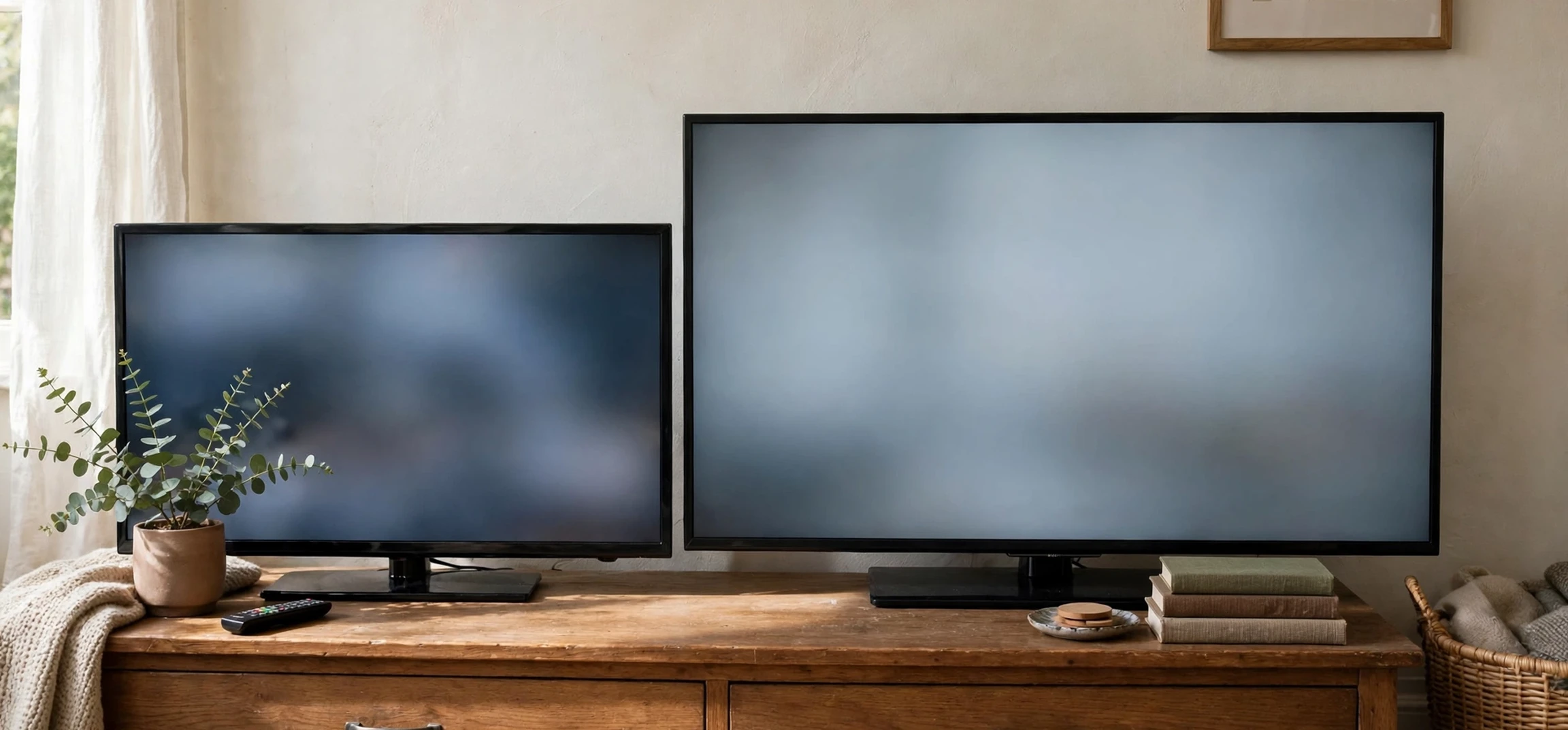
Choosing between two popular television sizes is a common dilemma for bedrooms, kitchens, small living rooms, and student flats, and this guide to 40 inch tv vs 32 is designed to make that choice easier. The phrase 40 inch tv vs 32 is used here as the exact comparison readers search for, covering a 40-inch screen against a 32-inch screen, and this article compares them on viewing distance, room size, picture detail, sound, features, and everyday use. Prices are deliberately not stated as current fact in this guide, because television prices change frequently with sales, models, and retailers, so readers should check the official retailer or manufacturer listing for the model they are considering at the time of purchase. The goal is to help you choose the right size for your room, not to push you toward the larger screen by default.
Screen size is measured diagonally, in inches, from one corner of the display to the opposite corner, and that measurement can be misleading in a 40 inch tv vs 32 comparison. A 40-inch television is not just a little bigger than a 32-inch model: because screen area grows with both width and height, the 40-inch screen has roughly half as much display area again as the 32-inch screen. That difference is noticeable in practice, especially for films, sport, and shared viewing, but it is not automatically better. A larger screen in a very small room can feel overwhelming, force your eyes to move constantly, and expose lower-resolution content more harshly. A smaller screen in a large room can feel distant and make subtitles or on-screen text harder to read. The right choice depends on distance first, and on content second.
40 Inch TV vs 32: Viewing Distance and Room Size
Viewing distance is the single most useful starting point in any 40 inch tv vs 32 comparison. As a rough guide, a 32-inch television generally suits a viewing distance of about 1.2 to 2 metres, which is typical for a bedroom, a desk setup, or a small sitting area where the viewer sits relatively close. A 40-inch television generally suits a distance of about 1.5 to 2.5 metres, which is common in a small to medium living room. These are guides, not strict rules, because personal preference, eyesight, and the height at which the television is mounted all matter. If you sit closer than the guide suggests for a larger screen, you may notice individual pixels on lower-resolution content; if you sit further away, the advantage of the larger screen starts to fade.
Room layout matters as much as raw distance in a 40 inch tv vs 32 decision. Measure the distance from your usual seat to the wall or stand where the television will sit, and also check the width available. A 40-inch television is wider than a 32-inch model, so it needs a wider stand or wall space, and it may dominate a small piece of furniture. In a bedroom, a 32-inch model often sits more comfortably on a dresser or a wall bracket without overwhelming the room. In a living room with a sofa facing a media unit, the 40-inch model usually fills the viewing field more naturally and works better when two or three people watch together from slightly different angles.
A Simple Distance Check
Before buying, try a simple test. Sit in your normal viewing position and hold a tape measure to the television location, or mark the distance on the floor. Then imagine the screen filling that space. If you mainly watch alone, close up, and in a small room, the smaller screen will often feel more comfortable. If you watch with family, from a sofa, or from a kitchen table further away, the larger screen will usually feel more natural. This practical check prevents the most common mistake in a 40 inch tv vs 32 decision: buying the larger screen because it seems like better value, then finding it too large for the room.
40 Inch TV vs 32: Picture Quality and Resolution
Picture quality in any 40 inch tv vs 32 comparison depends less on size alone and more on resolution, panel type, and the content you watch. Resolution describes how many pixels make up the picture. A 32-inch television is commonly sold in high-definition resolution, while a 40-inch television is more often available in higher resolutions, including full high-definition and, in some models, ultra-high-definition. At a normal viewing distance, a higher resolution on a larger screen can look sharper, because the pixels are smaller relative to the picture. At a close distance, however, a lower-resolution picture stretched across a larger screen can look softer, so resolution and size should be considered together.
Panel technology also affects the result in a 40 inch tv vs 32 comparison. Most modern televisions in these sizes use LED-backlit LCD panels, with differences in colour, contrast, and viewing angle between budget and mid-range models. A good 32-inch television with a well-tuned panel can look better than a poor 40-inch television with washed-out colours, especially in a bright room. Check viewing angle if people will watch from the side, check how the television handles dark scenes if you watch films at night, and remember that showroom lighting flatters almost every screen. Reviews that test the exact model, rather than the size category, are more useful than size alone.
Content matters too. If you mainly watch news, talk shows, and standard-definition channels, the difference between sizes will be modest, and the smaller screen may even hide imperfections better. If you mainly watch films, sport, nature documentaries, or high-definition streaming, the larger screen will show more detail and give a stronger sense of immersion. Gamers should also consider input lag and refresh rate, which vary by model and are not determined by size. In short, size sets the stage, but resolution, panel, and content decide how good the picture actually looks.
Sound, Features, and Everyday Use
Sound is often the weakest part of a small television in a 40 inch tv vs 32 comparison, because thin screens leave little room for speakers. A 40-inch model may have slightly larger speakers and a fuller sound than a 32-inch model, but the difference is usually modest, and neither size will match a dedicated soundbar or speaker system. If sound matters to you, budget for external audio rather than choosing a size for its speakers alone. Both sizes commonly offer similar smart features, including streaming apps, Wi-Fi, HDMI ports, and USB playback, although the exact number of ports and the speed of the smart interface vary by model and brand. Check the port count if you plan to connect a console, a set-top box, and a soundbar at the same time.
Everyday use in a 40 inch tv vs 32 choice also includes mounting, energy use, and longevity. A 32-inch television is lighter and easier to wall-mount, move, or fit into a small space, which suits renters and students. A 40-inch television is heavier and needs a sturdier bracket, but it is still manageable for most living rooms. Energy use tends to rise with screen size, though modern models are generally efficient, and the difference in running cost is usually small compared with the purchase decision. Consider also where the television will live in a few years: a 32-inch model bought for a bedroom may later move to a kitchen, while a 40-inch model bought for a flat may later suit a larger home.
| Factor | 32-inch television | 40-inch television |
|---|---|---|
| Best viewing distance | About 1.2 to 2 metres | About 1.5 to 2.5 metres |
| Best room | Bedroom, kitchen, small flat | Small to medium living room |
| Shared viewing | Best for one or two viewers | Better for groups and sofa viewing |
| Screen area | Smaller, less immersive | Roughly half as much area again |
| Portability | Lighter, easier to move and mount | Heavier, needs a sturdier mount |
| Typical resolution | Often high-definition | Often full high-definition or higher |
For related television reading on this site, see Apple TV movies 2025, Acorn TV guide, and best streams TV. Those guides cover content and services, while this guide focuses on choosing the hardware size itself.
Frequently Asked Questions
Is 40-inch too big for a bedroom?
It depends on distance. In a small bedroom where you sit less than 1.5 metres away, a 40-inch screen in a 40 inch tv vs 32 comparison can feel large, and a 32-inch model is often more comfortable. In a larger bedroom with a bed further from the wall, a 40-inch model can work well.
Is 32-inch too small for a living room?
For a small living room with close seating, a 32-inch television can be fine, especially for news and casual viewing. For a typical sofa distance or shared family viewing, a 40-inch model usually fills the view better and makes subtitles easier to read.
Does a bigger TV mean a better picture?
Not automatically. Picture quality depends on resolution, panel quality, and content. A larger screen shows more detail when the source is high quality, but it can also reveal flaws in low-resolution content more clearly than a smaller screen.
Should price decide the choice?
Price should be a factor, but not the only one, and prices change frequently, so check the current retailer listing for the exact model. A television that is the wrong size for your room is poor value even at a lower price, while the right size will be used comfortably every day.
Conclusion
The verdict in this 40 inch tv vs 32 guide, and in any honest 40 inch tv vs 32 summary, is refreshingly simple: choose by distance, then by content. A 32-inch television suits close, solo viewing in small rooms, while a 40-inch television suits sofa viewing, shared watching, and film or sport in a small to medium living room. Measure your seat, check the width of your stand, consider resolution and sound separately from size, and verify the current price and specifications with the official retailer before buying. Get those steps right, and either size can be the right television — because the best screen is not the largest one, but the one that fits your room and your viewing habits.



