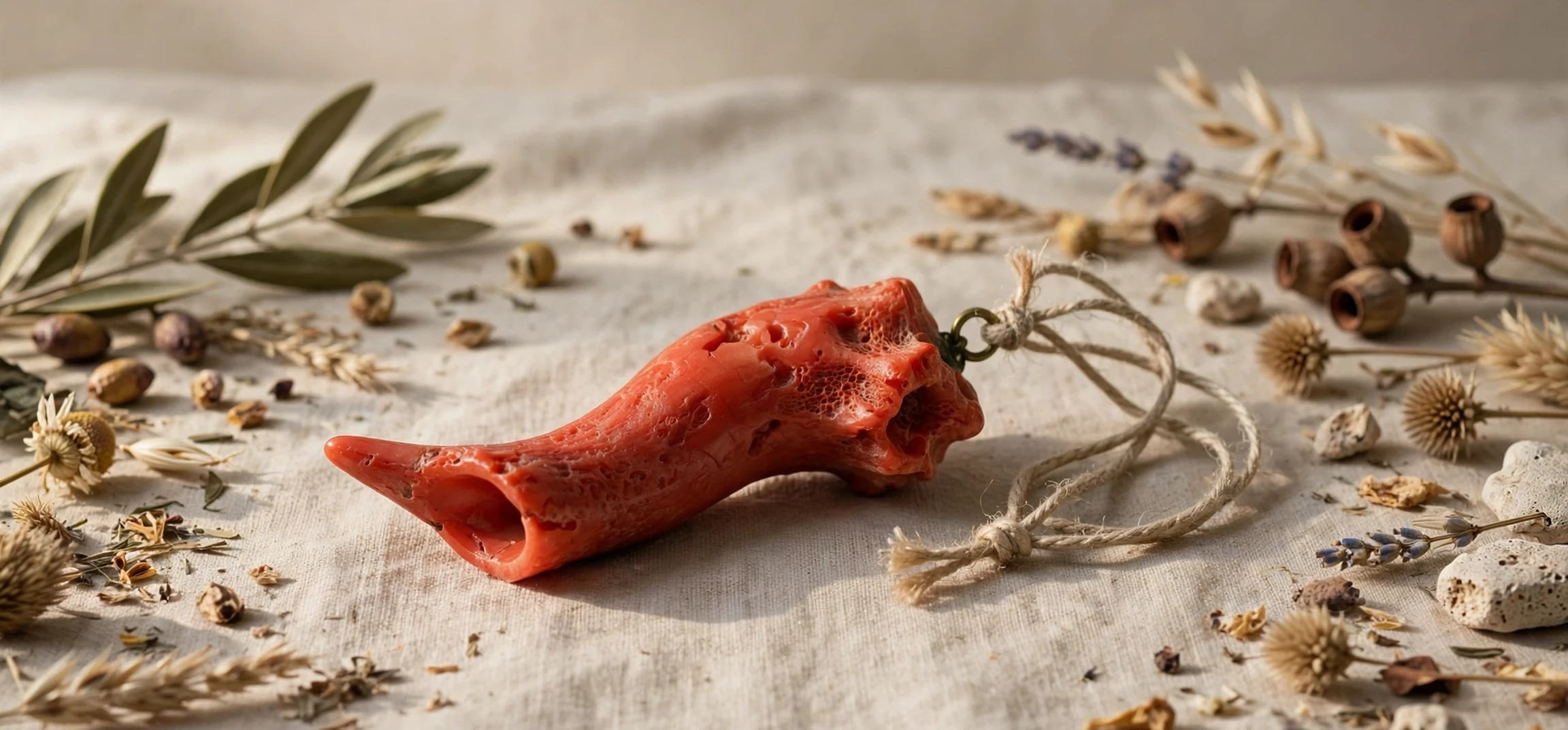
The meaning of the Italian horn is protection, good luck, and the turning away of envy and misfortune. Known in Italian as the cornicello, meaning “little horn”, this small, curved charm — usually red, often shaped like a chilli pepper or an animal horn — has been worn in Italy for centuries as a defence against the evil eye. You may have seen it hanging from a necklace, dangling from a car mirror, or displayed in an Italian home or shop, and wondered what it actually stands for. This guide explains the meaning of the Italian horn in full: its history, its symbolism, how it is traditionally worn and given, and how it is understood today, both in Italy and around the world.
The Italian horn is more than a souvenir. It belongs to a long tradition of folk belief in which everyday objects carry protective meaning, and it sits alongside other Italian symbols of luck and family, from the hand gesture against the evil eye to the red coral jewellery of the Mediterranean. Understanding it means looking at ancient ideas about envy, fertility, and strength, as well as at the practical question of what the charm means to the people who wear it now. Whether you have inherited one, received one as a gift, or are simply curious about Italian culture, this article gives you a clear, respectful account of its meaning.
The Meaning of the Italian Horn at a Glance
At its core, the meaning of the Italian horn is warding off the malocchio, the evil eye — the belief, found in many Mediterranean and Middle Eastern cultures, that a jealous or envious glance can bring bad luck, illness, or misfortune. The horn is thought to deflect that harmful gaze, absorbing or turning aside the negative energy before it can reach the wearer. Its curved, pointed shape is part of the symbolism: like a horn, it suggests strength and the ability to push back against danger, while its bright red colour is traditionally associated with vitality, life, and protection.
The horn is also linked with fertility, virility, and good fortune more broadly. In ancient Italy, horns were symbols of abundance — think of the cornucopia, the horn of plenty overflowing with fruit — and of the power of animals. The cornicello carries echoes of those older associations, which is why it is often given at moments of new beginnings: births, weddings, new homes, and new ventures. A gift of an Italian horn is, in effect, a wish: may you be protected, may you prosper, and may envy pass you by. That wish sums up the meaning of the italian horn in a single gesture.
It is important to say that the horn’s power is a matter of cultural belief, not scientific fact. Many people wear it as a connection to family heritage, as a beautiful piece of jewellery, or as a good-luck token, without expecting literal magical protection — just as others wear it with genuine faith in its traditional power. Both attitudes are part of the charm’s modern life, and both deserve respect. The meaning of the Italian horn is best understood as cultural: it expresses values of family, protection, and hope that have endured for generations. Those enduring values are at the heart of the meaning of the italian horn.
The History of the Italian Horn
The Italian horn’s roots reach back to antiquity. Horned animals were sacred or significant in many ancient cultures, and horns themselves were used as drinking vessels, musical instruments, and symbols of power. In the Roman world, phallic and horn-shaped amulets were commonly worn as protection against envy and harm, and coral — a material still associated with the cornicello — was prized for its colour and rarity. Over centuries, these older protective traditions blended with Christian and folk practices in southern Italy, particularly in Naples and the surrounding region of Campania, where the cornicello became a distinctive local symbol.
Naples is often described as the heartland of the Italian horn. Neapolitan folk culture has a rich tradition of beliefs about luck, the evil eye, and protective gestures, and the cornicello sits at the centre of that tradition. Craftsmen in Naples and elsewhere in southern Italy have made horns from coral, gold, silver, and horn itself for generations, and the charm became a standard gift within families, passed from parents to children as a sign of care. Italian emigrants carried the tradition with them to the Americas and beyond, so that today the horn is recognised in Italian diaspora communities around the world. That journey explains why the meaning of the italian horn is known far beyond Italy.
The shape of the modern cornicello is deliberately twisted and curved, resembling a chilli pepper — and indeed, some people do mistake it for a pepper at first glance. That resemblance is no accident: both the horn and the chilli share a bright red colour and a pointed, fiery form, and both have been associated with vitality and protection in folk belief. Traditional horns are often hand-crafted and slightly irregular, which collectors value as a sign of authentic craftsmanship rather than mass production. That hand-made character is part of the meaning of the italian horn for many owners.
The Meaning of the Italian Horn: Symbolism in Detail
Each element of the Italian horn carries meaning. The horn shape itself suggests the strength of a bull or goat, animals admired for their power and resilience, and the ability to confront danger head-on. The twist in the horn is sometimes said to confuse or deflect the evil eye, sending harmful energy off course. The point at the tip focuses that protective idea: just as a horn can gore an attacker, the charm is imagined to pierce or repel bad luck before it lands.
Colour matters too. Red is the traditional colour of the cornicello, and in Mediterranean folk belief red is the colour of life, blood, and vitality — the very things the evil eye is thought to threaten. Red coral, historically the most prized material for the charm, combines that colour symbolism with the rarity and beauty of a natural material from the sea. Modern horns come in gold, silver, and other materials as well, and while purists may prefer red coral, the protective meaning is generally understood to travel with the shape and the intention behind the gift, not only with the material. Intention, in other words, is central to the meaning of the italian horn.
Some horns are combined with other symbols. You may see a cornicello paired with a hand making the mano cornuta, the “horned hand” gesture, or worn alongside a cross or a saint’s medal. These combinations reflect the way folk belief and religious faith have coexisted in Italian culture for centuries: people draw on more than one source of protection, and the charm becomes part of a personal, layered expression of belief. For more on how cultural symbols carry layered meanings, see our guide to St Patrick’s Day meaning and our explainer on bildungsroman meaning, both of which explore how a single term can hold history, story, and identity at once. The same layered history shapes the meaning of the italian horn.
| Feature | Traditional meaning |
|---|---|
| Curved horn shape | Strength, power, ability to repel danger |
| Twist | Deflecting or confusing the evil eye |
| Red colour | Vitality, life, protection |
| Red coral material | Rarity, beauty, traditional potency |
| Given as a gift | A wish for protection and good fortune |
How the Italian Horn Is Worn and Given
Traditionally, the Italian horn is worn as a pendant on a necklace, where it sits close to the body and is visible to others — visibility matters, because the charm is meant to meet the envious gaze and turn it aside. It is also hung in cars, homes, and workplaces, placed near doorways or above entrances so that it guards a space as well as a person. Keyrings, bracelets, and earrings in horn form are common modern variations, allowing people to carry the symbol in whatever way suits their daily life.
There is a traditional etiquette around giving the horn. It is often said that a cornicello should be received as a gift rather than bought for oneself, because the protective power is thought to be strengthened by the giver’s good wishes. Whether or not you follow that custom, the horn is most commonly given with affection: from a parent to a child, between partners, or to a friend starting a new chapter. If you receive one, wearing it is a way of honouring the giver’s care, regardless of your personal beliefs about its power. That respect is part of living with the meaning of the italian horn.
Some traditions add further details. A horn that breaks is sometimes interpreted as having absorbed a harmful influence, fulfilling its protective purpose, and is then replaced with a new one. Others say the horn should be made of particular materials or blessed in particular ways. These customs vary by family and region, and there is no single authoritative rulebook: folk traditions are living practices, passed down and adapted, not fixed doctrines. That adaptability has kept the meaning of the italian horn alive across generations. If your family has its own custom around the horn, that custom is part of its meaning for you.
The Italian Horn in Modern Culture
Today, the Italian horn is both a cultural symbol and a fashion item. Jewellers in Italy and abroad sell cornicelli in gold, silver, and enamel, and the charm appears in popular culture as a recognisable sign of Italian heritage. That visibility is a modern chapter in the meaning of the italian horn. For many Italian-Americans and other members of the diaspora, wearing the horn is a way of staying connected to family roots, much like cooking a family recipe or speaking a few words of a grandparent’s language. It signals identity as much as belief.
At the same time, the horn’s meaning can be misunderstood outside its cultural context. Some people mistake it for a purely decorative pepper, or for a symbol with an unrelated meaning, and its traditional associations with virility can make it a subject of jokes. Those misunderstandings are worth correcting gently: the cornicello’s primary traditional meaning is protection against envy and misfortune, and it is worn with pride and affection by people for whom it carries family significance. Treating it with the same respect you would give any cultural or religious symbol is the right approach. Respectful curiosity is the best way to approach the meaning of the italian horn.
There is also a commercial side to be aware of. Mass-produced horns sold as souvenirs may bear little resemblance to hand-crafted traditional pieces, and claims about particular materials or powers should be treated with common sense. If you are buying a horn as a meaningful gift, choose a reputable jeweller, ask about the material, and value craftsmanship over exaggerated claims. The most important part of the gift is the intention behind it, not any promise of guaranteed luck. Keeping that in proportion honours the meaning of the italian horn honestly.
Myths and Facts About the Italian Horn
One common myth is that the Italian horn is a chilli pepper. While the two look similar and share a red colour, the cornicello is a horn, with roots in ancient horn symbolism that predate any connection with peppers. Another myth is that wearing the horn guarantees good luck or prevents all misfortune. Traditional belief is more modest: the horn is a protective charm, a focus for good wishes, not a guarantee, and most wearers understand it in that spirit.
A further misconception is that the horn belongs to a single religion or secret practice. In reality, it is a folk tradition that has coexisted with Catholic faith in Italy for centuries, and it is worn by people of varied beliefs, as well as by people who wear it purely as a cultural emblem. Its meaning is flexible enough to hold all of these attitudes, which is one reason it has endured. That flexibility is a key to the meaning of the italian horn. A symbol that can mean protection, heritage, love, and luck at once is a symbol with staying power.
Finally, some people worry that wearing a horn from another culture is disrespectful. As with any cultural symbol, the respectful approach is to learn what it means, wear it with understanding rather than as a joke, and appreciate its history. If you have received a horn as a gift from an Italian friend or family member, wearing it is a compliment to the giver, not an appropriation. If you are buying one for yourself, taking a few minutes to understand its story — as this guide aims to help you do — is the best way to honour it. A few minutes of learning enriches the meaning of the italian horn for any new owner.
Frequently Asked Questions
What is the Italian horn called in Italian?
It is called the cornicello, meaning “little horn”, and it is also sometimes called the corno portafortuna, the horn that brings good luck.
Is the Italian horn the same as a chilli pepper?
No, although they look similar. The cornicello is a horn-shaped charm with ancient roots in horn symbolism; its resemblance to a chilli is coincidental in origin, though both share red, fiery associations.
Should you buy an Italian horn for yourself?
Tradition often says it should be given as a gift, so its protective wishes come from someone else. Many people still buy their own, and the charm’s meaning as a cultural symbol remains whatever way you obtain it.
What does it mean if an Italian horn breaks?
In folk tradition, a broken horn is sometimes understood as having absorbed harmful influence on the wearer’s behalf, and it is then replaced with a new charm.
Conclusion
The meaning of the Italian horn is, at heart, a wish for safety and good fortune, expressed in a small, curved, red charm that has travelled from ancient horn symbolism through Neapolitan folk culture to the wider world. It stands against envy and the evil eye, it celebrates vitality and abundance, and it carries the affection of the person who gave it. Whether you wear one out of faith, heritage, or simple appreciation, understanding its story deepens its value: it is not just a piece of jewellery, but a link to centuries of Italian culture and to the universal human hope that those we love will be protected. That link is, finally, what the meaning of the italian horn is all about. For another look at how words and symbols gather meaning over time, see our guide to goad meaning, and keep exploring the rich traditions behind the objects we wear every day.



