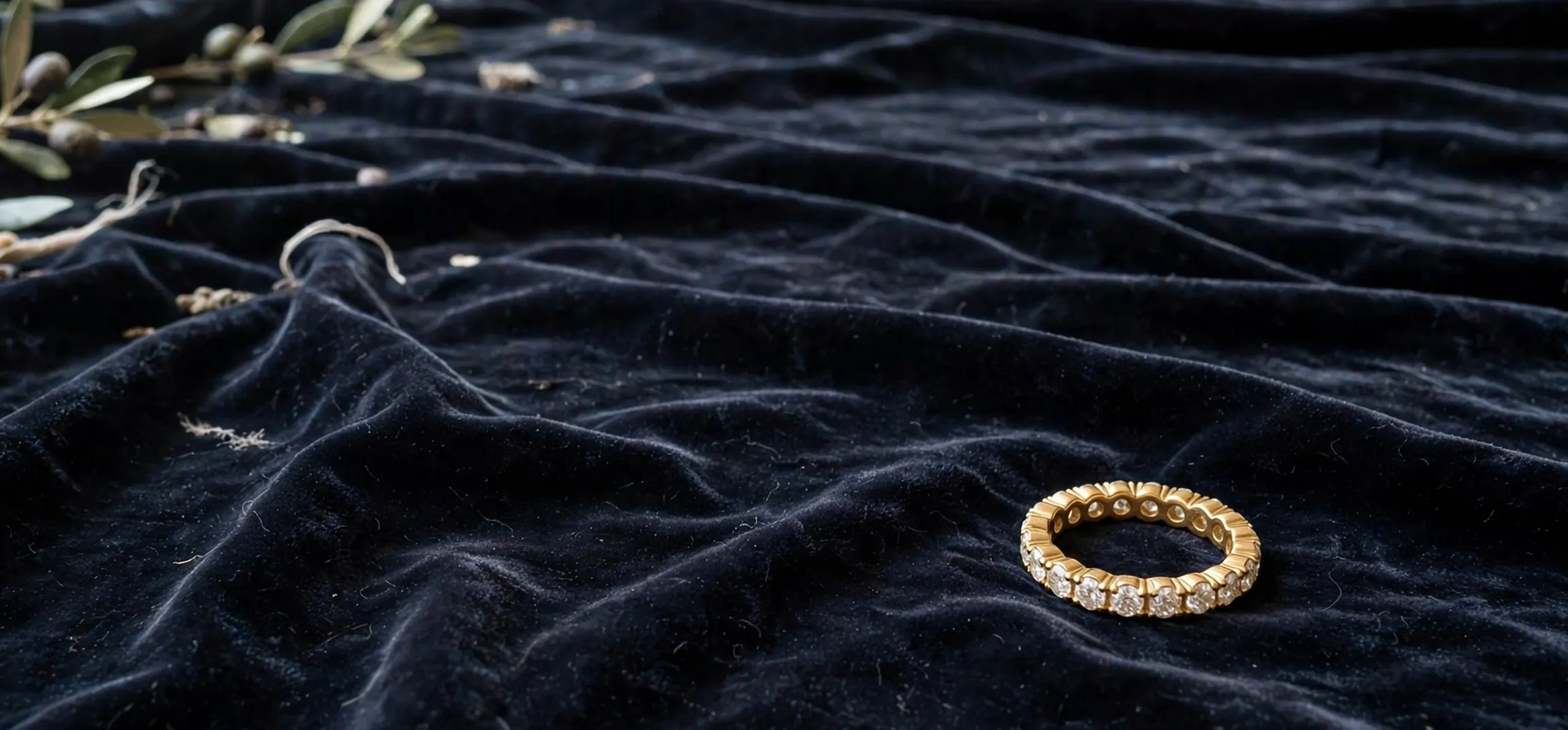
If you searched for eternity symbol meaning, you are asking about a design that appears in jewellery, tattoos, art, and religious imagery, and that is often confused with the infinity symbol. The eternity symbol most commonly refers to a ring or band of continuous, repeating motifs, such as interlocking circles, knots, or stones set all the way around, with no beginning and no end. Its meaning centres on permanence, unbroken commitment, and continuity: love without an endpoint, a bond that does not break, or a cycle that keeps returning. This guide explains the main forms of the eternity symbol, how it differs from infinity, where it appears in different cultures, and how to interpret it when you see it.
Symbols work because they compress an idea into a shape. A circle has no start and no finish, so it has long been used to represent wholeness and endlessness. An eternity design takes that idea further by repeating a pattern around the whole circle, so that the eye never finds a break. That visual continuity is the point. Whether the design is a ring worn on the finger, a carved band on a monument, or a woven knot in a manuscript, the message is similar: something that endures, repeats, or returns.
It is important to note at the outset that symbols do not have one fixed, universal meaning. The same shape can carry different associations in different cultures, religions, and personal contexts. An eternity ring given at a wedding anniversary means something specific to the couple involved, while an ancient carved band may have meant something different to the people who made it. This guide describes the most widely recognised meanings, and flags where meanings vary, rather than claiming a single authoritative interpretation for every use.
Eternity Symbol Meaning: The Main Forms
The best-known form is the eternity ring. In jewellery, an eternity ring is a band set with a continuous row of stones, usually diamonds or other gemstones, running around the whole ring, or sometimes around part of it. A full eternity ring has stones all the way around, with no gap, while a half-eternity ring has stones across the top half only, which is more practical for everyday wear. Eternity rings are traditionally given to mark a significant anniversary, the birth of a child, or another milestone in a long-term relationship. The unbroken circle of stones represents a love or commitment that continues without interruption.
A second form is the eternity knot or endless knot. Endless knots appear in several traditions, including Celtic art, Tibetan Buddhism, and other decorative arts, where a single line weaves over and under itself in a continuous pattern with no visible beginning or end. In Celtic art, such knots are often carved on stone crosses and manuscripts, where they are understood as representing the interconnection of life, eternity, and spiritual continuity. In Tibetan Buddhism, the endless knot is one of the eight auspicious symbols, representing the interdependence of wisdom and compassion and the endless cycle of existence. The visual logic is the same in both cases: a line that never breaks stands for something that never ends.
A third form is the eternity band in architecture and decorative art: a repeating pattern of circles, waves, or geometric motifs carved or painted around a building, a vessel, or a textile border. Greek key patterns, Celtic spirals, and Islamic geometric bands all use repetition to suggest order, continuity, and timelessness, although their specific cultural meanings differ. In each case, the repetition matters as much as the individual motif. A single circle suggests wholeness; a repeated, unbroken band suggests wholeness that continues.
Eternity Symbol Meaning Compared With Infinity
The eternity symbol is often confused with the infinity symbol, the sideways figure-of-eight shape. The two are related but distinct. The infinity symbol is a mathematical and philosophical sign representing something without limit: endless quantity, endless time, or endless possibility. It is an abstract symbol, usually drawn as a single continuous loop crossing over itself. The eternity symbol, by contrast, is usually a physical design, a ring, a band, or a knot, whose meaning is tied to a relationship, a commitment, or a cycle in human life. Infinity suggests boundlessness; eternity suggests endurance through time.
In practice, the two overlap. Jewellery makers sometimes combine them, setting an infinity motif on an eternity band, or describing a ring as both. Tattoo designs also blend the two, using an infinity loop to represent eternal love or an unbreakable bond. When you see such a combined design, it is best to read it as a personal statement by the wearer rather than a fixed code. The wearer may intend infinity, eternity, or both, and the only certain interpretation is the one they give. If you are choosing a design for yourself, that freedom is an advantage: you can choose the form whose story matches your own.
Other symbols are sometimes described as eternity symbols as well. The ouroboros, a serpent eating its own tail, is an ancient image of cyclic renewal, death and rebirth, and the unity of opposites. The ankh, an ancient Egyptian cross with a looped top, represents life, and in some modern uses is associated with eternal life. A simple unbroken circle, used in many cultures, can also function as an eternity symbol. These images share the same visual idea, a shape that returns to itself, but they come from different traditions and carry their own histories. Treating them as interchangeable loses those histories, so it is worth learning the background of the specific image you are looking at.
Eternity Symbol Meaning in Culture and Religion
In Western jewellery tradition, the eternity ring became popular in the twentieth century as a gift marking milestones in marriage. Its meaning is personal and relational: a promise renewed, a love that has lasted, a family that has grown. Because the ring is worn daily, its meaning is also practical. It is a visible, everyday reminder of a commitment, not only a ceremonial object. That combination of symbolism and daily wear explains why eternity rings remain popular for anniversaries, even as jewellery fashions change.
In Celtic tradition, endless knots and interlaced patterns appear on high crosses, manuscripts, and metalwork. Scholars interpret these patterns in several ways, including as representations of the interconnectedness of all life, the eternity of the soul, and the continuity of spiritual truth. It is worth being cautious here: much of what is said about Celtic knots in popular sources is modern interpretation rather than documented ancient belief. The patterns are certainly old, and their unbroken character is certainly deliberate, but the precise meanings assigned by their original makers are not fully known. A respectful reading acknowledges that uncertainty rather than inventing a single ancient doctrine.
In Buddhist tradition, the endless knot has a clearer doctrinal association, representing the interdependence of phenomena and the union of wisdom and method. It appears alongside other auspicious symbols on temples, textiles, and ritual objects. In Hindu and other South Asian traditions, endless or cyclical patterns also appear, often linked to ideas of rebirth and the cycles of time. In each tradition, the symbol gains its meaning from the wider system of beliefs around it, not from the shape alone. The same knot, removed from its context, becomes decoration; within its context, it becomes teaching.
Eternity symbols in tattoos and personal art
Tattoos are one of the most common modern uses of eternity imagery. People choose eternity bands, endless knots, infinity loops, or ouroboros designs to mark relationships, losses, recoveries, or personal beliefs. A tattoo’s meaning is personal by definition: two people with similar designs may intend quite different things. Common themes include remembrance of someone who has died, celebration of a lasting relationship, commitment to a personal value, or a reminder of resilience through repeated cycles of difficulty and recovery. If you are considering such a tattoo, take time to choose a design whose story you can explain in your own words, and work with a reputable artist who understands the cultural background of the design, especially for symbols drawn from a tradition that is not your own.
| Form | Where it appears | Common meaning |
|---|---|---|
| Full eternity ring | Jewellery | Unbroken love or commitment |
| Half-eternity ring | Jewellery | Milestone in a relationship, practical daily wear |
| Endless knot | Celtic and Buddhist art | Interconnection, continuity, spiritual endurance |
| Ouroboros | Ancient and modern art | Cyclic renewal, death and rebirth |
| Infinity loop | Jewellery and tattoos | Boundlessness, endless possibility |
| Repeating band pattern | Architecture and textiles | Order, timelessness, continuity |
How to Interpret an Eternity Symbol You See
When you encounter an eternity symbol, start with its form. Is it a ring, a knot, a band, or a loop? The form narrows the likely context. A ring on a finger in a jewellery shop is almost certainly about relationships. A knot carved on a historic monument is more likely about spiritual or cultural continuity. A loop in a mathematical text is about infinity as a concept, not about personal commitment. Context, including where the symbol appears and who made it, is usually more informative than the shape alone.
Next, consider the cultural setting. A symbol that is sacred in one tradition may be purely decorative in another, and using a sacred symbol casually can cause offence. If you are unsure, research the specific tradition before adopting or reproducing the design, and be prepared to choose a different design if the original carries meanings you do not intend. That care is part of what makes symbolic art meaningful: it respects the people for whom the symbol already has a history.
Finally, remember that personal meaning can legitimately differ from traditional meaning. A couple who choose an eternity ring for their tenth anniversary are not required to adopt a medieval theological interpretation of endless knots. They are using a widely understood visual language, unbroken continuity, to express their own story. Symbols survive because they are flexible enough to carry both shared tradition and personal meaning at once. That flexibility is not a flaw; it is the reason eternity imagery has lasted so long.
Frequently Asked Questions
Is the eternity symbol the same as the infinity symbol?
No, although they are related. Infinity is an abstract sign for boundlessness, drawn as a sideways figure of eight. Eternity designs are usually rings, bands, or knots whose unbroken pattern represents enduring commitment or continuity.
What does an eternity ring symbolise?
Most commonly, a love or commitment without an endpoint. Eternity rings are often given for anniversaries or to mark the birth of a child, with the continuous stones representing a bond that does not break.
What is an endless knot?
An endless knot is a pattern formed by a single line weaving over and under itself with no beginning or end. It appears in Celtic art and in Tibetan Buddhism, where it represents interconnection and continuity.
Can I use an eternity symbol from another culture?
You can, but research its background first, especially if it has religious significance. Choose designs respectfully, understand what they traditionally mean, and avoid using sacred imagery purely as decoration without that understanding.
Conclusion
The eternity symbol, in its many forms, returns to one visual idea: a pattern with no break, standing for something that endures. Whether it is a ring of continuous stones, an endless knot, a repeating architectural band, or a serpent returning to itself, the message is continuity through time, commitment, or cycles of renewal. Its precise meaning depends on form, culture, and personal intention, and the most honest interpretation takes all three into account. For related symbolism guides, see our articles on number symbolism in tattoos, tattoos with cultural meaning, and symbols in everyday communication, and take time to learn the story behind any symbol before you wear it or share it.