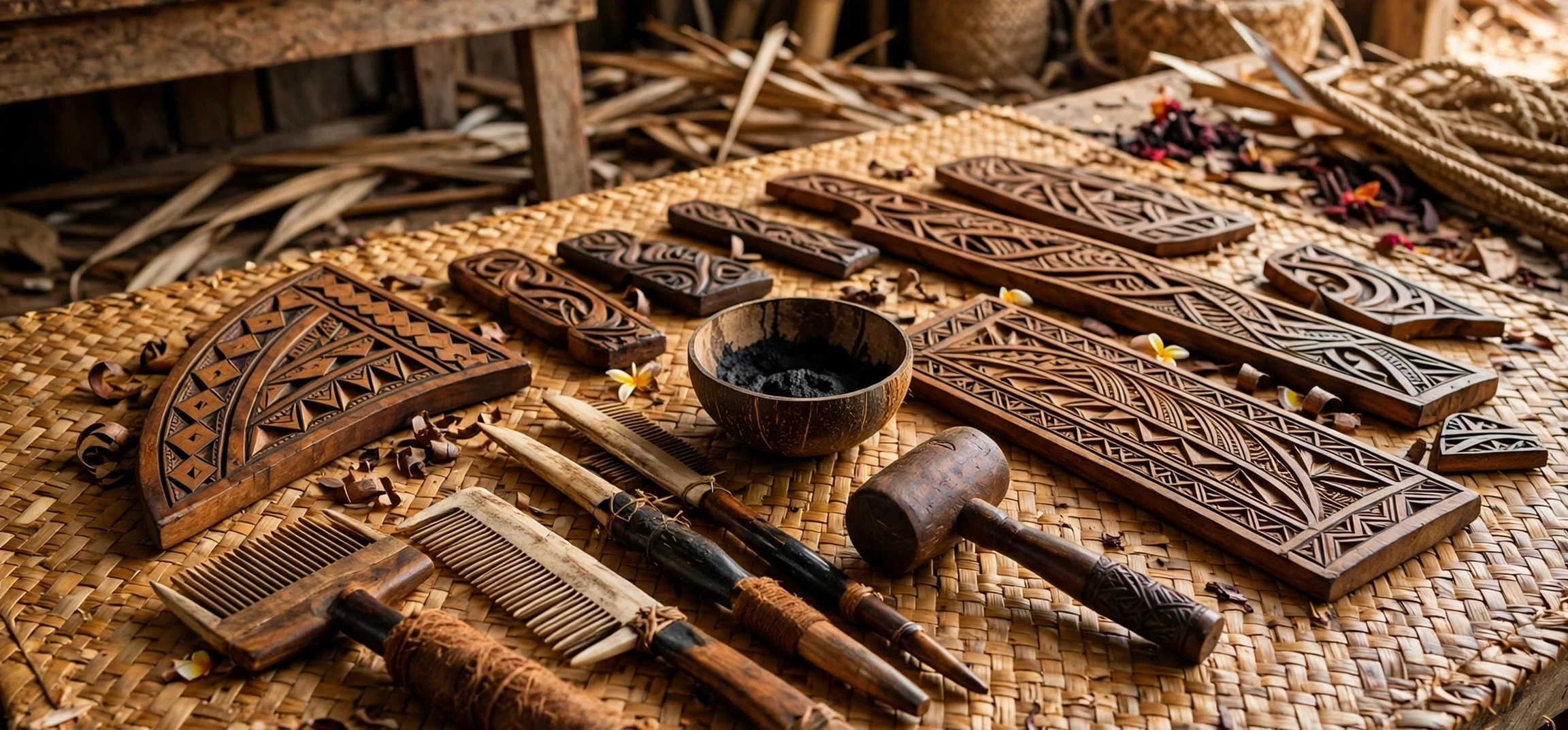
Samoan tattoos with meaning are among the most respected and visually distinctive tattoo traditions in the world, and they carry a depth of cultural history that goes far beyond decoration. In Samoa, tattooing is not a recent fashion; it is an ancient practice woven into identity, family, rank, service and storytelling. Samoan tattoos with meaning are traditionally created with hand-tapped tools, follow patterns passed down through generations, and mark important stages in a person’s life. This guide offers a respectful cultural overview of what these tattoos represent in general terms, why their patterns matter, and why cultural respect and guidance from knowledgeable practitioners are essential for anyone learning about them.
Samoan Tattoos With Meaning: Origins and Cultural Roots
The Samoan word most often associated with this tradition is tatau, from which the English word tattoo is derived. That linguistic link alone shows how influential Samoan tattooing has been globally, but it also hints at a responsibility: a practice that gave the world a word deserves to be understood on its own terms, not reduced to a style catalogue. In Samoan culture, tatau has historically been connected to service to family and village, to endurance, and to the transition into adult responsibilities. Receiving a traditional tattoo was, and in many contexts remains, a serious commitment rather than a casual choice.
Traditional Samoan tattoos with meaning are carried out by a tufuga ta tatau, a master tattooist whose skill is learned through long apprenticeship and whose role carries considerable respect. The tools are traditionally made from natural materials, including bone, shell, wood and natural pigments, and the tapping method produces the characteristic bold, geometric patterns. Modern studios may use machines for Samoan-inspired work, but the traditional hand-tapped method remains culturally significant, and many Samoan people regard it as the authentic form of the practice. The process can take many hours spread over several sessions, and endurance during the process is itself part of its meaning.
It is important to stress that Samoan tattoos with meaning are not a single design that can be copied from a picture. They are a visual language. Motifs are combined, placed and scaled according to the wearer’s family, village, status and personal story, and the overall composition matters as much as any single symbol. Two tattoos may share motifs yet mean quite different things because of their placement, symmetry and the story behind them. That is why general guides can explain themes, but cannot decode an individual’s tattoo from a photograph.
The Main Traditional Forms
The best-known traditional Samoan tattoo for men is the pe’a, a dense, extensive tattoo that traditionally covers the body from the waist to the knees, with additional work on the back and torso in some accounts. The pe’a is associated with service, courage and readiness to take on adult male responsibilities, and completing it has historically been a mark of commitment to family and community. Because of its scale and intensity, the pe’a is not undertaken lightly, and its cultural weight is widely recognised within Samoan communities.
For women, the traditional counterpart is the malu, a tattoo that is generally lighter and more finely patterned than the pe’a, traditionally placed on the legs from the upper thigh to below the knee. The malu is associated with grace, protection and the honoured role of women within family and village life, and it too carries deep cultural meaning. Like the pe’a, the malu is understood within its community context; its patterns are not simply decorative, and its significance is tied to the wearer’s identity and responsibilities.
Beyond these two major forms, Samoan tattooing includes smaller and more individual designs, including work on the arms, hands, chest and back, which may mark family connections, achievements, faith or personal milestones. Contemporary Samoan tattoo artists also create modern pieces that draw on traditional motifs while adapting scale and placement for the wearer. These modern works can still be deeply meaningful, but they are best understood as contemporary interpretations rather than as traditional pe’a or malu, and the distinction matters to many Samoan people.
The Hand-Tapped Method and Its Significance
The hand-tapped method deserves special attention because it shapes both the look and the meaning of Samoan tattoos with meaning. A comb-like tool is dipped in pigment and tapped into the skin with a mallet, building up lines and filled areas gradually. The rhythm of tapping, the sound, and the presence of family or supporters during sessions are all part of the experience in traditional settings. The method is slower and, by most accounts, more painful than machine tattooing, and that endurance is traditionally seen as part of the honour of receiving tatau, not as an unfortunate side effect.
Meanings of Samoan Tattoo Patterns in General Terms
Samoan tattoo patterns are built from geometric motifs, and each family of motifs carries broad associations that are best described in general terms. Ocean motifs, including waves and water patterns, are often associated with the sea that surrounds and sustains Samoa, with voyaging, and with the journey of life. Shark teeth patterns, formed from repeated triangular shapes, are widely associated with strength, protection and adaptability. Spearhead and arrow-like motifs can suggest courage, defence and leadership, while woven or net-like patterns may evoke family ties, community bonds and the interweaving of relationships.
Animal and nature motifs also appear, including turtles, birds and plant forms, each carrying associations that vary with context. The turtle, for example, is often linked in Pacific cultures with longevity, navigation and protection, while bird motifs may suggest freedom, guidance or connection between earth and sky. Plant motifs, such as leaves or fronds, can evoke growth, shelter and connection to the land. These are broad, general associations, not a fixed dictionary, and the same motif can carry different emphasis depending on the wearer, the artist and the composition as a whole.
Placement is itself meaningful. A pattern on the leg, arm or back does not mean the same thing in every case, because Samoan tattooing traditionally treats the body as a whole canvas, with symmetry, balance and coverage all contributing to the design’s story. A tattoo that covers a large area in a balanced, continuous composition reads differently from a small, isolated motif, even if both use similar shapes. Anyone studying Samoan tattoos with meaning should therefore look at the whole design, not just at individual symbols lifted out of context.
Family and genealogy are central themes. Many Samoan tattoos with meaning reference ancestry, village or family identity through patterns chosen or adapted by the tattooist in consultation with the wearer. In that sense, a Samoan tattoo can function like a visual genealogy, recording who a person is, where they come from, and what they owe to those who came before them. That is one reason why copying another person’s tattoo, or adopting patterns that belong to a specific family or rank without understanding, is regarded as disrespectful.
Cultural Respect and Appropriation: What to Know
The question of who should wear Samoan tattoos is sensitive, and it deserves a straightforward answer. Samoan tattoos with meaning are a living cultural practice belonging to Samoan people, and its most sacred and rank-specific forms, including the traditional pe’a and malu, are generally understood as belonging within Samoan cultural contexts. Non-Samoan people who admire the style should not simply choose a traditional design from the internet and ask a studio to copy it. That approach risks misrepresenting meanings, claiming status that has not been earned, and reducing a cultural practice to an aesthetic.
Respectful engagement starts with learning. Read Samoan voices, listen to tattooists and cultural practitioners, and understand the history before considering any tattoo inspired by Samoan art. If you have a genuine personal connection to Samoa, for example through family, long residence or close community ties, discuss your intentions openly with knowledgeable Samoan practitioners, who can advise on what is appropriate and what is not. If you do not have such a connection, consider whether a Samoan-inspired design is the right choice at all, and be open to the answer being no for certain traditional forms.
Consulting knowledgeable practitioners is not a formality; it is the most reliable way to avoid mistakes. A reputable Samoan tattooist will ask about your reasons, your connection to the culture, and what you hope the tattoo will represent, and will decline work that would be inappropriate. That honesty is a sign of a good practitioner, not a rejection to be shopped around. By contrast, a studio that offers to copy a pe’a pattern without asking any questions should be treated with caution, however skilled its machine work may be.
For readers interested in how names and personal identity are expressed through body art more generally, our guide to name tattoos behind the ear explores a different, smaller-scale tradition of personal tattooing. The contrast is instructive: a small name tattoo is usually a personal choice about an individual, while Samoan tattoos with meaning are embedded in a whole cultural system, and the two should not be approached in the same casual way.
Choosing a Practitioner and Preparing Properly
If, after learning and reflection, you are considering Samoan-inspired tattoo work with appropriate guidance, preparation matters. Research artists who specialise in Pacific tattooing, look at their healed work rather than only fresh photographs, and ask about their training, their approach to cultural consultation, and their hygiene standards. A professional studio should be licensed where required, use sterile single-use equipment for machine work or properly prepared traditional tools, and explain aftercare clearly. Do not be rushed into a decision, and do not choose an artist on price alone.
Aftercare is a practical part of respecting the work. Fresh tattoos need to be kept clean, protected from sun and water exposure as advised, and moisturised according to the artist’s instructions. Traditional hand-tapped work may have specific aftercare needs, and the artist’s guidance should be followed closely. Signs of infection, such as spreading redness, swelling, unusual pain or fever, should prompt prompt medical attention, not home remedies or waiting. A tattoo is a wound as well as an artwork, and treating it as such protects both your health and the design.
It is also worth thinking long-term. Samoan tattoos with meaning are designed to age with the wearer, and bold geometric patterns tend to hold up well over time, but all tattoos fade and spread slightly with age and sun exposure. Choosing placement that you can live with for decades, and a design whose meaning will still matter to you in later life, is part of the commitment. Temporary or trial versions can help some people test a placement, but they cannot replicate the cultural weight of a traditional tattoo, and they should not be presented as equivalent.
Samoan Tattoos in the Modern World
Today, Samoan tattoos with meaning are both a living tradition in Samoa and a global art form practised by Samoan diaspora communities in New Zealand, Australia, the United States and elsewhere. That diaspora presence has helped keep the tradition alive and has introduced it to wider audiences, but it has also increased the risk of commercial copying and decontextualised designs. Samoan artists and cultural advocates continue to educate the public about the difference between appreciation and appropriation, and their voices should be the first port of call for anyone learning about the subject.
Social media has amplified both sides of that story. On one hand, it allows tattooists to share their work, explain motifs and celebrate Samoan culture with a global audience. On the other hand, it makes it easy to screenshot a design, strip away its story, and present it as a generic tribal pattern. When you encounter Samoan tattoos online, take a moment to check whether the artist and wearer are credited, whether the cultural context is explained, and whether the post treats the tattoo as part of a living culture rather than as a trend. Those small checks help support respectful sharing.
Museums, books and documentaries also offer valuable context, and many Samoan cultural organisations publish material about tatau history and meaning. Combining those sources with direct guidance from practitioners gives a fuller picture than any single article can. This guide is an introduction, not an authority, and readers who want to go deeper should seek out Samoan-authored sources and community voices as their next step.
Frequently Asked Questions About Samoan Tattoos With Meaning
What do Samoan tattoos mean in general?
In general terms, Samoan tattoos express identity, family, service, endurance and connection to land and sea through geometric patterns whose specific meaning depends on the wearer, placement and composition. No single motif has one fixed meaning in isolation.
What are the pe’a and the malu?
The pe’a is the traditional extensive tattoo for men, covering the waist to the knees and beyond, while the malu is the traditional tattoo for women, generally placed on the legs. Both carry deep cultural significance within Samoan communities.
Can anyone get a Samoan tattoo?
Traditional forms such as the pe’a and malu are culturally specific and are generally understood as belonging within Samoan contexts. Anyone considering Samoan-inspired work should learn from Samoan voices and consult knowledgeable Samoan practitioners before deciding, and respect their guidance.
Are Samoan tattoos done by hand?
Traditionally, yes, using hand-tapped tools made from natural materials. Modern Samoan-inspired work may use machines, but the hand-tapped method remains culturally significant and is still practised by master tattooists.
| Motif family | General association | Note |
|---|---|---|
| Ocean and wave patterns | Sea, voyaging, life’s journey | Meaning varies with composition |
| Shark teeth triangles | Strength, protection, adaptability | Common in bold geometric work |
| Woven or net patterns | Family ties and community bonds | Often links other motifs together |
| Turtle and nature forms | Longevity, navigation, land connection | Interpretation depends on context |
| Spearhead shapes | Courage, defence, leadership | Placement affects emphasis |
Conclusion: Learning Samoan Tattoos With Meaning Respectfully
Samoan tattoos with meaning are a profound cultural language, not a catalogue of patterns to be borrowed at will. Their geometric motifs speak of family, service, endurance, land and sea, and their traditional forms, the pe’a and the malu, carry a weight that deserves respect and understanding. The best way to honour that tradition is to learn from Samoan voices, to recognise the difference between appreciation and appropriation, and to consult knowledgeable practitioners before considering any Samoan-inspired work. Approached in that spirit, learning about Samoan tattoos with meaning becomes a richer experience: not just an appreciation of beautiful patterns, but an appreciation of the people, history and values those patterns represent. For related reading on personal names and identity, see our guides to Cassian name meaning and Mariana meaning of the name.



