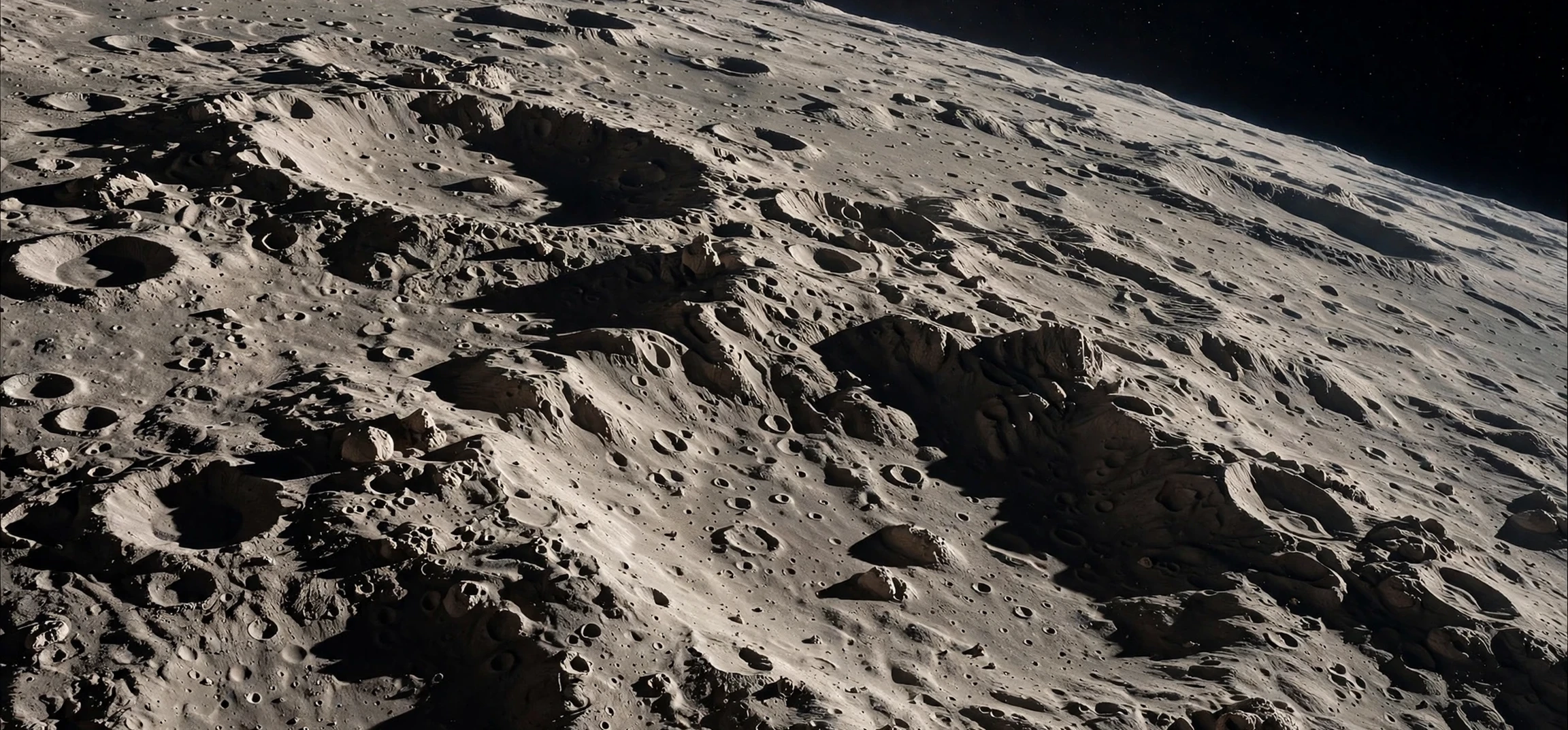
If you searched for “nasa dark side of the moon photos”, you have stumbled onto one of the most fascinating phrases in space science, and one of the most misunderstood. The photographs in question show a part of the Moon that, from Earth, we never see directly. They are not pictures of a permanently black hemisphere, and they were not taken in darkness. They are images of the Moon’s far side, captured by spacecraft that travelled around to the other side of our nearest neighbour and looked back at terrain that Earthbound observers can only imagine. This guide explains what those photographs show, why the far side looks so different, and how the images were made.
The phrase “dark side of the Moon” is poetic, and it has been popularised by music and by everyday speech, but in astronomy it is misleading. The far side of the Moon receives just as much sunlight, on average, as the side we see. What makes it “dark” in the older sense is not shadow but ignorance: for most of human history, it was unknown territory, hidden from every telescope on Earth. The photographs changed that. They turned a blank half of the map into cratered highlands, vast basins, and a landscape with its own distinct character.
NASA Dark Side of the Moon Photos: What They Show
The most striking thing about nasa dark side of the moon photos is how different the far side looks from the familiar face. The side we see from Earth is marked by dark, smooth plains that ancient observers mistook for seas and called maria. The far side has far fewer of those dark plains. Instead, it is densely cratered, rugged, and lighter in overall tone, a landscape that has been battered by impacts over billions of years without the broad volcanic resurfacing that smoothed parts of the near side. When you look at a far-side photograph, you are looking at some of the oldest preserved terrain in the inner solar system.
Among the most recognisable far-side features is the South Pole-Aitken basin, one of the largest impact structures known anywhere. It is so vast that it spans a significant fraction of the far side, and its rim and floor tell scientists about the deep interior of the Moon, since the impact that formed it excavated material from far below the surface. Other features include chains of craters, bright rays thrown out by younger impacts, and highland regions that stand in sharp contrast to the smoother near-side plains. Each photograph, whether a single frame or a stitched mosaic, adds another piece to this battered, ancient landscape.
It is worth pausing on what a photograph from lunar orbit actually is. These are not snapshots taken casually from a window. They are carefully planned observations made by cameras designed to work in harsh light, extreme temperature swings, and a vacuum. Some images are taken in visible light, much like an ordinary camera, while others use different wavelengths to reveal composition, temperature, or height. Colour in many published images is enhanced or assigned to make differences in rock type easier to see, which is why the same region can look subtly different in two different releases. The underlying data, however, is the same ancient surface.
Far Side Versus Dark Side: The Science
The reason we only ever see one side of the Moon is tidal locking. Over billions of years, Earth’s gravity slowed the Moon’s rotation until its spin period matched its orbital period. The Moon now takes the same amount of time to rotate once on its axis as it does to orbit Earth, so the same hemisphere always faces us. This is not a coincidence unique to our Moon. Many moons in the solar system are tidally locked to their planets, always showing the same face to the world they orbit.
Because of tidal locking, the far side was completely unseen until the space age. No telescope, however powerful, can peer around the edge of a sphere. The first glimpse came from a spacecraft that flew around the Moon and photographed the hidden hemisphere, and the images it returned were grainy, strange, and utterly unlike the familiar face. Since then, orbiters have mapped the far side in detail, and today we have complete global maps built from millions of individual images stitched together with great precision.
The “dark side” label also confuses people about day and night on the Moon. A lunar day, from one sunrise to the next at a given spot, lasts about an Earth month, because the Moon rotates so slowly. That means every part of the Moon, near side and far side alike, experiences roughly two Earth weeks of daylight followed by roughly two Earth weeks of night. During a lunar eclipse, when Earth blocks sunlight from reaching the near side, the far side is in full sunlight. There is no hemisphere that lives in permanent darkness, although some deep craters near the poles contain permanently shadowed floors where sunlight never reaches, and those cold traps are of great scientific interest for a different reason: they may hold water ice.
NASA Dark Side of the Moon Photos and the Missions Behind Them
The story of far-side photography is the story of lunar exploration itself. Early flyby missions gave humanity its first rough look, and the crewed Apollo missions that looped around the Moon gave astronauts direct views of the far side with their own eyes, along with photographs taken from orbit. Astronauts described the far side as stark and heavily cratered, a description that has held up as imaging has improved. Those early photographs, grainy by modern standards, were revolutionary: for the first time, the hidden hemisphere had a face.
Modern lunar orbiters have transformed the picture entirely. Spacecraft carrying high-resolution cameras have photographed the Moon’s surface in strips, orbit after orbit, until the whole globe is covered. The resulting mosaics allow scientists to count craters, measure slopes, and trace geological features across the entire far side. Some orbiters also carry laser altimeters, which measure height by timing reflected laser pulses, producing elevation maps that reveal mountains, valleys, and basin rims in three dimensions. Together, photographs and elevation data give a complete portrait of the far side.
Other missions have contributed famous views in which the far side appears alongside Earth. When a spacecraft sits at a vantage point beyond the Moon and looks back, it can capture the Moon’s far side in the foreground with Earth behind it, a perspective no Earthbound observer can ever have. These images are prized not only for their science but for their power to change how we see our place in space. The Moon, so familiar in our night sky, becomes a cratered world in its own right, and Earth becomes a small, bright sphere beyond it.
How Far-Side Images Are Made
Making a far-side photograph involves more than pointing a camera. The spacecraft must be in the right orbit, the lighting must be suitable, and the data must be sent back across hundreds of thousands of kilometres. Because the far side faces away from Earth, a spacecraft orbiting there cannot always communicate directly with home. Orbiters solve this by storing images and transmitting them when they swing around to the near side, or by relaying data through another spacecraft. The result is a steady stream of images that gradually fills in the map.
Image processing matters as much as image capture. Raw frames are corrected for the camera’s quirks, aligned to known coordinates, and adjusted so that neighbouring strips match in brightness. Scientists then combine strips into mosaics that can cover whole regions or the entire globe. Some mosaics are released in natural-looking colour, while others use false colour to highlight differences in mineral composition. Both are honest representations of the data; they simply emphasise different aspects of it. When you see a far-side image online, checking its caption will usually tell you which kind you are looking at.
| Feature of the far side | What it looks like | Why it matters |
|---|---|---|
| Heavily cratered highlands | Densely pitted, rugged, lighter in tone | Preserves a record of ancient impacts |
| Few dark maria plains | Little of the smooth dark terrain seen on the near side | Shows a different volcanic history |
| South Pole-Aitken basin | An enormous ancient impact basin | Exposes deep lunar material for study |
| Polar shadowed craters | Deep floors that never see sunlight | Possible cold traps for water ice |
Why the Far Side Looks So Different
The contrast between the two hemispheres is one of the Moon’s great puzzles, and scientists have proposed several explanations. One leading idea is that the crust is thicker on the far side, which made it harder for volcanic lava to reach the surface and flood impact basins there. On the near side, where the crust is thinner, lava welled up and filled basins, creating the dark plains we see. On the far side, the same basins largely stayed as rugged craters, never smoothed over. The difference in crustal thickness may itself trace back to Earth’s gravitational influence or to an ancient asymmetry in how the Moon cooled.
Another part of the story is the sheer age of the far-side surface. Because it was resurfaced less, it kept more of its early cratering record. Counting those craters gives scientists a clock: surfaces with more craters are generally older, since they have had longer to accumulate impacts. The far side’s dense cratering therefore tells us that we are looking at terrain that has survived, largely unchanged, for billions of years. It is a museum of the early solar system, preserved by the Moon’s lack of weather, water, and plate tectonics.
For readers interested in how we name and picture the worlds around us, our guide to how the planet Earth got its name explores the stories behind familiar names. If you enjoy working with photographs yourself, our guide to how to blur pictures on iPhone covers practical image techniques for everyday photos.
How to View and Understand the Photos
When you browse nasa dark side of the moon photos online, a few habits make the experience much richer. First, check the caption. It will usually tell you which spacecraft took the image, what kind of camera was used, and whether the colour is natural or enhanced. Second, look for a scale or a named feature, which gives you a sense of size. Lunar craters that look modest in a photograph can be tens of kilometres across, and basins can span hundreds. Third, compare the far side with the near side. The contrast in darkness, smoothness, and crater density is the single most instructive thing about these images. That contrast is the first thing most viewers notice in nasa dark side of the moon photos.
It is also worth remembering that a photograph is a moment frozen in particular lighting. Low sunlight throws long shadows that make craters and ridges stand out dramatically, while high sunlight flattens the same terrain and reveals colour and composition differences instead. Scientists deliberately photograph the same region under different lighting to build a complete picture. So if two images of the same area look quite different, that is not a contradiction. It is the same landscape seen under different light, each view revealing something the other hides.
Finally, treat spectacular claims about individual images with care. The internet is full of dramatic captions attached to lunar photographs, and not all of them are accurate. A reliable image will have a clear source, a date or mission context, and a caption that describes what is actually visible. If a caption promises something extraordinary but offers no source, enjoy the image for its beauty and check the claim against a reputable space agency release before repeating it. The real photographs are extraordinary enough without embellishment.
Frequently Asked Questions
Is the dark side of the Moon always dark?
No. The far side receives just as much sunlight as the near side over a full lunar cycle. “Dark” in the old phrase meant unknown, not unlit. Every part of the Moon experiences about two weeks of daylight followed by about two weeks of night.
Why can we not see the far side from Earth?
Because the Moon is tidally locked, rotating once in the same time it takes to orbit Earth once. The same hemisphere therefore always faces us, and the far side never turns into view from any telescope on Earth.
Which spacecraft photographed the far side?
Many missions have contributed, from early flybys that gave the first glimpse, through crewed missions that looped around the Moon, to modern orbiters that have mapped the whole globe in high resolution. The full set of nasa dark side of the moon photos is therefore a team effort across decades, not the work of a single flight.
Are the colours in the photos real?
Some images use natural-looking colour, while others use enhanced or false colour to highlight differences in rock type. Both are based on real data. The caption of a reputable release will tell you which kind you are viewing.
Conclusion
NASA dark side of the moon photos are, at heart, photographs of the unknown made known. They show a hemisphere that humanity could not see for all of history before the space age, and they reveal a landscape older, rougher, and more heavily cratered than the familiar face we see in the night sky. The phrase “dark side” survives because it is poetic, but the science is clearer and more interesting: the far side is not dark, it is simply turned away, and the photographs are our way of turning towards it. The next time you look at the Moon, remember that the face you see is only half the story, and that the other half, photographed by spacecraft that journeyed around to the far side, is just as real, just as ancient, and just as worthy of wonder.