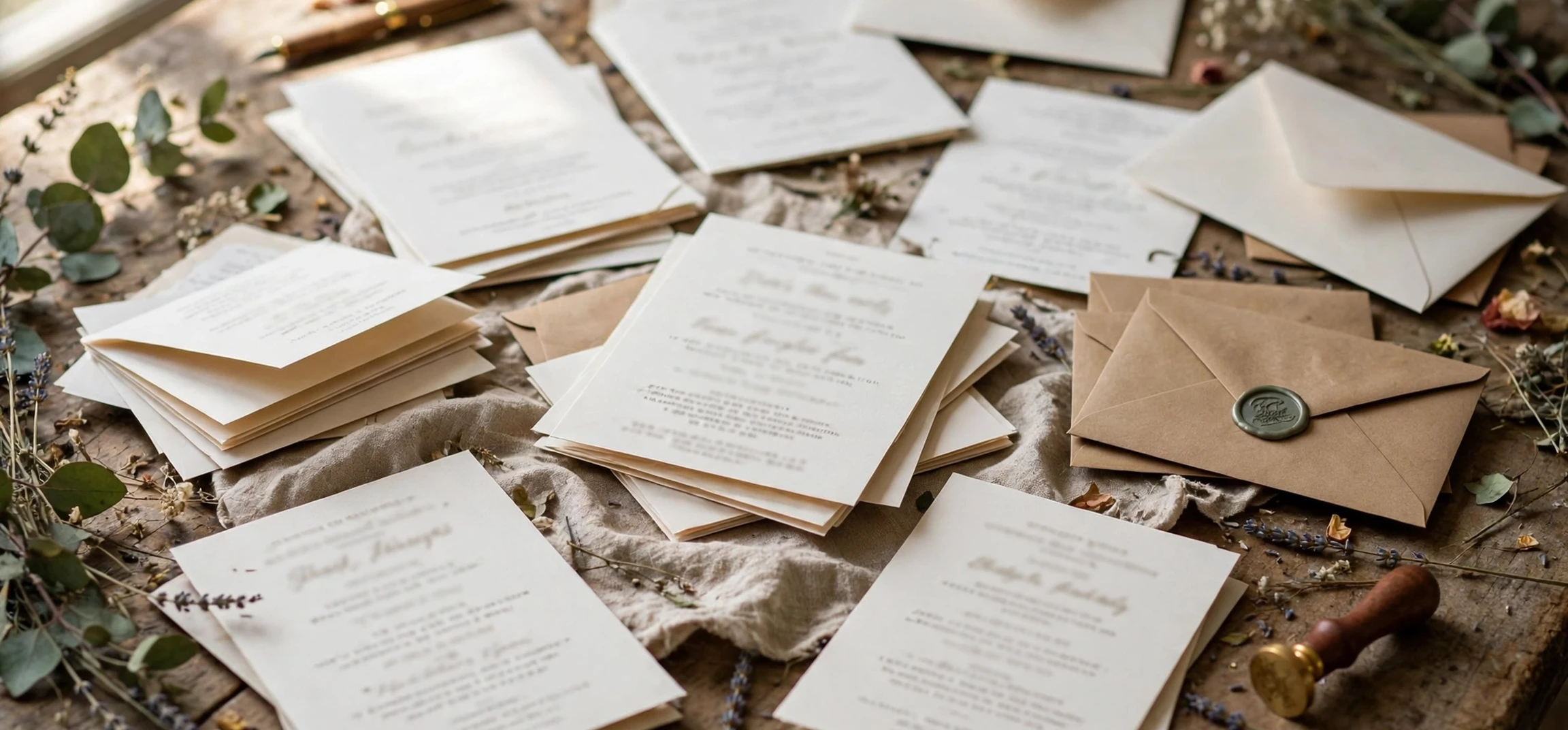
Getting the envelope right matters almost as much as the invitation inside it, and addressing to a family is the part that most often causes hesitation. Should you name every person, use a collective family name, or add children separately? The answer depends on who is invited, how formal the wedding is, and whether children are included, but the guiding principle is simple: make every invited guest feel clearly and warmly included, without inviting anyone by accident. This guide explains addressing to a family step by step, with examples for married couples, unmarried partners, single parents, blended families, and households where children are, or are not, invited.
Addressing to a family starts with one decision: who exactly is on the guest list? Before you write a single envelope, confirm the household list with your partner and, if relevant, your families. A family invitation can mean a couple, a couple with children, a single parent with children, or several adults sharing a home. Each version needs slightly different wording, and guessing can lead to awkward conversations later. Once the list is settled, addressing to a family becomes a matter of following a clear pattern rather than improvising on every envelope.
Addressing to a Family: The Outer Envelope
The outer envelope is the formal, posted envelope, and it carries the full address and the names of the invited guests. For a married couple with the same surname, the traditional form is “Mr and Mrs Thomas Bennett” on the first line, followed by the postal address. For a couple with different surnames, list both names in full, for example “Ms Eleanor Hart and Mr James Whitfield”. Alphabetical order is a safe choice when you are unsure which name should come first, and either partner may reasonably be listed first in a modern invitation.
When addressing to a family that includes children, the outer envelope usually names the adults and adds “and Family” after the family name, such as “Mr and Mrs Thomas Bennett and Family”. This is the classic shorthand, and it is widely understood to include the children who live in that household. It works best when the invitation itself, or the inner envelope, makes clear which children are invited. If only some children are invited, or if the children are adults living elsewhere, do not use “and Family”, because it may be read as an invitation to everyone in the household. In that case, name each invited person individually.
For a single parent, the outer envelope should name the parent first, followed by “and Family” if the children are invited, for example “Ms Sarah Collins and Family”. For an unmarried couple living together, write both full names, joined by “and”, rather than assuming a shared surname. For a household of adult siblings or housemates, name each invited adult separately on the outer envelope, since “and Family” does not suit adults who are not a couple or a parent-child household. Careful addressing to a family in this way prevents the common problem of a guest assuming a partner or housemate is invited when they are not.
Addressing to a Family: The Inner Envelope
Many formal invitations include an inner envelope, which sits inside the outer envelope and holds the invitation card itself. The inner envelope is less formal and more specific: it lists the first names of everyone invited, which is how guests know exactly who is included. For example, an inner envelope might read “Thomas, Eleanor, Sophie and Oliver”, while the outer envelope reads “Mr and Mrs Thomas Bennett and Family”. This pairing gives you both formality on the outside and clarity on the inside.
If you are not using an inner envelope, put that same clarity elsewhere, such as on the reply card or the details card, where you can write the number of seats reserved or the names of the invited guests. Addressing to a family without an inner envelope still works well, provided the invitation does not leave room for doubt. A line such as “We have reserved two seats in your honour” is clearer than a blank reply card, which guests may fill in with extra names. Whatever format you choose, the goal is the same: every invited person should be able to see their name, or a clear family reference, and no one should have to guess.
Children deserve the same clarity as adults. On the inner envelope, list children by first name, in age order from eldest to youngest. If children are not invited, do not list them, and do not add “and Family” to the outer envelope. Instead, address the envelope to the adults only. Many couples worry that this will seem unwelcoming, but a clear adults-only invitation is kinder than an ambiguous one that leads to a difficult conversation at the reply stage. You can soften the message on the details card with a warm note such as “We love your little ones, but we are keeping our celebration adults-only”, which explains the decision without making it feel personal.
Addressing to a Family: Children, Plus-Ones and Blended Families
Blended families call for extra care, because surnames and households may differ. Address the invitation to the adults and children who live together as one household, and send a separate invitation to a parent or child who lives elsewhere, even if they are part of the same wider family. For example, if a child splits their time between two homes, it is usually best to send the invitation to the household where the child is most often based, or to ask a parent which address is preferred. Addressing to a family in a blended situation is less about rigid rules and more about recognising the household as it actually lives day to day.
Plus-ones are a separate question from family invitations. A plus-one is an invited guest of an invited guest, usually a partner, and should be named on the envelope whenever you know their name: “Ms Eleanor Hart and Mr James Whitfield” is clearer than “Ms Eleanor Hart and Guest”. If you do not know the partner’s name, “and Guest” is acceptable on the inner envelope, but it should only be used when a plus-one has genuinely been offered. Never add “and Guest” out of politeness if the guest list does not allow it, because the guest will reasonably assume someone else is invited. Similarly, children over eighteen who live with their parents are usually sent their own invitation, since they are adults in their own right, even if they share an address.
Titles also matter when addressing to a family. Use the titles guests actually use, whether that is Mr, Mrs, Ms, Mx, Dr, or a professional or military title, and do not assume a title from a surname or a relationship. If you are unsure, ask a family member or use the full name without a title. A respectful, accurate form of address is far better than a traditional form that gets someone’s name or identity wrong. For same-sex couples, list both names in full, in the order you would use for any couple, and do not default to one partner’s surname for both. Modern wedding etiquette is flexible on order and formality, but it is firm on accuracy and respect.
Addressing to a Family: Examples at a Glance
The table below gathers the most common household types and the wording that suits each one. Use it as a starting point, then adjust the names, titles, and details to match your own guest list. Remember that these are guides for etiquette, not legal rules, and a warm, clear invitation matters more than perfect traditional form.
| Household type | Outer envelope | Inner envelope |
|---|---|---|
| Married couple, same surname | Mr and Mrs Thomas Bennett | Thomas and Eleanor |
| Couple, different surnames | Ms Eleanor Hart and Mr James Whitfield | Eleanor and James |
| Couple with young children | Mr and Mrs Thomas Bennett and Family | Thomas, Eleanor, Sophie and Oliver |
| Single parent with children | Ms Sarah Collins and Family | Sarah, Mia and Noah |
| Adults only, no children invited | Mr and Mrs Thomas Bennett | Thomas and Eleanor |
| Adult child living at home | Separate invitation in their own name | Their first name alone |
When you review the table, notice how addressing to a family changes with the household, not with the wedding theme. A relaxed countryside wedding and a formal city wedding can both use the same envelope wording, because the wording describes who is invited, not how grand the day will be. If your wedding is very informal, you may choose first names only on both envelopes, and that is perfectly acceptable, provided the invited guests are still clear. Formality is a style choice; clarity is an etiquette requirement.
Addressing to a Family: Common Mistakes to Avoid
The most common mistake in addressing to a family is using “and Family” when only some family members are invited. A second common mistake is addressing an invitation to “The Bennett Family” without naming anyone, which can leave guests unsure whether children, partners, or adult children are included. A third mistake is assuming a surname: writing a partner’s surname as if it matches the other partner’s, or using a married name for someone who does not use it. Each of these is easy to avoid with a quick check of the guest list and, when in doubt, a polite question to someone who knows the family well.
Another mistake is handwriting that is beautiful but unreadable. Calligraphy is lovely, but the postal service and your guests still need to read the names and address. If you are handwriting envelopes, write slowly, use a dark ink, and double-check every spelling before sealing. For printed envelopes, use a clear font at a readable size, and proofread a sample before printing the full set. A misspelt name on an otherwise perfect invitation can overshadow the care you put into everything else, so this final check is worth the time. For more ideas on wording and household guides, see our family-oriented guide and our writing guide, and for posted invitations generally, our direct mail guide may help with presentation.
Finally, remember that addressing to a family is also about timing and tone. Send invitations early enough for families to arrange childcare, travel, and time off, and keep the tone warm throughout. If a family cannot attend in full, thank them graciously for whatever part they can share, and do not press for explanations. Weddings bring families together, and a thoughtfully addressed invitation is a small but meaningful way of saying that every invited person matters, by name and as part of the family group.
Addressing to a Family: Frequently Asked Questions
Should I write “and Family” if children are not invited?
No. Addressing to a family with “and Family” is understood to include the children of the household, so leave it off when the invitation is adults-only, and name the adults only on the envelope.
Do adult children living at home get their own invitation?
Usually, yes. Adults are normally invited in their own right, with their own envelope, even if they share an address with their parents. This avoids any doubt about whether they are included.
What if I do not know a plus-one’s name?
Use “and Guest” on the inner envelope only when a plus-one has genuinely been offered. If you can find out the name before posting, do so, because a named guest always feels more welcome than a generic guest.
Can I use first names only on the envelope?
Yes, for an informal wedding, first names on both envelopes are perfectly acceptable. The key point in addressing to a family is clarity about who is invited, not the level of formality.
Conclusion
Addressing to a family is straightforward once you decide who is invited and write it down clearly: name the adults on the outer envelope, add “and Family” only when children are included, list every invited person by first name on the inner envelope, and send separate invitations to adults living in the same household. Check titles and surnames, proofread every envelope, and keep the tone warm. Done well, addressing to a family sets the tone for the whole celebration, showing each household that they are genuinely wanted, clearly invited, and warmly welcomed.