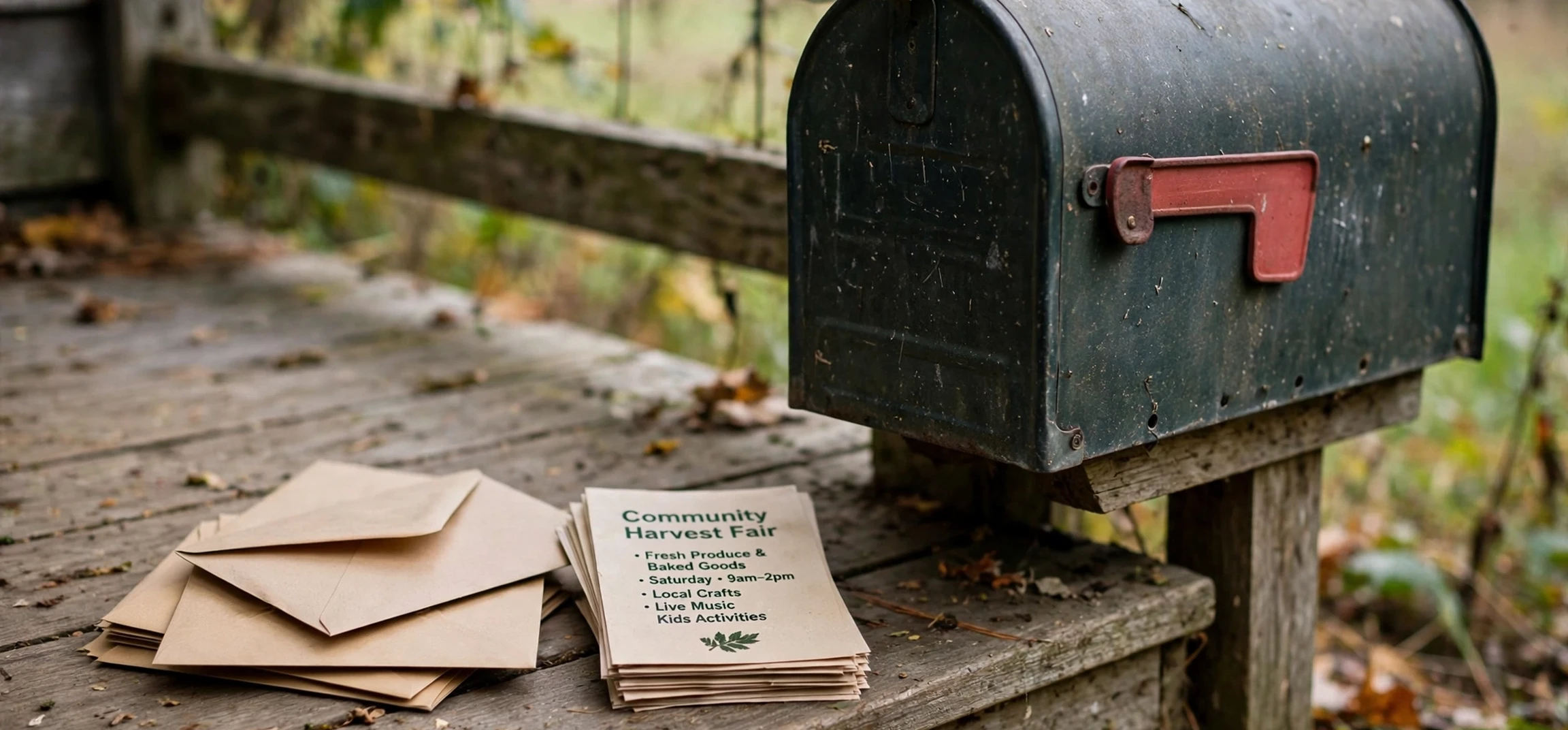
US mail advertising, better known as direct mail advertising, is one of the oldest forms of small-business marketing — and it still works, because a well-designed postcard or letter lands in a home, stays on a fridge or a desk, and reaches people who may never see your online adverts. This guide explains US mail advertising from scratch: what it is, which formats suit a small budget, how to target the right households or businesses, what a campaign costs, how to design mail that gets opened, and how to track whether it actually brings in customers.
Direct mail is not about sending as much paper as possible. It is about sending the right offer to the right people at the right time, with a clear next step. A local café, a plumber, a dentist, a boutique or a trades business can all use US mail advertising profitably, provided the campaign is planned, the list is sensible and the results are measured. This guide shows you how, step by step, without jargon and without a large agency budget.
US Mail Advertising Basics: What Direct Mail Really Is
US mail advertising means promoting a business by sending printed material through the postal service directly to homes or businesses. Unlike a general advert in a newspaper or on a billboard, direct mail is addressed and targeted: you choose who receives it, whether by neighbourhood, by postcode area, by customer type or by past purchase history. That targeting is its main advantage.
Common formats include postcards, letters, flyers, brochures, catalogues and door-hangers delivered by post. Postcards are the most popular choice for small businesses because they are cheap to print and post, need no envelope, and are read at a glance. Letters feel more personal and suit higher-value offers or existing customers. Brochures and catalogues suit businesses with many products or services to show, but they cost more and should be used only when the offer justifies the expense.
Direct mail works best as part of a wider marketing mix, not as a replacement for it. A postcard that drives people to your shop, your phone number or your website works harder when the website and the shop experience match the promise on the card. Think of US mail advertising as the invitation: the rest of your business must deliver on it.
US Mail Advertising: Targeting the Right Audience
Targeting decides whether US mail advertising makes money or wastes it. Start with geography: for most local businesses, the customers who matter live or work within a short drive. Mailing every household in that area, known as saturation mailing, is simple and effective for broad offers such as a new shop opening or a seasonal sale. It is also relatively affordable per piece, because postal services often offer bulk rates for saturation routes.
Targeted mailing is more selective. You might mail only homes in certain neighbourhoods, only businesses of a certain type, or only your existing customers. Targeted lists can come from your own customer records, which are usually your best list, because those people already know you. Rented or purchased lists are also available, but they must be used lawfully and respectfully: only use reputable list providers, follow postal and privacy rules, and never buy lists that appear to contain private or scraped personal data.
Segmentation improves results further. New customers need a clear introduction and an incentive to try you. Existing customers respond better to loyalty offers, reminders and seasonal services. Lapsed customers — people who have not bought for a while — often respond to a “we miss you” offer. Sending the same card to all three groups is simpler, but sending a tailored version to each group usually earns a higher response.
US Mail Advertising: Designing Mail That Gets Opened and Read
Design is where many small-business mail campaigns succeed or fail. A postcard has only a few seconds to earn attention, so the headline must state the benefit immediately: what you offer, for whom, and why it matters now. Avoid clever but vague headlines. “Half-price gutter cleaning this month for homes in Riverside” beats “Quality you can trust” every time, because it is specific, local and time-limited.
Keep the layout clean. One main message, one clear offer and one call to action are enough. Include your business name, phone number or website, and address or service area, so that a reader who is interested can act without searching. Use a large, readable typeface, high-contrast colours and a real photograph of your work, your shop or your team where possible. Stock images can look generic; a genuine photo builds trust.
For letters, the opening matters most. Address the reader by name where you have it, state the reason for writing in the first two sentences, and keep the letter to one page where possible. A personal signature, even a printed one, adds warmth. For all formats, proofread carefully: a spelling error or a wrong phone number can undo an otherwise excellent campaign, and it is expensive to reprint.
US Mail Advertising: Costs, Budgets and What to Expect
Costs for US mail advertising fall into three parts: design, printing and postage. Design can be free if you use a template, or a modest one-off cost if you hire a designer. Printing costs fall sharply with quantity, which is why postcards are often printed in batches of 500 or 1,000. Postage is usually the largest cost, and bulk postal rates can reduce it significantly compared with single-piece stamps, especially for saturation mailings.
As a planning guide, a small local campaign of 1,000 postcards might cost a few hundred to over a thousand dollars in total, depending on size, colour, paper and postage class. Larger campaigns cost more in total but less per piece. Always get quotes for design, print and postage together before committing, and ask your printer or mail house about postal discounts, paper options and delivery timing. A mail house can also handle addressing, sorting and delivery, which saves considerable time on larger runs.
Response rates vary widely by industry, offer and list quality. A typical direct mail response rate for a local small business is often in the low single digits as a percentage, which sounds small until you calculate the value of each new customer. If a new customer is worth hundreds of dollars over a year, even a modest response can pay for the campaign many times over. That lifetime value, not the response rate alone, is the number that matters.
| Format | Best for | Relative cost | Key strength |
|---|---|---|---|
| Postcard | Local offers, openings, sales | Low | Seen at a glance, no envelope needed |
| Letter | Personal offers, existing customers | Medium | Feels personal and detailed |
| Flyer | Events, menus, services lists | Low to medium | Room for more detail than a card |
| Brochure | Multi-service businesses | Medium to high | Professional, keeps well at home |
| Catalogue | Product ranges | High | Full range showcase, higher ticket sales |
US Mail Advertising: Tracking Results and Improving Each Campaign
Tracking is what turns US mail advertising from a gamble into a system. The simplest method is a unique offer code on each campaign: a discount code, a “mention this card” offer or a dedicated phone extension. When customers use the code, you know exactly which mailing brought them in. A dedicated landing page for a campaign works the same way online, and it lets you measure visits as well as sales.
Record three numbers for every campaign: how many pieces you sent, how many responses you received, and how much revenue those responses produced. From those, calculate cost per response and return on spend. If a campaign loses money, do not simply repeat it larger: change one variable at a time — the headline, the offer, the audience or the timing — and test again. Small, steady improvements compound into a reliable channel.
Timing also matters. Seasonal businesses should mail before the season, not during it. A heating business mails in autumn, a garden business in spring, and a gift shop before major holidays. Mailing too late means customers have already chosen a provider. Plan your calendar a month or two ahead, and allow time for design, printing and postal delivery, which can take a week or more for bulk mail.
For related business guidance, see our business function taxonomy guide, our letterhead address format guide and our ecommerce job title guide. Together, they cover the structure, presentation and roles behind a professional small business.
Frequently Asked Questions: US Mail Advertising
Does US mail advertising still work for small businesses?
Yes, especially for local businesses. Direct mail reaches homes regardless of online algorithms, stays visible longer than a social media post, and works well for neighbourhood offers, services and repeat customers.
What is the cheapest way to start with direct mail?
Start with a postcard to a small local area or to your existing customers. Keep the design simple, use a clear offer, and track responses with a unique code so you can judge the result before scaling up.
How many pieces should I send?
Start with 500 to 1,000 pieces for a first test. That is enough to see a response pattern without risking a large budget, and you can expand the winning version in the next round.
Do I need a mail house?
Not for a small run, which you can address and post yourself. For larger runs, a mail house saves time on printing, addressing, sorting and postal discounts, and is usually worth the fee.
How do I stay lawful and respectful with mailing lists?
Use your own customer records first, use reputable list providers for rented lists, follow postal and privacy rules in your area, and always include your business name and a way to opt out of future mail where required.
Conclusion: Making US Mail Advertising Work for You
US mail advertising rewards clarity, targeting and measurement. Choose a format that fits your budget, mail a specific offer to a well-chosen audience, design for a few seconds of attention, and track every response. Start small, learn what your local customers respond to, and repeat what works. Done that way, direct mail is not an old-fashioned expense — it is a dependable, local marketing channel that can bring new customers through your door month after month.



