If you have ever wondered about metronomes definition, you are asking about one of the simplest and most useful tools in music. A metronome is a device, or an app, that produces regular beats at a chosen speed so that musicians can practise, perform, and record in steady time. When people search for metronomes definition, they usually want more than a one-line answer: they want to know how the tool works, what its settings mean, how different types are used, and how it helps players of every instrument. This guide covers all of that in plain language, with practical examples for beginners and for more experienced players.
Timing is the backbone of music. A melody can be beautiful, but if its rhythm wobbles, the performance feels unsteady. A metronome gives an external, impartial pulse that does not get tired, distracted, or carried away by excitement. By practising with that pulse, musicians train their internal sense of time, learn to play evenly, and build the control needed to speed up gradually without losing accuracy. It is used in bedrooms, classrooms, rehearsal rooms, studios, and concert halls, and it is just as useful for a first-week piano student as for a professional drummer.
Metronomes Definition: What Is a Metronome?
The core metronomes definition is straightforward: a metronome is a timekeeping device that marks time at a regular, adjustable rate, producing an audible click, beep, or visual flash on each beat. The rate is measured in beats per minute, usually shortened to BPM. A setting of 60 BPM means one beat per second, 120 BPM means two beats per second, and so on. The musician chooses a tempo, starts the metronome, and plays one note, chord, or step per beat, or a fixed number of notes per beat, depending on the exercise.
Most metronomes also let you set a time signature or an accent pattern, so that the first beat of each bar sounds different from the others. That accent helps a player feel where each bar begins, which is essential in music with a strong pulse, such as a march in four-four time or a waltz in three-four time. Some metronomes add subdivisions, sounding two, three, or four smaller clicks inside each main beat, which helps players practise faster passages cleanly. These features turn a simple clicker into a flexible practice partner.
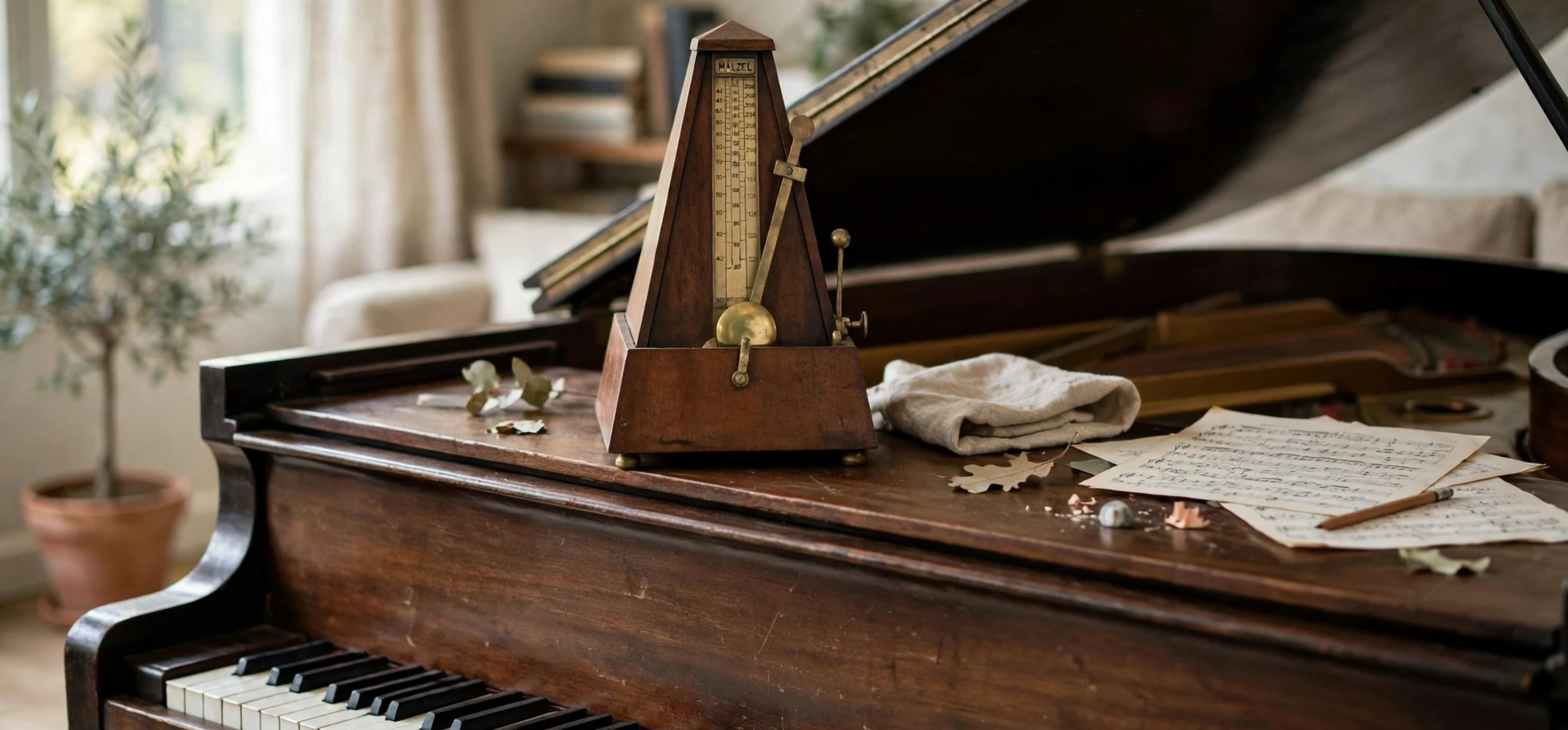
The word itself comes from Greek roots meaning measure and time, which is a neat summary of what the tool does: it measures time for music. Early mechanical metronomes used a swinging pendulum with a sliding weight, and the position of the weight set the tempo. Modern electronic and app metronomes use a quartz timer or a digital clock, but the job is unchanged. Whether the beat comes from a wooden pyramid on a piano or from a phone app, the metronomes definition remains the same: a regular, adjustable pulse for musical timekeeping.
Metronomes Definition: Types of Metronome
Mechanical metronomes are the classic wind-up pyramid shape many people picture. They need no batteries, they are satisfyingly visual because you can watch the pendulum swing, and their tick has a warm, wooden character. Their tempo range is usually marked on a scale, and you set it by sliding a weight up or down the pendulum rod. They are less precise than digital models at very fast or very slow extremes, and they can be affected if the surface is not level, but many players love them for their simplicity and charm.
Electronic metronomes are small, battery-powered boxes with a speaker, a display, and buttons or a dial. They offer precise BPM settings, a wider tempo range, volume control, headphone output, and often a tap-tempo feature: tap a button in time with a song and the device calculates the BPM. Many also offer different click sounds, accent patterns, and a visual flashing light. They are portable, affordable, and popular with students who need accuracy without fuss.
App and software metronomes run on phones, tablets, and computers. They add features that hardware cannot easily match, such as set lists, practice logs, programmable tempo changes, and polyrhythm modes that play two patterns at once. Some integrate with recording software, so a studio track can be recorded to the same click that the band rehearsed with. The main drawback is distraction: a phone full of notifications is not an ideal practice companion, so many players use a dedicated device or put the phone in a focus mode during practice.
There are also specialist forms, such as clip-on vibrating metronomes worn on the body, which let a performer feel the beat without hearing a click, and large visual metronomes for conductors and ensembles. In an orchestra, the conductor’s beat serves as a living metronome, but rehearsals still use click tracks and metronome markings to agree on tempo. For related musical vocabulary, see our guides to rubato in music and subito in music, both of which describe expressive departures from a strict pulse that only make sense once a steady pulse is understood.
How to Use a Metronome in Practice
- Start slower than the target tempo. Choose a speed where you can play the passage accurately and evenly, even if it feels easy.
- Play with the click, not against it. Aim to land each note exactly on the beat, and listen for whether you are rushing ahead or dragging behind.
- Increase gradually. Raise the tempo by small steps, such as four to eight BPM at a time, and only move up when the slower speed feels secure.
- Use subdivisions for fast passages. If a run feels messy at full speed, set the metronome to sound smaller divisions so every note has a reference point.
- Practise without the click sometimes. Once a passage is secure, turn the metronome off and check whether your internal pulse holds steady on its own.
A useful exercise is to set the metronome to sound only on some beats, for example only on beats two and four, or only on the first beat of each bar. This forces you to keep time internally for the silent beats and reveals whether you are truly steady or merely following the click. Another exercise is to practise a scale or arpeggio with the metronome, then gradually remove beats until you can play a whole bar with only one click to anchor it. These drills build a stronger internal clock than simply playing along to every click.
Teachers often warn against two habits. The first is starting too fast and practising mistakes at speed, which trains errors into muscle memory. The second is ignoring the metronome when it feels uncomfortable, which is usually a sign that the tempo is revealing a real weakness. A metronome is not a judge; it is a mirror. If you consistently rush a particular bar, that bar needs slower, focused work, not a faster tempo setting.
Tempo Markings, BPM, and a Short History
Sheet music often includes a metronome marking, written as a note value followed by an equals sign and a number, for example a crotchet equals 120. That marking tells the player the intended beats per minute for that note value. Italian tempo words, such as allegro for fast and andante for a walking pace, give a general character, and the metronome number makes that character precise. A piece may also include tempo changes, marked with new numbers or with words meaning to speed up or slow down.
The mechanical metronome as we know it was patented in the early nineteenth century, and composers such as Beethoven embraced it as a way to communicate tempo exactly. Before that, tempo was described only in words, which left much more room for interpretation. The metronome did not end debate about tempo: performers still interpret markings in light of style, acoustics, and expression. But it gave musicians a shared reference point, and it remains the standard way to record and communicate tempo in scores, rehearsals, and recording sessions.
Choosing the Right Metronome for You
- Beginners: an app or a simple electronic model is enough. Look for clear BPM display, volume control, and a tap-tempo button.
- Piano and classroom players: a mechanical metronome looks good on the instrument and needs no batteries, but check that its tick is loud enough for your room.
- Drummers and band players: look for a loud click, headphone output, and subdivision options, since drums need a clear pulse in a noisy room.
- Recording musicians: choose a model or app that can sync with recording software and save tempo maps for each song.
- Performers who dislike audible clicks: consider a vibrating metronome that pulses silently against the skin.
Price is not a reliable guide to usefulness. A free app can serve a beginner perfectly well, while a professional may pay for a rugged device with precise controls and a long battery life. What matters is that you actually use it. The best metronome is the one that is within reach, easy to start, and loud or visible enough for your instrument and room. Keep it beside your practice space, not in a drawer, and make it part of your warm-up routine.
Frequently Asked Questions About Metronomes Definition
What does BPM mean on a metronome?
Beats per minute. It counts how many beats the metronome sounds in one minute, so higher numbers mean faster tempos and lower numbers mean slower tempos.
Do I need a metronome if I can already keep time?
Even strong players use one to check their steadiness, to practise gradual speed increases, and to agree on tempo with other musicians or a recording session. It is a checking tool, not only a beginner’s aid.
Is a mechanical or digital metronome better?
Neither is universally better. Mechanical models are visual and need no power, while digital models are more precise and offer more features. Choose based on your instrument, room, and budget.
Can a metronome help with exam or audition preparation?
Yes. Examiners and audition panels notice steady rhythm, and systematic metronome practice is one of the most reliable ways to build it. Start slow, increase gradually, and record yourself to check progress.
Metronomes Definition: What Searchers Usually Want to Know
When someone types metronomes definition into a search engine, the question is usually practical: what is this tool, and why do musicians use it? The phrase metronomes definition points to a simple answer, a device that marks musical time with a regular beat, but the full metronomes definition includes tempo settings, accent patterns, and practice methods. Searching for metronomes definition is often the first step for a student who has just been told to practise with one, or for a parent buying a first metronome.
The most useful part of any metronomes definition is the practice advice that follows it. A metronomes definition that only names the tool misses why it matters: steady time, gradual speed building, and honest feedback about rushing or dragging. If you remember one idea from this metronomes definition, let it be the habit of starting slow, listening carefully, and increasing tempo only when accuracy is secure. That habit turns the metronomes definition from a dictionary entry into a daily practice tool that genuinely improves playing.
In short, metronomes definition means a steady, adjustable musical pulse. Keep this metronomes definition in mind every time you practise, and let the metronomes definition guide you to start slow and build speed gradually.
Conclusion
The metronomes definition, at its heart, is simple: a tool that gives musicians a regular, adjustable beat, measured in beats per minute, so they can practise and perform in steady time. From the swinging pendulum of a mechanical model to the programmable clicks of a modern app, the purpose has not changed. A metronome trains your internal clock, reveals rushing and dragging, and lets you build speed without sacrificing accuracy. Whether you are learning your first scale, preparing for an exam, or recording with a band, a few minutes of focused metronome practice each day will make your playing noticeably steadier. Start slow, listen honestly, and let the pulse do its quiet, steady work.