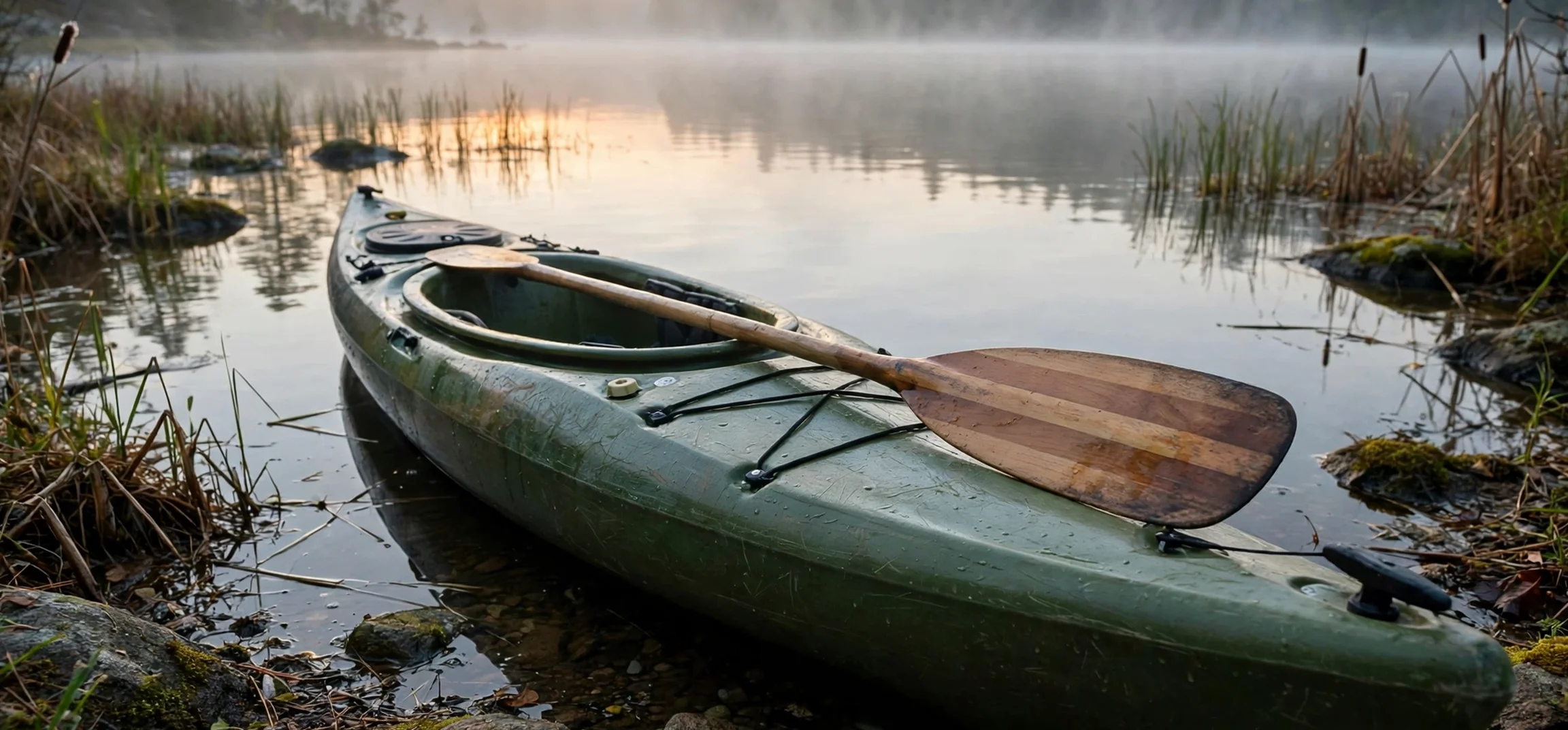
Choosing the right size of paddle for kayak trips is one of the easiest ways to make paddling more comfortable, more efficient, and more enjoyable. A paddle that is too long forces your hands high, strains your shoulders, and makes each stroke feel heavy. A paddle that is too short forces you to lean and reach, splashes water into the boat, and makes it hard to steer straight. The correct size depends mainly on your height, the width of your kayak, and the style of paddling you plan to do, with touring, recreational, and whitewater paddling each favouring a slightly different length. This guide explains how to measure, how to use height charts sensibly, how blade shape and shaft type affect the choice, and how to test a paddle before you buy. It covers general recreational advice only: always follow the safety guidance for your local waters and wear a properly fitted life jacket.
Size of Paddle for Kayak Trips: The Basics
A kayak paddle is measured from tip to tip, in centimetres, and most adult recreational paddles fall between about 210 and 240 centimetres. The length is not a fashion choice. It sets the angle of your stroke, the height of your hands, and how far the blade reaches into the water beside the boat. A wider kayak needs a longer paddle, because the blade must clear the side of the boat and still enter the water cleanly. A narrower kayak allows a shorter paddle, because the blade is already close to the water. Your height matters because taller paddlers have longer arms and a higher seating position, so they can handle, and usually need, a longer shaft to keep the stroke comfortable.
Paddling style matters just as much. Low-angle paddling, the relaxed touring style in which the shaft stays closer to horizontal and the blade enters the water at a shallow angle, usually suits a longer paddle. High-angle paddling, the more powerful style used for speed, fitness paddling, and whitewater, usually suits a shorter paddle, because the blade moves more vertically and the stroke is quicker. Recreational paddling on calm lakes and slow rivers usually sits between the two. If you are buying your first paddle and you plan to paddle calm water at a relaxed pace, a mid-length touring or recreational paddle is the safest starting point.
Size of Paddle for Kayak Choice by Height and Boat Width
Height charts are a helpful starting point, but they are guides, not rules, because boat width and paddling style change the answer. As a general pattern, shorter paddlers in narrower boats use shorter paddles, while taller paddlers in wider boats use longer paddles. A paddler under about 165 centimetres tall in a narrow touring kayak might start around 210 to 220 centimetres. A paddler between about 165 and 180 centimetres in a typical recreational kayak might start around 220 to 230 centimetres. A paddler over about 180 centimetres, or anyone in a wide fishing or tandem kayak, might start around 230 to 240 centimetres. These are starting ranges for trying paddles, not prescriptions, and the best test is always to sit in your own boat and paddle.
Boat width is the detail most beginners overlook. A fishing kayak that is 85 centimetres wide needs a noticeably longer paddle than a touring kayak that is 55 centimetres wide, even for the same paddler. A tandem kayak, a sit-on-top with a high seat, and a kayak with a raised fishing seat all raise your seating position or widen the distance to the water, which again points to a longer paddle. If you paddle more than one boat, you may need to compromise, or choose an adjustable paddle that covers a range of lengths. Adjustable paddles are heavier and slightly less rigid than fixed-length paddles, but for a beginner who shares boats or is still learning their style, the flexibility is often worth it.
Quick Sizing Guide
| Paddler height (approx.) | Narrow kayak (touring) | Average recreational kayak | Wide kayak (fishing or tandem) |
|---|---|---|---|
| Under 165 cm | 210 to 220 cm | 220 to 230 cm | 230 cm |
| 165 to 180 cm | 210 to 220 cm | 220 to 230 cm | 230 to 240 cm |
| Over 180 cm | 220 cm | 220 to 230 cm | 230 to 240 cm |
Read this table as a shortlist for testing, not as a final answer. If you fall between two rows, or between two boat widths, try both lengths on the water if you can. A ten-centimetre difference is easy to feel after twenty minutes of paddling, even if it looks tiny on a shop floor.
Blade Shape, Size, and Material
Once the length is roughly right, blade shape changes how the paddle feels. A long, narrow blade suits low-angle touring: it enters the water quietly, pulls smoothly, and is gentle on shoulders over a long day. A shorter, wider blade suits high-angle paddling: it catches more water per stroke, gives more power, and suits shorter, faster trips, but it can tire shoulders more quickly. Beginners usually do best with a mid-sized blade, because it is forgiving, does not demand perfect technique, and works for both relaxed and moderately brisk paddling. Very large blades look powerful, but they are harder to control and can strain joints if your technique is still developing.
Material affects weight, stiffness, and price. Plastic and aluminium paddles are affordable, tough, and fine for occasional recreational use, but they are heavier, and weight matters more than many beginners expect: you lift the paddle thousands of times in a single outing. Fibreglass paddles are lighter and more comfortable for longer trips, while carbon paddles are the lightest and stiffest, at a higher price. A lighter paddle is not just a luxury; it reduces fatigue and makes it easier to keep good technique late in the day. If your budget forces a choice, many experienced paddlers suggest prioritising a lighter paddle over a more expensive boat accessory, because the paddle is the part you move constantly.
Shaft Shape, Feathering, and Grip
The shaft is the part you hold, and its shape matters for comfort. A straight shaft is simple, strong, and common. A bent shaft, which has a slight bend where each hand grips, can reduce wrist strain for some paddlers, especially on longer trips. Oval or indexed shafts help you feel the blade angle without looking, which is useful for beginners who are still learning to keep the blade square in the water. If you have small hands, check the shaft diameter in the shop: a shaft that is too thick will tire your hands and make your grip slip when wet.
Feathering is the angle between the two blades. On a feathered paddle, the blades are offset, often by about 60 degrees, so that the blade in the air slices through the wind rather than catching it. Feathering helps in wind, but it requires a wrist movement on each stroke, which some beginners find awkward. Many modern paddles allow you to adjust the feather angle, or to set the blades unfeathered, with both blades in the same plane. Starting unfeathered is simpler, and you can experiment with feathering later once your basic stroke feels natural. Drip rings, small rubber rings near each blade, help keep water from running down the shaft onto your hands and lap, and they are worth checking when you buy.
Paddle Length for Different Kinds of Kayaking
Recreational kayaking on calm lakes, canals, and slow rivers is the most forgiving setting. A mid-length paddle with a mid-sized blade, chosen from the table above, will suit most people. Touring and sea kayaking usually favour a slightly longer, narrower-bladed paddle for efficient low-angle strokes over long distances, and touring paddlers often carry a spare paddle as well. Whitewater kayaking uses much shorter paddles, often around 190 to 205 centimetres for adults, because the boat is short and wide, the strokes are fast and vertical, and a long paddle would be clumsy in rapids. Fishing kayaks, with their wide hulls and high seats, need the longest recreational paddles, and many fishing paddlers also value a paddle with a hook-retrieval notch or a measuring scale on the shaft.
Children need properly sized paddles too, not simply a cut-down adult paddle. A child paddle is shorter, lighter, and has a smaller shaft and blade, so a young paddler can control it without tiring quickly. Buying a child an adult paddle “to grow into” usually backfires, because the child learns poor technique to cope with the weight and length, and enjoys paddling less. The same principle applies to smaller adults: a paddle that fits your body and boat will always beat a paddle chosen for someone else’s size. For ideas about getting out on the water more generally, see guided fishing trips on the water and other outdoor guides on this site.
How to Test a Paddle Before You Buy
The shop-floor test is a useful first step. Stand the paddle upright beside you: for a low-angle touring style, the top of the paddle should reach roughly between your chin and your forehead when the blade tip is on the ground, while high-angle paddlers often choose a paddle that reaches nearer chin height. This standing test is only a rough check, because it does not account for boat width or seating height. The better test is to sit in a kayak, or in a demo boat of similar width, hold the paddle with your hands about shoulder-width apart, and mime a stroke. Your top hand should stay below shoulder height, your elbows should stay comfortably bent, and the blade should reach the water without you leaning far to either side.
If a shop or club offers on-water demos, take them. Paddle for at least fifteen minutes, try a gentle cruise and a few stronger strokes, and notice your shoulders, wrists, and lower back. A paddle that feels fine for two minutes can feel heavy after half an hour, and that is the feeling that matters. Borrow from friends or a paddling club before buying if you can, and note the length, blade size, and material of any paddle you enjoy. Keep a short note of what worked, because paddle lengths are easy to forget once you are back in the shop. If you are also comparing outdoor gear suppliers, you may find this guide to identifying an outdoor gear website useful background reading.
Common Paddle Sizing Mistakes to Avoid
The most common mistake is buying the longest paddle in the shop in the belief that longer means better reach. In practice, an over-long paddle raises your hands, increases wind resistance, and makes each stroke heavier. The second mistake is copying a friend’s paddle length without accounting for a different boat width or height. The third mistake is choosing purely on price and ending up with a very heavy paddle that discourages longer trips. The fourth mistake is ignoring blade size: a long paddle with a huge blade can be exhausting, while a shorter paddle with a modest blade can feel effortless. Finally, many beginners forget transport and storage: a two-piece or four-piece paddle packs into a car and a cupboard far more easily than a one-piece paddle, and a four-piece paddle is easier to take on a flight or a long trip.
Maintenance matters too, whatever length you choose. Rinse a paddle with fresh water after saltwater use, check ferrules and joints for sand and grit, and store it out of prolonged direct sunlight. A paddle that clicks, wobbles, or sticks at the joint needs cleaning or repair before your next trip, because a joint failure on the water is more than an inconvenience. With basic care, a good paddle lasts for years, and the right length will still feel right as your technique improves.
Frequently Asked Questions
What length paddle do I need for a recreational kayak?
Most adults in an average recreational kayak start with 220 to 230 centimetres, adjusting up for a wider boat or greater height and down for a narrower boat or high-angle style. Test on the water if possible.
What happens if my kayak paddle is too long?
Your hands rise too high, your shoulders tire faster, and each stroke feels heavier. You may also catch more wind with the blade that is out of the water.
What happens if my kayak paddle is too short?
You lean and reach to get the blade into the water, splash more water into the boat, and find it harder to steer straight, especially in a wide kayak.
Are adjustable paddles a good choice for beginners?
Yes, for many beginners. They let you try different lengths, share a paddle between boats, and adjust as your style develops, even though they are slightly heavier than a fixed-length paddle.
Conclusion
The right size of paddle for kayak trips comes down to three questions: how tall are you, how wide is your boat, and how do you like to paddle. Start with the height and width guide in this article, favour a mid-sized blade and a comfortable weight, and test on the water whenever you can. A paddle that fits will keep your hands low, your shoulders relaxed, and your strokes efficient, which means longer, happier days on the water. Avoid the temptation to buy the longest or cheapest paddle by default, and remember that a lighter, well-sized paddle is an investment in every trip you take. Once you have found a length that feels natural, note it down, look after the paddle, and enjoy the difference a good fit makes on your next outing.



