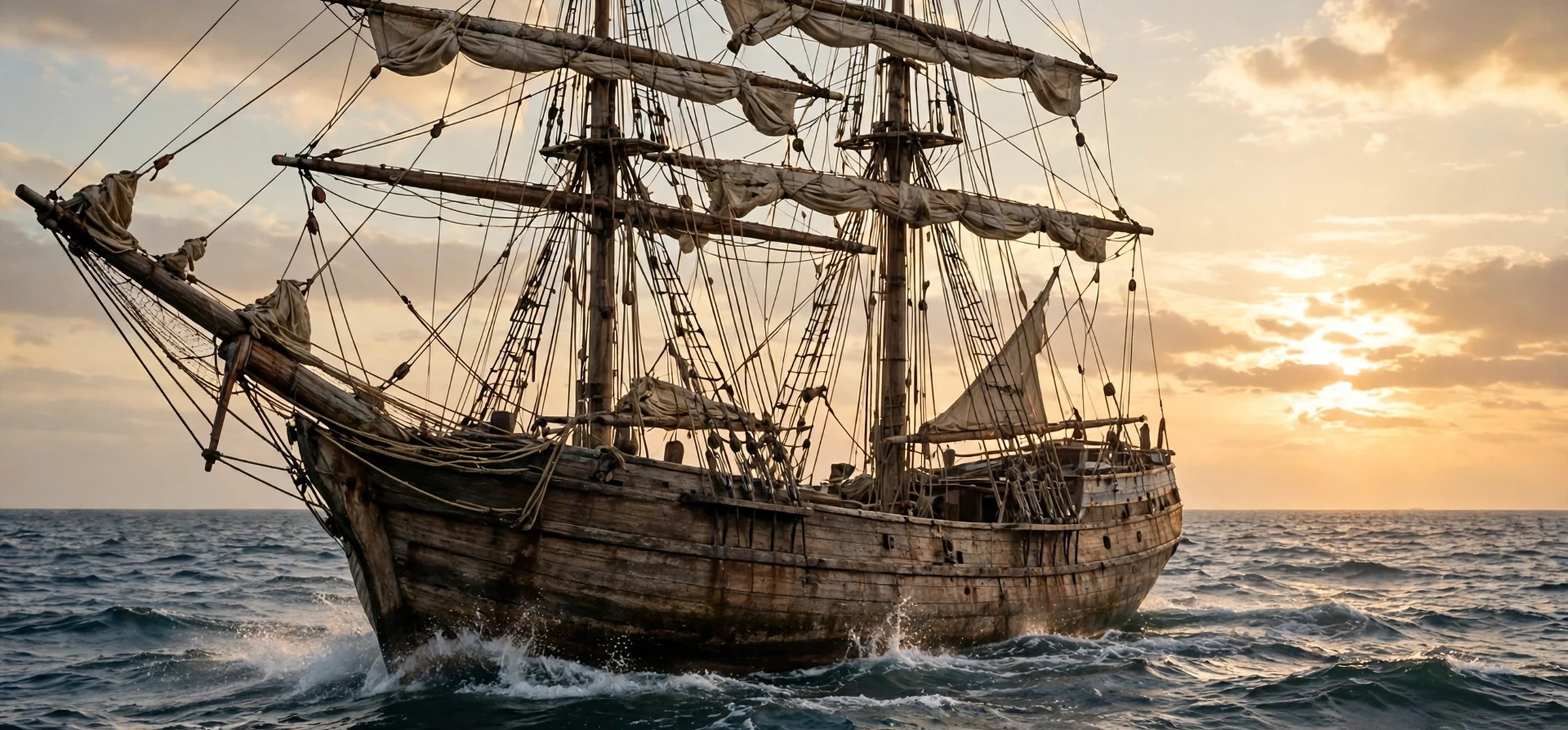
The question what was blackbeards ships name has a clear answer, and it opens a door into one of the most fascinating stories of the Golden Age of Piracy. Blackbeard’s most famous ship was the Queen Anne’s Revenge, a vessel he captured, refitted as a pirate flagship, and used to terrorise shipping along the American coast. This guide explains the ship’s history, how Blackbeard acquired it, what made it formidable, and what happened to it, separating documented history from the legends that grew up around it.
Who Was Blackbeard?
Blackbeard, whose real name was probably Edward Teach, or Thatch, was an English pirate active in the early eighteenth century, during the period historians call the Golden Age of Piracy. He is remembered for his fearsome appearance: a tall figure with a long black beard, into which he supposedly wove slow-burning fuses to create a terrifying, smoking silhouette in battle. That theatricality was deliberate. Blackbeard understood that reputation could win a surrender without a fight, and he cultivated his image accordingly.
His career was actually short, lasting only about two years as an independent captain, from around 1716 until his death in 1718. In that brief span he became the most famous pirate of his age, a reminder that legend and longevity are not the same thing. Much of what people “know” about him comes from a single early source, Captain Charles Johnson’s General History of the Pyrates, published in 1724, which mixed documented fact with embellishment.
What Was Blackbeards Ships Name? The Answer in Brief
The question of what was Blackbeards ships name has a short answer and a long story. The short answer is Queen Anne’s Revenge, the former French slave ship La Concorde, captured in November 1717 and wrecked in June 1718. The long story involves a two-year career, a blockade of Charleston, a disputed wrecking, and three centuries of legend-building that turned a working pirate flagship into a cultural icon.
That distinction between short answer and long story matters for anyone researching pirate history. Search results that give only the ship’s name miss the context that makes it interesting, while popular retellings that embellish the story obscure the documented facts. The most satisfying accounts do both: they answer the question immediately, then explain why the answer matters.
For visitors to North Carolina, the story has a physical dimension: the Beaufort Inlet wreck site and the artefacts recovered from it, displayed in museums, offer a tangible connection to Blackbeard’s world. Seeing a cannon raised from the seabed makes the history concrete in a way that text alone cannot, and it is worth seeking out for anyone whose interest was sparked by a simple question about a ship’s name.
What Was Blackbeards Ships Name: Queen Anne’s Revenge
Before Blackbeard captured it, the Queen Anne’s Revenge was a French slave ship called La Concorde, launched in 1710. In November 1717, Blackbeard’s fleet captured it off the Caribbean island of Martinique. He renamed it Queen Anne’s Revenge, a name that may have referenced the recently ended War of the Spanish Succession, in which Queen Anne’s Britain had fought France, or may simply have sounded suitably defiant.
Blackbeard refitted the ship for piracy, increasing its armament substantially. Accounts credit it with as many as forty guns, an extraordinary number for a pirate vessel, which typically carried far fewer. With a crew that may have numbered several hundred at its peak, the Queen Anne’s Revenge was less a nimble raider than a floating fortress, capable of intimidating merchant ships into surrender and of blockading a port, as Blackbeard famously did at Charleston in 1718.
What Happened to Queen Anne’s Revenge?
The Queen Anne’s Revenge ran aground on a sandbar in Beaufort Inlet, in present-day North Carolina, in June 1718, while Blackbeard was attempting to enter the harbour. Whether the grounding was accidental or deliberate has been debated ever since: some historians argue that Blackbeard deliberately wrecked the ship to break up his large crew and keep a greater share of the loot, while others regard it as a navigational accident in treacherous waters.
Blackbeard transferred to a smaller sloop and continued pirating for a few more months, until he was killed in November 1718 by a naval force under Lieutenant Robert Maynard, off Ocracoke Island. The wreck of the Queen Anne’s Revenge remained lost for nearly three centuries, until researchers identified a wreck site in Beaufort Inlet in 1996. Subsequent archaeological work recovered cannons, anchors, and artefacts consistent with the ship, and the site is now regarded by most scholars as the Queen Anne’s Revenge, although identification of any centuries-old wreck involves some interpretation.
Blackbeard’s Other Ships
Although Queen Anne’s Revenge is the famous name, Blackbeard commanded other vessels during his career. Before capturing La Concorde, he sailed as part of Benjamin Hornigold’s fleet, and after losing the Queen Anne’s Revenge he used the sloop Adventure, in which he died. Pirate captains changed ships frequently, capturing better vessels and abandoning worse ones, so a single “Blackbeard’s ship” is a simplification: the Queen Anne’s Revenge was his flagship at the height of his power, not his only command.
| Ship | Period | Significance |
|---|---|---|
| Early sloops | 1716–1717 | Service under Hornigold, learning the trade |
| Queen Anne’s Revenge | 1717–1718 | Flagship, peak of Blackbeard’s power |
| Adventure (sloop) | 1718 | Final command, death at Ocracoke |
Fact Versus Legend
Blackbeard’s legend exaggerates almost everything: his cruelty, his treasure, and his supernatural menace. In reality, there is no reliable evidence that he killed anyone before his final battle, and no documented buried treasure has ever been found. His genius lay in intimidation, not slaughter: a merchant crew that surrendered without a fight was more profitable, and less risky, than one that resisted.
The Queen Anne’s Revenge itself shows the same pattern. It was a real, formidable ship, but its legend grew after its rediscovery, when each recovered cannon and artefact added to a story already larger than life. The archaeology is genuinely valuable, because it grounds the legend in physical evidence: the size of the guns, the medical instruments, and the everyday objects of a pirate crew tell us more about real piracy than any number of fictional retellings.
Frequently Asked Questions
What was Blackbeard’s ship called?
His most famous ship was the Queen Anne’s Revenge, captured from the French as La Concorde in 1717 and wrecked in 1718.
Was Blackbeard’s real name Edward Teach?
Probably, although contemporary spellings vary between Teach and Thatch. His true name is not documented with complete certainty.
What happened to the Queen Anne’s Revenge?
It ran aground at Beaufort Inlet, North Carolina, in June 1718. A wreck identified in 1996 is widely accepted as the ship.
Did Blackbeard bury treasure?
There is no reliable evidence that he did. The buried-treasure legend owes more to fiction, including Treasure Island, than to Blackbeard’s documented career.
Piracy in the Golden Age
Blackbeard’s career belongs to a specific historical moment: the years after the War of the Spanish Succession ended in 1713, when thousands of sailors, including many privateers who had been licensed to attack enemy shipping, found themselves unemployed. Some turned to piracy, and the Caribbean and American coast, with their busy merchant routes and weak colonial defences, offered rich pickings.
Piracy in this period was organised more democratically than popular culture suggests. Pirate crews often elected their captains, voted on major decisions, and divided loot according to written articles agreed before sailing. Captains who abused their crews could be deposed, and quartermasters balanced the captain’s authority. That structure helps explain Blackbeard’s style: his theatrical menace worked because his crew supported it, and his reputation benefited the whole crew by encouraging surrender.
The Golden Age was also brief. By the 1720s, colonial governors, naval patrols, and offers of pardon combined with crackdowns to suppress piracy sharply. Blackbeard’s death in 1718 came at the turning point, when authorities decided that the pirate threat to trade could no longer be tolerated. His fame, ironically, grew after his death, as writers turned a two-year career into a legend that has lasted three centuries.
Modern archaeology has transformed our understanding of this period. Wreck sites like the Queen Anne’s Revenge, and the artefacts recovered from them, show the everyday reality of pirate life: the weapons, the medical tools, the food remains, and the personal possessions of ordinary crew members. That material evidence complements written sources, which were often written by the pirates’ enemies and are therefore biased.
For readers who want to explore further, the best starting point remains the primary sources, read critically: trial records, colonial correspondence, and the early histories, cross-checked against archaeology. Popular retellings are entertaining, but they blend fact and fiction freely, and the real story, of unemployed sailors, democratic crews, and short, violent careers, is compelling enough without embellishment.
Conclusion
Blackbeard’s ship’s name, Queen Anne’s Revenge, is the key to a story that is more interesting than the legend: a captured French vessel, refitted into a forty-gun flagship, used to blockade a colonial port, and lost on a sandbar within a year. Blackbeard’s fame rests on a short, theatrical career, and the archaeology of his wreck has given historians a rare, tangible link to the Golden Age of Piracy. For more history explainers, see our guides to naval history, adventure stories, and word origins.



