Many people hear the phrase get down to brass tacks and wonder about the brass tax origin, because the saying sounds practical, direct, and a little old-fashioned all at once. In everyday speech, getting down to brass tacks means stopping the small talk and dealing with the most important facts, figures, and decisions. The brass tax origin is therefore not only a question about history, but also a question about why a simple workshop image became a lasting way to talk about serious business. This guide explains the leading theories, the evidence behind each one, and how the phrase is used today, so that readers can understand the expression with confidence and use it correctly in writing and conversation.
What the phrase means today: brass tax origin in plain language
When someone says it is time to get down to brass tacks, they usually mean that discussion should move from pleasantries and general ideas to concrete details. Those details might include a price, a deadline, a set of responsibilities, or the central problem that must be solved before anything else can move forward. The brass tax origin matters here because the image itself helps explain the meaning. Brass tacks were small, real, and useful objects, and the phrase borrows their sense of something solid and unadorned. In modern offices, classrooms, and negotiations, the saying still works because it signals focus without sounding rude, and it tells listeners that the speaker wants clarity rather than more background.
Understanding the brass tax origin also helps readers avoid a common confusion. The phrase is brass tacks, with an s, not brass tax, although the two sound alike in fast speech and are sometimes mixed up in search queries and informal writing. Brass tacks were actual fasteners used in upholstery and woodwork, while a tax is a financial charge, so the two ideas belong to different worlds. Writers who know the brass tax origin can therefore spell the idiom correctly, explain it to others, and recognise when a version they see online is simply a mishearing. Readers interested in meanings of symbols in everyday language will find that many everyday sayings follow a similar path, starting as a concrete image and then becoming a general way of describing an attitude or a decision.
The workshop theory: brass tax origin and upholstery tacks
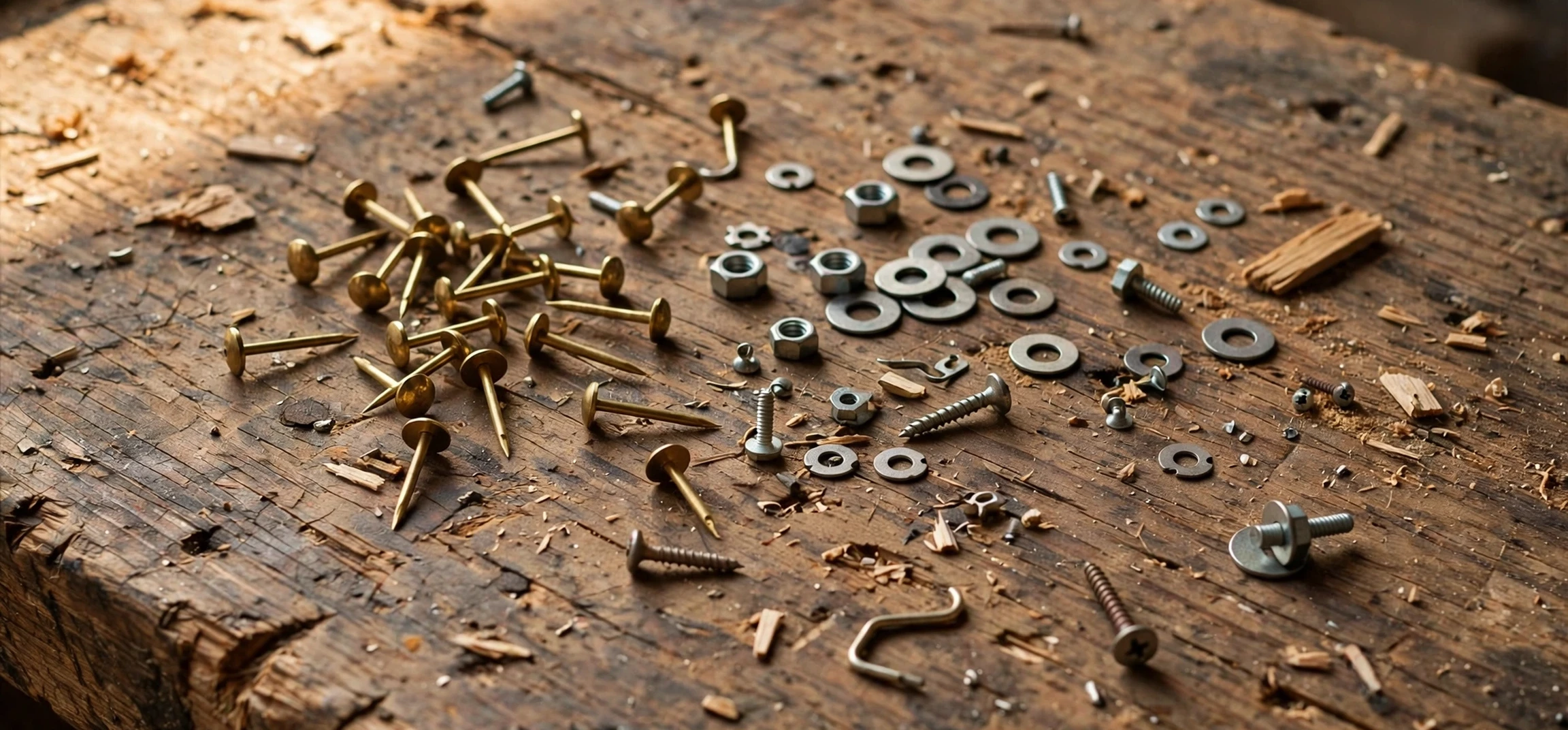
One of the most widely repeated explanations for the brass tax origin comes from furniture making and upholstery. In that trade, brass tacks were used to fasten fabric to wooden frames, and they were often placed in a visible, decorative line along chairs and sofas. Some accounts suggest that when cloth was stripped back during repair, the worker reached the brass tacks underneath, which marked the solid frame and the real structure of the piece. On this reading, getting down to brass tacks meant getting past the soft covering and reaching the firm foundation, an image that fits the modern sense of getting to the heart of a matter very neatly.
Supporters of the workshop theory also point out that brass was a familiar, durable material in homes and workshops long before the phrase became common in print. A tack is small, but it holds things together, and a row of brass tacks could be both functional and decorative. That combination of usefulness and visibility makes the image memorable, which is one reason idioms survive. Critics note, however, that a neat image is not the same as proof. The brass tax origin remains debated precisely because several trades used tacks, and because early printed examples do not always come with a clear explanation from the writer. Even so, the workshop account remains popular because it explains both the wording and the meaning in a single, easy picture, and because it connects language to ordinary work rather than to a rare or secret practice.
The shop counter theory: brass tax origin in retail history
A second explanation for the brass tax origin comes from old shops and fabric stores, where brass tacks were supposedly set into a counter to mark standard lengths of cloth. A customer and a shopkeeper could measure fabric against those fixed points, which gave both sides a shared, honest reference and reduced argument about length. In this story, getting down to brass tacks meant starting from agreed measurements rather than from guesswork, which again matches the modern meaning of dealing with facts. The theory is attractive because it ties the phrase to trade, fairness, and everyday bargaining, three settings where clear terms matter a great deal.
Historians urge caution about this version of the brass tax origin as well. Fixed measuring points certainly existed in markets, but direct evidence linking a specific row of brass tacks to the first uses of the phrase is limited. Some researchers have searched early newspapers and trade records for confirmation and found the connection hard to prove beyond doubt. That uncertainty does not make the theory useless. It shows how idioms often grow out of a general way of working, rather than from one single event that everyone remembers. Readers can appreciate the shop counter story as a plausible background while still recognising that language history often leaves room for more than one reasonable account, and that how word meanings change over time is common in the study of older expressions.
Other theories about the brass tax origin
Beyond workshops and shops, other suggestions about the brass tax origin have appeared over the years. Some writers connect the phrase to the brass fittings on furniture, doors, or instruments, arguing that the basic metal parts represented the essential elements of a thing once decoration was removed. Others suggest a link to the idea of paying attention to small but important details, since tacks are tiny yet hold larger structures together. A few accounts even propose rhyming slang or a playful variation on an older phrase, although those ideas have less support in printed records. Taken together, these theories show that a short idiom can attract many explanations, especially when its literal image is familiar but its first use is not fully documented.
For everyday users, the lesson of the brass tax origin debate is practical rather than academic. It is not necessary to settle every historical detail before using the phrase well. What matters most is spelling it correctly, using it when a conversation needs focus, and avoiding it when a more direct statement would be clearer. A manager might say that a meeting should get down to brass tacks about a budget, a teacher might use it to move a class from general discussion to a specific task, and a writer might use it sparingly so that it keeps its force. In each case, the phrase works because listeners already understand the signal, even if they have never studied its background, and further reading in guides to common expressions shows how such signals become part of shared language.
How the phrase appears in print and speech
The brass tax origin is often explored through dated examples in newspapers, books, and letters. The phrase appears in American English in the nineteenth century, and its use grew as business, politics, and journalism created more settings where speakers needed a quick way to call for serious discussion. Early examples tend to appear in contexts involving money, agreements, or practical plans, which supports the general sense that the idiom belonged to working life before it became a general expression. Over time, writers began to use it in fiction, speeches, and everyday conversation, and that spread helped fix both its wording and its meaning for later generations.
In present-day English, the phrase is slightly informal but widely understood, and it appears in both spoken and written forms. It is common in news commentary, workplace communication, and advice writing, where it often introduces a list of key points or a direct question. Writers should note that the phrase can sound brisk if used at the start of a sensitive conversation, so pairing it with polite language can help. For example, saying that it may help to get down to brass tacks about timing and costs is gentler than demanding that others stop talking and focus at once. Tone, context, and audience therefore matter as much as the definition, and careful speakers adjust the phrase to suit the moment rather than using it in exactly the same way every time.
Using the expression correctly today
Correct use of the phrase begins with the plural form brass tacks and with a verb that suggests movement toward the main issue, such as get, come, or cut to. Common patterns include getting down to brass tacks, coming down to brass tacks, and talking brass tacks, each of which keeps the focus on essentials. The phrase is usually followed by a topic, such as a price, a schedule, or a decision, so that listeners know what the essential matter actually is. Without that topic, the expression can feel vague, because it promises focus but does not name the subject. Good writing therefore pairs the idiom with a clear noun phrase, turning a colourful saying into a useful signpost for the reader.
Writers should also avoid overusing the expression, since idioms lose strength when they appear too often. One well-placed use in an article, speech, or meeting can sharpen attention, while repeated use can make the language feel tired or overly casual. In formal reports, a plain statement such as focusing on the key figures may serve better than the idiom, especially when readers include people who use English as an additional language. In informal writing, by contrast, the phrase can add warmth and personality. The brass tax origin thus offers more than a history lesson. It reminds writers that expressions carry tone as well as meaning, and that choosing the right moment is part of using language well.
Theories Compared
| Theory | Main idea | Strength |
|---|---|---|
| Workshop and upholstery | Tacks mark the solid frame under fabric | Explains the image and the meaning clearly |
| Shop counter measuring | Fixed tacks give a shared measure for cloth | Links the phrase to fair trade and facts |
| General brass fittings | Basic metal parts stand for essentials | Fits the sense of stripping away decoration |
| Rhyming or playful origin | A variation on an older saying | Less evidence in early printed records |
Frequently Asked Questions
Is it brass tacks or brass tax?
The correct idiom is brass tacks, in the plural. The brass tax origin is often searched with the singular form because the two sound alike, but published usage and dictionaries support tacks, referring to small fasteners.
When did the phrase become common?
Examples of the phrase appear in nineteenth-century American English, especially in business and practical contexts. Interest in the brass tax origin grew as the saying spread into journalism, fiction, and everyday speech.
Can the phrase be used in formal writing?
It can, but sparingly. In formal reports, a plain phrase such as focusing on the essential facts may be clearer, while in general writing the idiom adds a direct and familiar tone.
What does getting down to brass tacks mean?
It means moving past introductions and general talk to the central facts, figures, or decisions that need attention, such as price, timing, or responsibility.
Conclusion
In summary, the brass tax origin points to ordinary working life, where small brass fasteners stood for something solid, measurable, and real. Whether the strongest link is to upholstery, to shop counters, or to brass fittings in general, the modern meaning is stable and useful. The phrase tells listeners that it is time to focus on essentials, and it does so with an image that has lasted for well over a century.
Writers and speakers who remember the correct plural form, pair the idiom with a clear topic, and use it sparingly will get the most value from it. The history may remain partly open, but the practical guidance is clear. Get past the covering, reach the frame, and deal with the facts that matter most, and the expression will have done exactly the work it was made to do.