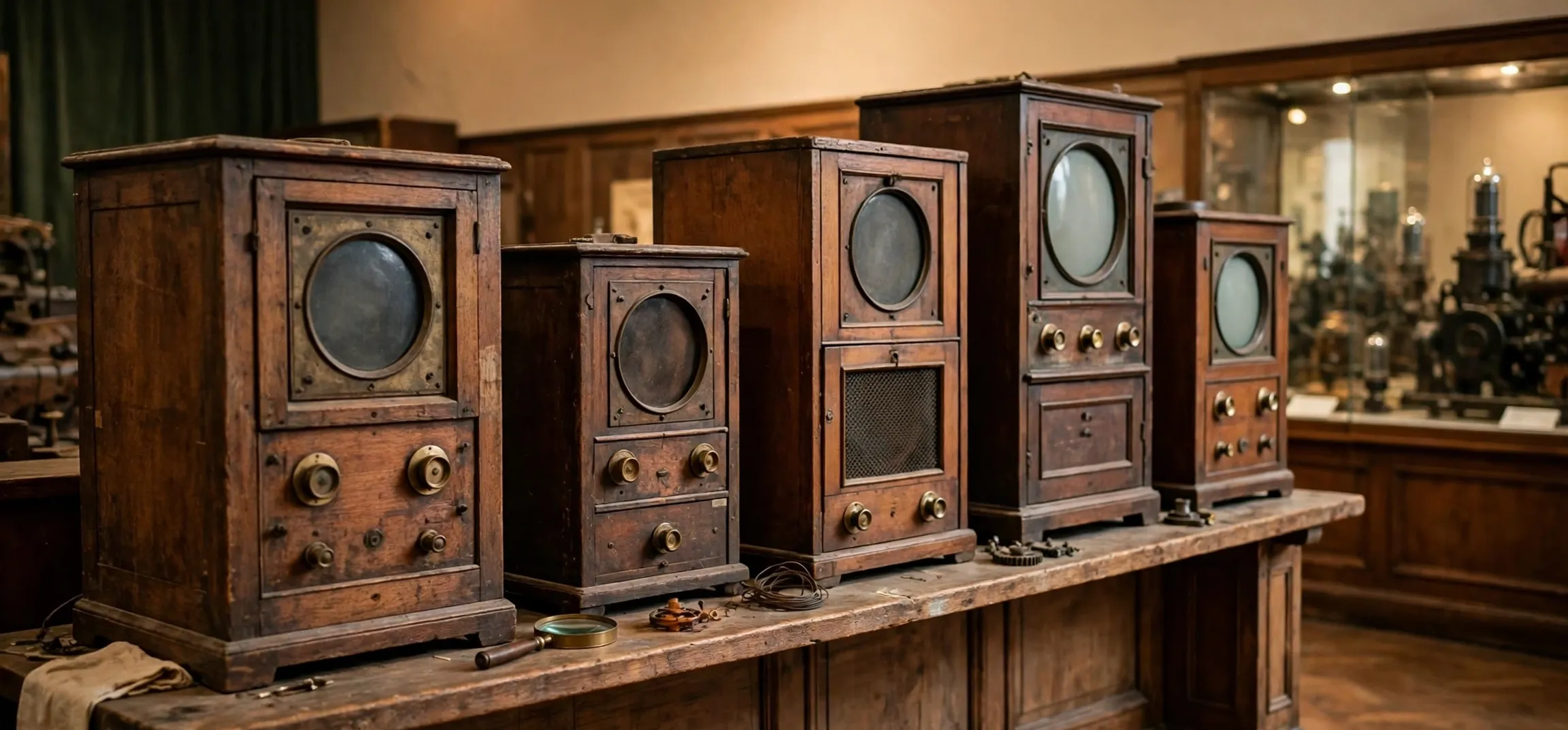
Ask who the creator of the tv was, and you will quickly discover that historians give you more than one name. That is not evasiveness. Television was not invented in a single moment by a single person working alone. It emerged over several decades, as inventors in different countries solved different parts of the same problem: how to turn a picture into an electrical signal, send that signal somewhere else, and turn it back into a picture.
The three names that come up most often in the creator of the tv debate are Philo Farnsworth, an American who built the first fully electronic television system, John Logie Baird, a Scottish inventor who gave the first public demonstrations of a working mechanical television, and Charles Francis Jenkins, an American pioneer who worked along a similar mechanical path and promoted the new medium tirelessly in the United States.
Each of these men has a genuine claim, because each achieved something real at a moment when television was still widely treated as a fantasy. This guide explains what each one actually did, why the credit became contested, how patent battles shaped the story, and why the fairest answer to the creator of the tv question is that television had several creators, working in parallel, whose inventions built on the work of scientists who came before them.
Why the creator of the tv has no single answer
Most famous inventions have a messy history if you look closely, and television is messier than most. The basic idea of sending pictures by electricity was discussed in the nineteenth century, long before the technology existed to do it. Early thinkers imagined scanning an image line by line, converting each line into signals, and rebuilding the image at the other end. That scanning idea is the foundation everything else rests on, and no single creator of the tv can claim it exclusively.
What changed in the early twentieth century was that the necessary components finally existed. Sensitive light-detecting materials, vacuum tubes that could amplify weak signals, and cathode ray tubes that could display a glowing picture gave inventors real tools to work with. Even then, two rival approaches developed side by side. Mechanical systems used spinning discs with holes arranged in a spiral to scan images, while electronic systems used beams of electrons and no moving parts at all. The creator of the tv argument is largely an argument about which of those approaches, and which first demonstration, should count as the true beginning.
The main claimants for creator of the tv
Three pioneers dominate the history books, and a fair summary of the creator of the tv story has to give each of them his due. They worked independently, in different countries, with different methods, and each reached an important milestone before the others in at least one respect.
Philo Farnsworth and electronic television
Philo Farnsworth is the name most strongly associated with electronic television. As a young man in the early 1920s, he worked out the concept of scanning an image with an electron beam, line by line, using a device he called an image dissector. In 1927, in San Francisco, he made what is generally recognised as the first successful transmission of an all-electronic television image. His system had no spinning discs and no moving parts in the scanning process, which is why many historians regard Farnsworth as the strongest single answer to the creator of the tv question: the television in your home descends from his electronic approach, not from the mechanical one.
John Logie Baird and mechanical television
John Logie Baird took the mechanical route, building his system around a spinning disc of the kind first described decades earlier. Working in London in the mid-1920s, he achieved the first public demonstration of a working television system that could show recognisable moving images of live subjects, and he followed it with a string of firsts, including early demonstrations of colour television and a transatlantic transmission. For a generation, Baird was the public face of television in Britain, and his demonstrations did more than almost anything else to convince newspapers and broadcasters that television was real.
Charles Francis Jenkins and American mechanical television
Charles Francis Jenkins, an experienced inventor who had already worked on motion picture projection, pursued mechanical television in the United States at roughly the same time as Baird. He transmitted moving silhouette images, demonstrated his radiovisor equipment, and even ran an early experimental television station broadcasting scheduled programmes to a small audience of hobbyists. Jenkins rarely wins the creator of the tv argument outright, but his work shows how widely the race was being run: inventors on both sides of the Atlantic were converging on television at the same moment, using similar ideas.
| Inventor | Approach | Best-known contribution |
|---|---|---|
| Philo Farnsworth | Electronic scanning | First all-electronic television transmission, in 1927 |
| John Logie Baird | Mechanical scanning disc | First public demonstrations of working television, in the mid-1920s |
| Charles Francis Jenkins | Mechanical scanning | Early transmissions and an experimental television station in the United States |
Read together, the table explains the whole dispute. Baird demonstrated first in public, Farnsworth built the system that ultimately won, and Jenkins proved the idea was in the air everywhere. Choosing one name means choosing which of those achievements you value most.
Mechanical versus electronic television
The mechanical systems came first because they could be built from familiar parts: a disc, a motor, a light source and a photocell. Their weakness was built in. A spinning disc can only scan so many lines, so mechanical pictures stayed small, dim and low in detail, typically a few dozen lines. Broadcasters experimented with them, including early BBC broadcasts using Baird equipment, but the ceiling was obvious to engineers even at the time, and the search for a better television system continued in laboratories.
Electronic television removed the ceiling. With no moving parts, an electron beam could scan hundreds of lines many times per second, producing a brighter, sharper picture that could keep improving as tubes and circuits improved. Through the 1930s, large companies invested heavily in electronic systems, standards rose, and mechanical television was quietly abandoned. That is why Farnsworth, rather than the earlier demonstrators, is so often named the creator of the tv in modern accounts: his approach is the direct ancestor of every television that followed, from cathode ray sets to the flat screens of today.
Patents, broadcasters and the road to the living room
The fight over credit was not only fought in laboratories. Farnsworth held key patents, and the powerful Radio Corporation of America, which was developing its own electronic television under researchers such as Vladimir Zworykin, challenged his priority. In a famous patent dispute, Farnsworth’s earlier notes and sketches were upheld, and the corporation eventually took a licence from him, a rare outcome for a giant company dealing with an independent inventor. The legal record from that fight is one reason his claim as creator of the tv rests on documents, not just legend.
Meanwhile, television had to become a service, not just an invention. Regular broadcasts began in Britain and the United States in the late 1930s, paused or slowed during the Second World War, and then expanded rapidly in the late 1940s and 1950s as sets became affordable. By the time television took over the living room, it had been built by thousands of engineers, standard-setters and broadcasters. Remembering that wider story does not diminish the pioneers; it simply explains why the creator of the tv title fits no one person perfectly.
Frequently asked questions
Who is most often called the inventor of television? Philo Farnsworth is most often given that title in modern histories, because he achieved the first all-electronic television transmission in 1927 and his approach became the basis of television as it developed. When people ask about the creator of the tv, his name is usually the answer they are given, with Baird recognised for the earliest public demonstrations.
Did John Logie Baird really invent television before Farnsworth? Baird demonstrated a working mechanical television system publicly in the mid-1920s, before Farnsworth’s electronic transmission, so in terms of showing television to an audience, Baird was first. The systems were fundamentally different, however, and the mechanical approach was later abandoned in favour of the electronic one.
What did Charles Francis Jenkins contribute? Jenkins developed mechanical television in the United States in parallel with Baird, transmitted moving silhouette images, promoted the medium through demonstrations, and operated an early experimental station. His work is an important part of the creator of the tv story because it shows the invention happening in several places at once.
Why do some sources name other inventors entirely? Because television rests on earlier ideas and components with their own inventors, including the scanning disc concept from the nineteenth century and the cathode ray tube work of other scientists, plus later corporate research by engineers such as Vladimir Zworykin. Depending on which layer of the technology a source focuses on, it may credit a different name.
Conclusion
So, who was the creator of the tv? The honest answer is layered. Baird showed the public a working television first, Jenkins proved the same idea in America, and Farnsworth built the electronic system that actually became television, defending his priority in the patent record. If a single name must be chosen, Farnsworth has the strongest claim, but the full story is richer and fairer than any one name allows.
Television is best understood as a relay rather than a solo sprint: nineteenth-century thinkers supplied the scanning idea, mechanical pioneers proved pictures could fly, and electronic pioneers made those pictures good enough to change the world. That is why the creator of the tv debate never quite dies, and why it remains one of the most interesting arguments in the history of technology.
Keep exploring with our companion pieces on who invented TV, the year TV was invented, and when television was invented.