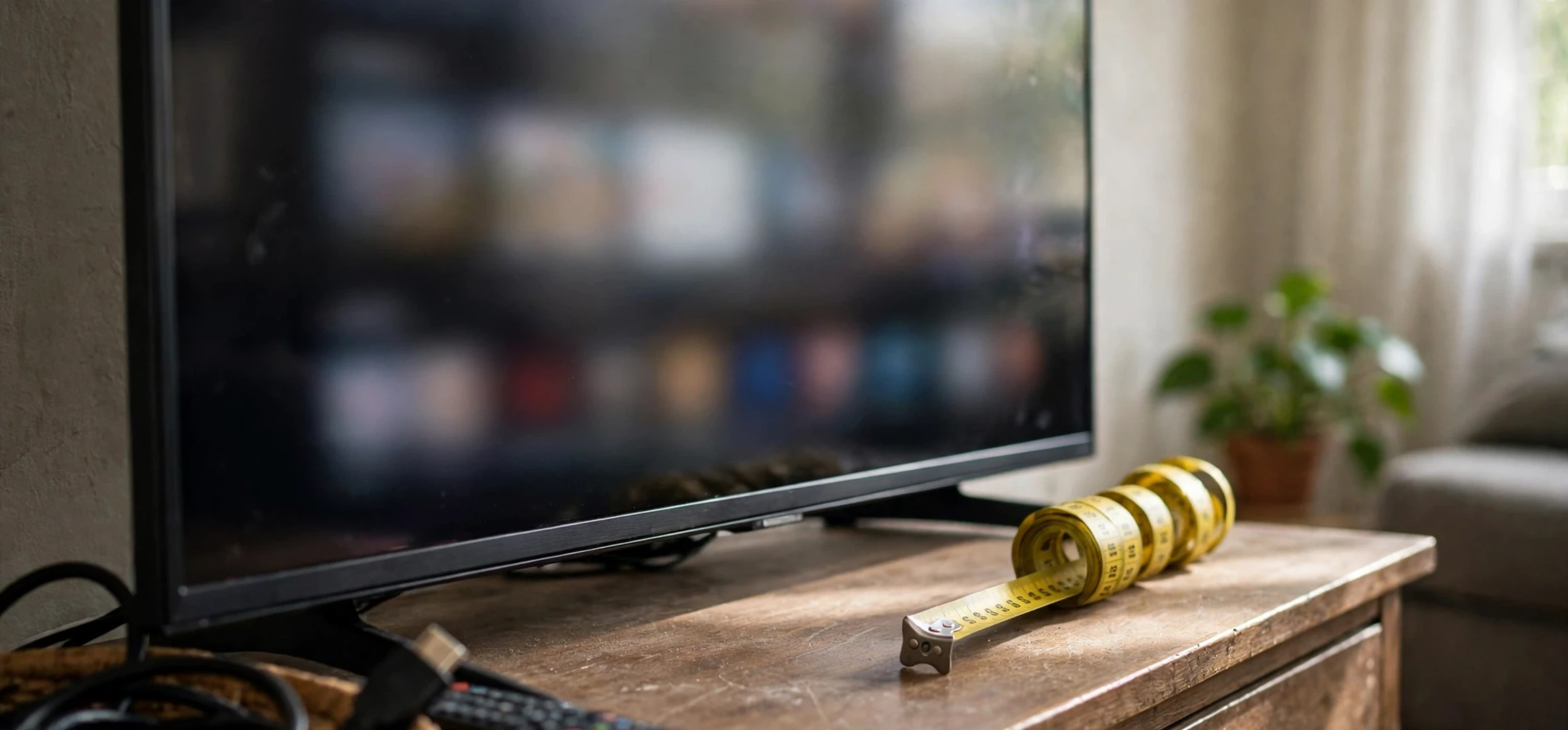
If you searched for 55inc tv size, you almost certainly meant the size of a 55-inch television (55inc tv size), and this guide answers that question in full. The phrase 55inc tv size is simply a compressed search term for 55-inch TV (55inc tv size) size, and it points to one of the most popular television sizes sold today. A 55-inch TV (55inc tv size) is large enough to feel cinematic in a living room, yet small enough to suit many bedrooms and flats, which is why so many shoppers start with this size before they compare anything else. Before you buy, though, it helps to know exactly what the number means, because the diagonal measurement alone does not tell you how wide the set is, how tall it stands, how much wall space it needs, or how far away you should sit. This guide covers all of that, in plain language, with typical dimensions, viewing-distance guidance, and practical checks you can do at home with a tape measure.
A television described as 55 inches is measured diagonally across the screen, from one corner to the opposite corner, and that measurement covers the screen itself rather than the whole body of the set. Manufacturers quote the diagonal because it is a single, standard figure that lets shoppers compare models quickly, but two televisions with the same diagonal can still differ slightly in overall width and height because of bezel thickness, stand design, and the shape of the back panel. That is why this guide gives you typical overall dimensions as well as the screen figure, and why you should always check the exact product specifications for the model you plan to buy. If you are replacing an older television, do not assume the new set will be the same width, because modern screens are much wider relative to their height than the squarer sets of the past.
If You Searched for ‘55inc tv size’: What It Means
When people type 55inc tv size into a search engine, they are usually asking a practical question: how big is this television in real life, and will it fit my room? The answer starts with the diagonal, which is 55 inches, or about 140 centimetres. On a modern widescreen television with a 16:9 aspect ratio, that diagonal works out to a screen roughly 48 inches wide and 27 inches tall, or about 122 centimetres wide and 69 centimetres tall. Those are screen-only figures, so the full television, including its frame, will be a little larger, typically around 48 to 49 inches wide and 28 to 30 inches tall without the stand, depending on the brand and model. Once the stand is fitted, the height can rise to roughly 30 to 31 inches, and the depth, including the stand feet, is usually around 11 to 13 inches.
It is worth pausing on the aspect ratio, because it explains why a 55-inch television (55inc tv size) looks so much wider than an old television of a similar diagonal. A 16:9 screen is sixteen units wide for every nine units tall, which suits films and modern television programmes that are also made in widescreen. If you are upgrading from a much older set, the new screen may feel dramatically wider even if the diagonal number has not changed much, so measure the width of your wall or unit rather than trusting your memory of the old set. Also remember that the diagonal is measured in inches in most markets, while room measurements in the United Kingdom are often taken in centimetres or metres, so keep a converter or a tape measure that shows both units close at hand while you plan.
Typical Dimensions of a 55-Inch Television
The table below summarises the typical dimensions you can expect, but treat these as a planning guide rather than a promise for any single model. Always confirm the exact figures on the manufacturer’s specification page before you order, because bezels have become thinner over time and some premium models are noticeably slimmer than budget models. The figures here are rounded to the nearest whole inch and centimetre, which is precise enough for choosing furniture and wall space, though not a substitute for the official specification when the fit is tight.
| Measurement | Typical figure (inches) | Typical figure (centimetres) |
|---|---|---|
| Screen diagonal | 55 | 140 |
| Screen width | 48 | 122 |
| Screen height | 27 | 69 |
| Overall width with bezel | 48 to 49 | 122 to 124 |
| Overall height without stand | 28 to 30 | 71 to 76 |
| Overall height with stand | 30 to 31 | 76 to 79 |
| Depth without stand | 2 to 3 | 5 to 8 |
| Depth with stand | 11 to 13 | 28 to 33 |
| Weight | 30 to 40 pounds | 14 to 18 kilograms |
Weight matters more than many shoppers expect, especially if you plan to wall-mount the set. A 55-inch television (55inc tv size) is not extremely heavy by modern standards, but it is large and awkward to hold, so wall mounting is a two-person job and the bracket must be rated for both the weight and the mounting pattern of your model. The mounting pattern, often described as VESA, is the arrangement of screw holes on the back of the set, and it varies between models, so check it before you buy a bracket. If you plan to place the television on a stand, check the width between the feet as well as the overall width, because some models have feet set wide apart near the edges, while others use a central pedestal that fits narrower furniture.
How 55inc tv size Relates to Viewing Distance
Viewing distance is where the 55inc tv size question becomes genuinely useful, because the right distance depends on the size of the screen and the resolution of the content you watch. As a general guide, a 55-inch television (55inc tv size) suits a viewing distance of roughly 7 to 11 feet, or about 2.1 to 3.4 metres, for comfortable everyday viewing. At the nearer end of that range, a high-resolution picture looks sharp and immersive, which suits films and sport. At the farther end, the picture still looks clear, but the sense of immersion fades, and you may find yourself wishing for a larger screen. If your sofa sits closer than about 6 feet from the screen, a 55-inch set can feel overwhelming for some viewers, especially during fast-moving scenes, while a distance beyond 12 feet can make fine detail harder to appreciate.
Resolution changes the calculation. With ultra-high-definition content, you can sit a little closer than you could with older high-definition content, because the smaller pixels are harder to pick out individually. That is one reason many buyers now choose larger screens than they would have a decade ago: the picture stays smooth at distances that once would have revealed the pixel structure. Even so, personal comfort matters as much as any formula, and the best test is a simple one. Mark out the width of a 55-inch screen on your wall with painter’s tape, sit in your usual seat, and watch your existing television for an evening with that outline in view. If the outline feels dominant, consider a smaller size; if it feels modest, the 55-inch set will probably suit you well.
Room Size Checks Before You Buy
Start by measuring the wall or alcove where the television will go, and leave at least a few inches of breathing room on each side for ventilation and for reaching cables at the back. Televisions generate heat, and a set squeezed tightly into a cabinet can run warmer and become harder to service, so airflow matters as much as appearance. Next, measure the depth of your unit or shelf, and remember that the stand feet need full support: a foot hanging over the edge is unsafe, however stable it may look at first glance. Finally, think about glare. A screen facing a bright window can be hard to watch during the day, and while many modern screens handle reflections better than older ones, position still matters. If glare is a problem, try shifting the set slightly or adjusting curtains before you blame the screen itself.
Height and Eye Level
Eye level is the second half of comfortable viewing, and it is often overlooked. Ideally, the centre of the screen should sit roughly at eye level when you are seated in your usual position, which for most sofas means the centre of a 55-inch screen ends up around 42 to 48 inches from the floor, depending on your seating height. If the television sits too high, perhaps above a fireplace, you may find yourself tilting your head back for long periods, which becomes uncomfortable during a film. A tilting wall bracket can help in that situation, but it is better to choose a lower position when you have the choice. If you are using a stand, measure the height of the unit as well as the television, because the two together determine where the centre of the screen lands.
Wall Mounting a Television of This Size
Wall mounting a 55-inch television (55inc tv size) frees up surface space and can look very tidy, but it needs a little planning. First, identify what your wall is made of, because plasterboard, brick, and stud walls need different fixings, and a bracket that is secure on brick may pull out of plasterboard without the right anchors. Second, plan your cables before you drill: power, aerial or streaming connections, and any games console or soundbar leads should all be routed neatly, and it is much easier to add a cable channel or trunking before the set goes up than afterwards. Third, check that the bracket allows access to the ports on the back of the television, because some slim brackets hold the set so close to the wall that plugging in a new device becomes a struggle.
Sound is another consideration. Many 55-inch television (55inc tv size)s have slim built-in speakers that fire downwards or backwards, and wall mounting can change how they sound, sometimes for the better and sometimes not. If you watch a lot of films or sport, a separate soundbar often makes a bigger difference to enjoyment than a small step up in picture quality, and it is worth budgeting for one if your room allows. When you position a soundbar, keep it clear of the bottom edge of the screen and make sure it does not block the remote sensor, which on many models sits along the lower bezel. A little care at installation stage saves a lot of fiddling later.
For more ideas on getting the most from a television setup, you may enjoy our guide to streaming options for TV viewers, and if you are comparing services, our overview of TV plans and prices may help you weigh up the running costs alongside the purchase. A TV guide to popular viewing can also help you decide what you will actually watch most, which in turn affects whether a larger or smaller screen is the better investment for your household.
Choosing Between 55 Inches and the Neighbouring Sizes
The 55inc tv size question often leads to a second question: should you step up to 65 inches or down to 50 or 43 inches instead? The honest answer depends on your room and your viewing distance. In a small bedroom where the bed sits 6 feet from the wall, a 43-inch or 50-inch set may be more comfortable and easier to place. In a large living room where the sofa sits 10 feet or more from the screen, a 65-inch set may feel more cinematic, though it will also cost more and demand a wider unit or wall. The 55-inch size sits in the middle of that range, which is precisely why it sells so well: it suits the majority of living rooms without dominating them.
Budget is the other factor. Larger screens generally cost more, and the jump from 55 inches to 65 inches can be substantial, so it is worth asking whether the extra size will genuinely improve your daily viewing or whether the money would be better spent on better picture quality, a soundbar, or a more comfortable seating arrangement. Picture quality, brightness, and colour accuracy matter at every size, and a well-chosen 55-inch television (55inc tv size) with a good panel will usually please its owner more than a larger set with a weaker panel. Read reviews that test real content, not just specification sheets, and pay attention to how a set handles the programmes you watch most, whether that is drama, sport, news, or gaming.
Frequently Asked Questions
How wide is a 55-inch TV (55inc tv size)?
A 55-inch television (55inc tv size) is typically about 48 to 49 inches wide overall, or roughly 122 to 124 centimetres, including the frame. The screen itself is about 48 inches wide. Always check the exact model specification if the fit is tight, because bezel thickness varies.
How far should I sit from a 55-inch TV (55inc tv size)?
A comfortable range for most viewers is roughly 7 to 11 feet, or about 2.1 to 3.4 metres. Ultra-high-definition content can be enjoyed from the nearer end of that range, while viewers who prefer a less immersive picture may favour the farther end.
Will a 55-inch TV (55inc tv size) fit on a standard unit?
Most television units designed for large screens will hold a 55-inch set, but check two measurements: the overall width of the television and the distance between its stand feet. Central-pedestal stands fit narrower units, while wide-set feet need a broader surface.
Is the 55-inch figure the width or the diagonal?
It is the diagonal, measured from one corner of the screen to the opposite corner. The width of a 55-inch widescreen television is about 48 inches, which is noticeably less than 55 inches, so do not use the diagonal figure as the width when planning wall space.
Is a 55-inch TV too big for a bedroom?
It depends on the room. In a larger bedroom with a viewing distance of 7 feet or more, a 55-inch set works well. In a small bedroom where you sit 5 or 6 feet from the screen, a smaller set may be more comfortable, though many viewers happily adjust to the larger picture within a few days.
Conclusion
To sum up, the search term 55inc tv size points to a straightforward question with a practical answer: a 55-inch television (55inc tv size) measures about 48 inches wide and 27 inches tall on screen, roughly 48 to 49 inches wide overall, and it suits a viewing distance of about 7 to 11 feet. Measure your wall, your unit, and your seating distance before you buy, check the exact specification of the model you want, and think about height, glare, and sound as well as size. Do those simple checks, and a 55-inch television (55inc tv size) is an excellent choice for most living rooms: large enough to feel cinematic, sensible enough to live with every day, and flexible enough to suit films, sport, drama, and gaming alike. If you searched for 55inc tv size hoping for a quick figure to plan around, you now have it, plus the context to use it wisely.