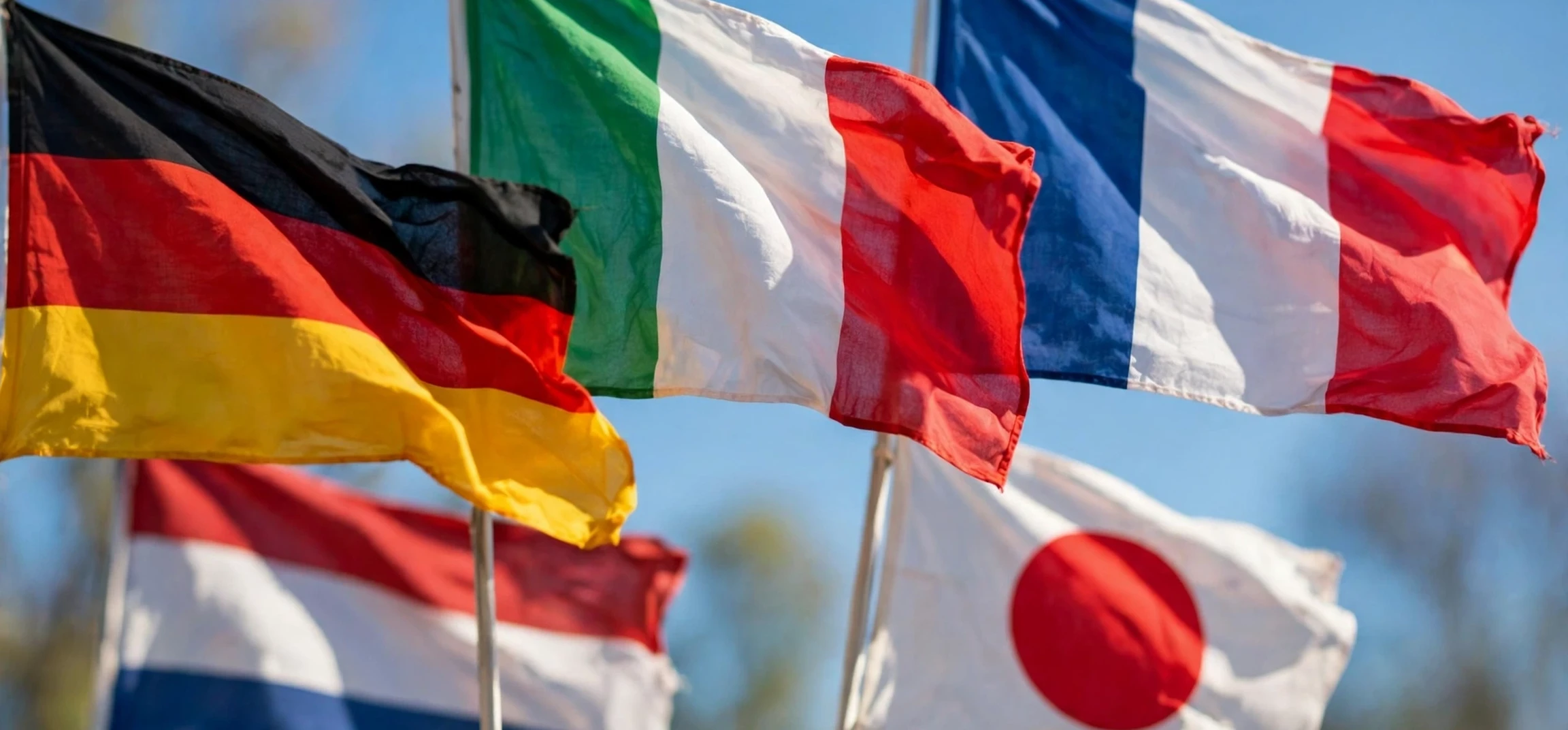
When people ask about colors on flags meaning, they are usually asking a deceptively simple question: why is a flag red, blue, green, or white, and what is that colour supposed to stand for? The honest answer is that flag colours rarely have one fixed, universal meaning. The same colour can be associated with different ideas in different countries, at different times, and in different design traditions. This guide explains the conventional associations that are most often attached to flag colours, why those associations exist, and why they should be treated as general symbolism rather than as verified fact about any particular flag.
That caution matters. Many flags were designed for historical, political, or practical reasons that have little to do with colour symbolism as it is described in popular lists. A colour may have been chosen because it was available, because it matched a ruling house, because it echoed an earlier banner, or because it distinguished one flag from another at sea or on a battlefield. Later explanations may then attach a symbolic meaning to a choice that was originally practical. Keeping that history in mind prevents the common error of reading a modern list of meanings back into every flag as if it were an official code.
colors on flags meaning: how to read flag colours
The best way to read flag colours is to treat them as conventional associations, not as a dictionary. In popular flag writing, red is commonly associated with courage, sacrifice, or revolution; blue with loyalty, justice, or the sky and sea; white with peace, purity, or honesty; green with nature, growth, or faith; yellow and gold with wealth, sunlight, or generosity; and black with determination, strength, or mourning. These associations recur across many popular guides, which is why they feel familiar. They are, however, summaries of cultural associations, not statements that every red flag means courage or that every green flag means nature.
Context changes the reading. A colour takes much of its meaning from the colours beside it, from the symbols placed on the flag, and from the history of the country or organisation that uses it. Red, white, and blue together, for example, form a combination that appears on many flags for historical reasons connected with earlier revolutions and alliances, not because the three colours were chosen together from a single list of meanings. A single colour, read in isolation, therefore tells only part of the story.
Design tradition also matters. Some flag traditions favour bold, simple blocks of colour that can be recognised at a distance, which was essential when flags were used to identify ships and armies. Others favour colours drawn from a national coat of arms, from a religious tradition, or from a political movement. A flag designed in the nineteenth century may follow different conventions from a flag designed in the twentieth century, even when both use the same colours.
Why the same colour can mean different things
Colour symbolism is cultural, not natural. There is no physical law that makes red mean courage or blue mean loyalty. Those links come from stories, literature, religion, heraldry, and political history, and different cultures have built different links. In some traditions, white is associated with mourning rather than with peace. In others, yellow carries associations with caution or with royalty, depending on the period. A popular list that presents one meaning per colour is therefore simplifying a much richer and more varied picture.
That variation is not a flaw in flag design. It is a reminder that flags are national and cultural objects first, and colour charts second. The meaning of a flag lives in its history and in the way its people understand it, not in a universal code that can be applied from outside.
colors on flags meaning: the common associations in detail
Red is the most widely used colour on national flags, and it carries the widest range of conventional associations. In popular symbolism, red is linked with bravery, with the blood shed in struggle, and with revolutionary change. Those associations draw on the visibility of red, on its use in military banners, and on its role in revolutionary movements. At the same time, red has been used for purely practical reasons: it was a dye that could be produced reliably, and it stands out clearly against sky and sea. A red flag may therefore be red for symbolic reasons, practical reasons, or both, and the popular meaning should not be assumed to be the original reason.
Blue is commonly associated with loyalty, truth, justice, and with the sky and the sea. Its popularity on flags reflects both its heraldic history and its calming, authoritative appearance. Blue dyes and pigments were historically more expensive than some other colours, so blue could also signal status or expense, although modern production has removed that barrier. In maritime nations, blue naturally suggests the sea, while in other contexts it suggests the sky, freedom, or constancy.
White is commonly associated with peace, purity, honesty, and surrender. The white flag of truce is one source of the peace association, and the use of white in religious and ceremonial dress is another. White also serves a practical design purpose: it separates stronger colours, makes a flag readable at a distance, and provides a neutral field for symbols. A white stripe may therefore be there for contrast as much as for symbolism, and the two purposes often work together.
Green is commonly associated with nature, fertility, growth, and, in many contexts, with Islamic tradition. Its use on flags in regions with strong agricultural traditions reflects the landscape, while its use in other regions reflects religious or political identity. Green is also the colour of Islam in many flag traditions, which is why it appears prominently on the flags of several Muslim-majority countries. That association is cultural and historical, not a rule that every green flag carries a religious meaning.
Yellow and gold are commonly associated with the sun, with wealth, with harvest, and with generosity. Gold in heraldry traditionally suggested nobility and value, and yellow provided a bright, visible colour that could stand for sunlight or for grain. In practice, yellow and gold are often used interchangeably on flags, with the exact shade depending on production rather than on a symbolic distinction. A flag described as gold in one source may be described as yellow in another, without any change in design.
Black is commonly associated with determination, strength, endurance, and mourning. It appears less often as a main field colour than red, blue, white, and green, but it is widely used for symbols, outlines, and stripes. In some traditions, black carries associations with the past, with struggle, or with the earth. In others, it is simply a strong, clear colour that makes neighbouring colours stand out. As with the other colours, the popular association should be treated as a convention, not as a verified statement about any single flag.
| Colour | Common conventional association | Caution |
|---|---|---|
| Red | Courage, sacrifice, revolution | Also chosen for visibility and availability |
| Blue | Loyalty, justice, sky and sea | Meaning varies with tradition and context |
| White | Peace, purity, honesty | Often used for contrast and readability |
| Green | Nature, growth, faith | Religious association applies in some traditions only |
| Yellow and gold | Sunlight, wealth, harvest | Shades vary by production, not by meaning |
| Black | Determination, strength, mourning | Often a design colour as well as a symbol |
| Orange | Energy, enthusiasm, harvest | Less common on national flags |
| Purple | Royalty, dignity, rarity | Historically rare because dye was costly |
The table summarises popular associations, not official meanings. It is useful as a starting point for understanding why colour lists look the way they do, but it should not be quoted as if it were an authoritative code for every flag.
Colour combinations and design patterns
Many flags use combinations that have their own histories. Tricolours, flags with three vertical or horizontal stripes, became popular in Europe after the French Revolution, and the pattern spread widely as new nations adopted flags in the nineteenth and twentieth centuries. The colours of a tricolour may echo an earlier flag, a political movement, or a set of ideals, but the pattern itself is a design convention that many countries share for different reasons.
Pan-African colours, commonly described as red, black, and green, with yellow or gold in some versions, are associated with African unity and with movements for independence. Pan-Arab colours, commonly described as red, white, black, and green, are associated with Arab unity and with shared history. Pan-Slavic colours, commonly described as red, white, and blue, are associated with Slavic peoples and their historical connections. These groupings are real traditions, but they are broad: individual flags within each group have their own histories, and the shared colours do not mean that every flag in the group carries the same official explanation.
Scandinavian cross flags, with a cross shifted toward the hoist, form another design family. The cross pattern reflects a shared history and a shared Christian heritage in popular accounts, while the colours differ from country to country. The pattern, rather than any single colour, is what links the family together. That example shows why design, symbol, and colour must be read together: the cross carries meaning that the colours alone do not.
Symbols matter as much as colours
Many flags carry symbols that do more specific work than colours can. Stars, suns, moons, crosses, and animals each bring their own associations, and a flag with a distinctive symbol is usually identified by that symbol rather than by its colours alone. A star may suggest unity, guidance, or a number of states or provinces. A sun may suggest a new day, energy, or a geographical feature. A crescent may suggest faith or history, depending on the tradition. Colour lists that ignore symbols therefore miss the most specific part of many flag designs.
Why some colours are rare on flags
Purple is the classic example of a rare flag colour. In popular accounts, purple dye was historically expensive to produce, because it was made from sea snails in small quantities, so purple cloth was associated with royalty and wealth. That cost made purple impractical for large flags, which needed to be produced in quantity and replaced often. Modern dyes have removed the cost barrier, but the tradition of avoiding purple on national flags has largely persisted, and only a few national flags include purple, usually in a small symbol rather than as a main field.
Orange, pink, and brown are also uncommon as main flag colours, for different reasons. Orange appears on some flags, often for historical reasons connected with a ruling house or a political movement, but it has not become a standard flag colour. Pink and brown are rarely used because they are harder to distinguish at a distance and because they lack the heraldic tradition that supports red, blue, white, black, green, and yellow. The palette of flags is therefore shaped by history, by visibility, and by heraldry, not only by symbolism.
How to read a specific flag without guessing
If you want to know what the colours of a particular flag mean, start with the history of that flag rather than with a general colour list. Look for the date it was adopted, the designer or committee behind it, and any official explanation issued at the time. Some flags have well-documented official meanings for each colour and symbol. Others have no official colour symbolism at all, and popular explanations were added later by writers and enthusiasts. Distinguishing those two cases is the key to accuracy.
Be wary of explanations that sound too neat. A story that assigns a perfect, poetic meaning to every stripe and every shade is often a later invention, especially when it appears in many sources with identical wording but no citation. A more reliable account will mention debate, change over time, and the practical reasons that shaped the design. History is usually messier than a colour chart, and that messiness is itself informative.
For a related look at how colour words appear in other guides, see the site’s explanation of analogous colours and a guide to a colour guide, both of which show how colour language works in design contexts beyond flags.
Frequently asked questions
Do flag colours have official meanings?
Sometimes, but not always. Some flags were adopted with an official explanation for their colours and symbols. Others were adopted without one, and popular meanings were attached later. Always check the history of the specific flag rather than assuming a general list applies.
What does red mean on a flag?
In popular symbolism, red is commonly associated with courage, sacrifice, and revolution. That association is conventional, not universal, and red may also have been chosen for visibility, for heraldic reasons, or because it echoed an earlier banner.
What does blue mean on a flag?
In popular symbolism, blue is commonly associated with loyalty, justice, and the sky and sea. As with red, the association is a cultural convention, and the specific reason for blue on a particular flag may be historical rather than symbolic.
Why do so many flags use red, white, and blue?
The combination spread through historical influence, including revolutionary movements and alliances, and through the popularity of tricolour designs. Shared colours do not mean shared official meanings, and each flag in the group has its own history.
Is purple really rare on flags?
Yes, as a main field colour. Historical dye costs made purple impractical for large flags, and the tradition has persisted even though modern dyes are cheap. A few national flags include purple in small symbols, but it remains uncommon as a dominant colour.
Conclusion
Colors on flags meaning is best understood as a set of conventional associations layered over a complex history of design, politics, and practicality. Red, blue, white, green, yellow, black, and the rarer colours each carry familiar popular meanings, and those meanings help explain why colour lists look the way they do. They do not, however, provide a verified code for every flag. The reliable way to read a flag is to start with its own history, treat popular associations as a guide rather than a verdict, and remember that colour, symbol, and pattern work together. Read that way, flags become more interesting, not less, because each one tells a specific story that no general chart can replace.