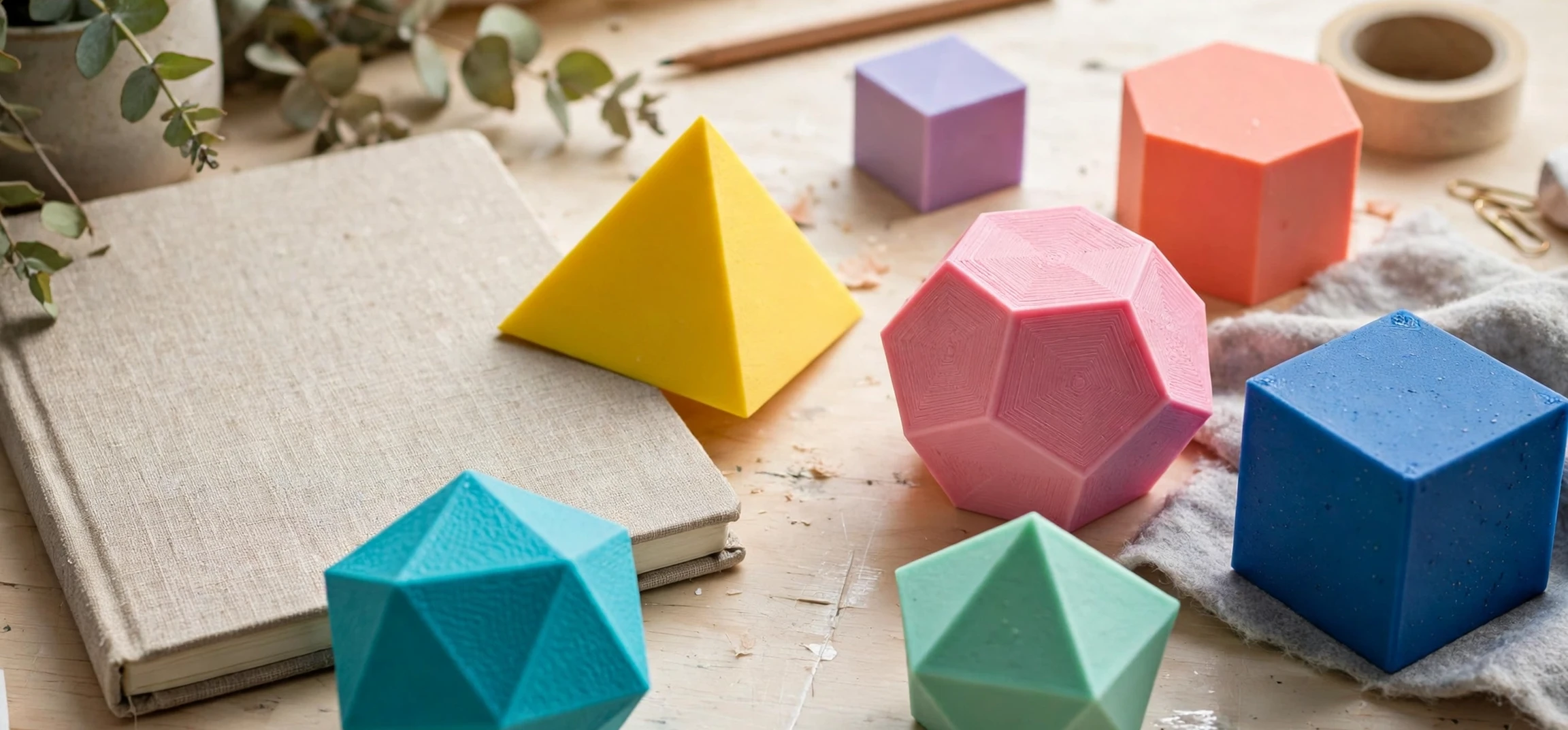
When someone types mathematical shapes and names into a search box, they are often looking at something and thinking: what is that shape called? This guide answers that question visually. Instead of starting from definitions, we start from what you can see: the outline, the corners, the curves, and the everyday objects that share the same form. By the end, you will be able to look at a sign, a tile, a box, a ball, or a building and match it to its correct name, because mathematical shapes and names become easy once each name is tied to a picture you already know.
Visual identification works in three quick steps. First, ask whether the shape is flat or solid. A drawing on paper, a sign on a wall, or a shadow on the ground is flat. An object you could pick up, such as a ball, a box, or a tin, is solid. Second, count what you can see: sides and corners for flat shapes, faces and edges for solid ones. Third, check for special clues: equal sides, right angles, parallel lines, or curves. Those three steps will carry you through almost every identification puzzle, from a classroom worksheet to a pattern spotted on a walk.
This guide is organised the way your eyes work. We begin with round shapes, because curves are the easiest to spot, then move to triangles, then to four-sided shapes, then to shapes with five or more sides, and finally to solid shapes. Along the way you will find everyday examples for every name, plus the lookalike pairs that cause the most confusion and the simple checks that separate them. Keep this guide open while you look around a room and you will be surprised how many mathematical shapes and names you can already recognise.
Mathematical Shapes and Names: Spotting Round Shapes
Round shapes are the friendliest place to start, because the eye catches curves instantly. A circle is the most perfect round shape: every point on its edge is the same distance from its centre. Look for a circle in a clock face, a coin, a plate, a wheel, or the full moon. If the shape is round but stretched, longer one way than the other, you are looking at an oval, known in maths as an ellipse. An egg, a rugby ball seen side on, and the orbit path drawn in many diagrams are ovals. A semicircle is exactly half a circle, with one straight edge and one curved edge, like a protractor or a half-moon window.
To check a circle, look for symmetry. A circle looks the same from every direction through its centre, and any line through the centre cuts it into two matching halves. An oval has only two lines of symmetry, one along its length and one across its width, which is why it looks stretched rather than perfectly balanced. A semicircle has just one line of symmetry, down its middle. These symmetry checks are quick, need no measuring, and work even from a photograph. When you practise spotting round mathematical shapes and names in daily life, start with the kitchen: plates, mugs seen from above, jar lids, and frying pans all offer circles, while chopping boards and serving platters often offer ovals.
The words that go with round shapes
Round shapes come with a small set of useful words. The radius runs from the centre to the edge. The diameter runs right across through the centre, and it is twice the radius. The circumference is the distance around the outside. A chord is a straight line joining two points on the edge without passing through the centre, while a sector is a slice, like a slice of pizza, bounded by two radii and an arc. Learning these words as a set helps you describe what you see precisely, whether you are talking about a wheel, a round table, or a circular garden bed.
Mathematical Shapes and Names: Recognising Triangles
Triangles are easy to spot because they have exactly three sides and three corners, but telling one triangle from another takes a closer look. Start by checking the sides. If all three sides look equal, you have an equilateral triangle, the most balanced triangle of all, like a perfectly even road sign or a triangular musical instrument. If two sides match and the third differs, you have an isosceles triangle, a very common shape in rooflines, where the two sloping sides match. If no sides match, you have a scalene triangle, the irregular member of the family, often seen in sails, ramps, and modern architecture.
Next, check the angles. A right-angled triangle has one square corner, the kind you see in the corner of a page or where a wall meets a floor. A set square, the triangular drawing tool, is a right-angled triangle. An acute triangle has all its corners sharp and smaller than a square corner, while an obtuse triangle has one wide, open corner larger than a square corner. A triangle can be both isosceles and right-angled at the same time, so do not worry if two labels seem to fit: they describe different features, sides and angles, and both can be true. For a refresher on the maths words behind these checks, see our guides to mean in maths and converse in mathematics.
Triangles in everyday life
Triangles are everywhere once you start looking. Warning road signs are triangles with the point at the top. Roof ends are triangles. A slice of pizza, a wedge of cheese, and a folded sandwich cut diagonally all show triangular faces. Bridges and cranes use triangular frames because triangles are rigid: unlike a four-sided frame, which can wobble, a triangle holds its shape under pressure. That is why engineers love triangles, and why spotting them in structures is a good way to remember both their name and their purpose.
Four-Sided Shapes at a Glance
Four-sided shapes, called quadrilaterals, are the largest family of everyday shapes, and they are also the easiest to mix up. The trick is to check two things: whether the sides are equal, and whether the corners are square. A square has four equal sides and four square corners, like a chessboard square, a coaster, or a tile. A rectangle has four square corners but two long sides and two short sides, like a door, a book cover, a phone screen, or a sheet of paper. If you see four square corners, your shape is either a square or a rectangle, and the side lengths decide which.
If the corners are slanted rather than square, you are in rhombus and parallelogram territory. A rhombus has four equal sides with slanted corners, like a diamond shape on a playing card or a kite design. A parallelogram has opposite sides equal and parallel with slanted corners, like a leaning rectangle or a slanted tile pattern. A trapezium has at least one pair of parallel sides, often with a top edge shorter than the bottom edge, like a flowerpot seen side on or a handbag shape. A kite has two pairs of neighbouring sides equal, with one long diagonal and one short one, like a traditional flying kite. Drawing these five shapes in a row and comparing them is one of the best visual exercises you can do, because the differences are small but consistent.
Square, rectangle, rhombus, or diamond?
The word diamond causes more confusion than any other everyday shape word. In daily speech, diamond usually means a square tilted so that it stands on one corner. In maths, that tilted square is still a square if its sides are equal and its corners are square; if its corners are slanted, it is a rhombus. The safe visual rule is this: check the corners first. Square corners mean square or rectangle. Slanted corners with equal sides mean rhombus. Once you adopt that habit, the diamond confusion disappears, and you will name four-sided shapes correctly even when they are rotated in unusual ways.
Five Sides and More: Counting Your Way to the Name
For shapes with five or more sides, counting is your best friend. A pentagon has five sides: picture a home plate, a government building seen from above, or the pattern on a football, where pentagons sit among hexagons. A hexagon has six sides: picture honeycomb, a bolt head, a pencil cross-section, or a tiled floor. A heptagon has seven sides and is rarer in everyday objects, though it appears in coins, designs, and architecture. An octagon has eight sides and is instantly recognisable as a stop sign. A nonagon has nine sides and a decagon ten; both appear in coins, badges, and decorative patterns.
Regular shapes, where all sides and angles are equal, are the easiest to identify because they look balanced from every side. Irregular shapes, where sides differ, still carry the same name as long as the side count matches, so an uneven five-sided shape is still a pentagon. When you are counting sides in a photograph or a pattern, mark each side as you count, either with your finger or in your mind, because it is easy to lose track past seven or eight. The counting roots help too: penta means five, hexa six, hepta seven, octa eight, nona nine, and deca ten. Learn that chant and the names of mathematical shapes and names with many sides become a counting exercise rather than a memory test.
Shapes in patterns and tiling
Patterns are a wonderful place to practise identification, because the same shape repeats and gives you many chances to check. Triangles, squares, and hexagons tile a surface without gaps, which is why they dominate floor tiles, mosaics, and honeycomb. Pentagons do not tile neatly on their own, which is why they often appear combined with other shapes, as on a football. Looking at a tiled floor and naming each tile shape is a quick daily drill, and it trains your eye to notice side counts and angle types without any worksheet at all.
Solid Shapes: What You Can Pick Up
Solid shapes are identified by their faces, the surfaces you can touch. A sphere has one curved surface and no corners, like a ball, an orange, or a globe. A cube has six square faces, like a dice, a sugar cube, or a gift box. A cuboid has six rectangular faces, like a shoebox, a book, or a brick. A cylinder has two flat circular ends and one curved side, like a tin, a candle, or a drinking glass. A cone has one circular base and a curved side meeting at a point, like an ice cream cone, a traffic cone, or a party hat. A pyramid has a flat base and triangular sides meeting at a point, like the famous ancient monuments or a tent shape. A prism has two matching ends joined by rectangles, like a Toblerone bar, which is a triangular prism, or a tent.
The most useful visual check for solids is the face test. Pick the object up, or imagine turning it, and ask what shape each face is. If every face is a square, you have a cube. If the faces are rectangles, you have a cuboid. If you see two circles and a curved side, you have a cylinder. If you see a point at the top and a circle at the bottom, you have a cone. This face test also explains the pairing between flat and solid shapes: a square face belongs to a cube, a circular face belongs to a cylinder or a cone, and a triangular face belongs to a pyramid or a prism. Learning mathematical shapes and names as pairs, flat plus solid, doubles your vocabulary with half the effort.
Lookalike solids and how to separate them
Three lookalike pairs deserve attention. A cube and a cuboid both have six faces, but a cube has square faces while a cuboid has rectangular faces. A cylinder and a cone both have a circular base, but a cylinder has the same width all the way up while a cone narrows to a point. A pyramid and a prism both have triangular faces or ends, but a pyramid comes to a point while a prism keeps the same cross-section along its length. Asking one question, does it narrow to a point, does it stay the same width, or are its faces square, will separate each pair in seconds.
Visual Identification Cheat Sheet
The table below turns everything in this guide into a quick visual checklist. Find the description that matches what you see, and the name follows.
| What you see | Shape name | Quick check | Everyday example |
|---|---|---|---|
| Perfectly round, flat | Circle | Same distance from centre to edge everywhere | Clock face, coin, plate |
| Round but stretched | Oval (ellipse) | Longer one way than the other | Egg, rugby ball side view |
| Three sides | Triangle | Count three corners | Warning sign, roof end |
| Four equal sides, square corners | Square | All sides equal, all corners square | Tile, coaster |
| Four sides, square corners, two lengths | Rectangle | Opposite sides equal | Door, book cover |
| Four equal sides, slanted corners | Rhombus | Equal sides, no square corners | Playing-card diamond |
| Five sides | Pentagon | Count five sides | Home plate |
| Six sides | Hexagon | Count six sides | Honeycomb, bolt head |
| Eight sides | Octagon | Count eight sides | Stop sign |
| Round, solid, no corners | Sphere | Round in every direction | Ball, orange |
| Six square faces | Cube | Every face a square | Dice, sugar cube |
| Two circles, curved side | Cylinder | Same width top to bottom | Drinks tin, candle |
| Circle base, point at top | Cone | Narrows to one point | Ice cream cone, traffic cone |
Practise: A Five-Minute Identification Game
Teachers who set homework on mathematical shapes and names often find that pupils who play spotting games outperform pupils who only memorise lists, because the game forces the eye to do the work of counting sides, checking corners, and noticing curves. If you are revising for a test on mathematical shapes and names, play the game below, then return to the cheat sheet and check any shape you were unsure about.
Try this game in any room. Set a timer for five minutes and name as many shapes as you can see. The window might be a rectangle. The mirror might be an oval or a circle. The tabletop might be a rectangle or a circle. The lampshade might be a cylinder or a cone. The bookshelf might be a cuboid, and the books on it a row of smaller cuboids. The rug might be a rectangle with a patterned border of triangles or diamonds. Score one point for each shape, and two points for each shape you can name with a property, such as a right-angled triangle, a regular hexagon, or a rectangular prism. Played daily, this game builds instant recognition faster than any list, because it ties each name to a real object in a real place.
For a harder round, look for combined shapes. A house front is often a rectangle topped by a triangle. A pencil is a hexagonal prism with a conical wooden tip and a small cylindrical lead point. A tent is a triangular prism with a rectangular groundsheet. A bottle is a cylinder with a narrower cylindrical neck and sometimes a conical shoulder. Naming combined shapes is the final step in visual identification, and it is the skill that turns a textbook list into genuine geometric fluency.
Mistakes that even careful eyes make
Even careful observers make three mistakes. The first is calling a sphere a circle: remember, a ball is a sphere, and only its flat outline or shadow is a circle. The second is calling any four-sided shape a square: check the corners and the side lengths before deciding. The third is miscounting sides on shapes with seven or more sides: mark each side as you count, and double-check by counting the corners, which should match the side count in any polygon. These three habits, flat versus solid, corners before names, and counted sides, will keep your identifications accurate.
Frequently Asked Questions
How do I spot a hexagon quickly?
Count six sides and look for a balanced, honeycomb-like outline. A regular hexagon looks the same from every side, and it appears in bolt heads, honeycomb cells, and many tiled patterns. If you count six sides, the name is hexagon, even if the sides are uneven.
How do I tell an oval from a circle?
A circle is equally wide in every direction through its centre, while an oval is longer one way than the other. Hold your thumbs as a frame, or imagine folding the shape: a circle folds into matching halves along any line through its centre, while an oval matches along only two lines.
How do I tell a cube from a cuboid?
Look at the faces. A cube has six square faces, all the same size. A cuboid has six rectangular faces, with opposite faces matching. A shoebox is a cuboid, while a dice cube is a cube.
What is the fastest way to learn mathematical shapes and names visually?
Tie each name to an everyday object, practise the five-minute room game daily, and use the cheat sheet table above as your checklist. Visual memory grows through repeated real-world spotting, not through rereading definitions.
Conclusion
Visual identification turns geometry from a list of definitions into a way of seeing, and that is the real payoff of learning mathematical shapes and names. When you can look at a sign and say octagon, at a tin and say cylinder, at a roofline and say triangular prism, the names stop being school vocabulary and start being tools for describing the world. Keep the three-step check in mind, flat or solid, count what you see, then check for special clues, and keep the cheat sheet nearby until the names come automatically. The shapes have been around you all along; now you have the names to match them, and every room, street, and pattern you meet becomes another chance to practise.



