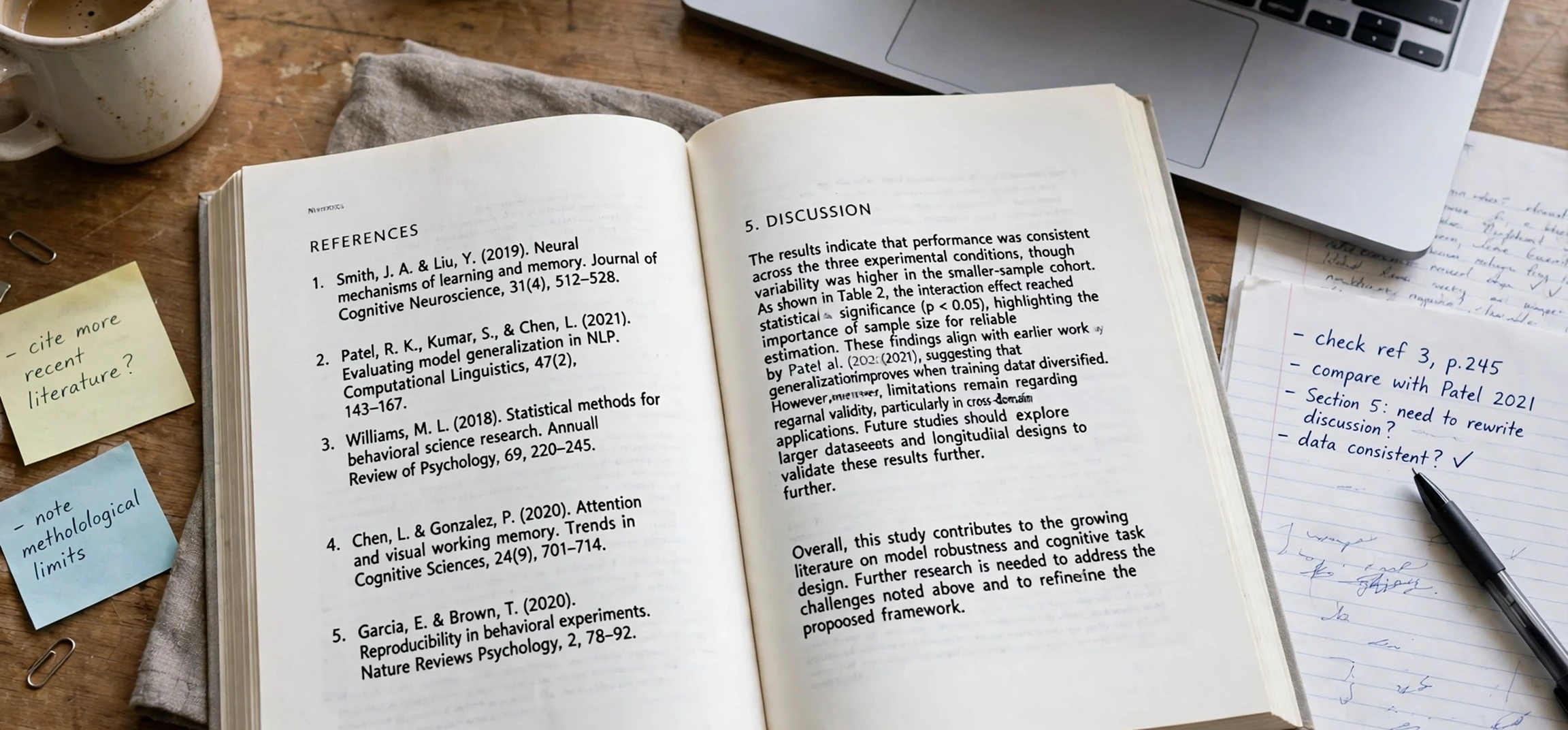
Learning APA in text citation with two authors is less about memorising a single format and more about learning when each form is used. With two authors, APA style asks you to name both authors every time you cite the work, but the way those names appear changes depending on whether the citation sits inside your sentence or at the end of it. That distinction — narrative versus parenthetical — is where most errors happen, and it is the focus of this guide to APA in text citation with two authors.
Instead of presenting a generic list of rules, this article follows the decision a writer actually makes while drafting. First, you decide whether the authors are part of your sentence or only part of your evidence. Then you choose the connector word, the punctuation, and the year placement that match that choice. Finally, you check that the reference-list entry lines up with what you wrote in the text. Each of those steps is explained with examples that use invented author names, so you can see the pattern without copying a real source incorrectly.
APA in Text Citation with Two Authors: The Core Rule
The core rule for APA in text citation with two authors is simple to state and easy to misapply. Every in-text citation for a work by two authors includes both surnames, every time it is cited. Unlike works with three or more authors, where APA style shortens later citations, a two-author work never drops to a single name plus a shortened form. If you cite the same two-author source five times, both names appear five times.
That rule exists for a clear reason. With only two authors, naming both keeps attribution fair and unambiguous. A reader who sees only one name might assume a single-author work, or might struggle to find the source in the reference list. Keeping both names visible avoids that confusion, and it also respects the shared contribution behind the work.
The second part of the rule is about the word that joins the names. In a narrative citation, where the authors are part of your sentence, the names are joined by the word and. In a parenthetical citation, where the whole citation sits inside brackets at the end of a clause or sentence, the names are joined by an ampersand. That single difference is the most reliable way to tell the two forms apart, and it is worth practising until it feels automatic.
Narrative vs Parenthetical APA in Text Citation with Two Authors
A narrative citation weaves the authors into the grammar of your sentence. The authors are the subject, or part of the subject, and the year follows their names in brackets. For example, with invented authors Patel and Okafor, a narrative citation looks like this: Patel and Okafor (2021) argue that clear citation helps readers trace evidence. The sentence would still make sense if you removed the year, because the authors are doing the arguing.
A parenthetical citation, by contrast, keeps the authors outside the sentence grammar. The claim comes first, and the evidence follows in brackets: Clear citation helps readers trace evidence (Patel & Okafor, 2021). Here, the sentence makes sense without the bracketed part, because the citation is an addition rather than a subject. The ampersand signals that the names belong to the bracketed reference, not to the flow of the sentence itself.
Choosing between these forms is a writing decision, not just a formatting one. Narrative citations put emphasis on the authors and are useful when you are discussing a particular study, comparing viewpoints, or introducing a source for the first time. Parenthetical citations put emphasis on the idea, and are useful when you are summarising a general point supported by a source, or when you are citing several sources for one claim. Good academic writing usually mixes both forms, using narrative citations sparingly for emphasis and parenthetical citations for routine support.
These patterns are the heart of APA in text citation with two authors, because they show how the same source looks when the authors lead the sentence.
Narrative Examples
Consider these narrative patterns. Each one keeps both authors, uses and, and places the year immediately after the names:
- Patel and Okafor (2021) found that students improved when citation was taught as a reading skill.
- According to Patel and Okafor (2021), citation choices affect how readers judge evidence.
- In their follow-up analysis, Patel and Okafor (2023) note that the same pattern held across disciplines.
Notice that the year stays with the authors even when the sentence continues for some time afterwards. The reader should not have to search for the date. If you mention the same source again in the same paragraph, later narrative citations still include both names and the year, because the two-author rule does not allow shortening.
By contrast, APA in text citation with two authors in parenthetical form keeps the emphasis on the claim, with the evidence tucked neatly at the end.
Parenthetical Examples
Parenthetical patterns keep the same information, but in a different order and with different punctuation:
- Students improved when citation was taught as a reading skill (Patel & Okafor, 2021).
- Citation choices affect how readers judge evidence (Patel & Okafor, 2021).
- The pattern held across disciplines (Patel & Okafor, 2023).
In each case, the comma before the year, the ampersand between the names, and the closing bracket after the year are all part of the format. Leaving out the comma, or using and inside the brackets, are the two most common small errors, and both are easy to catch in proofreading if you know to look for them.
A useful habit when learning APA in text citation with two authors is to read each citation back as a sentence. If the authors are the subject, the citation should read naturally with and. If the citation is an aside in brackets, it should read naturally with an ampersand. That read-back test catches most errors before submission.
When Both Names Appear Every Time
The phrase every time deserves emphasis, because it is where writers who know the three-author rule sometimes go wrong. In APA style, a work with three or more authors is shortened after the first citation, but a work with two authors is not. There is no first-use full form followed by a shortened form. The full two-name form is the only form.
This applies across a paragraph, across a section, and across the whole document. It also applies when you cite the same work in a table note, a figure note, or a footnote-style aside, if your institution allows those forms. Consistency matters more than brevity here. A reader scanning your paper should be able to recognise the same source instantly, without wondering whether a single name refers to the same work or a different one.
There is one related situation worth clarifying. If two different sources in your reference list share a first author surname and a similar year, you may need additional care to keep them distinct, but you still do not drop the second author. Instead, you rely on the full citation, including the year and, where needed, a letter suffix on the year, to distinguish them. The reference list, discussed below, is what makes that distinction work.
Mastering APA in text citation with two authors also means handling quotations confidently. The locator, such as a page number, is an addition to the citation, not a replacement for either author name, and both names still appear in full.
APA in Text Citation with Two Authors in Different Sentence Positions
Citations do not always sit at the start or end of a sentence. They can appear in the middle, after a clause, or after a quotation. The narrative-parenthetical distinction still governs the form, even in those positions.
When a quotation is involved, the citation follows the quoted material, and the page or paragraph locator is added. In a parenthetical quotation citation, the pattern is: “Quoted words here” (Patel & Okafor, 2021, p. 42). In a narrative quotation citation, the authors and year come first, and the locator follows the quotation: Patel and Okafor (2021) state that “quoted words here” (p. 42). The page numbers in these examples are illustrative, and you should always use the locator for the source you actually consulted.
When you cite two sources for one point, the parenthetical form joins them with a semicolon, ordered alphabetically by first author surname: (Okafor & Patel, 2021; Singh & Lee, 2019). The examples here use invented pairings to show the ordering rule. The key point is that each two-author source keeps both names, even inside a combined citation.
When you refer to a source in a heading, a table title, or a caption, follow your institution’s guidance, but keep the two-author pattern consistent. Do not shorten a heading citation to one name for space, because the same ambiguity problem arises, just in a more visible place.
A clear grasp of APA in text citation with two authors therefore requires holding two formats in mind at once: the short pointer in the text, and the full entry at the end.
Students sometimes ask whether APA in text citation with two authors changes when a source is cited in a table or figure note. The answer is no: the same two-name rule applies, because the reader still needs to match the short citation to the full reference entry without ambiguity.
How the Reference-List Entry Differs
The in-text citation and the reference-list entry for APA in text citation with two authors serve different purposes, and their formats reflect that difference. The in-text citation is a brief pointer. The reference-list entry is the full address that lets a reader find the source. Understanding the contrast helps you avoid copying one format into the other.
In the text, you use surnames only, plus the year. In the reference list, you use surnames plus initials, the year in brackets, the title, and publication details, in a fixed order. The connector also changes: the reference list uses an ampersand before the second author, regardless of whether the in-text form was narrative or parenthetical. That is because the reference list is not a sentence, so it follows the list convention rather than the sentence convention.
A generic reference-list pattern for a two-author journal article looks like this, with invented details:
Patel, A. R., & Okafor, C. N. (2021). Title of the article in sentence case. Title of the Journal in Title Case, 14(2), 101–118.
Compare that with the in-text forms. The text gives Patel and Okafor (2021) or (Patel & Okafor, 2021). The reference list gives initials, a full title, a journal title, volume, issue, and page range. Neither form is a substitute for the other, and a paper needs both: every in-text citation must match an entry in the reference list, and every reference-list entry should correspond to at least one in-text citation.
| Feature | In-text citation | Reference-list entry |
|---|---|---|
| Names shown | Surnames only | Surnames plus initials |
| Connector | and in narrative; & in parenthetical | & before the second author |
| Year | Year only, after names or in brackets | Year in brackets after authors |
| Title included | No | Yes, plus publication details |
| Shortening | Never for two authors | Full entry every time |
One more point about APA in text citation with two authors is worth stressing: consistency across the document matters as much as correctness in a single citation. A paper that uses and in brackets in one place and an ampersand in a sentence in another will look careless, even if each individual citation is close to correct.
Common Errors in APA in Text Citation with Two Authors
Most errors in APA in text citation with two authors fall into a small set of patterns. Checking for them during proofreading will catch the majority of mistakes.
- Using and inside brackets. Parenthetical citations need an ampersand, not the word and.
- Using an ampersand in a sentence. Narrative citations need the word and, because the authors are part of the sentence.
- Dropping the second author. Two-author works keep both names on every citation, unlike longer author lists.
- Missing the comma before the year in brackets. Parenthetical form requires a comma between the names and the year.
- Reversing name order. Keep the order shown in the source and in the reference list. Do not alphabetise the two names inside a single citation.
- Mismatching text and reference list. Spelling, year, and order must agree between the in-text citation and the reference entry.
A practical proofreading method is to search your draft for the ampersand and for the word and near author names, and to check each instance against its sentence position. If the names are inside brackets, you should see an ampersand. If the names are part of the sentence, you should see and. That single check resolves the most frequent confusion.
The questions below revisit APA in text citation with two authors from the angle students ask about most often: whether anything ever shortens, and whether the two forms can be mixed.
APA in Text Citation with Two Authors FAQ
Do I use et al. for two authors?
No. The shortened et al. form is not used for two-author works in APA style. Both surnames appear in every in-text citation.
Does the rule change on the second citation?
No. There is no shortened second form for two authors. The first, second, and later citations all use the same two-name pattern.
What if the authors have the same surname?
Follow your institution’s guidance and the current APA manual for that edge case, and keep both names visible. The guiding principle remains the same: the reader must be able to identify the source without ambiguity.
Can I mix narrative and parenthetical forms?
Yes. Mixing forms is normal and often improves readability, as long as each individual citation follows the correct pattern for its position.
Writing clearly about sources is part of writing clearly in general. For a broader look at writing guidance, see a writing guide with four tips from a published author and what multimodal text means, both of which discuss how form and meaning work together in written work.
One last check for APA in text citation with two authors is to confirm that every in-text name pair has a matching reference entry, with the same spelling and year.
Conclusion: APA in Text Citation with Two Authors
APA in text citation with two authors becomes straightforward once you treat it as a sentence-position decision. If the authors are in your sentence, use and and put the year after their names. If the citation is in brackets, use an ampersand and a comma before the year. Keep both names every time, in every part of the document, and make sure the reference-list entry matches with surnames, initials, and full publication details. That consistency is what makes your citations easy to follow, fair to both authors, and simple for a reader to trace. When you proofread, check the connector first, the comma second, and the reference-list match third, and most two-author citations will take care of themselves.
For help with precise wording in academic writing, see the technical meaning behind a term, which explains why small wording choices can change how a reader understands a sentence.



