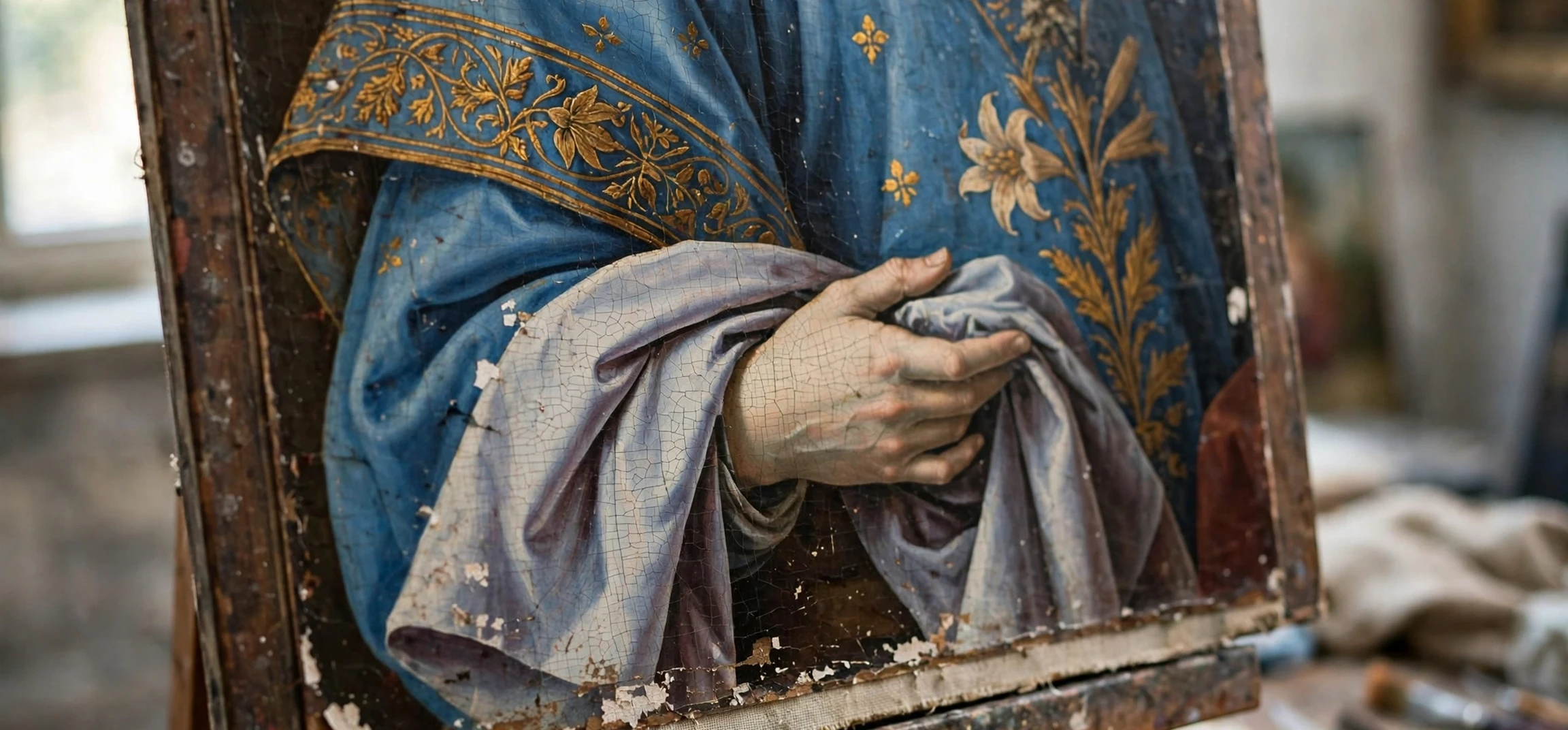
Leonardo da Vinci’s The Last Supper is one of the most famous paintings in the world, and one question comes up again and again when people look at it: who’s in the last supper? The painting shows Jesus sharing a final meal with his twelve apostles, the moment just after he has announced that one of them will betray him. Answering who’s in the last supper means naming those thirteen figures, understanding where each one sits in the composition, and recognising how Leonardo used gesture and expression to tell a story without words. This guide offers an art-history explainer: who the figures are, how they are grouped, and what to look for when you see the painting, treated with respect for the religious subject and without invented claims.
The Last Supper was painted by Leonardo da Vinci between about 1495 and 1498, on a wall of the refectory, or dining hall, of the convent of Santa Maria delle Grazie in Milan, Italy. It is a mural, not a canvas painting, and it was commissioned by Ludovico Sforza, the Duke of Milan. Leonardo painted it using an experimental technique on dry plaster rather than the traditional wet-plaster fresco method, which is one reason the work began to deteriorate relatively soon after it was finished and has needed careful conservation ever since. Today it remains in its original location, viewed by visitors under controlled conditions that protect the fragile surface.
Who’s in The Last Supper? An Overview
So, who’s in the last supper, in brief? At the centre sits Jesus, calm and composed, with his arms spread along the table. Around him sit the twelve apostles, his closest followers: Peter, Andrew, James the son of Zebedee, John, Philip, Bartholomew, Thomas, James the son of Alphaeus, Matthew, Simon, Thaddeus, and Judas Iscariot. That makes thirteen figures in total. Leonardo arranged them in four groups of three, two groups on each side of Jesus, so that the composition feels balanced while each group reacts in its own way to the announcement of betrayal.
The painting captures a specific moment from the Gospel accounts: the Last Supper, the final meal Jesus shared with his apostles before his crucifixion, in which he instituted the Eucharist. Leonardo chose not the calm institution of the meal, but the dramatic instant just after Jesus says that one of those present will betray him. Each apostle responds differently: some lean forward in shock, some gesture in protest, some turn to a neighbour to ask what was meant. Those reactions are the painting’s drama, and identifying the figures is the key to reading it. Anyone asking who’s in the last supper is really asking how to read those reactions group by group.
Who’s in The Last Supper on the Left Side?
Reading from left to right, the first group of three consists of Bartholomew, James the son of Alphaeus, and Andrew. Bartholomew, at the far left, stands and leans forward, his hands on the table, as if rising in alarm. Next to him sits James the son of Alphaeus, sometimes called James the Less, who reaches toward Peter in a questioning gesture. Andrew, the third figure in this group, holds up both hands in a gesture of surprise, his palms open, as if to say that he cannot be the one meant.
The second group on the left consists of Judas Iscariot, Peter, and John. Judas, who would betray Jesus, is traditionally identified by the money bag he clutches and by his position: he leans back slightly, in shadow, reaching toward the same dish as Jesus, a detail drawn from the Gospel accounts. Peter, next to him, leans toward John and gestures with a hand, as if urging John to ask Jesus whom he means. John, traditionally shown as the youngest apostle, sits closest to Jesus on this side, leaning away with his head inclined, his hands folded, in a posture of sorrow and gentleness. This grouping is one of the most discussed passages in the painting, because the closeness of Peter, Judas, and John creates a dense knot of gesture and meaning. For visitors wondering who’s in the last supper, this left-of-centre trio is the place to start.
Who’s in The Last Supper on the Right Side?
On the right side of Jesus, the first group consists of Thomas, James the son of Zebedee, and Philip. Thomas, who would later be known for doubting the resurrection until he saw proof, points upward with one finger, a gesture that art historians often read as questioning or emphasising. James the son of Zebedee, the brother of John, throws his arms wide in disbelief. Philip, next to him, places his hands on his chest, as if asking whether he could possibly be the one Jesus means. Together, the three convey protest and self-questioning.
The final group, at the far right, consists of Matthew, Thaddeus, and Simon. Matthew turns toward the other two with his arms spread, as if repeating or explaining what has just been said. Thaddeus, also known as Jude, leans toward Simon with a look of shock, while Simon, at the far right edge, sits with his arms spread and his hands open, in a gesture of astonishment. Simon is sometimes called Simon the Zealot, to distinguish him from Simon Peter. This closing group balances the opening group on the far left, giving the composition its symmetry: alarm and questioning at both edges, with calmer, more intimate reactions near the centre. Together, the five groups answer who’s in the last supper in full.
| Position (left to right) | Figure | How Leonardo shows them |
|---|---|---|
| Far left group | Bartholomew, James son of Alphaeus, Andrew | Standing in alarm, reaching, hands raised in surprise |
| Left of Jesus | Judas Iscariot, Peter, John | Clutching a bag, leaning to John, inclined in sorrow |
| Centre | Jesus | Calm, arms spread, framed by a doorway and window |
| Right of Jesus | Thomas, James son of Zebedee, Philip | Pointing upward, arms wide, hands on chest |
| Far right group | Matthew, Thaddeus, Simon | Turning to explain, leaning in shock, arms spread |
How Leonardo Arranged the Scene
Leonardo’s arrangement is a masterclass in composition. Jesus sits at the exact centre, framed by a doorway and a window behind him that form a natural halo-like shape around his head. The perspective lines of the room, the ceiling, the tapestries, and the tiled floor all converge toward a point behind Jesus, drawing the viewer’s eye to him. The table stretches across the foreground, and the apostles sit behind it, so that the viewer feels like a guest in the room, seated opposite the meal.
The grouping into threes is deliberate. Earlier depictions of the Last Supper often lined the apostles up in a stiff row, with Judas separated on the opposite side of the table. Leonardo broke with that convention, placing all thirteen figures on the same side of the table and grouping them into animated clusters. That choice makes the painting feel like a single moment of conversation, with overlapping gestures and glances, rather than a formal portrait. It also makes the question of who’s in the last supper easier to answer, because each trio can be studied on its own. It also lets Leonardo show a range of human reactions, from shock and denial to sorrow and confusion, within one unified scene.
Leonardo also used light and colour with care. The room is lit from the left, and the figures’ robes, in blues, reds, greens, and earth tones, help the viewer distinguish one apostle from another. Jesus wears a muted red and blue, traditional colours in religious art, and his calm posture contrasts with the agitation around him. That contrast is the painting’s emotional centre: stillness at the middle, turmoil at the edges, held together by the geometry of the room. Once you can name the figures, the question of who’s in the last supper becomes a way into that contrast.
History, Damage, and Conservation
The Last Supper’s history is almost as famous as the painting itself. Because Leonardo painted on dry plaster with an experimental mixture, the paint began to flake within his own lifetime. Over the centuries, the work suffered further damage from humidity, from a doorway cut through the lower part of the wall, from bombing during the Second World War, and from well-meaning but harmful early restoration attempts. What visitors see today is the result of a long, careful conservation programme completed in 1999, which cleaned the surface, stabilised the paint, and recovered details that had been hidden under centuries of grime and overpainting.
Conservation has also clarified the identifications of the figures. Earlier restorations and copies sometimes altered gestures or expressions, and art historians have used Leonardo’s own preparatory drawings, early copies, and written descriptions to confirm who is who. Some identifications, particularly among the less prominent apostles, have been debated, but the broad arrangement described here, four groups of three around a central Jesus, is the widely accepted reading. That consensus is what lets guides answer who’s in the last supper with confidence on the main points. Where sources differ on a minor detail, this guide follows the most common art-historical account rather than presenting a disputed point as settled fact.
For more explainers on historical and cultural topics, see our guide to the Holy Bible and our article on what jubilee means in the Bible, which give background on the texts behind the painting in the same accessible style.
Last Supper FAQ
Who’s in the last supper in total?
Thirteen figures: Jesus at the centre, with his twelve apostles around him, arranged in four groups of three.
Who is sitting next to Jesus?
John sits closest to Jesus on the viewer’s left, and Thomas, James the son of Zebedee, and Philip form the group on the viewer’s right, with Thomas nearest to Jesus on that side.
How can you identify Judas in the painting?
Judas is traditionally identified by the money bag he holds and by his shadowed, leaning posture as he reaches toward the same dish as Jesus, in the group to the viewer’s left of Jesus.
Where is The Last Supper located?
It is a mural on the wall of the refectory of Santa Maria delle Grazie in Milan, Italy, where it has remained since Leonardo painted it in the late 1490s.
Why is The Last Supper so famous?
It is famous for its dramatic choice of moment, its naturalistic gestures and expressions, its masterful perspective and composition, and its influence on centuries of later art, as well as for its fragile, much-conserved condition.
Conclusion
Answering who’s in the last supper opens up the whole painting. Once you know the thirteen figures, Jesus at the centre and the twelve apostles in four groups of three, you can follow Leonardo’s story: the shock, the denial, the questioning, and the sorrow that ripple outward from a single announcement. The painting endures not only because of its subject, but because Leonardo made that subject human, showing recognisable reactions in a carefully built room, lit and composed to draw every eye to the calm figure at its heart. Seen that way, The Last Supper is both a religious image and a study in how people respond when their world is suddenly shaken.



