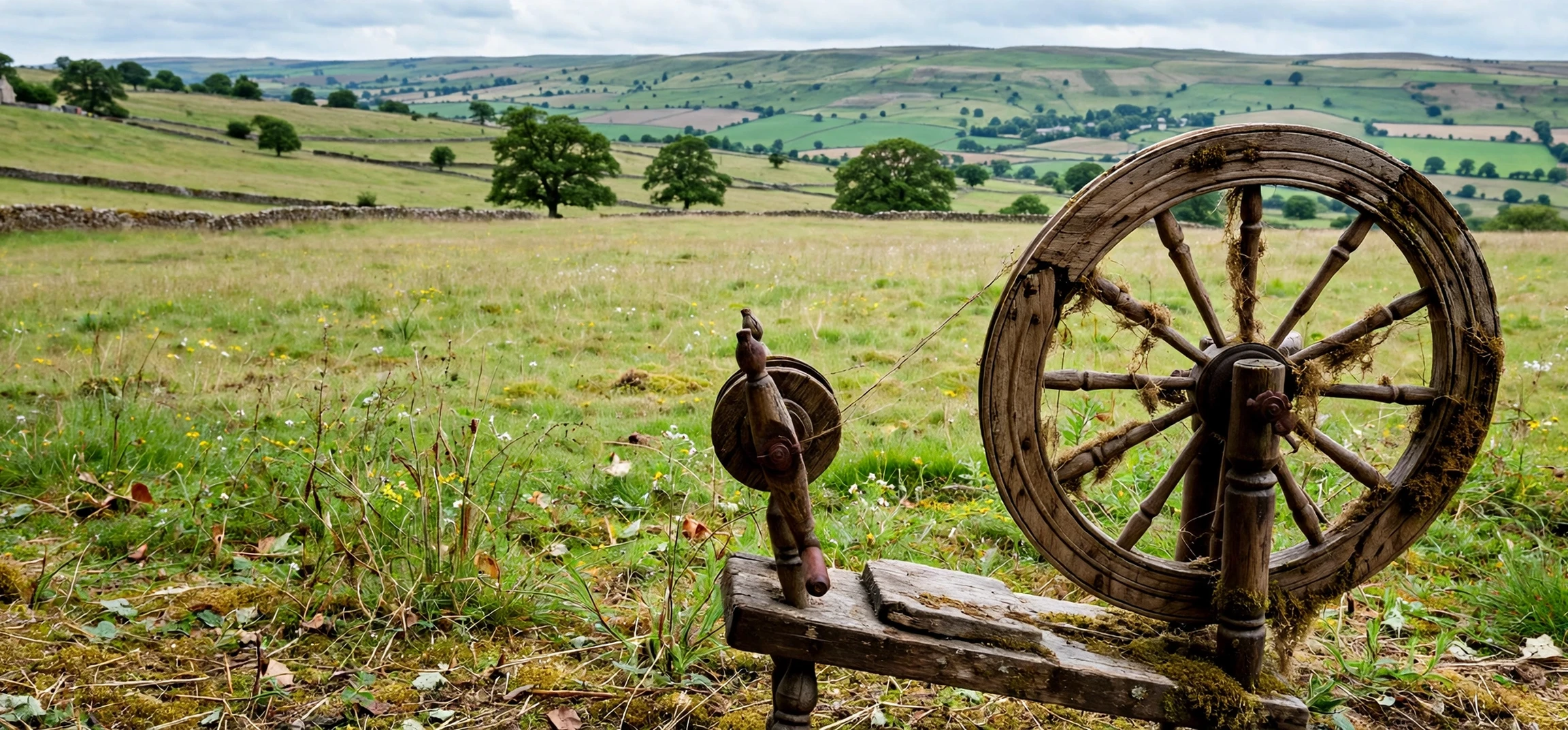
The meaning of distaff is best understood as two connected ideas from history: first, a distaff was a practical tool used in spinning, and second, the word distaff became an adjective describing the maternal line of a family. If you meet the word in an old novel, a family history book, a museum label, or a discussion of inheritance, it almost always points to one of those two senses. This guide explains both meanings in plain language, traces how the tool gave rise to the family meaning, and shows how to use the word correctly in modern writing without sounding vague or old-fashioned.
Many historical words survive in a changed form long after the object they named has left everyday life. The distaff is a good example. Few people spin flax or wool at home today, yet the word remains in phrases such as the distaff side of a family. Understanding the original tool makes the later family meaning easy to remember, because the image behind the phrase is concrete: the side of the family associated with the women who once held the distaff while spinning.
Table of Contents
- The Meaning of Distaff as a Spinning Tool
- The Meaning of Distaff as Maternal Line
- Distaff Side Versus Spear Side
- History of the Distaff in Daily Life
- Distaff in Language and Culture
- How to Use Distaff Correctly Today
- Frequently Asked Questions
- Conclusion
The Meaning of Distaff as a Spinning Tool
In its oldest and most literal sense, a distaff is a staff or stick used to hold fibres ready for spinning. The spinner wound unspun flax, wool, hemp, or similar fibre around the distaff, keeping it tidy and within reach, and then drew out small amounts of fibre to twist into thread or yarn with a spindle or a spinning wheel. The distaff therefore did not spin the fibre itself. It organised the work, held the raw material, and freed the hands of the spinner to control tension and twist.
Distaffs came in many forms. A simple handheld distaff could be a forked stick or a short staff with a cage-like top that gripped a bundle of fibre. A larger distaff might be mounted on a spinning wheel or held under the arm, tucked into a belt, or set upright in a stand. Some were plain working tools, while others were carved, painted, or decorated, especially when given as gifts or used on festive occasions. The variety reflects a simple truth: spinning was daily work in many households for centuries, and tools were adapted to the fibre, the spinner, and the setting.
The fibre most closely linked with the distaff in European history is flax, the plant fibre used to make linen. Flax fibres are long, smooth, and slippery, and they need careful handling before they become thread. Winding dressed flax onto a distaff kept the fibres aligned and prevented tangling. Wool could also be held on a distaff, although wool preparation often used cards or combs as well. Hemp, used for rope and coarse cloth, was another fibre that spinners handled in a similar way.
How Spinning With a Distaff Worked
The basic process was patient and rhythmic. First, the spinner prepared the fibre by cleaning and combing it so that short, tangled pieces were removed and the remaining fibres lay in one direction. Next, the prepared fibre was wrapped around the head of the distaff and secured, often with a ribbon or band. Then the spinner pulled a small amount of fibre from the bundle, twisted it into thread, and wound the finished thread onto a spindle or bobbin. Each step depended on the last, and a well-loaded distaff saved time because the spinner did not need to stop and reorganise the fibre every few minutes.
Spinning was often social as well as practical. People spun while talking, watching children, listening to stories, or sitting near a fire in the evening. Because the work was portable, a handheld distaff allowed a spinner to work while walking or standing. That portability helped make spinning a familiar sight in homes, farms, and workshops, and it explains why the distaff became a symbol of domestic work and, in older imagery, of female labour in particular.
Why the Distaff Mattered Before Factories
Before industrial spinning machines, almost all thread for cloth, rope, nets, and household textiles was spun by hand. A household might need many lengths of thread in a year for clothing, bedding, sacks, and repairs. The distaff was therefore not a rare craft object. It was part of the ordinary equipment of making cloth, alongside the spindle, the wheel, cards, and the loom. When writers of earlier centuries mentioned a distaff, readers understood at once that they meant everyday textile work, not a special or mysterious item.
The arrival of mechanised spinning changed that picture. Factories could produce thread far faster than hand spinners, and home spinning declined in many places. The distaff survived in folk crafts, museums, and traditional spinning communities, but it left the centre of daily life. Its second meaning, however, proved longer lived, because family history and genealogy still need a short way to distinguish one side of a family from the other.
The Meaning of Distaff as Maternal Line
As an adjective, distaff describes something relating to the female line of descent, especially the line traced through a mother, grandmother, and other female ancestors. The distaff side of a family is the maternal side. If a trait, name, story, or inheritance is said to come down the distaff side, it comes through women in the family rather than through men.
This sense grew directly from the tool. Because spinning with a distaff was, in many historical societies, work strongly associated with women, the distaff became a symbol for women and for the female line. The phrase made an abstract idea visible: just as a distaff held the fibre that became thread, the women of a family held and passed on the family line. The metaphor is old, but it is still clear once the tool is explained.
Genealogists and family historians still use the term because it is precise. Saying that a cousin is related on the distaff side tells a reader at once that the connection runs through mothers rather than fathers, without a long explanation. The same precision matters in history writing. When a historian says that a property, title, or custom passed on the distaff side, the reader knows that the chain of transmission went through women, which may matter for understanding inheritance rules, naming customs, or social status in that period.
Examples That Make the Sense Clear
Consider a family story passed from a grandmother to a mother and then to a daughter. That is a story handed down the distaff side. Consider a surname or a piece of family knowledge that a child learns from maternal relatives rather than paternal relatives. Again, the distaff side is the useful label. The term does not say anything about the value of the inheritance. It simply identifies the route it took.
It is also important to use the term only for the line of descent, not as a general synonym for women or for female relatives as a group. A mother, sister, or aunt is a female relative, but the phrase distaff side refers to the line itself and to relatives connected through that line. Keeping that distinction makes writing sharper and avoids turning a precise historical term into a vague label.
Distaff Side Versus Spear Side
The traditional opposite of the distaff side is the spear side, also called the sword side in some contexts. The spear side is the paternal line, traced through fathers and male ancestors. The contrast is deliberate: the distaff stood for spinning and domestic textile work, while the spear stood for warfare and male roles in older societies. Together, the pair gave writers a compact way to distinguish the two sides of a family.
Both terms belong mainly to historical and genealogical writing today. Modern family descriptions usually say maternal side and paternal side, which are clearer to most readers. The older pair remains useful when reading old texts, because an author of an earlier century might use distaff side and spear side without explanation, expecting the reader to know the symbols. Recognising the pair prevents a common misunderstanding, in which a reader treats distaff as a place name or a personal name rather than as a description of lineage.
| Term | Line described | Symbol behind the term |
|---|---|---|
| Distaff side | Maternal line, through mothers | Distaff used in spinning |
| Spear side | Paternal line, through fathers | Spear associated with warfare |
| Maternal side | Same as distaff side, modern wording | Word for mother |
| Paternal side | Same as spear side, modern wording | Word for father |
The table also shows why a modern writer might choose one term over the other. In a genealogy report, distaff side adds a historical flavour and connects the text to older sources. In a general article for a wide audience, maternal side is usually clearer. The best choice depends on the reader, not on which term sounds more impressive.
History of the Distaff in Daily Life
The distaff is very old. Spinning itself predates written history, and early spinners needed some way to hold prepared fibre. Archaeologists have found spindle whorls and related tools from ancient settlements, and images from ancient art show figures holding staffs loaded with fibre. The exact shape varied by region and period, but the function stayed the same for a long time: keep fibre ordered, accessible, and ready to draw out.
In medieval and early modern Europe, the distaff became a familiar household object. It appears in paintings, proverbs, and folk tales, sometimes as a plain tool and sometimes as a symbol. A well-known image in older literature is a woman at a spinning wheel with a distaff nearby, a scene that signalled home, industry, and patience. At the same time, the distaff could appear in satire or moral writing, where a writer used spinning imagery to comment on gender roles. Reading those passages today requires care, because the writer may be using the distaff as a symbol rather than describing actual work.
Decorated distaffs also tell a social story. In some regions, a distaff was a traditional gift, and a finely carved example showed skill and affection. Brides, daughters, and respected spinners might receive or own distaffs that were far more elaborate than a plain working tool. Museums now preserve such examples, and their labels often explain both the craft and the social meaning. A decorated distaff is therefore evidence of two histories at once: the history of textile technology and the history of family and community life.
Hand spinning did not vanish entirely when factories arrived. It continued in rural areas, in craft traditions, and later in revival movements that valued handmade cloth. Modern hand spinners still use distaffs, and contemporary makers produce them in wood and other materials. For a learner today, trying a distaff can make the history tangible in a way that reading alone cannot, because the balance of the tool and the need to draw fibre evenly become obvious within minutes.
Distaff in Language and Culture
Beyond genealogy, distaff appears in a small set of idioms and literary uses. The most durable is the distaff side, already explained above. Another older use describes the female sex in general, a usage that now sounds dated and should be avoided in modern writing unless quoting an old source. The reason is simple: modern readers expect precise language, and using a tool name as a broad label for women can sound reductive even when the writer intends no slight.
In folklore, spinning and the distaff often carry symbolic weight. Spinning turns loose fibre into a continuous thread, and storytellers have long used that image for fate, life, and time. The thread of life, the spinning of a tale, and the weaving of a plot all draw on textile work. The distaff, as the holder of raw fibre, fits naturally into that imagery as the starting point of a story or a life. Recognising the image helps a reader enjoy older tales without mistaking a symbol for a literal claim.
Place names, surnames, and craft terms rarely use distaff today, which is one reason the word can puzzle a modern reader. When it does appear, context usually gives the clue. If the passage concerns cloth, spinning, or a workshop, the tool sense is likely. If the passage concerns ancestors, inheritance, or cousins, the family sense is likely. If both appear together, the writer may be deliberately playing on the connection between the two meanings.
For related word histories, see our guides to 888 tattoo meaning, all encompassing meaning, and bildungsroman meaning, which explain how single words can carry a literal sense and a wider figurative sense.
How to Use Distaff Correctly Today
Use the noun for the tool when writing about spinning, textiles, museums, or historical crafts. A sentence such as, “She wound the prepared flax around the distaff before she began to spin,” is clear and accurate. Use the adjective for the maternal line when writing about genealogy or family history, and consider adding a short gloss for general readers, such as, “on the distaff side, meaning the maternal line.” That gloss costs only a few words and prevents confusion.
Avoid using distaff as a casual synonym for feminine, female, or womanly in modern prose. The older broad sense is still recorded in dictionaries, but it reads as dated and can distract from the point. Similarly, avoid inventing phrases that stretch the metaphor too far. The strength of the word lies in its two established senses, and keeping to them makes writing trustworthy.
Spelling and grammar are straightforward. Distaff is a single word, pronounced with stress on the first syllable. As a noun, it can be pluralised as distaffs when several tools are meant. As an adjective, it comes before the noun it modifies, as in distaff side or distaff line. No hyphen is needed in the common phrases, and the word does not take a capital letter unless it begins a sentence or appears in a title.
When researching family history, pair the term with clear names and dates. A note that says, “related on the distaff side through her maternal grandmother,” gives a future reader enough detail to follow the line. A note that says only, “distaff relative,” is less useful, because it does not identify the connecting ancestor. Precision in genealogy is a kindness to anyone who reads the research later.
Frequently Asked Questions
What is a distaff in simple terms?
A distaff is a stick or staff used to hold fibre, such as flax or wool, ready for spinning into thread. The spinner draws fibre from the distaff and twists it into yarn.
What does distaff side mean?
Distaff side means the maternal side of a family, traced through mothers and female ancestors. It is the opposite of the spear side, which means the paternal side.
Is distaff still used today?
Yes, in two settings. Hand spinners still use distaffs as tools, and genealogists and historians still use distaff side to describe the maternal line. In everyday conversation, maternal side is more common.
Where does the word distaff come from?
The word comes from older forms linked to spinning and to the staff itself. Its history reflects the tool first and the family meaning second, which is why the two senses remain connected.
Can I use distaff in modern writing?
Yes, when the context is clear. Use it for the spinning tool or for the maternal line, and add a brief explanation for general readers if the term might be unfamiliar.
Conclusion
The meaning of distaff joins a practical craft to a precise family term. As a tool, the distaff held fibre ready for spinning and supported the daily work of making cloth in homes and workshops for centuries. As an adjective, it names the maternal line, the side of a family traced through mothers, and it stands opposite the spear side, the paternal line. Remembering the tool makes the family phrase easy to grasp, and remembering the family phrase explains why an old spinning tool still appears in genealogy and history writing. Use the word for those two senses, explain it briefly for a general reader, and it will add clarity rather than confusion to your writing.



