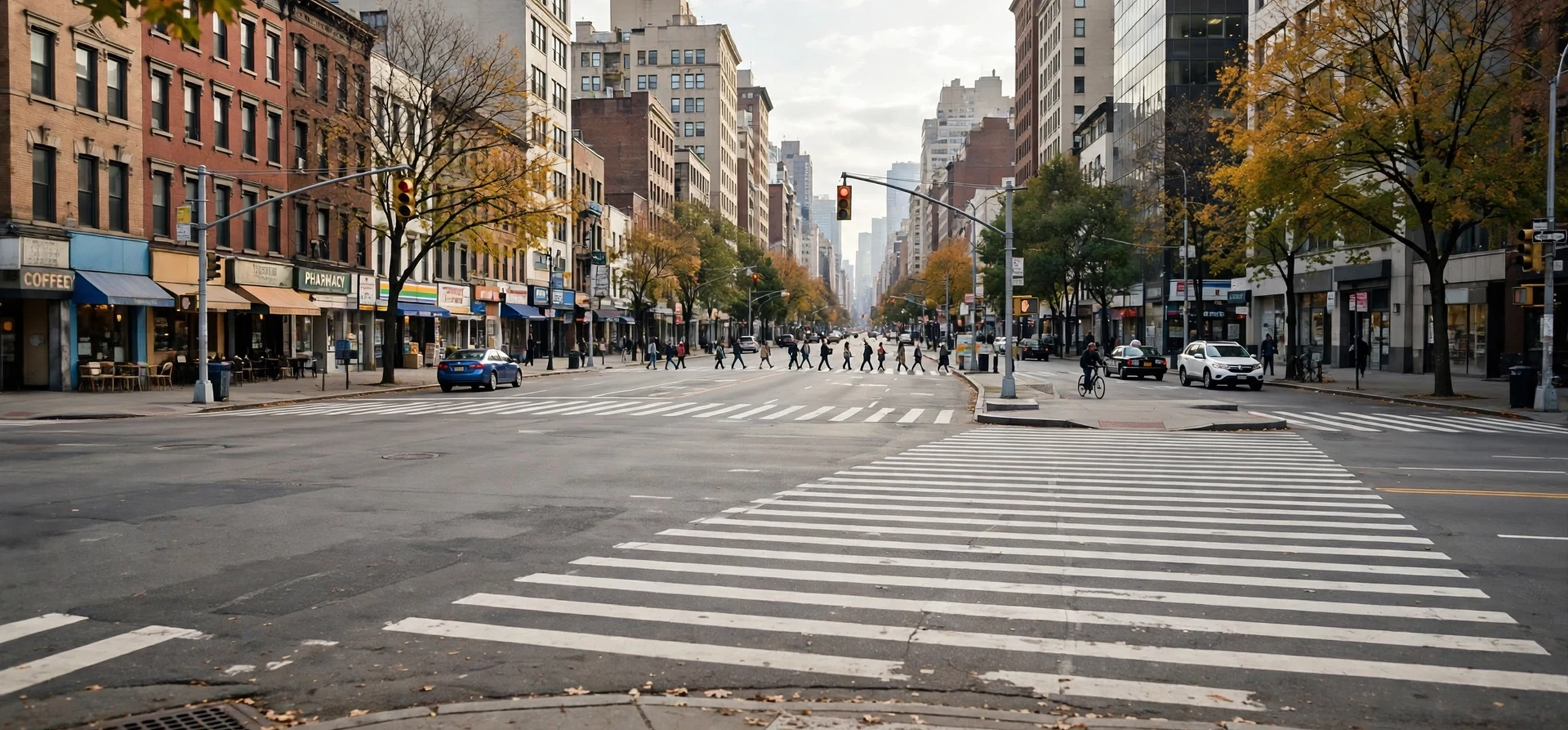
If you have ever heard someone described as a jaywalker and wondered what the term actually covers, you are asking about jaywalk meaning in both its dictionary sense and its legal sense, and the two are not quite the same. In everyday language, jaywalking means crossing a road in a way that is careless, unlawful, or outside the marked crossing places. In legal language, the details depend on where you are: different cities, states, and countries define the offence differently, set different penalties, and enforce it with different levels of strictness. This guide explains jaywalk meaning from its surprising historical origin to its modern rules, so you can understand the word, use it correctly, and cross roads more safely.
The word itself is older than most people expect. It dates to the early twentieth century, when motor cars were becoming common in American cities and streets that had once been shared casually by pedestrians, horses, carts, and trams suddenly became dangerous places. City authorities and motoring groups needed a word for pedestrians who did not follow the new rules of the road, and “jaywalker” was the word they chose. Understanding that history helps explain why the term still carries a slightly scolding tone today, even in places where it is rarely enforced.
Jaywalk Meaning: The Basic Definition
The core of jaywalk meaning is simple: a jaywalker is a pedestrian who crosses a road unlawfully or without regard for traffic rules. The most common examples are crossing against a red pedestrian signal, crossing a busy road away from a crosswalk when one is nearby, crossing diagonally through an intersection, or stepping into traffic without checking for approaching vehicles. In everyday speech, the word is sometimes used more loosely for any careless road crossing, even where no specific law has been broken. In that loose sense, it is closer to a criticism of behaviour than a legal charge.
Dictionaries generally define the verb “jaywalk” as crossing a street in a place or manner that is against traffic regulations, and the noun “jaywalker” as a person who does so. That definition is a useful starting point, but it hides an important complication. Traffic regulations are local. A crossing that is perfectly lawful in one city may be an offence in another, and a crossing that is tolerated in practice may still be technically unlawful on paper. Anyone who wants to know whether a particular crossing counts as jaywalking needs to check the rules for that specific place, not just the dictionary.
It is also worth distinguishing jaywalking from ordinary pedestrian crossing. Crossing a quiet residential street at a sensible point, after looking both ways, is not usually what people mean by jaywalking, even if there is no painted crosswalk. Jaywalking, in its usual sense, involves either breaking a signal, ignoring a nearby crossing, or crossing in a way that creates danger or disruption for traffic. The element of carelessness or rule-breaking is central to the word.
History explains why the term still sounds like a scolding. The jaywalk meaning in its original slang sense was unkind, and the jaywalk meaning today keeps a trace of that judgement even when it is used as a neutral legal term.
Jaywalk Meaning and History: Where Did the Word Come From?
The history of jaywalk meaning begins with the word “jay” itself. In early twentieth-century American slang, a “jay” was a country person unfamiliar with city ways, someone considered naive or foolish in an urban setting. The term was not kind. When cars began to fill city streets, motoring organisations and newspapers started calling careless pedestrians “jaywalkers,” implying that they walked like country folk who did not understand city traffic. The label was part of a broader campaign to establish new street rules that favoured motor vehicles over pedestrians.
Before cars, city streets were genuinely shared spaces. People crossed wherever they pleased, children played in the street, and vendors worked from carts. The arrival of fast motor traffic changed that balance, and it changed it quickly. Deaths and injuries rose sharply, and cities responded with traffic lights, crosswalks, one-way streets, and rules that confined pedestrians to certain places. The word “jaywalker” helped sell those rules to the public by framing the pedestrian, rather than the driver, as the problem. It is a reminder that language about road safety has always been shaped by competing interests, not just by neutral safety advice.
Over time, the insulting edge of “jay” faded, and “jaywalking” became a standard legal and everyday term in the United States. In Britain and many other English-speaking countries, the word is understood but used less often, partly because the laws are different. In the United Kingdom, for example, there is no general offence of jaywalking as there is in many American jurisdictions, and pedestrians are expected to use judgement rather than obey a single jaywalking rule. That difference is a useful reminder that the word’s legal weight depends entirely on location.
Laws show how flexible the term is. The jaywalk meaning in one American state may be a specific offence, while the jaywalk meaning in another country may be little more than a description of careless crossing with no standalone offence attached.
Travellers should pay special attention to this section. The jaywalk meaning you learned at home may not match the rules abroad, and the jaywalk meaning abroad may carry a fine even where the same behaviour at home would attract no penalty.
Jaywalking Laws Around the World
In the United States, jaywalking laws vary by state and city. Many states prohibit crossing against a pedestrian signal, crossing between intersections where a crosswalk is available, or crossing diagonally. Penalties are usually fines, and in some cities enforcement has become a matter of public debate, with critics arguing that fines fall unevenly on different communities and that enforcement distracts from measures that would make streets safer for everyone, such as slower speed limits and better crossings. In recent years, some American cities and states have loosened or repealed jaywalking rules, or have told police to deprioritise enforcement, reflecting a shift toward treating pedestrian safety as a design problem rather than purely a behaviour problem.
In much of Europe, the approach is different. Germany, for example, has rules requiring pedestrians to use crossings where provided and to obey signals, and fines are possible, although enforcement varies. In the United Kingdom, Ireland, and several other countries, there is no standalone offence called jaywalking, but pedestrians can still be held responsible if their careless behaviour causes an accident, and drivers also have duties to take care for pedestrians. In Australia, states have their own road rules, and crossing against a signal or away from a crossing can attract a fine. The pattern is clear: almost everywhere has some rules about where and how pedestrians cross, but the name, scope, and strictness of those rules differ widely.
For travellers, the practical lesson is to observe local behaviour and signals rather than assuming the rules from home apply. In a new city, watch where other pedestrians cross, obey pedestrian lights even if locals seem relaxed about them, and remember that being legally in the right does not protect you physically if a driver does not see you. Road safety rules exist to reduce risk, but they cannot remove it entirely, and caution is always the better guide.
Safety advice does not depend on the legal label. Whether or not a crossing meets the local jaywalk meaning, the practical question is the same, and the jaywalk meaning should never distract from looking, listening, and using a safe crossing point.
Jaywalking Versus Crossing Safely
Safe crossing is a skill, and it is worth describing in concrete terms. The basic steps are familiar from childhood road safety lessons, but they are easy to forget as adults, especially when distracted by phones or in a hurry. Stop at the kerb, look for a safe crossing point, and prefer a marked crosswalk, footbridge, or signal-controlled crossing where one is nearby. Check traffic in both directions, listen for vehicles that may be quiet, such as electric cars and bicycles, and do not start crossing if a signal is about to change. Cross directly, without dawdling or weaving, and keep watching while you cross, because a situation that looked safe when you stepped off the kerb can change.
Children, older people, and people with reduced mobility need extra time and extra care, and drivers are expected to allow for that. Parents teaching children about jaywalking should explain not only the rule but the reason: a driver travelling at speed needs time to see a pedestrian, react, and stop, and that time grows with speed and with poor visibility. Understanding stopping distances makes the rule feel less arbitrary and more like common sense. The same logic applies to crossing at night, in rain, or where parked vehicles block the view. If you cannot see traffic clearly, traffic cannot see you clearly either.
It is also worth thinking about the other side of the road safety equation. Drivers have responsibilities too, including observing speed limits, giving way at crossings, and watching for pedestrians at junctions. A street where drivers routinely speed and pedestrians have nowhere safe to cross is a design failure, not simply a collection of individual failures. Good road safety combines sensible pedestrian behaviour, careful driving, and streets designed with crossings in convenient places. When any one of those three is missing, risk rises.
The table below puts the definition into concrete situations. Each row illustrates jaywalk meaning in practice, and each safer alternative shows how jaywalk meaning can be avoided without giving up a convenient route.
Common Jaywalking Examples and Safer Alternatives
| Situation | Why it is risky or unlawful | Safer alternative |
|---|---|---|
| Crossing against a red pedestrian signal | Drivers do not expect pedestrians; signals exist to separate flows | Wait for the green signal, even if the road looks clear |
| Crossing mid-block beside a marked crosswalk | Drivers focus on the crosswalk, not on mid-block crossings | Walk to the crosswalk and use it |
| Crossing diagonally through an intersection | You spend longer in traffic and face vehicles from several directions | Cross one road at a time, using the marked routes |
| Stepping out between parked vehicles | Neither you nor drivers can see each other in time | Find a gap in parked vehicles with a clear view both ways |
| Crossing while looking at a phone | Attention and hearing are reduced; reaction time suffers | Put the phone away until you reach the other side |
This table is a general guide to common situations, not a legal code. Local rules may define these situations differently, and the safest course is always to follow local signals and crossings and to use judgement when visibility or traffic makes a crossing unsafe.
Enforcement debates often use the same word to mean different things. One side uses jaywalk meaning to describe dangerous behaviour, while the other uses jaywalk meaning to describe a minor infraction that is punished unevenly, and that difference drives much of the disagreement.
Penalties, Enforcement, and Fairness Debates
Where jaywalking is an offence, the usual penalty is a fine. The amount varies widely, from a small fixed penalty to a larger fine in some jurisdictions. In most places, jaywalking is not a criminal offence in the serious sense, and it does not normally result in a court appearance unless it is combined with other behaviour or is disputed. Enforcement, however, is uneven. In some cities, police rarely enforce jaywalking unless it causes danger or disruption. In others, enforcement campaigns target busy intersections at particular times. That unevenness is part of why the public debate about jaywalking has grown.
Critics of strict jaywalking enforcement make several arguments. They point out that fines can fall disproportionately on people who have fewer transport choices and who walk more out of necessity. They argue that a street with no convenient crossing forces pedestrians into difficult choices, and that punishing the pedestrian without fixing the street is unfair. They also argue that enforcement resources would be better spent on measures with stronger safety evidence, such as lower speed limits, better lighting, and more crossings. Supporters of enforcement argue that clear rules protect both pedestrians and drivers, and that predictable behaviour makes traffic flow safer for everyone.
These debates are not abstract. They affect real policy, and several jurisdictions have already changed their laws in response. Some have decriminalised jaywalking, some have made enforcement a low priority, and some have kept fines but added guidance to officers about fair and consistent application. Whatever the local policy, the underlying safety advice does not change: use crossings where provided, obey signals, and cross with care. A change in the law changes the legal consequence, not the physics of a collision.
The questions below cover the points readers ask most often. Each answer returns to the core jaywalk meaning, because the jaywalk meaning is the anchor for the history, the law, and the safety advice alike.
Frequently Asked Questions About Jaywalking
What is jaywalking in simple terms?
In simple terms, jaywalk meaning is crossing a road unlawfully or carelessly, for example against a red pedestrian signal or away from a nearby crosswalk. The exact legal definition depends on the laws of the place where you are crossing.
Is jaywalking illegal everywhere?
No. Many American states and cities have jaywalking offences, and several other countries have similar rules, but the United Kingdom, for example, has no general offence called jaywalking. Always check local rules when travelling, and follow local signals and crossings regardless.
Where does the word jaywalker come from?
It comes from early twentieth-century American slang, where a “jay” was a naive country person in the city. Motoring groups applied the term to pedestrians who did not follow the new traffic rules as cars became common.
Can you be fined for jaywalking?
Yes, in places where it is an offence, the usual penalty is a fine. Amounts and enforcement vary widely, and some places have loosened or deprioritised enforcement in recent years.
What is the safest way to cross a road?
Use a marked crosswalk or signal-controlled crossing where one is nearby, obey the pedestrian signal, look both ways, avoid distractions such as phones, and cross directly while continuing to watch traffic.
As this guide closes, the definition is worth restating plainly. The jaywalk meaning is unlawful or careless road crossing, and the jaywalk meaning in any given place must be checked against local rules rather than assumed.
Conclusion: Jaywalk Meaning in Plain Language
So, jaywalk meaning is more than a dictionary entry. It is a word with a history, a legal meaning that changes by place, and a practical meaning that comes down to crossing with care. Originally an insult aimed at country visitors to the city, it became a standard term for unlawful or careless crossing as cars took over city streets. Today, it sits at the centre of debates about fairness, enforcement, and street design, but the safest advice remains unchanged: use the crossing, obey the signal, look, listen, and cross with attention. For related word explanations, see our guide to the legally binding meaning and our guide to court disposition meaning, both of which explain how everyday legal terms are actually used. Understanding the word jaywalking is a small step, but it is part of a larger skill: reading the street, respecting its rules, and sharing it safely with everyone else who uses it.