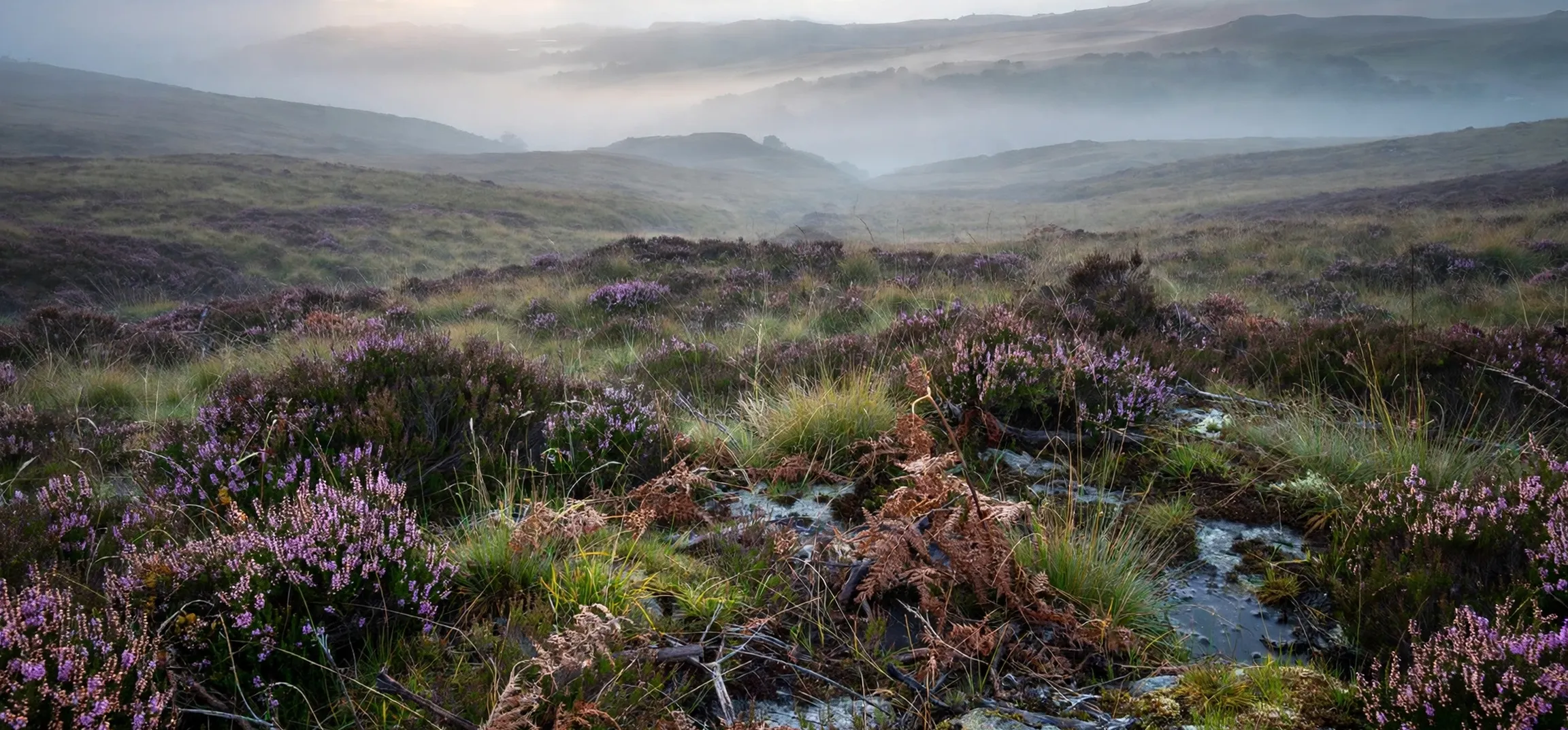
The definition of moor is best understood by looking at its two main uses in English. As a noun, a moor is a broad area of open, uncultivated land, usually on high ground, where the soil is acidic and the vegetation is low and hardy. As a verb, to moor means to secure a boat, ship, or other floating vessel in place with ropes, chains, or anchors. Although these two meanings look unrelated at first glance, both have long histories in English, and both are still used today in everyday speech, literature, geography, and sailing. The definition of moor therefore depends on context: a walker on a hillside and a sailor in a harbour are using the same word for very different things.
This guide explains each meaning in plain language, explores where moors are found, why they matter for wildlife and history, and how the verb is used on water. It also looks at the older historical use of the word for a people, a sense that is now dated and should be used with care. By the end, you will be able to recognise which meaning is intended, use the word correctly in a sentence, and understand why moors appear so often in novels, poems, and travel writing.
What Is the Definition of Moor as a Noun?
The noun sense of the definition of moor describes a tract of open land that has not been ploughed, built on, or enclosed for intensive farming. Moors are often found on uplands and plateaus, where thin soils, strong winds, and heavy rainfall make the ground unsuitable for most crops. Heather, grasses, mosses, and small shrubs dominate the plant life, and the landscape can look bare in winter and purple, gold, or green in summer. Peat often builds up in the wettest places, forming boggy ground that preserves plant remains for thousands of years.
Moors are not the same as meadows, downs, or commons, although they share some features. A meadow is usually grassland that is cut for hay, while a down is a rolling chalk hill. A moor is wilder and less managed, and it is often associated with a feeling of openness and remoteness. People visit moors for walking, birdwatching, and photography, but they must also respect the terrain, because paths can be wet, weather can change quickly, and some areas are protected for conservation.
Key Features of Moorland
Moorland is shaped by climate, geology, and centuries of grazing. Sheep and other livestock have traditionally kept trees and tall shrubs from taking over, while burning and cutting in some areas have encouraged fresh heather growth. The result is a landscape that is both natural and managed, and that supports birds such as grouse, curlew, and golden plover, as well as insects, reptiles, and hardy plants. Conservationists value moors for their peat, which stores carbon, and for their role in holding rainwater and slowing runoff into rivers below.
Definition of Moor as a Verb: Securing a Boat
The verb sense in the definition of moor is common in sailing, boating, and shipping. To moor a vessel means to fasten it securely so that it does not drift away. This can involve tying ropes to a dock, a bollard, a buoy, or a post, or dropping an anchor into the seabed. A boat that is moored is held in place, but it may still rise and fall with the tide and swing gently with the wind and current. A mooring, as a noun, can also mean the place itself, or the equipment used to hold the vessel.
Sailors use several related terms. A vessel may be moored alongside a quay, moored to a buoy in a harbour, or moored fore and aft, meaning that lines are attached at both the front and the back. Good mooring matters for safety: loose lines can let a boat drift into other vessels, while lines that are too tight can strain fittings when the tide changes. In marinas, permanent moorings are often rented, and boat owners return to the same spot time after time.
Everyday Examples of Mooring
You might read that a fishing boat was moored in the harbour overnight, that a canal narrowboat was moored beside a towpath, or that a ship remained moored offshore while waiting for a berth. In each case, the meaning is the same: the vessel was deliberately secured. The word can also be used figuratively, as when someone says they feel moored to a place or a routine, meaning that they feel anchored or held in place, although this figurative use is less common than the literal sailing sense.
Origins and History of the Word Moor
The English word moor comes from Old English, where it referred to marshy or uncultivated land. Over time, its meaning narrowed in some regions to upland heath, while in others it kept a broader sense of waste or wild ground. Place names preserve this history: Dartmoor, Exmoor, and the North York Moors are all famous English moorlands, and many smaller places carry moor in their names because the land around them was once open and unenclosed.
The verb to moor has a separate but related history, connected to words for fastening and securing. It appears in maritime records from the medieval period onward, when ships were tied to posts and anchors in harbours and rivers. The shared spelling is a reminder that English often reuses a familiar word for a new purpose, and that dictionaries list the noun and verb senses separately for clarity.
The Historical Sense of Moor for a People
There is also an older historical sense, capitalised as Moor, that referred to Muslim inhabitants of North Africa and, in medieval European writing, to people from that region and from parts of Spain under Muslim rule. This sense appears in history books, older literature, and names such as the Moors of medieval Spain. In modern usage, it is dated and can be imprecise, because it grouped together many different peoples, cultures, and regions under a single label. Modern writers usually prefer specific names for peoples, places, and periods, and they use Moor only when quoting historical sources or discussing that period directly.
Understanding this sense helps readers of older books, where a character described as a Moor may be identified by religion, origin, or appearance in ways that modern readers find unfamiliar. When you meet the word in a historical context, it is worth checking the date and the source, rather than assuming it carries the same meaning it would carry today.
Where Moors Are Found Around the World
Although the word is most closely tied to Britain, similar landscapes exist in many countries. In northern England and Scotland, large moors cover hills and plateaus and attract walkers from around the world. In Ireland, bogs and heathlands share many features with moorland. In other parts of Europe, heath and upland grassland play a similar role, while in North America, tundra and open prairie can feel similar, even though they are formed by different climates and soils.
Moors are valuable for science as well as scenery. Peat cores taken from moorland bogs can reveal past climates, because pollen and plant remains are preserved layer by layer. Archaeologists also find ancient trackways, settlements, and burial sites on moors, where the wet, acidic ground sometimes preserves wood, leather, and other materials that would decay elsewhere. This is one reason why moorland is often protected by law.
Moors in Literature and Culture
Moors have a powerful place in English literature. In Emily Bronte’s Wuthering Heights, the Yorkshire moors are almost a character in themselves, wild, changeable, and inseparable from the emotions of the people who live near them. In Arthur Conan Doyle’s The Hound of the Baskervilles, Dartmoor provides a misty, threatening backdrop for a mystery. Poets have also used moors to suggest freedom, loneliness, endurance, and the passage of time.
This literary fame has shaped how many people picture a moor even if they have never visited one. Films and television programmes often use moorland for scenes that need a sense of isolation or drama, with wind, mist, and wide skies doing much of the storytelling. Travel writers, by contrast, often stress the quieter pleasures of moorland: long views, birdsong, heather in bloom, and the feeling of being far from roads and towns.
Using Moor in Sentences: A Quick Reference
The best way to learn a word is to see it in context. The table below shows the noun, the verb, and the historical sense side by side, with a short example for each. Notice how the surrounding words make the intended meaning clear, even though the spelling is the same.
| Form | Meaning | Example sentence |
|---|---|---|
| Noun | Open, uncultivated upland | They walked across the moor as the mist began to lift. |
| Verb | To secure a boat in place | The crew will moor the boat beside the harbour wall. |
| Noun (mooring) | Place or equipment for securing a boat | Their boat has a permanent mooring in the marina. |
| Historical noun | Older term for North African Muslims | The history book discussed the Moors in medieval Spain. |
For readers who enjoy word guides, related explainers on this site cover other terms in the same clear style. You can explore a guide to word meanings through meaning and definition of business, a maths explainer at mean definition in maths, and another name guide at definition of the name Marissa.
Frequently Asked Questions About Moor
Is a moor the same as a heath?
The two words overlap, but they are not identical. Heathland is usually lowland and dominated by heather and gorse, while moorland is often upland and can include bog, grass moor, and heather moor. In everyday speech, people sometimes use them loosely, but geographers and conservationists draw a clearer distinction based on altitude, soil, and vegetation.
Can moor be both a noun and a verb?
Yes. As a noun, it names a landscape or a mooring place. As a verb, it describes the action of securing a vessel. The context of the sentence, and words such as boat, harbour, hill, or heather nearby, usually show which sense is meant.
How is moor pronounced?
In most varieties of English, moor rhymes with door and pour, although regional accents vary. It is a single syllable, and it should not be confused with more, even though the two words can sound similar in some accents.
Definition of Moor: Putting It All Together
When readers ask for the definition of moor, they usually want one clear answer, but the honest answer is that the definition of moor has two everyday branches and one historical branch. The landscape branch of the definition of moor points to open upland ground, heather, peat, and wide skies, while the sailing branch of the definition of moor points to ropes, anchors, and a vessel held safely in place. Keeping those branches apart is the simplest way to avoid confusion, because the same spelling can describe a hillside walk in one sentence and a harbour in the next.
A useful habit is to check the words around the term whenever the definition of moor is in doubt. Hills, heather, mist, and walking point to the landscape meaning, while boats, harbours, ropes, and tides point to the sailing meaning. Historical writing, with its older use of the capitalised form, points to the third branch. With that habit, the definition of moor becomes easy to recognise, easy to explain, and easy to use correctly in both speech and writing.
For quick revision, remember that the definition of moor is not a single fixed picture. The definition of moor as a landscape, the definition of moor as a sailing verb, and the historical definition of moor each belong to a different context, and the definition of moor that fits a sentence is the one its surrounding words point to. Keeping a short note of the definition of moor in each sense makes future reading faster and prevents the common mix-up between a hillside and a harbour.
Conclusion
In short, the definition of moor covers an open upland landscape, the act of securing a boat, and, in older writing, a historical name for a people. The landscape sense is the one most readers will meet in travel writing and literature, while the verb sense belongs to harbours, rivers, and marinas. Knowing both meanings, and recognising the dated historical sense, makes it much easier to read the word with confidence. Whether you are crossing a windswept hillside or tying up a boat at the end of the day, moor is a word with deep roots in the English landscape and in English life at sea.