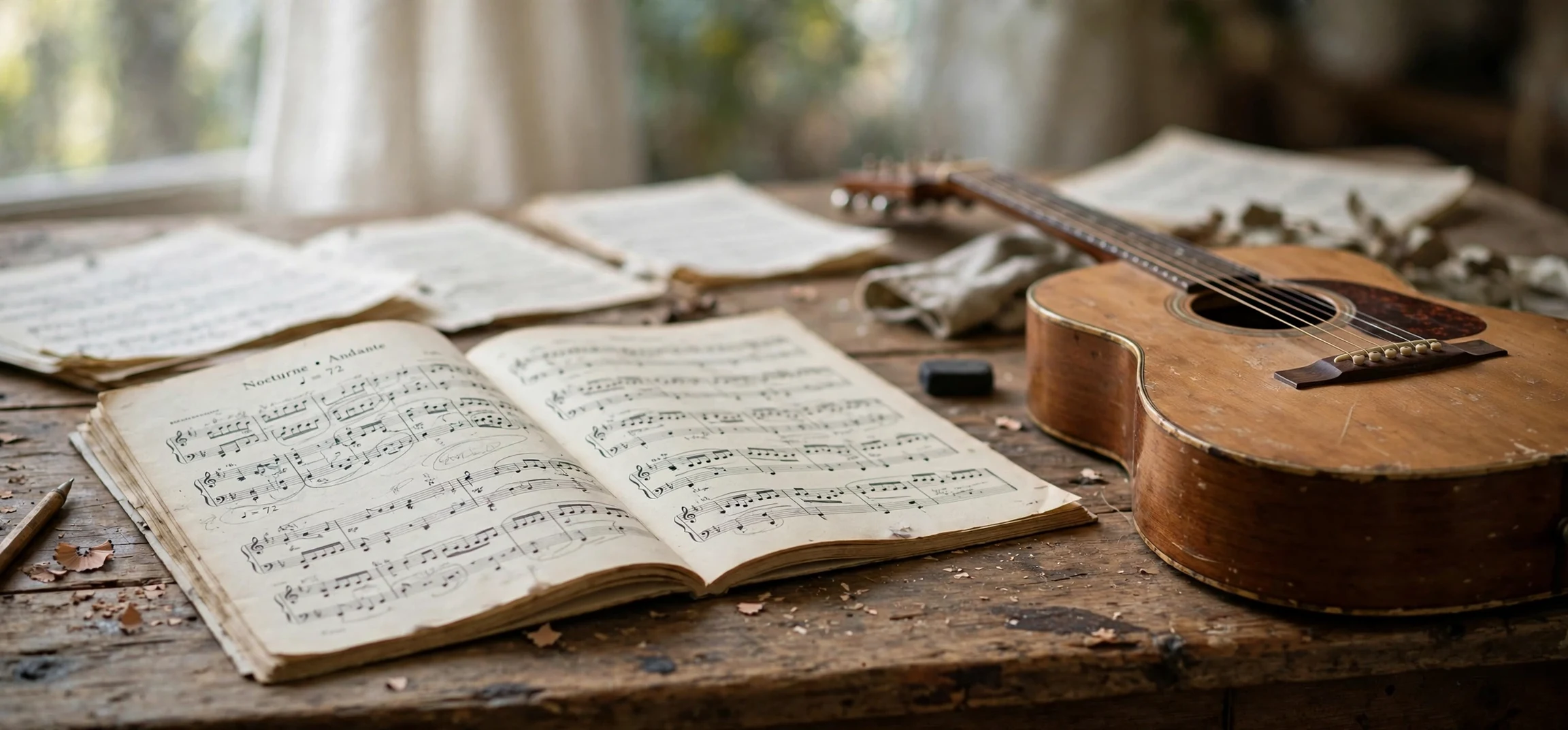
If you searched for music notations and meanings, this reference guide is designed to help you recognise the symbols on a printed score and understand what each one asks a musician to do. Sheet music can look crowded at first, because a single page carries pitch, rhythm, volume, speed and expression all at once. Once you learn to read it in layers, however, the system becomes logical and even reassuring. The staff tells you pitch, the note shapes tell you duration, and the smaller marks around them shape how the notes should sound. This article works through those layers one by one, starting with the staff and clefs and moving on to note values, rests, dynamics, articulation and common signs that change or repeat a passage. It is written as a steady reference you can return to whenever a new symbol appears in a piece you are learning.
It helps to think of notation as a set of instructions written in a shared visual language. Composers use it so that musicians who have never met can still play the same piece in a recognisably similar way. Performers still make choices about tone, balance and feeling, but the notation gives them a common starting point. That is why the same symbols appear in music for piano, voice, guitar, strings, wind instruments and many other instruments, even though the way each instrument produces sound is very different. Learning the symbols therefore saves time in rehearsals and practice, because you spend less time guessing and more time listening. It also makes it easier to learn new pieces independently, since you can work out much of the music before you hear a recording.
Music Notations and Meanings: The Staff and Clefs
The staff is the set of five horizontal lines on which most Western music is written. Notes sit either on a line or in a space between lines, and their vertical position shows whether they are higher or lower in pitch. A clef at the start of the staff tells you which line stands for which note, and without it the same dot could mean several different pitches. The treble clef, also called the G clef, curls around the second line from the bottom, marking that line as G. It is commonly used for higher-pitched instruments and for the right hand in piano music. The bass clef, also called the F clef, marks the fourth line from the bottom as F, and it is commonly used for lower-pitched instruments and for the left hand in piano music. When a piece needs notes beyond the five lines, short extra lines called ledger lines extend the staff upwards or downwards.
The key signature appears near the start of each staff, just after the clef, and it shows which notes are sharpened or flattened throughout the piece unless a later sign cancels the change. A sharp raises a note by a semitone, a flat lowers it by a semitone, and a natural cancels a previous sharp or flat for that note. Accidentals placed directly before a single note apply only to that note and to later notes of the same pitch in the same bar, unless the key signature or another accidental changes them. This system keeps the page tidy, because the composer does not need to write a sharp or flat before every affected note. Beginners sometimes find key signatures confusing, but it helps to learn them slowly, one at a time, and to check the signature before starting each new line. With practice, you will start to hear the pattern of the key before you even play the first note.
Reading Pitch Step by Step
A useful way to approach pitch is to read notes in small groups rather than trying to take in a whole line at once. Start by identifying the clef, then the key signature, then the first few notes, and say their letter names aloud if that helps. Notice whether notes move by step to a neighbouring line or space, or leap to a note further away, because stepwise movement is usually easier to follow and leaps often mark a change in direction or emphasis. Singing or humming the line, even roughly, can also help you connect the written symbol with the sound it represents. Over time, this slow and careful reading builds into fluent sight reading, where your eyes move ahead of your hands or voice. Nobody learns that fluency in a single session, and patient, regular practice matters far more than speed.
Music Notations and Meanings: Note Values and Rhythm
Note values show how long each note lasts relative to the beat. A semibreve, also known as a whole note, is an open note head with no stem, and it usually lasts for four beats in common time. A minim, or half note, is an open note head with a stem and usually lasts for two beats. A crotchet, or quarter note, is a filled note head with a stem and usually lasts for one beat. Quavers, or eighth notes, are filled note heads with stems and flags or beams, and each usually lasts for half a beat, so two quavers fill the time of one crotchet. Semiquavers, or sixteenth notes, have two flags or beams and each usually lasts for a quarter of a beat. A dot placed after a note increases its length by half of its original value, so a dotted crotchet lasts for one and a half beats. Ties join two notes of the same pitch into one longer sound, while slurs, which look similar but join notes of different pitches, ask for smooth, connected playing.
The time signature tells you how beats are organised into bars. It appears as two numbers at the start of the piece, after the clef and key signature. The upper number shows how many beats are in each bar, and the lower number shows which note value counts as one beat. In four-four time, there are four crotchet beats in each bar, which gives music a steady, walking feel. In three-four time, there are three crotchet beats in each bar, which often gives music a lilting, dance-like feel. In six-eight time, the beat is usually grouped in two groups of three quavers, which can feel flowing and rocking. Bar lines divide the music into bars, and a double bar line marks the end of a section or, in some cases, the end of the whole piece. Counting aloud while you practise is one of the most reliable ways to keep rhythm steady, especially when rests or dotted notes interrupt the pattern.
| Symbol | Name | Usual Length in Four-Four Time |
|---|---|---|
| Open note head, no stem | Semibreve or whole note | Four beats |
| Open note head with stem | Minim or half note | Two beats |
| Filled note head with stem | Crotchet or quarter note | One beat |
| Filled note head with flag or beam | Quaver or eighth note | Half a beat |
| Filled note head with two flags or beams | Semiquaver or sixteenth note | Quarter of a beat |
| Note followed by a dot | Dotted note | Original length plus half again |
Rests and Silence in a Score
Rests are the symbols for silence, and they are just as important as notes, because music needs breathing space and contrast. A semibreve rest hangs below a line of the staff, a minim rest sits on top of a line, and crotchet, quaver and semiquaver rests each have their own shapes and lengths matching the notes of the same names. A whole-bar rest is often written as a semibreve rest placed in the middle of the bar, whatever the time signature. Rests help to shape phrases, create suspense, and give performers a moment to breathe or prepare for the next entry. Beginners sometimes rush through rests or treat them as empty time, but counting through them carefully usually improves the whole performance. Silence, used well, can make the notes around it sound clearer and more deliberate.
Repeats and endings also shape how a score is read. A repeat sign, formed by a double bar line with two dots, tells the player to go back and play a section again. First and second time bars show different endings for the first and second play-through of a repeated section. The signs for dal segno and da capo send the player back to a marked point or to the beginning, and the word fine marks where the piece should finish after that return. These directions save space on the page, because the composer does not need to print the same passage twice. They do require careful reading, however, and it is worth tracing the route through the piece with a pencil before you play it, so you do not lose your place during a performance.
Dynamics and Volume Markings
Dynamics show how loud or soft music should be, and they are usually written in abbreviated Italian terms below the staff. The most common markings are pianissimo, meaning very soft, piano, meaning soft, mezzo piano, meaning moderately soft, mezzo forte, meaning moderately loud, forte, meaning loud, and fortissimo, meaning very loud. A crescendo, shown by a hairpin opening to the right or by the word cresc., asks for a gradual increase in volume, while a decrescendo or diminuendo, shown by a hairpin closing to the right, asks for a gradual decrease. Sudden changes are also possible, and a forte marking immediately after a piano passage can create surprise or drama. Dynamics are relative rather than exact, so forte in a gentle song will sound different from forte in a large orchestral work, and good performers adjust to the instrument, the room and the other musicians around them.
Volume markings work together with articulation to shape the character of each note. A staccato dot above or below a note head asks for a short, detached sound, while a tenuto line asks for a note to be held for its full value with a slight emphasis. An accent mark asks for a note to be stressed more strongly than its neighbours. A slur over a group of notes asks for them to be played smoothly and connected, without a break between them, and a phrase mark, which can look very similar, shows a longer musical sentence. The difference between a slur and a phrase mark depends on context and instrument, so teachers often help beginners tell them apart in the pieces they are studying. Learning these small marks gradually will make your playing sound more musical, because the same notes can feel light and playful, or serious and sustained, depending on how they are articulated.
Tempo and Expression Marks
Tempo markings tell you the speed of the music, and they are often written at the top of the score in Italian. Largo suggests a very slow and broad speed, adagio suggests a slow and calm speed, andante suggests a walking speed, moderato suggests a moderate speed, allegro suggests a fast and lively speed, and presto suggests a very fast speed. A metronome mark, which gives a number of beats per minute, can make the intended speed more precise. Changes in speed are shown by words such as accelerando, meaning gradually faster, and ritardando or rallentando, meaning gradually slower. A tempo, written after a change, means return to the original speed. Expression words add further character, such as dolce for sweetly, espressivo for expressively, and cantabile for in a singing style. These words do not change the notes themselves, but they change how a performer approaches them, and that is often what makes a performance memorable.
Other common signs include the fermata, which asks for a note or rest to be held longer than its written value, and the breath mark, which shows a short pause, often for singers and wind players. Trills, mordents and turns are ornaments that decorate a main note with quick neighbouring notes, and their exact performance can vary with style and period, so listening to examples and asking a teacher for guidance is often helpful. Pedal markings for piano show when the sustaining pedal should be pressed and released, while bowing marks for string instruments show whether the bow should move down or up. Guitar music may include chord diagrams, finger numbers and strumming directions. Each instrument therefore has some specialist symbols, but the core system of staff, rhythm, dynamics and tempo remains shared, which is why a grounding in the main symbols helps across many kinds of music.
How to Practise Reading Notation
A steady practice routine helps notation become familiar rather than intimidating. Start with pieces that use only a few note values and a simple key, and read the rhythm by clapping or tapping before you play the pitches. Then add the pitches slowly, checking the clef and key signature as you go, and only increase the speed when the notes and rhythm feel secure together. It can help to circle or highlight a new symbol each time you meet one, and to write its meaning in your own words in a notebook. Listening to a recording while following the score is also valuable, because it connects the visual symbols with the sounds they produce. If you play with others, watching how experienced musicians follow repeats, dynamics and tempo changes will teach you a great deal about reading ahead and staying together.
Common mistakes are easy to avoid once you know to look for them. One is forgetting the key signature and playing a sharpened or flattened note as natural. Another is ignoring rests or shortening dotted notes, which distorts the rhythm even when the pitches are correct. A third is playing every note at the same volume, which flattens the character of the music and hides the phrases the composer shaped. Finally, many beginners focus only on the notes and miss repeat signs or tempo changes, which can lead to confusion in the middle of a piece. Checking the score in layers, first for pitch and rhythm, then for dynamics, articulation and directions, gives you a more complete picture and reduces surprises. You might also enjoy exploring how symbols work in familiar listening, such as following a well-known theme in a theme music compilation while noticing its rhythm and phrasing, or comparing musical signs with everyday signs in a guide to the meaning of emoticon symbols.
Frequently Asked Questions
What is the difference between a tie and a slur?
A tie joins two notes of the same pitch into one longer sound, so the second note is not played separately. A slur joins notes of different pitches and asks for smooth, connected playing, with each pitch still sounded. The curved lines look similar, so checking whether the pitches are the same is the quickest way to tell them apart.
Do I need to learn Italian to read music?
No, you do not need to speak Italian. Most tempo, dynamic and expression terms come from Italian by tradition, but beginners can learn the common words gradually as they appear in pieces. Keeping a short personal glossary of terms you have met is often more useful than trying to memorise a long list at once.
Why do some notes have dots after them?
A dot after a note increases its length by half of its original value. A dotted crotchet therefore lasts for one and a half beats in music where a crotchet is one beat. Dotted rhythms create a lilting or driving feel, depending on the pattern, and counting them carefully helps keep the rhythm steady.
Conclusion
Learning music notations and meanings is less about memorising every symbol at once and more about recognising the layers of a score: pitch on the staff, duration in note shapes, silence in rests, volume in dynamics, and character in articulation and tempo marks. With that framework, each new symbol has a place, and each new piece becomes a little easier to approach. Take your time, practise in small steps, check key signatures and repeat signs before you play, and listen as much as you read. The symbols are there to serve the music, and once they feel familiar, they quietly disappear into the background, leaving you free to enjoy playing and listening with greater confidence.



