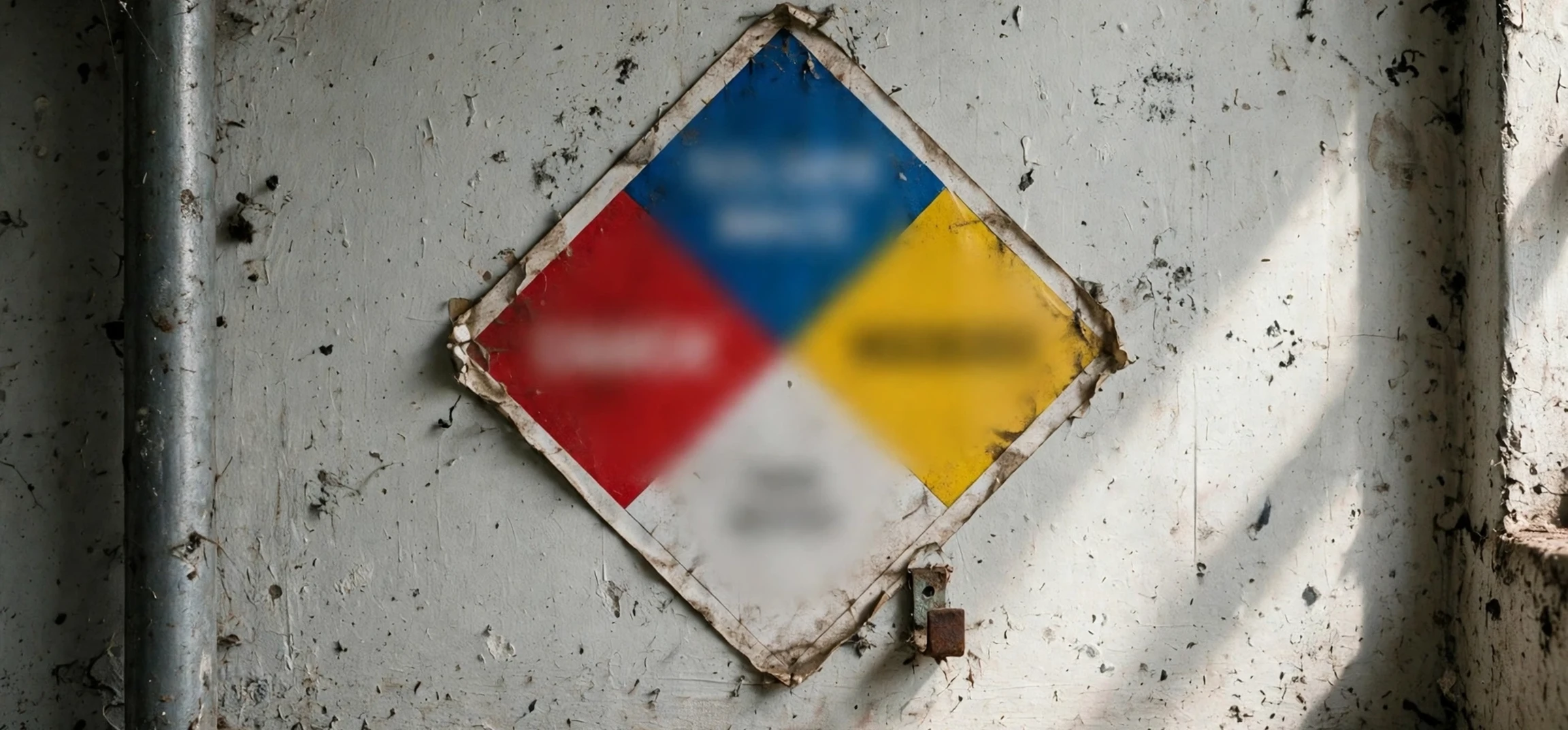
You have probably seen it on the side of a chemical tank, a warehouse door, or a laboratory wall: a diamond split into four coloured sections, each carrying a number. That symbol is the NFPA diamond, and understanding it can help you recognise chemical hazards at a glance. This guide explains what the NFPA diamond is, what each colour and number means, and how the system is — and is not — meant to be used.
The NFPA diamond comes from the National Fire Protection Association’s standard for identifying hazardous materials, widely known as NFPA 704. Its purpose is to give emergency responders a rapid, standardised summary of a material’s hazards so they can decide how to approach an incident safely. It is not a complete safety data sheet, and it is not a substitute for proper training.
What Is the NFPA Diamond?
The NFPA diamond is a square sign turned 45 degrees so it looks like a diamond, divided into four smaller diamonds: blue on the left, red at the top, yellow on the right, and white at the bottom. The blue, red, and yellow sections each carry a number from 0 to 4. The white section carries special symbols rather than a number. Together, the four sections summarise the health, fire, reactivity, and special hazards of a material.
The system is deliberately simple. In an emergency, a firefighter arriving at a burning warehouse does not have time to read a ten-page safety document. A glance at the NFPA diamond tells them whether the material is acutely toxic, highly flammable, dangerously reactive, or water-reactive, and that shapes the response in the first critical minutes.
The NFPA Diamond Colours and Numbers
Each colour answers a different question. Blue, on the left, answers: how dangerous is this material to health on short exposure? Red, at the top, answers: how easily does it burn? Yellow, on the right, answers: how reactive or unstable is it? White, at the bottom, answers: is there anything special responders must know, such as water reactivity or oxidising properties?
In each numbered section, 0 means minimal hazard and 4 means severe hazard. The scale is consistent across colours, which makes the diamond easy to read once you know it: a 4 anywhere demands serious caution, while a row of zeros describes a comparatively low-hazard material.
| Number | Blue (Health) | Red (Flammability) | Yellow (Reactivity) |
|---|---|---|---|
| 0 | No significant health risk beyond ordinary handling | Will not burn under normal conditions | Stable even under fire conditions |
| 1 | Irritation or minor injury possible | Needs preheating before it will burn | Normally stable, may become unstable at high temperature |
| 2 | Temporary incapacitation or residual injury possible | Ignites with moderate heating | Violent chemical change possible at high temperature or pressure |
| 3 | Serious injury possible on short exposure | Ignites under most ambient conditions | May detonate with a strong initiating source |
| 4 | Life-threatening on very short exposure | Burns readily or vaporises rapidly | Readily detonates |
The White Section of the NFPA Diamond
The white, bottom section of the NFPA diamond carries special hazard symbols instead of numbers. The most common are W with a line through it, meaning the material reacts dangerously with water and water must not be used on it; OX, meaning the material is an oxidiser that can intensify a fire; and SA, meaning the material is a simple asphyxiant gas. Other symbols exist for specific hazards, and the full list is defined in the NFPA 704 standard.
The water-reactivity symbol deserves emphasis because it is counter-intuitive. The instinct in a fire is to apply water, but for a water-reactive material that can make the incident far worse, producing flammable gases or violent reactions. That is exactly the kind of information the NFPA diamond exists to convey instantly.
How to Read an NFPA Diamond in Practice
Start with the red section: it tells you the fire risk. Then check blue for the health risk to anyone nearby, yellow for reactivity, and white for special warnings. A diamond reading 4-4-4 with a water-reactivity symbol describes a material that is dangerous in every dimension and must not be approached with water — a very different situation from a diamond reading 1-0-0, which describes a low-hazard material.
Remember that the numbers describe the hazard under fire or emergency conditions, not necessarily the risk in ordinary, careful use. A laboratory solvent may carry a high flammability number yet be used safely every day in small quantities with proper ventilation and no ignition sources. The diamond is an emergency summary, not a ban on use.
What the NFPA Diamond Does Not Tell You
The NFPA diamond does not cover chronic health effects, such as long-term exposure risks, and it does not replace a safety data sheet, which gives detailed handling, storage, first-aid, and spill procedures. It also does not identify the material itself: two different chemicals can share the same diamond numbers while needing different handling. The diamond is a first-glance tool for responders, and anyone working with a hazardous material should know the full safety data sheet for that specific substance.
Signage rules also matter. The diamond is typically displayed on fixed facilities, tanks, and storage areas rather than on small containers, which instead carry product labels under other labelling systems. If you see an NFPA diamond on a building, it usually refers to the most hazardous material stored there, or to the general hazard of the area.
Frequently Asked Questions About the NFPA Diamond
Is the NFPA diamond the same as a hazard label on a bottle?
No. Bottle labels follow consumer and workplace labelling rules with pictograms and hazard statements. The NFPA diamond is an emergency-response sign for facilities and bulk storage.
What does a 0 mean in the NFPA diamond?
It means minimal hazard in that category under emergency conditions. It does not mean the material is harmless in all circumstances.
Who uses the NFPA diamond?
Primarily emergency responders, facility managers, and safety professionals. Members of the public may see the signs but should never use them as a reason to approach a hazardous scene.
Should I rely on the NFPA diamond for workplace safety?
Use it as one tool among several. Safety data sheets, training, and site procedures are the primary sources for day-to-day handling.
Learning and Using the NFPA Diamond Safely
Knowing what the NFPA diamond means is only useful if the knowledge is shared with everyone who might need it. In workplaces that store hazardous materials, NFPA diamond signs are part of a wider safety system that includes staff training, emergency plans, and regular drills. New employees should be shown the diamonds on their site and told what each one refers to, so that in an emergency they recognise the sign rather than encountering it for the first time under stress.
Emergency responders train specifically on NFPA 704, learning to combine the diamond reading with other information: the type of building, the quantity of material, the weather, and whether people are inside. Members of the public who see an NFPA diamond should treat it as information, not as an invitation to investigate. If you see a damaged tank or a leaking container bearing a diamond, move away, keep others away, and call emergency services, telling them what the diamond shows if you can do so safely from a distance.
Where NFPA Diamonds Appear
You will most often see NFPA diamonds on the outside of buildings that store chemicals, on bulk tanks, on warehouse doors, and at the entrances to laboratory or industrial areas. They may also appear on transport placards, although road and rail transport uses its own placard system alongside or instead of the NFPA diamond. A single facility can display several diamonds if it stores several hazardous materials, and the diamond on the building entrance usually reflects the most severe hazard present or the hazard of the area behind that entrance.
For students and curious readers, the NFPA diamond is a good starting point for learning about chemical safety, but it should lead you to fuller sources: safety data sheets, your employer’s procedures, and recognised safety training. A symbol that can be read in seconds is powerful precisely because it summarises deeper knowledge — it does not replace that knowledge.
Worked Examples: Reading the NFPA Diamond
Consider a material whose NFPA diamond reads 2-3-0 with no special symbol. The blue 2 warns that short exposure could cause temporary incapacitation, the red 3 warns that it ignites readily under most ambient conditions, and the yellow 0 tells responders the material is stable. A firefighter reading that diamond knows the priority is keeping people away from the vapour and controlling ignition sources, while worrying less about explosion. Contrast that with a diamond reading 4-1-2 with a water-reactivity symbol: here the health risk dominates, reactivity is a serious concern, and water must not be used. The two diamonds describe completely different emergencies, which is exactly why the system exists.
Practice reading diamonds on materials you encounter in everyday life, such as cleaning products in a janitorial store or fuel storage at a depot, and you will quickly find the colours become second nature. The numbers reward a moment of attention: a 4 anywhere is a stop-and-think signal, and a white-section symbol can change the entire response.
The NFPA diamond packs a great deal of safety information into a single symbol: health on the left, fire at the top, reactivity on the right, and special hazards at the bottom, each graded from 0 to 4. Learning to read it takes minutes, and in an emergency those minutes matter. For more safety explainers, see our guide to climbing harness fitting and safety and our article on commercial insurance meaning.



