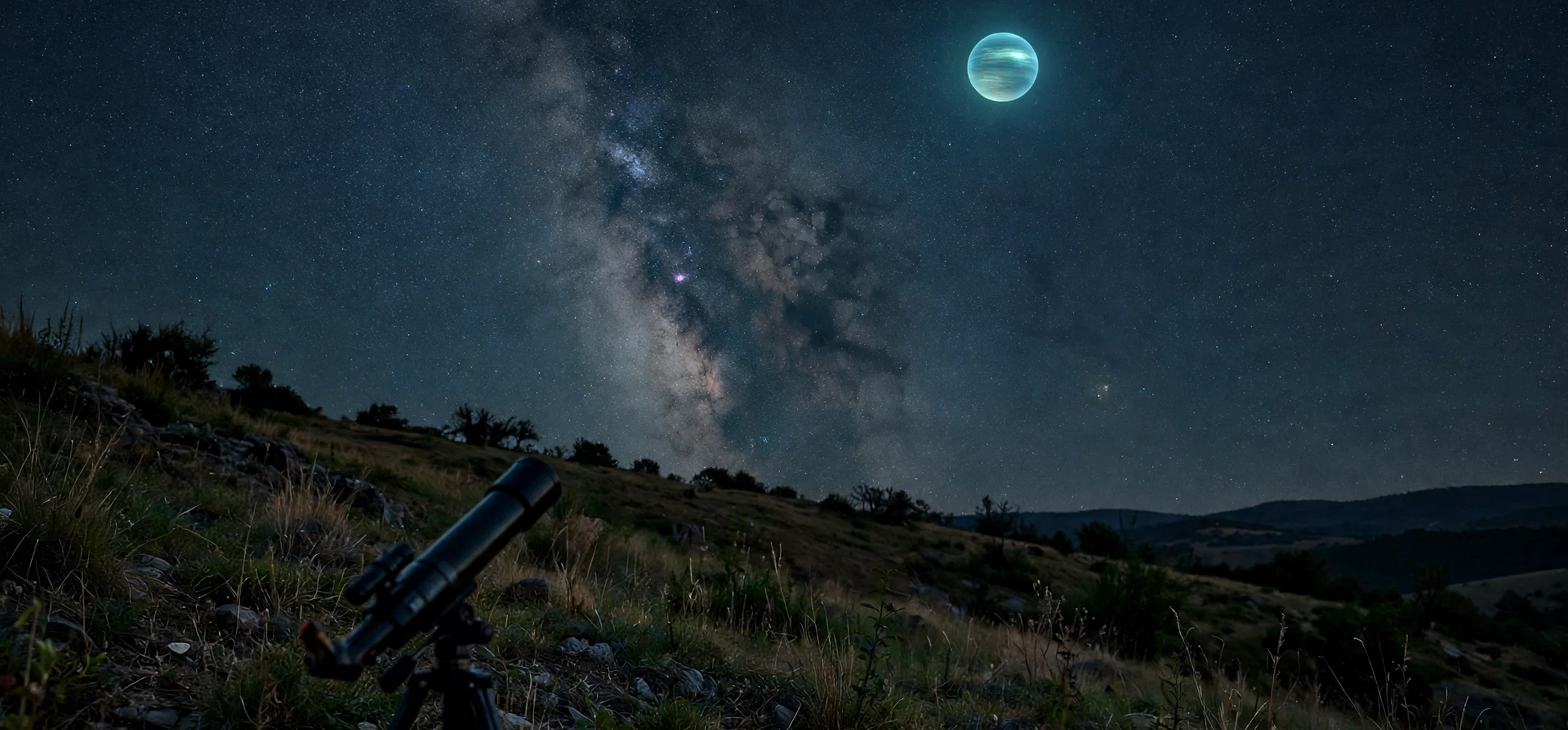
The origin of uranus name is one of the most interesting stories in astronomy, because Uranus is the only planet named after a Greek god rather than a Roman one, and because its name was not settled for decades after its discovery. When William Herschel found the planet in 1781, he did not call it Uranus at all. He proposed naming it after King George III. Other astronomers suggested other names, and only gradually did Uranus, the Greek god of the sky, win out. This guide explains the origin of uranus name in full: the discovery, the naming dispute, the Greek myth behind the name, and why the choice still causes smiles in classrooms today.
To understand the origin of uranus name, it helps to start with what was known before 1781. For thousands of years, people could see five planets with the naked eye: Mercury, Venus, Mars, Jupiter and Saturn. Those five carried Roman names, following a long tradition in which the wandering lights of the sky were linked to gods. Uranus was too faint to be recognised as a planet by ancient observers, although it had occasionally been recorded as a star. Herschel’s telescope changed that. On 13 March 1781, observing from Bath in England, he noticed an object that did not behave like a star. Further observation showed that it moved against the background stars and had a disc, not a point of light. It was a new planet, the first to be discovered in recorded history.
Origin of Uranus Name: Discovery and the First Proposal
Herschel first thought the object might be a comet, but as astronomers tracked its orbit, it became clear that it was a planet circling the Sun far beyond Saturn. Herschel, who was supported by King George III, proposed naming it Georgium Sidus, Latin for “George’s Star”, in honour of his patron. The name was a political gesture as much as an astronomical one. In Britain it was used for a time, but astronomers in other countries were reluctant to name a planet after a British king, especially so soon after the American Revolutionary War. The French, in particular, preferred a mythological name that belonged to no nation.
Several alternatives were suggested. Some proposed naming the planet after Herschel himself. Others suggested names from mythology that would fit the existing pattern. The astronomer Johann Elert Bode, in Germany, argued for Uranus, and his suggestion gradually gained support. Bode’s reasoning was elegant: in mythology, Saturn was the father of Jupiter, and Uranus was the father of Saturn. If the new planet lay beyond Saturn, then naming it after Saturn’s father made a neat, logical sequence in the sky. That argument, combined with the desire for a neutral, classical name, helped Uranus prevail.
Origin of Uranus Name: The Greek God of the Sky
In Greek mythology, Uranus, spelt Ouranos in Greek, was the personification of the sky itself. He was the husband of Gaia, the Earth, and the father of the Titans, including Cronus, known in Roman myth as Saturn. According to the myths, Uranus and Gaia produced the first generations of divine beings, and Uranus was eventually overthrown by his son Cronus, just as Cronus was later overthrown by Zeus, or Jupiter. The myth therefore places Uranus at the very beginning of the divine family tree, as the sky that arches over the Earth.
This background explains why the origin of uranus name breaks the Roman pattern. The other planets are named for Roman gods: Mercury, Venus, Mars, Jupiter and Saturn, with Neptune, discovered later, also Roman. Uranus alone keeps its Greek form, because Bode took the name directly from Greek mythology rather than converting it to the Roman equivalent, Caelus. The Roman god Caelus was the counterpart of Uranus, but the name Caelus was never seriously adopted for the planet. Uranus stuck, Greek spelling and all, and it remains the exception that proves the classical naming rule.
The pronunciation of Uranus has also been a long-running talking point. In English, the traditional classical pronunciation places the stress on the first syllable, roughly “YOOR-uh-nus”, while a more modern pronunciation stresses the second syllable. Astronomers and teachers often prefer the first-syllable stress, partly to avoid the unfortunate jokes that the second-syllable version invites. Schoolchildren have been making the same joke for generations, and the origin of uranus name is often taught alongside a gentle warning to pronounce it carefully. The jokes do not change the history, but they are part of why the name is so memorable.
Origin of Uranus Name: How the Name Was Settled
The name was not settled overnight. For decades after 1781, different countries and different publications used different names. British almanacs used Georgium Sidus for a time. Some writers used Herschel. Others used Uranus. It was only in the mid-nineteenth century, as international astronomy became more organised, that Uranus became the universally accepted name. By the time Neptune was discovered in 1846, the mythological pattern was firmly established, and Neptune was named without a comparable dispute.
This slow settlement tells us something about how scientific naming works. A name must be acceptable to an international community, not just to the discoverer or one nation. It must fit existing patterns well enough to be useful, and it must survive use in textbooks, charts and almanacs. Uranus survived because it was classical, neutral and logically linked to Saturn. Georgium Sidus, by contrast, was tied to one monarch and one moment in politics, and it faded as that moment passed. The origin of uranus name is therefore not just a story about mythology; it is a story about how science chooses language that can be shared across borders.
| Planet | Named after | Tradition |
|---|---|---|
| Mercury | Messenger god | Roman |
| Venus | Goddess of love | Roman |
| Mars | God of war | Roman |
| Jupiter | King of the gods | Roman |
| Saturn | God of agriculture and time | Roman |
| Uranus | God of the sky, father of Saturn | Greek |
| Neptune | God of the sea | Roman |
The Planet Behind the Name
Uranus itself is a remarkable world, and its character fits its sky-god name in an unexpected way. It is an ice giant, composed largely of water, methane and ammonia ices, with a pale blue-green colour caused by methane in its atmosphere. It is the seventh planet from the Sun, about nineteen times farther from the Sun than Earth, and it takes about eighty-four Earth years to complete one orbit. Its most famous feature is its tilt: Uranus rotates on its side, with an axial tilt of about ninety-eight degrees, probably the result of a giant collision early in its history. It effectively rolls around the Sun, with each pole spending about twenty-one years in continuous sunlight followed by twenty-one years of darkness.
Uranus has a faint ring system and a family of moons, most named after characters from the works of William Shakespeare and Alexander Pope, rather than from classical mythology. That naming choice, made later, is another break with tradition: while the planet’s own name comes from Greek myth, its moons honour English literature. The largest moons, Titania, Oberon, Umbriel, Ariel and Miranda, are all Shakespearean names. This mix of Greek myth for the planet and literary names for its moons makes Uranus a favourite example in lessons about astronomical naming.
The origin of uranus name also helps explain why textbooks stress the Greek spelling: the name was chosen deliberately, not inherited from Rome, and the origin of uranus name is therefore taught as an exception to the usual Roman pattern. Only one spacecraft, Voyager 2, has visited Uranus up close, flying past in January 1986. It revealed a surprisingly calm-looking world, with few visible storms at the time, and it discovered additional moons and rings. Since then, telescopes, including the Hubble Space Telescope and the James Webb Space Telescope, have watched Uranus change with the seasons, showing brighter polar regions and occasional storms. For readers who enjoy the science behind names, our guide to the science meaning of matter and our explainer on fault in science offer useful background on how scientific terms are defined and used.
Uranus in Culture and Language
Beyond astronomy, the origin of uranus name continues to surface in classrooms and popular science, where the story of a disputed royal dedication replaced by a Greek sky god is retold as a lesson in how science names things. Beyond astronomy, the name Uranus appears in astrology, literature and popular culture, usually carrying associations with the sky, sudden change and originality. In astrology, Uranus is linked to innovation, rebellion and unexpected events, a modern layer of meaning that has nothing to do with the ancient Greek god but everything to do with the planet’s tilted, unconventional character. In science fiction, Uranus is sometimes used as a remote, cold setting, a place at the edge of the known Solar System. Its distance and its sideways rotation make it a natural symbol for strangeness and independence.
The name has also entered everyday language, and the origin of uranus name is part of that wider story: a planet name that gave rise to an element name, linking astronomy and chemistry. The name has also entered everyday language through the chemical element uranium, which was named after the planet. The German chemist Martin Heinrich Klaproth named uranium in 1789, just eight years after Herschel’s discovery, following the tradition of naming new elements after newly discovered planets. Cerium, palladium and neptunium later followed the same pattern. So the origin of uranus name echoes beyond astronomy into chemistry, where uranium’s name still recalls the planet that inspired it.
For students, the story is a useful reminder that the origin of uranus name was a decision, not an accident, and that the origin of uranus name reflects the values of the astronomers who chose it: classical learning, international neutrality and logical order. For students, the story is a useful reminder that names are choices, not inevitabilities. The planet could have been called George’s Star, and schoolchildren would have learned a very different story. Instead, an argument about mythology, family relationships among gods and international neutrality gave us Uranus. The name connects a modern telescopic discovery to an ancient Greek image of the sky, and it does so through a chain of decisions made by real people with political, scientific and cultural motives. If you enjoy tracing how names acquire meaning, you may also like our guides to name origins such as Brandon name meaning.
Frequently Asked Questions
Is Uranus a Greek or Roman name?
Uranus is Greek. It is the only planet with a Greek name; the others use Roman names. Its Roman counterpart would have been Caelus, but that name was not adopted.
What was Uranus first called?
Its discoverer, William Herschel, proposed Georgium Sidus, meaning George’s Star, after King George III. The name Uranus, suggested by Johann Elert Bode, gradually replaced it.
How do you pronounce Uranus?
The traditional classical pronunciation stresses the first syllable, roughly “YOOR-uh-nus”. That pronunciation is preferred in formal astronomy teaching.
Why does Uranus fit after Saturn?
In mythology, Uranus was the father of Saturn. Bode argued that a planet beyond Saturn should bear the name of Saturn’s father, creating a logical sequence outward from the Sun.
Conclusion
The origin of uranus name begins with a telescope, and the origin of uranus name remains a favourite teaching example because it combines discovery, politics and mythology in one short history. The origin of uranus name begins with a telescope in Bath, passes through a royal dedication that other nations declined to use, and ends with a Greek sky god whose name fitted the planet’s position beyond Saturn. Uranus is Greek where its neighbours are Roman, ancient where its discovery is modern, and mythological where its politics were very contemporary. That combination is what makes the story worth retelling: a planet found by science, named by argument, and kept by consensus. The next time you hear the name, remember that it was chosen, debated and finally agreed, and that its Greek sky-god origin still arches, fittingly, over the whole Solar System story.