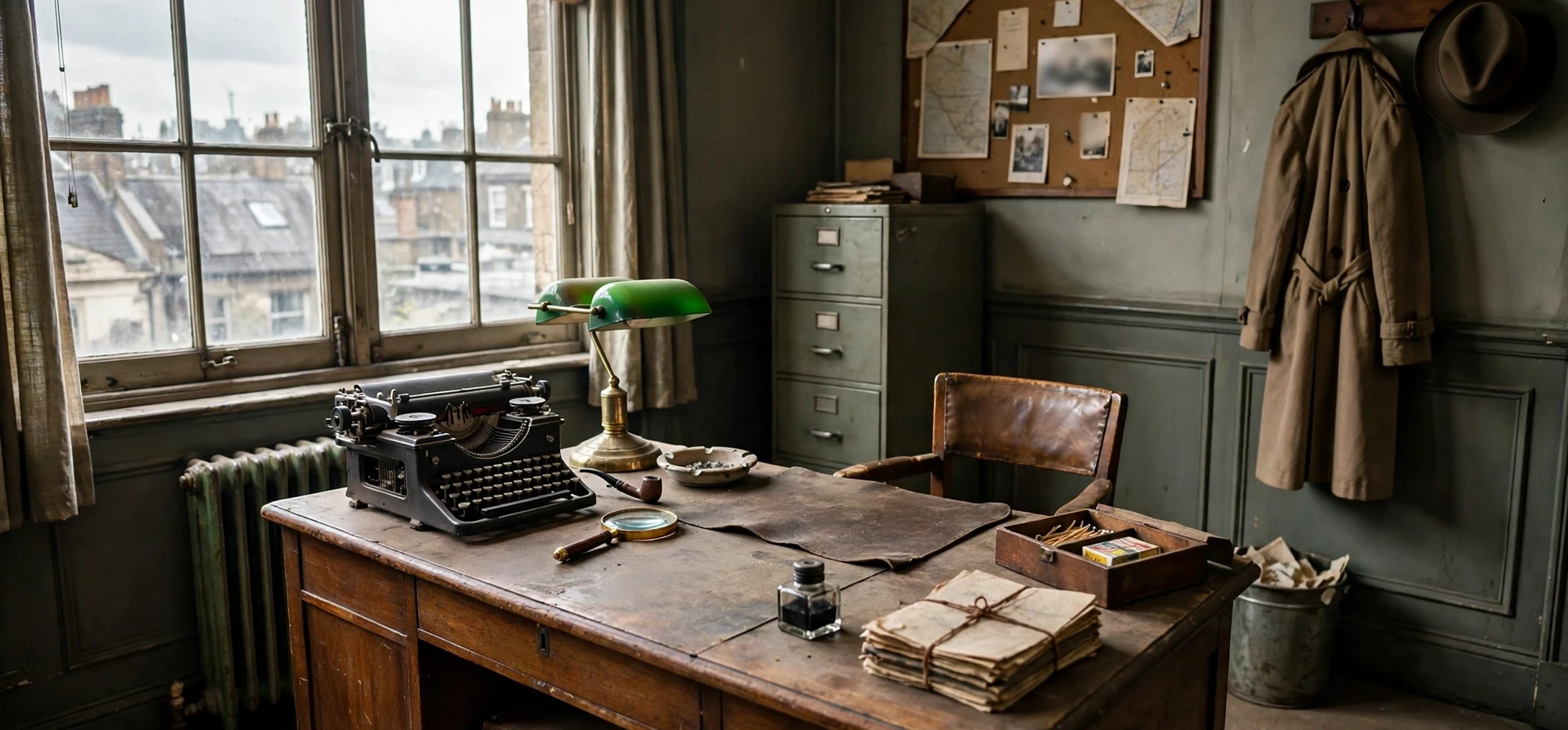
The Partners in Crime British TV series is the BBC’s 2015 adaptation of Agatha Christie’s Tommy and Tuppence stories, a sparkling period detective drama that brought one of Christie’s most charming creations to the screen. Starring David Walliams as Tommy Beresford and Jessica Raine as Prudence “Tuppence” Cowley, the series follows a married couple who run a detective agency in 1950s London, solving cases that mix espionage, murder, and comedy of manners. This guide explains what the series is, how it adapts Christie’s books, who the characters are, and why it stands apart from the many other Christie adaptations on television.
Tommy and Tuppence are unusual among Christie’s detectives. Unlike Poirot, with his method and his moustaches, or Miss Marple, with her village parallels, Tommy and Tuppence are ordinary young people — later a married couple — who stumble into detection through curiosity, courage, and a taste for adventure. That ordinariness is their charm, and the television series leans into it, presenting detection as something a bright, brave couple might do between domestic life and the wider world of post-war Britain.
Partners in Crime British TV Series: Overview
The series, broadcast by the BBC in 2015, consists of six episodes forming two three-part stories. The first, “The Secret Adversary”, adapts Christie’s 1922 novel of the same name, in which Tommy and Tuppence, newly reunited after the First World War, become entangled in a search for a missing treaty and a conspiracy involving a mysterious figure known as Mr Brown. The second, “N or M?”, adapts the 1941 novel, set during the Second World War, in which the couple hunt for enemy agents in a seaside boarding house.
The adaptation updates and reshapes the stories for television, most visibly by setting both in the 1950s rather than in their original periods. That choice gives the series a distinctive look — post-war London, rationing’s aftermath, new fashions, and a society in transition — and it allows Tommy and Tuppence to be presented as a settled married couple with a shared history, rather than as the young adventurers of the books. The change divides purists, but it gives the series a coherent world and a strong visual identity of its own.
Tommy and Tuppence
Tommy Beresford is the steadier half of the partnership: decent, methodical, and quietly brave, with a background in military and intelligence work that gives him useful contacts and a sense of duty. Tuppence is the spark: quick-witted, impulsive, and fearless, with a talent for improvisation and disguise that repeatedly gets the couple into — and out of — trouble. The dynamic between them is the heart of the series: Tommy plans, Tuppence acts, and the cases are solved by the combination.
David Walliams and Jessica Raine play the couple with evident affection for the material. Walliams, best known for comedy, brings warmth and a slightly bewildered decency to Tommy, while Raine gives Tuppence energy, glamour, and steel. Their chemistry carries the series through its lighter moments and its tenser ones, and it is the main reason the adaptation works as television even where it departs from the books. The supporting cast, including a rotating set of suspects, officials, and eccentrics, provides the period texture that Christie adaptations depend on.
Partners in Crime British TV Series Versus Other Christie Adaptations
Christie adaptations on British television are dominated by Poirot and Miss Marple, and Partners in Crime stands out precisely because it is neither. Poirot stories are puzzles solved by a brilliant detective; Marple stories are puzzles solved by observation of human nature. Tommy and Tuppence stories are adventures: the couple are not brilliant deductive machines but resourceful amateurs who blunder, improvise, and persevere. The tone is therefore lighter, faster, and more romantic, with espionage and chase sequences alongside the drawing-room revelations.
The series also differs in its period setting. While Poirot adaptations famously settled into a stylised 1930s, Partners in Crime chose the 1950s, with its own fashions, music, and social anxieties — the Cold War replacing the Second World War as the background threat in the second story. That choice makes the series feel distinct rather than like a lesser Poirot, and it gives the production design a fresh palette: brighter colours, newer cars, and a London rebuilding itself after the war.
The Books Behind the Series
Tommy and Tuppence appear in five Christie books, spanning more than fifty years of the author’s career — a unique span that lets readers follow a couple from youth to old age. “The Secret Adversary” (1922) introduces them as young people after the First World War. “Partners in Crime” (1929) is a collection of short stories in which they parody famous fictional detectives. “N or M?” (1941) sends them after wartime spies. “By the Pricking of My Thumbs” (1968) finds them middle-aged, investigating a mystery in a retirement home. “Postern of Fate” (1973), Christie’s last novel, shows them in old age, still detecting.
The television series draws on the first and third of these books, and its title comes from the second. Readers who enjoy the series will find the books rewarding in a different way: the novels are less polished than the television version, more of their period, and more episodic, but they share the same central pleasure — a partnership built on affection, banter, and mutual reliance. The short-story collection is a particularly good next step, because its parodies show Christie’s playfulness and her deep knowledge of detective fiction.
Reception and Legacy
The Partners in Crime British TV series received a mixed but generally warm reception. Critics praised the leads, the production design, and the light tone, while some Christie purists objected to the period change and to the invention of new plot elements. Audiences, however, responded to the charm of the central couple, and the series has found a steady afterlife on streaming services and repeat broadcasts, where new viewers discover it alongside the better-known Christie adaptations.
The series has not, so far, been followed by further Tommy and Tuppence adaptations, which is a pity: the later books, with the couple ageing through the decades, would offer rich material for a continuing series. For now, the six episodes stand as a self-contained introduction to two of Christie’s most likeable creations — a reminder that detective fiction is not only about brilliant loners, but can also be about partnership, marriage, and adventure shared. Fans of classic detective drama may also enjoy our guides to period drama series and television streaming guides.
| Story | Source novel | Setting in the series | Central threat |
|---|---|---|---|
| The Secret Adversary | The Secret Adversary (1922) | 1950s London | Missing treaty; Mr Brown conspiracy |
| N or M? | N or M? (1941) | 1950s seaside town | Enemy agents in wartime Britain (adapted) |
Why Tommy and Tuppence Endure
Tommy and Tuppence endure because they offer something rare in detective fiction: a partnership of equals built on affection rather than on genius. Poirot dazzles alone, and Marple observes alone, but Tommy and Tuppence succeed together, covering each other’s weaknesses and amplifying each other’s strengths. That model of detection feels warmer and more human than the lone genius, and it gives readers and viewers a relationship to invest in alongside the mystery.
The couple’s longevity across Christie’s career also matters. Readers who meet them young in The Secret Adversary can follow them into middle age and old age, watching a marriage develop across decades of British history. Few fictional detectives age in real time, and fewer still do so as a couple. The television series captures only the middle of that arc, but it hints at the rest: a partnership that began in adventure and matured into something steadier, without losing its spark. That arc is the real reason fans continue to ask for more Tommy and Tuppence, on screen and in print.
Watching Partners in Crime Today
New viewers can approach the series without any prior knowledge of Christie: the two stories are self-contained, the characters are introduced clearly, and the 1950s setting is established through costume, music, and production design rather than through exposition. Watching the Secret Adversary story first preserves the intended introduction to Tommy and Tuppence as a couple, while the second story rewards viewers who already know the pair’s dynamic. Either way, the series works as light, stylish entertainment, and as an invitation to the wider world of Christie adaptations that surround it.
Frequently Asked Questions
What is the Partners in Crime British TV series?
It is the BBC’s 2015 adaptation of Agatha Christie’s Tommy and Tuppence stories, starring David Walliams and Jessica Raine as a married detective couple in 1950s Britain, in six episodes across two stories.
Which Christie books does it adapt?
“The Secret Adversary” (1922) and “N or M?” (1941). The series title comes from the short-story collection “Partners in Crime” (1929).
Is Partners in Crime connected to Poirot or Miss Marple?
No. Tommy and Tuppence are separate Christie characters, and the series stands alone, though it shares the author’s world of interwar and post-war British detection.
Conclusion
The Partners in Crime British TV series is a charming, stylish entry in the Christie canon: a period detective drama built around a married couple who detect by courage and improvisation rather than by genius. Its 1950s setting, its sparkling leads, and its mix of espionage and comedy make it distinct from Poirot and Marple, and an excellent starting point for anyone who wants Christie with more adventure and more romance. Six episodes may be all there are, but they are six episodes well worth watching.



