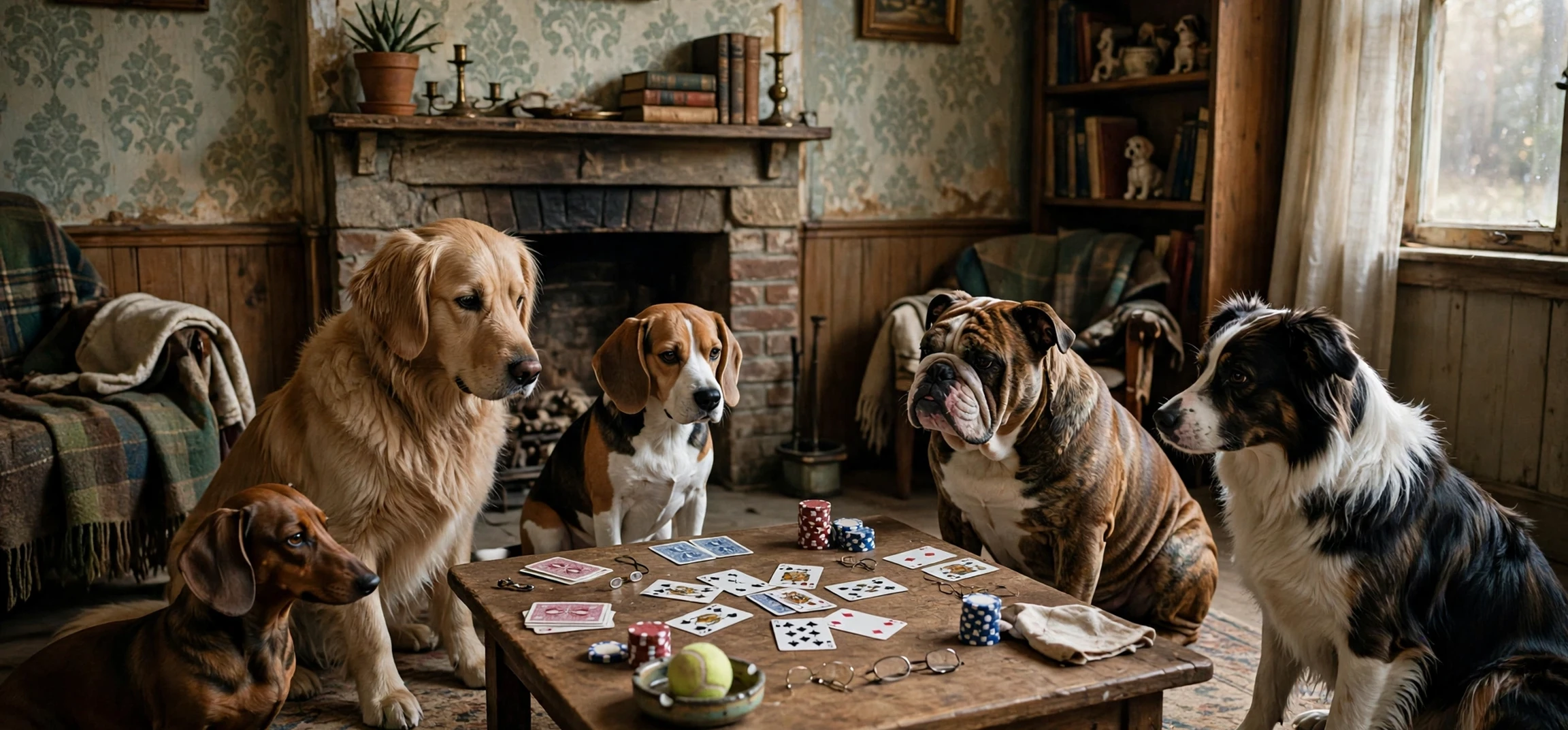
The famous picture of dogs playing cards is not a single painting at all, but a whole family of images that has become one of the most recognised jokes in American art. Most people picture the same scene when they hear the phrase: a group of dogs, dressed and posed like men, gathered around a green table, cards in their paws, one of them cheating, another looking suspicious, and the whole room lit like a late-night club. That scene, or one very like it, was painted by Cassius Marcellus Coolidge, an American artist working at the start of the twentieth century, as part of a series commissioned to advertise cigars. The paintings were never meant for a gallery wall, yet they outlived their advertising purpose by more than a century, and they still turn up on posters, calendars, puzzles, and bar walls around the world.
Part of the enduring appeal is that the joke is instantly readable, even to someone who has never seen the paintings in a museum. Dogs behaving like people is a classic comic device, and poker, with its bluffing, cheating, and poker faces, is a perfect setting for it. The dogs are not cute in the usual sense: they are earnest, shifty, triumphant, and exasperated, and their expressions do the storytelling. That combination of familiarity and absurdity explains why the image survived the move from cigar advertising to popular culture, and why it is still parodied, referenced, and reproduced today. For a lighter look at dogs in popular culture, see our guide to cartoon dogs characters, and for dog names in another language, see dog names in Spanish.
famous picture of dogs playing cards: The Artist Behind the Dogs
Cassius Marcellus Coolidge was born in 1844 in Antwerp, New York, and he was a man of many trades before he became famous for dogs. He worked as a sign painter, a cartoonist, a bank founder, and an inventor, and he even held a patent for a type of comic foreground, the painted board with a hole for a face that became a staple of fairs and seaside attractions. That background matters, because Coolidge was not a fine-art painter in the academic sense: he was a commercial artist who understood how to make an image that would catch the eye, tell a story at a glance, and stick in the memory. His dogs are painted in a straightforward, illustrative style, with clear expressions and readable gestures, because they were designed to work as advertisements first and as pictures second.
The commission that made him famous came in 1903 from Brown and Bigelow, a company that produced advertising calendars and promotional art. Coolidge was asked to paint a series of pictures featuring dogs in human situations, initially for cigar advertising. The brief was commercial, but Coolidge treated the dogs with surprising seriousness: he gave them distinct personalities, consistent breeds, and a shared world of masculine club life, complete with cigars, drinks, and late-night card games. That consistency is one reason the series feels like a single story rather than a set of unrelated jokes, and it is why viewers remember individual dogs and scenes long after seeing them.
Coolidge’s Life and Working Style
Coolidge painted quickly and prolifically, and he was not precious about his work in the way a gallery artist might be. He produced the dog paintings as commercial commissions, and many of them were reproduced as prints, calendars, and advertising items rather than exhibited as originals. That commercial origin shaped the style: bold, legible compositions, strong contrasts, and expressions that read clearly even at a small size or from across a room. It also shaped the subject matter: the dogs inhabit a world of bars, billiard rooms, and clubhouses, because that was the world of the products being advertised and the customers being courted.
For decades, that commercial origin kept the paintings outside the serious art world, and Coolidge was often dismissed as a kitsch painter rather than studied as an artist. In recent decades, that judgement has softened, as art historians and popular audiences alike have recognised the skill in his characterisation, the wit in his compositions, and the cultural insight in his choice of subject. The paintings are now discussed as a distinctive form of American popular art, and originals have achieved notable prices at auction, a reversal that Coolidge himself, who died in 1934, did not live to see.
famous picture of dogs playing cards: The Series, Painting by Painting
Coolidge’s dog series is usually described as sixteen paintings, produced between 1903 and 1910, although the exact count and grouping vary slightly between sources because some related dog paintings are included or excluded. Nine of the sixteen are directly about poker, while the others show dogs in other human pursuits, such as playing billiards, going to court, or taking a train. The poker paintings form the core of the popular image, and within them, a few titles stand out as the ones most people recognise, even if they do not know the titles.
The best-known painting is A Friend in Need, painted in 1903. It shows a bulldog slipping an ace to a companion under the table, while the other dogs, including a collie, a Saint Bernard, and a Great Dane, concentrate on their hands or look on with varying degrees of suspicion. The cheating bulldog is the joke and the story at once: the title is ironic, because the friend in need is receiving help that breaks the rules of the game. The composition is tight, the expressions are vivid, and the painting works even without its title, which is why it became the emblem of the whole series.
| Painting | Date | What Happens | Why It Is Remembered |
|---|---|---|---|
| A Friend in Need | 1903 | A bulldog passes an ace under the table to a fellow player | The iconic cheating scene; the image most people mean by dogs playing poker |
| A Bold Bluff | 1903 | A Saint Bernard pushes a large stake forward with confidence | The bluff as pure theatre, with the other dogs reacting in disbelief |
| Waterloo | 1906 | A game ends in confrontation, with a dog accused of cheating | The series turns from comedy to drama; the title signals defeat |
| Poker Sympathy | 1903 | Dogs commiserate over a lost hand | Shows the social, consoling side of the card table |
| Pinched with Four Aces | 1903 | A player is caught holding an unbeatable hand under suspicious circumstances | The title is the punchline, and the expressions carry it |
| Sitting Up with a Sick Friend | 1905 | Dogs gather around a poker table in a domestic setting | A reminder that the series extended beyond the club room |
| His Station and Four Aces | 1903 | A railway setting frames a poker game | Shows Coolidge placing the dogs in everyday American life |
| New Year’s Eve in Dogville | 1903 | Dogs celebrate at a card table on New Year’s Eve | The festive, communal side of the series |
A Friend in Need in Detail
Look closely at A Friend in Need, and the storytelling becomes clear. The dogs are not generic: each breed carries a personality, from the sturdy bulldog at the centre of the trick to the watchful collie and the imposing Saint Bernard. The table is green, the room is dim and club-like, and the props, cigars, drinks, and cards, place the scene firmly in adult masculine leisure of the period. The humour comes not from the dogs being dogs, but from the dogs being people: they bluff, they cheat, they suspect, and they pretend not to notice, exactly as human poker players do. That human behaviour, performed by animals, is what makes the painting funny rather than merely cute.
The painting also rewards attention to small details. One dog’s paw is hidden, another’s eyes are narrowed, and the body language of the group tells you who is winning, who is losing, and who knows more than they are saying. Coolidge understood that a poker game is a drama of information: who knows what, who pretends to know what, and who is caught knowing too much. By giving that drama to dogs, he made it both funnier and easier to read, because the viewer is not distracted by human fashion or identity and can concentrate on the expressions themselves.
The Other Poker Paintings
The other poker paintings extend the same joke in different directions. A Bold Bluff shows the moment of bravado, when a player stakes heavily on a weak hand and dares the others to call. Waterloo, painted later in the series, shows the darker aftermath, when cheating is exposed and the game breaks down into accusation and confrontation. Poker Sympathy shows the quieter side of the table, when players console a loser, and Pinched with Four Aces shows the moment when an impossibly good hand becomes evidence against its holder. Together, these paintings form a small cycle of poker life, from bluff to triumph to exposure, and that cycle is part of why the series feels complete rather than repetitive.
Why the Image Endures in Popular Culture
The dogs playing poker image endures for several reasons, and none of them is accidental. First, it is immediately legible: a viewer understands the joke in seconds, without needing to know anything about art history. Second, it is endlessly adaptable: the basic scene can be updated with new breeds, new settings, and new jokes, while remaining recognisable. Third, it occupies a useful cultural space between fine art and popular decoration: it is respectable enough to hang in a home or a bar, and playful enough to appear on a puzzle, a T-shirt, or a greeting card without seeming out of place. That flexibility has kept it in circulation long after most advertising art of its period was forgotten.
The image has also been referenced and parodied so often that it has become a shorthand for poker itself, and for a certain kind of old-fashioned, male, club-room leisure. Television shows, films, cartoons, and advertisements have all borrowed the scene, sometimes with dogs, sometimes with other animals, and sometimes with people in dog-like poses. Each reference reinforces the original, because the viewer recognises the source even when the copy is deliberately different. That feedback loop, in which parody preserves the original, is one of the strongest forms of cultural survival, and it explains why a set of cigar advertisements from 1903 is still a living image today.
From Kitsch to Collectible
The journey from advertising print to auction highlight is itself part of the story. For much of the twentieth century, Coolidge’s dogs were treated as kitsch: popular, sentimental, and not to be taken seriously as art. Reproductions were cheap and widespread, and originals were not highly valued. In 2005, that changed in public perception when two original Coolidge poker paintings, A Bold Bluff and Waterloo, sold at auction for a combined figure that made headlines and surprised many observers. The sale did not suddenly make Coolidge a fine-art master in the academic sense, but it did signal that popular art with a long cultural life deserves serious attention, and that originality, condition, and provenance matter even for commercial paintings.
Today, original Coolidge paintings are held in private collections and occasionally exhibited, while reproductions remain widely available. That dual existence is fitting: the paintings were made to be reproduced, and their fame was built on reproduction, yet the originals carry a material history, brushwork, and scale that no print can fully convey. A viewer who has only seen a poster may be surprised by the size, texture, and colour of an original, and by the care Coolidge took with fur, fabric, and expression, even within a commercial brief.
How to See and Appreciate the Paintings Today
If you want to see the paintings properly, start with A Friend in Need and A Bold Bluff, then look at Waterloo to see how the series darkens. Notice the breeds and how Coolidge uses them as character types, notice the props and what they say about the period, and notice how much of the story is told through eyes and paws rather than through words. Then look at one of the non-poker dog paintings, such as a billiards or courtroom scene, to see how Coolidge applied the same device, animals behaving as people, to other parts of American life. That wider view shows that the poker paintings were not a one-off joke but part of a sustained comic world.
When you buy or display a reproduction, remember that the image is in a complicated position regarding copyright and reproduction rights, depending on the specific painting, its date, and the source of the reproduction. Commercial use of the image may require permission or a licence, while personal display of a lawfully purchased print is a different matter. If you plan to use the image commercially, check the rights position for that specific work rather than assuming that age alone settles it. For personal enjoyment, a good-quality print, viewed at a size where the expressions are legible, is the best way to appreciate what Coolidge achieved.
Frequently Asked Questions
Who Painted Dogs Playing Poker?
Cassius Marcellus Coolidge, an American commercial artist, painted the series for Brown and Bigelow between 1903 and 1910. The series is often called Dogs Playing Poker, and it includes sixteen paintings in total, nine of them directly about poker.
Is the Famous Picture One Painting or Many?
Many. The famous image is a series, not a single work. A Friend in Need is the best-known single painting, but A Bold Bluff, Waterloo, Poker Sympathy, and the other poker paintings are part of the same series and the same comic world.
Why Were the Paintings Made?
They were commissioned as advertising art, originally for cigar promotion, and reproduced as calendars and prints. Their commercial origin explains their bold, legible style and their club-room settings, and it makes their later fame as popular art all the more remarkable.
Where Are the Original Paintings Now?
Originals are mostly in private collections and appear at auction from time to time. Reproductions are widely available as posters, prints, calendars, and puzzles, which is how most people encounter the images today.
Conclusion
The famous picture of dogs playing cards endures because it is a perfect popular joke, executed with genuine skill. Coolidge took a commercial brief, a set of dogs, and a card game built on bluff and deception, and he made a world that viewers have recognised, laughed at, and reproduced for more than a century. A Friend in Need, with its cheating bulldog and its suspicious companions, remains the emblem of that world, but the full series, from bluff to Waterloo, shows a richer comic cycle than any single image can convey. Whether you meet the dogs on a bar wall, a puzzle box, or an auction catalogue, you are meeting a piece of American popular culture that began as advertising and became art by staying in people’s lives. Look again at the expressions next time you see them: the dogs are not just playing cards, they are playing people, and that is why the joke still works. For more on dogs in popular culture, explore our guide to cartoon dogs and the related topics across the site.



