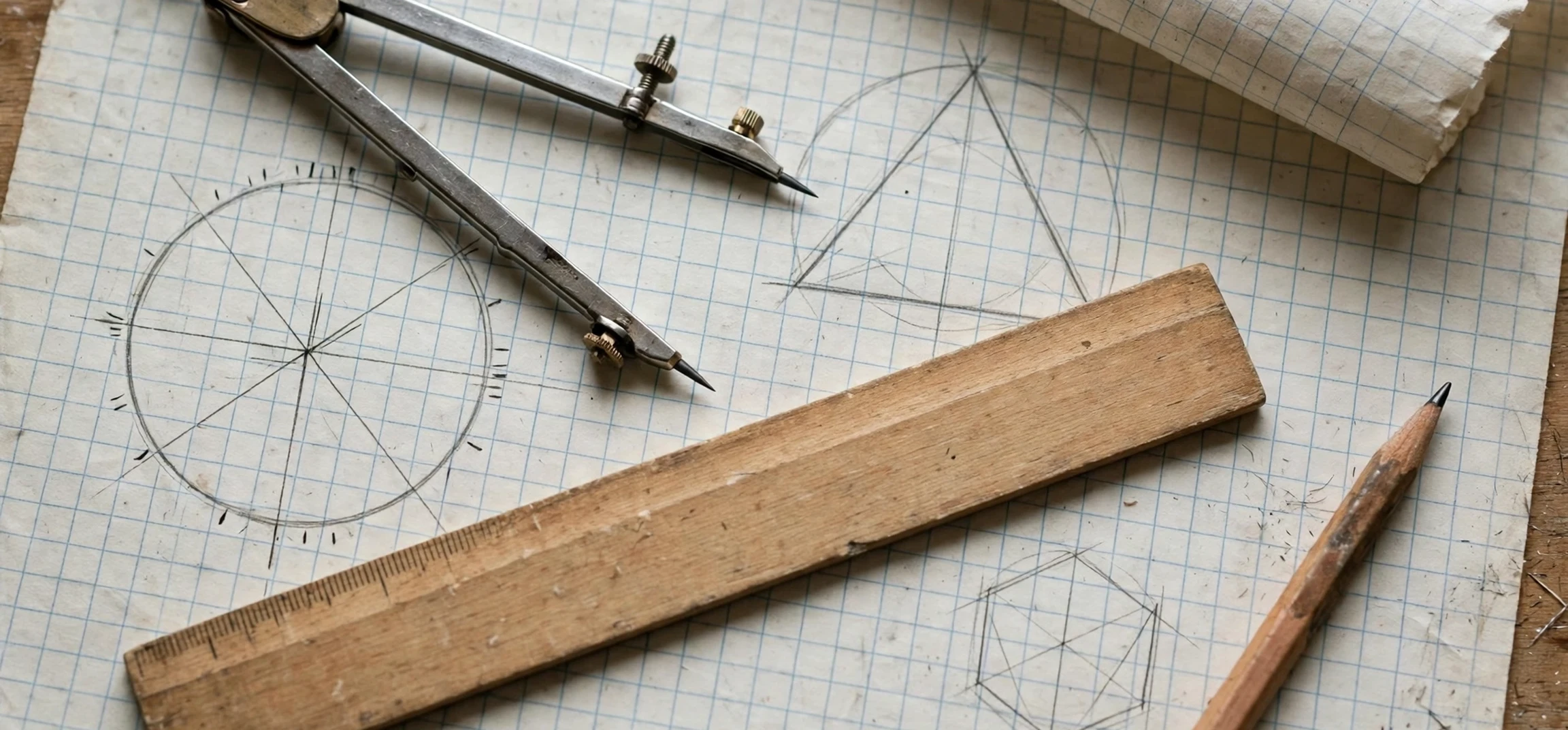
Students meeting geometry for the first time often ask what is a point geometry definition, and the answer is both simple and surprisingly deep. In geometry, a point is a location in space that has no size, no length, no width, and no depth. It marks a position and nothing else. This guide explains the point meaning in geometry, how points relate to lines, planes, and shapes, why mathematicians define something with no size, and how points are used in coordinate geometry, design, and everyday measurement.
Point Meaning in Geometry: The Basic Definition
The point meaning in geometry starts with Euclid, whose Elements, written around 300 BCE, defined a point as “that which has no part.” In modern language, a point is a zero-dimensional object: it has position but no extent. You cannot measure a point’s length because it has none. You cannot divide it into parts because it has no parts. It is, in a sense, the simplest possible geometric object, and everything else in geometry is built from it: lines are made of points, planes are made of lines, and solids are bounded by planes.
This definition puzzles beginners, and understandably so. How can something with no size be useful? The answer is that a point is not a physical dot but an idea: a precise location. When a map marks a city with a dot, the dot on paper has size, but the point it represents does not. The drawn dot is a symbol, just as a written word is a symbol for a spoken sound. Geometry works with the idea, not the ink, and that abstraction is what makes it powerful.
What Is a Point Geometry Definition? Points, Lines, and Planes
Geometry builds upward from points in a clear hierarchy. A line is a straight, one-dimensional collection of points extending infinitely in both directions. It has length but no width. A plane is a flat, two-dimensional surface extending infinitely, made up of lines and therefore of points. It has length and width but no thickness. A solid, such as a cube, is a three-dimensional object bounded by planes. Each level adds one dimension, and each level is defined using the level below it.
Several fundamental facts govern how points relate to lines and planes. Any two distinct points determine exactly one line: there is one and only one straight line passing through both. Any three points that do not lie on the same line determine exactly one plane. Two lines in a plane either intersect at a single point, run parallel and never meet, or coincide. These facts, called postulates or axioms, are the starting assumptions from which the rest of geometry is proved, and they all begin with points.
What Is a Point Geometry Definition in Coordinate Geometry?
Coordinate geometry gives points a practical address system. In a two-dimensional plane, a point is identified by an ordered pair of numbers, (x, y), which describe its horizontal and vertical distance from an origin point, (0, 0). In three-dimensional space, a point is identified by a triple, (x, y, z). This system, developed by René Descartes, connects geometry to algebra: geometric problems about points, lines, and shapes can be translated into equations and solved numerically.
Coordinate geometry is the basis of much modern technology. Computer graphics represent images as collections of points, or pixels, arranged on a grid. GPS navigation locates you as a point on the Earth’s surface, expressed in latitude and longitude. Engineering drawings specify the positions of holes, corners, and joints as coordinate points. In each case, the abstract idea of a point as a location becomes a practical tool for describing the real world with precision.
| Object | Dimensions | Defined by | Example |
|---|---|---|---|
| Point | 0 | Position only | A location on a map |
| Line | 1 | Two points | A straight road on a map |
| Plane | 2 | Three non-collinear points | A flat sheet of paper |
| Solid | 3 | Bounding planes | A cube |
Special Types of Points
Geometry names many special points, each defined by its relationship to a shape. The midpoint of a line segment is the point exactly halfway between its endpoints. The vertices of a polygon are the points where its sides meet. The centre of a circle is the point equidistant from every point on the circle. A triangle has several famous centres: the centroid, where its medians meet; the circumcentre, the centre of the circle passing through its vertices; and the incentre, the centre of the circle inscribed within it. Each of these points is defined by a precise geometric property, not by appearance.
Points also appear in advanced geometry in forms that stretch intuition. In projective geometry, points at infinity are added to describe where parallel lines meet. In topology, a point is an element of a set with a particular structure, and the notion of distance may not apply at all. These extensions show how durable the point concept is: by starting with something as simple as a location, mathematics builds structures of enormous generality.
Points in Everyday Life
Although points are abstract, they appear in everyday language constantly. We talk about meeting points, starting points, turning points, and points of view, all borrowing the geometric idea of a location in some space, whether physical or metaphorical. In sports, points are scores, a different but related use of the word. In design, a focal point is the location that draws the eye. These everyday uses show how deeply the geometric concept has entered general thinking: a point is where something is, or where attention rests.
For students, the practical lesson is to treat points as tools, not mysteries. When solving a geometry problem, label your points clearly, note which points define which lines and planes, and use coordinates when algebra will help. Most geometry errors come not from misunderstanding points but from losing track of which point is which. Clear labelling is half the battle.
Points in Art and Design
Artists and designers use points constantly, even when they do not call them by the geometric name. In pointillism, a painting technique developed in the late nineteenth century, images are built from thousands of small dots of colour that blend in the viewer’s eye. In graphic design, a focal point is the place where the eye lands first, and designers arrange other elements to lead toward it. In typography, a point is also a unit of measurement, equal to one seventy-second of an inch, used to specify type sizes.
Digital design extends the idea further. Vector graphics describe images as mathematical points connected by lines and curves, which is why a vector logo can be scaled to any size without losing quality: the points are recalculated, not stretched. Raster images, by contrast, are grids of fixed pixels, which is why enlarging them causes blurring. Understanding points as locations rather than marks explains both systems, and it is a useful foundation for anyone working with visual media.
Teaching Points to Beginners
Teachers introducing points often start with a concrete image: a dot on a map, a pin on a noticeboard, or a star in the sky. Each of these is a physical thing with size, so the teacher must then make the leap explicit: the point itself is the location, not the mark. A helpful exercise is to ask students to imagine zooming in on a dot until it fills the page: the location remains, but the mark grows meaningless. That exercise captures the abstraction at the heart of geometry.
Another useful approach is to have students name points in a diagram and describe lines and shapes by their points: “the line through A and B,” “the triangle with vertices P, Q, and R.” This language reinforces the idea that points are the building blocks, and it gives students a precise vocabulary for describing geometric relationships. Precision of language is one of geometry’s great gifts, and it starts with the humble point.
Frequently Asked Questions
What is a point in geometry?
A point is a location in space with no size, length, width, or depth. It has position only and is the most basic object in geometry.
Can a point be measured?
No. A point has no dimensions, so it cannot be measured. Distances are measured between points, not of points themselves.
How many points define a line?
Two distinct points determine exactly one straight line.
What is the difference between a point and a dot?
A dot is a physical mark with size, used to represent a point on paper or a screen. The point itself is the abstract location the dot stands for.
Conclusion
The answer to what is a point geometry definition is deceptively simple: a location with no size, from which all of geometry is built. Points define lines, lines define planes, and planes bound solids, while coordinate systems turn points into addresses that power graphics, navigation, and engineering. Understanding points as ideas rather than marks is the key that unlocks the rest of geometry, and it is a concept worth getting right at the start. For more on mathematical foundations, see our guides on mathematical terms and general knowledge.



