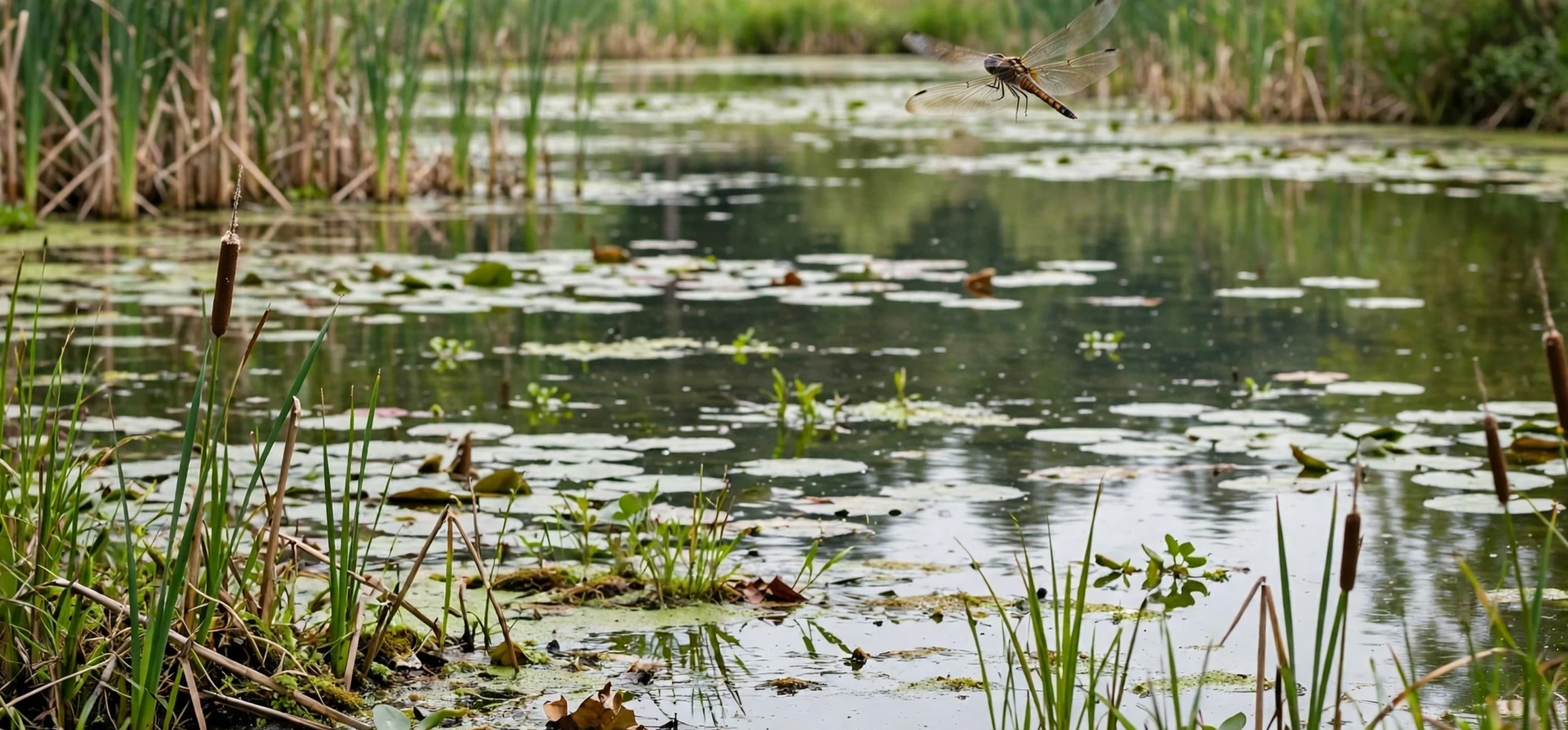
The scientific name for a dragonfly at species level is a two-part Latin name, and learning a few famous examples is the fastest way to understand how dragonfly naming works. The query “scientific name for a dragonfly” often comes from someone who has seen a particular dragonfly and wants its proper name, or from a student who needs an example for homework. This guide takes the species-level angle: it explains binomial naming, lists well-known dragonfly species with their scientific names, and shows how to tell dragonflies from their damselfly relatives.
How the Scientific Name for a Dragonfly Works
Every dragonfly species has a binomial name made of two parts: the genus, written with a capital letter, and the species, written in lower case, with the whole name italicised in formal writing. The common green darner, for example, is Anax junius, where Anax is the genus and junius is the species. The genus groups together closely related species, while the species part identifies one particular kind. This system, introduced by Carl Linnaeus in the eighteenth century, gives every species a unique name that is recognised worldwide, regardless of local common names.
Common names, by contrast, vary by region and language: the same insect might be called a darner in one place and a hawker in another, and different insects sometimes share a common name. Scientific names remove that confusion, which is why field guides, research papers, and exam answers prefer them. When you see a name such as Libellula quadrimaculata, you can be sure exactly which insect is meant, even if you have never heard its common name, the four-spotted chaser.
Famous Dragonfly Species and Their Scientific Names
Several species are famous enough to serve as examples. The common green darner, Anax junius, is one of the largest and most widespread dragonflies in North America and is known for its long migrations. The blue dasher, Pachydiplax longipennis, is a small, brightly coloured species common around ponds across much of the continent. The wandering glider, Pantala flavescens, is found on every continent except Antarctica and is famous for travelling enormous distances, sometimes across oceans.
In Britain and Europe, well-known species include the emperor dragonfly, Anax imperator, a large and powerful insect with a green thorax and blue abdomen, and the four-spotted chaser, Libellula quadrimaculata, named for the dark spots on its wings. The broad-bodied chaser, Libellula depressa, is another familiar pond species, recognisable by its flattened, pale-blue abdomen in males. Learning two or three of these names gives you a solid foundation, and each one illustrates how genus and species work together. Related science reading includes fault science meaning and our order-level guide to the scientific name for a dragonfly.
How to Read and Write Scientific Names Correctly
Writing a scientific name correctly matters in school and in published work. Italicise the full binomial, capitalise only the genus, and never capitalise the species part, even when it is derived from a person’s name. After the name, you may see an abbreviation or a name in parentheses, which refers to the scientist who first described the species; this authority citation is common in formal taxonomy but is not required in everyday writing. If you are handwriting, underline the name instead of italicising it.
Pronunciation is more forgiving than spelling, since Latin names are pronounced differently in different countries. The key habit is consistency: use the same name throughout a piece of work, give the common name alongside the scientific name on first mention, and check the spelling against a reliable field guide or database. Misspelling a genus by one letter can point to a different group entirely, so a quick check is always worth the effort.
Dragonflies, Damselflies, and the Scientific Name for a Dragonfly
The species in this guide are all true dragonflies, in the suborder Anisoptera, but their order, Odonata, also contains damselflies in the suborder Zygoptera. Damselfly species have their own binomial names too, such as Ischnura elegans for the blue-tailed damselfly, and the same naming rules apply. The field marks that separate the groups, size, wing position at rest, and eye placement, are worth learning alongside the names, since a correct identification is the first step to a correct scientific name.
Whether you are answering a homework question or labelling a photograph, the approach is the same: identify the insect as precisely as you can, then look up its binomial name in a trusted source. Start with the order Odonata, narrow to Anisoptera for true dragonflies, and finish with the genus and species. That habit turns a vague question into a precise answer, and it works for every insect group, not just dragonflies.
| Common name | Scientific name |
|---|---|
| Common green darner | Anax junius |
| Blue dasher | Pachydiplax longipennis |
| Wandering glider | Pantala flavescens |
| Emperor dragonfly | Anax imperator |
| Four-spotted chaser | Libellula quadrimaculata |
| Broad-bodied chaser | Libellula depressa |
Scientific Name for a Dragonfly: More Species to Know
Beyond the famous examples, several more species illustrate how dragonfly naming works across different genera. The scarlet skimmer, Crocothemis servilia, is a vivid red species found across Asia and introduced elsewhere, and its genus name Crocothemis reflects its saffron-like colouring. The eastern pondhawk, Erythemis simplicicollis, is a common North American species whose males turn powdery blue-green with maturity, showing how colour changes with age. The Halloween pennant, Celithemis eponina, is named for its orange and black wing markings, which resemble seasonal decorations, and it often perches with its wings fluttering in the breeze.
The widow skimmer, Libellula luctuosa, shares its genus with the four-spotted chaser and the broad-bodied chaser, which shows how a genus groups related species that share structural features. Its common name comes from the dark bands on its wings, which look like mourning veils, and it is a familiar sight around ponds in eastern North America. Learning species within one genus is a useful exercise, since it reveals what members of a genus share and how species differ within it.
Geography also shapes dragonfly names and distributions. Some species, like the wandering glider Pantala flavescens, are found almost worldwide, while others are restricted to a single region or even a single island, which makes them conservation priorities. Regional field guides are therefore essential: a guide for Britain will not cover North American species, and a tropical guide will include families absent from temperate regions. Checking the range given in a guide prevents misidentification, since a species cannot be present where it does not live.
For students, the practical lesson is to build a personal list of species names, starting with the common ones in your area and adding new ones as you encounter them. Write each name with its common name alongside, note the habitat and season, and review the list regularly. Over time, the binomial system stops feeling like a code and starts feeling like a set of names for real insects you have actually seen, which is exactly how professional naturalists learn it.
Scientific Name for a Dragonfly: How New Species Get Names
New dragonfly species are still being discovered, particularly in tropical regions where many streams and forests remain poorly surveyed. When researchers find an insect that differs consistently from known species, in structure, colour, or genetics, they describe it in a scientific paper, designate a type specimen held in a museum, and propose a binomial name following the international rules of zoological nomenclature. The name must be unique within its genus and must follow Latin grammar, though it may honour a person, a place, or a distinctive feature.
Genetic research has also reshaped existing names, splitting one species into two when populations prove distinct, or merging two names when they prove to be the same insect. Such revisions can confuse field guides, which may use older names for years, but they reflect genuine scientific progress. For students and enthusiasts, the lesson is to check the date of a guide and to expect occasional changes: scientific names are working tools that improve as knowledge grows, not permanent labels fixed forever.
Frequently Asked Questions
What is an example of a scientific name for a dragonfly?
Anax junius, the common green darner, is a classic example of a dragonfly binomial name.
Why do scientific names have two parts?
The genus groups related species and the species part identifies one kind, giving every species a unique worldwide name.
Do damselflies have scientific names too?
Yes. Damselflies are in the same order, Odonata, and each species has its own binomial name, such as Ischnura elegans.
What is the largest dragonfly species?
Among living species, the giant petaltail of Australia is one of the largest, with a wingspan reaching around 13 centimetres, though exact records vary.
Do dragonfly species names change?
Occasionally, when research shows a species belongs in a different genus, its genus name changes while the species part usually stays the same.
Conclusion
At species level, the scientific name for a dragonfly is a binomial such as Anax junius or Libellula quadrimaculata, built from a genus and a species. Learn a few famous examples, write them correctly, and pair them with the group names Odonata and Anisoptera, and dragonfly naming will hold no mysteries for you. From skimmers to pennants, each new species name adds to a working knowledge of dragonflies, and that knowledge grows fastest when it is tied to real sightings.



