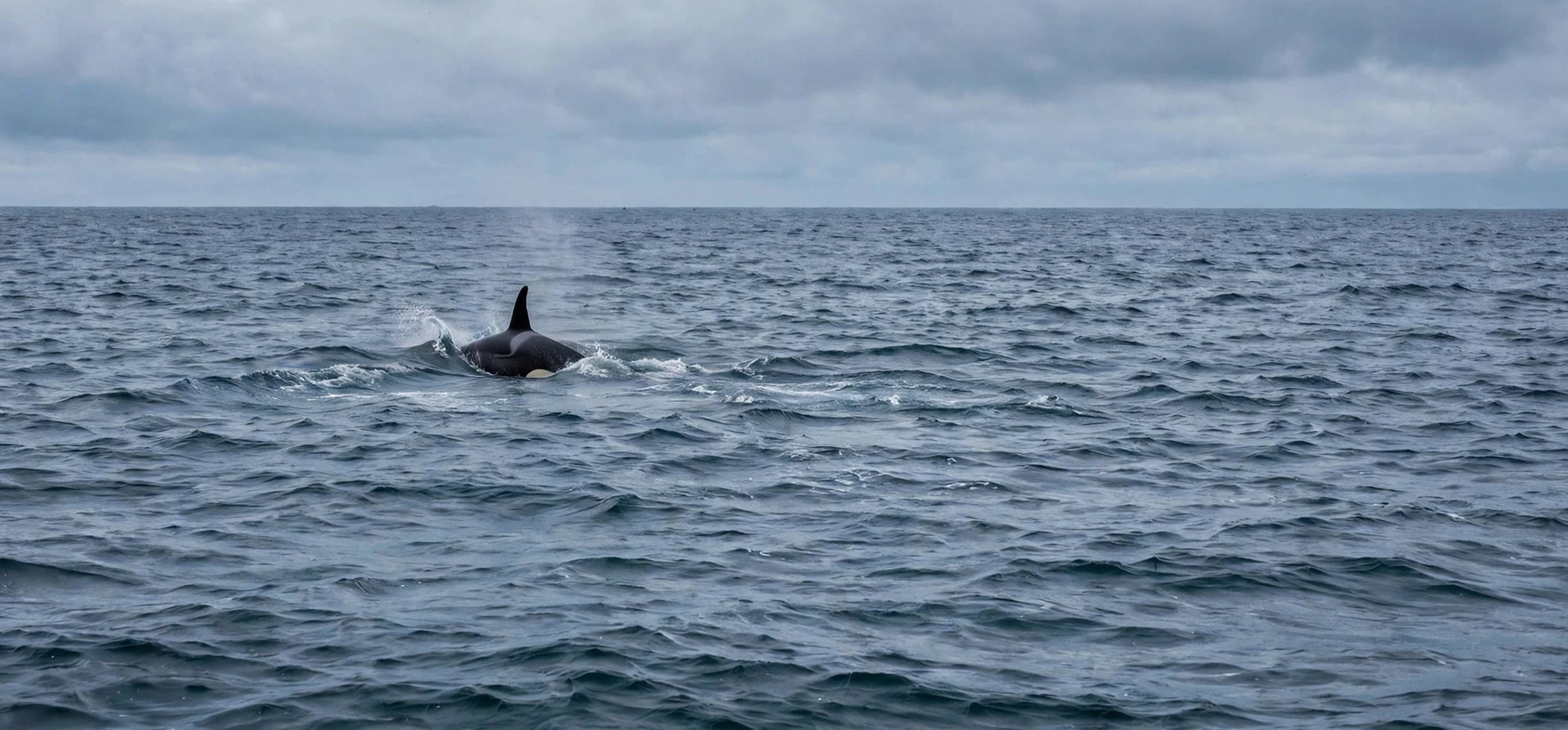
A clear killer whale definition starts with a surprise: despite the name, a killer whale is not a whale in the everyday sense of a great baleen giant, but the largest member of the oceanic dolphin family. Known scientifically as Orcinus orca, this black-and-white predator is found in oceans all around the world, from icy polar seas to warmer temperate waters. The killer whale definition therefore covers both biology and behaviour: a highly intelligent, social marine mammal that hunts cooperatively, communicates with a complex range of sounds, and lives in stable family groups called pods. Understanding what the term really means helps to clear up centuries of myth, fear and misunderstanding about one of the ocean’s most remarkable animals.
In this guide, we explain the killer whale definition in plain language, look at how orcas are classified, describe their appearance and size, explore their diet and hunting methods, and examine their social lives, intelligence and conservation status. Whether you are a student, a wildlife enthusiast, or simply curious about why such a graceful animal carries such a dramatic name, this article gives you a complete and accurate picture.
Killer Whale Definition Explained
At its simplest, the killer whale definition is this: an orca is a toothed whale belonging to the dolphin family Delphinidae. Toothed whales differ from baleen whales because they have teeth rather than baleen plates for filtering food, and they hunt individual prey rather than straining tiny organisms from the water. Orcas sit at the top of this group in size, with adult males reaching up to nine metres in length and weighing as much as six tonnes, while females are somewhat smaller, typically reaching around seven metres.
The scientific name Orcinus orca reflects an old association with Orcus, a Roman god of the underworld, and hints at the animal’s formidable reputation. In older literature, orcas were sometimes called “whale killers”, because sailors observed them hunting large whales. Over time, the words were reversed to “killer whale”, a name that has stuck even though it can be misleading. Orcas do hunt other whales on occasion, but they also eat fish, squid, seals, sea lions, penguins and many other kinds of prey, depending on where they live and which population they belong to.
It is also important to understand that not all killer whales are the same. Scientists recognise different ecotypes, which are populations adapted to particular regions, diets and hunting styles. For example, some orcas specialise in fish, especially salmon, while others specialise in marine mammals. These groups may look slightly different, use different calls, and rarely interbreed, even when they share the same waters. This diversity is one reason why a single short killer whale definition can never capture the full story.
Killer Whale Definition and Classification
Classification helps to place the orca within the wider family of marine mammals. Orcas belong to the order Cetacea, which includes all whales, dolphins and porpoises. Within that order, they belong to the suborder Odontoceti, the toothed whales, and to the family Delphinidae, the oceanic dolphins. Their genus is Orcinus, and they are the only living species in that genus.
| Classification level | Orca classification |
|---|---|
| Kingdom | Animalia |
| Phylum | Chordata |
| Class | Mammalia |
| Order | Cetacea |
| Family | Delphinidae (oceanic dolphins) |
| Genus | Orcinus |
| Species | Orcinus orca |
Because orcas are mammals, they breathe air, give birth to live young, nurse their calves with milk, and are warm-blooded. A calf is born after a gestation of roughly fifteen to eighteen months and stays close to its mother for years, learning hunting techniques, migration routes and the distinctive calls of its pod. Female orcas can live for fifty years or more, and some are believed to reach ninety, while males generally live for thirty to fifty years. These long lives, combined with strong family bonds, make orca societies unusually stable for a wild predator.
Appearance and Identification
Orcas are instantly recognisable. Their bodies are predominantly black on top and white underneath, with a distinctive white patch above and behind each eye and a pale grey saddle patch behind the dorsal fin. This bold pattern is thought to help with camouflage: seen from above, the dark back blends with deep water, while seen from below, the white belly blends with bright surface light. The tall, triangular dorsal fin of an adult male can reach nearly two metres in height and often leans slightly, while the female’s fin is smaller and more curved.
Individual orcas can often be identified by the shape of their dorsal fin, the pattern of their saddle patch, and any scars or nicks they have acquired. Researchers use photographs of these features to track animals over decades, building detailed life histories for whole populations. This photo-identification work has revealed how far orcas travel, how pods change over time, and how individual animals contribute to group hunting and calf care.
Size, colour and markings
Size varies by sex, age and population. Newborn calves are about two and a half metres long and weigh around 180 kilograms. They are often a brownish or yellowish colour at first, darkening to black and white as they grow. Adult males develop a much larger dorsal fin and broader jaw than females, a difference known as sexual dimorphism. In some populations, orcas may appear slightly yellowed because of a thin coating of diatoms, tiny algae that grow on the skin in cold waters and wear off when the animals move to warmer seas.
Where Killer Whales Live
One of the most remarkable features of orcas is their range. They are among the most widely distributed mammals on Earth, second only to humans in global spread. They live in every ocean, from the Arctic and Antarctic to the tropics, and they are found in coastal bays, open seas and even some enclosed waters. They tend to be most abundant in colder, nutrient-rich regions where prey is plentiful, such as the North Pacific, the North Atlantic and the Southern Ocean.
Despite this wide range, individual populations often stay within a relatively small home area. Resident orcas in the North Pacific, for example, follow salmon runs along the coast, while other groups travel long distances in search of seals or other prey. Some Antarctic orcas undertake seasonal movements linked to sea ice and prey availability. This combination of global distribution and local specialisation is unusual and helps to explain why orcas have adapted to so many different marine environments.
Diet and Hunting Behaviour
The killer whale definition would be incomplete without its hunting behaviour, because orcas are apex predators, meaning they have no natural predators as adults. Their diet, however, is far from uniform. Fish-eating orcas may feed almost entirely on salmon, herring or other schooling fish, while mammal-eating orcas hunt seals, sea lions, porpoises and even large whales. Some populations also eat squid, sharks, rays, penguins and seabirds.
What unites these diets is cooperation. Orcas hunt in groups, using teamwork, communication and learned strategies passed down through generations. Fish-eating pods may herd salmon into tight balls before taking turns to feed, while mammal-hunting pods may work together to create waves that wash seals off ice floes. Other groups have been observed hunting in coordinated lines, stunning prey with tail slaps, or driving fish into shallow water where they are easier to catch. These techniques are not instinct alone; young orcas spend years watching older animals and practising before they become skilled hunters.
Orcas also use echolocation, producing clicks that bounce off objects and return as echoes, allowing them to locate prey in dark or murky water. Combined with excellent hearing and vision, this gives them a detailed picture of their surroundings. Their varied calls, whistles and pulsed sounds also help pods stay together, coordinate hunts and recognise one another. Each pod has its own dialect, a set of calls that is distinct from neighbouring groups, much like a regional accent.
Social Life and Intelligence
Orcas live in matrilineal societies, meaning family groups are centred on older females. A typical pod consists of a mother, her offspring and sometimes several generations of descendants. These bonds can last a lifetime: in resident populations, neither males nor females permanently leave their mother’s pod, although pods may join together temporarily to form larger groups for socialising or hunting.
Older females, sometimes called grandmothers, play a vital role. After they stop reproducing, often in their forties, they continue to help the group by sharing ecological knowledge, such as where to find salmon in lean years, and by caring for calves. Research has shown that calves with a living grandmother are more likely to survive, particularly when food is scarce. This post-reproductive contribution is rare in the animal kingdom and is one reason why orca society fascinates scientists.
Intelligence in orcas is evident in problem-solving, play, imitation and cultural learning. Young animals learn by observing adults, and different populations develop their own traditions, from hunting methods to vocal dialects. Some groups play with kelp, surf in waves, or engage in elaborate social behaviour that appears to serve no immediate survival purpose. Such behaviour suggests a rich inner life and a capacity for learning that goes well beyond simple instinct.
Why Are They Called Killer Whales?
The name “killer whale” often causes confusion and even fear, but its history is more about observation than aggression towards people. Early sailors and whalers saw orcas attacking large whales and described them as whale killers. The phrase was later reversed, and the shorter name endured. In many cultures, orcas have other names that reflect respect rather than fear, including “orca”, from the scientific name, and names in Indigenous languages that describe their role as skilled hunters or relatives of the sea.
It is worth noting that there are no confirmed records of wild orcas fatally attacking humans. Wild orcas generally avoid people, and encounters in the wild are usually calm and curious. The dramatic name therefore says more about human storytelling than about the everyday behaviour of the animal. Modern wildlife guides and educators often prefer “orca” precisely because it avoids the misleading suggestion that these animals are mindless killers.
Conservation and Threats
Globally, orcas are listed as Data Deficient by the International Union for Conservation of Nature, because different populations face very different pressures and more research is needed. Some populations are healthy, while others, such as the Southern Resident orcas of the North Pacific, are endangered. Threats include reduced prey, especially declining salmon stocks, chemical pollution that accumulates in their blubber, noise from shipping and other human activity that interferes with communication and hunting, entanglement in fishing gear, and disturbance from boats.
Conservation efforts focus on protecting prey species, reducing pollution, managing vessel traffic, and preserving critical habitats. For the public, responsible whale watching, keeping a respectful distance, and supporting marine protected areas are practical ways to help. Learning an accurate killer whale definition is itself a conservation step: when people understand orcas as intelligent, social animals rather than monsters, they are more likely to support measures that protect them and their ocean homes.
For readers interested in how words and names are defined more generally, our guides to defining terms clearly and to the meaning of a literary term show how a careful definition can clear up common confusion, just as it does for the orca.
To summarise the killer whale definition for quick revision: an orca is a toothed whale and the largest oceanic dolphin, a social apex predator that hunts cooperatively and lives in family pods. That killer whale definition is worth remembering because it corrects the common idea that orcas are simply large whales or solitary killers. In practice, the killer whale definition describes intelligence, cooperation and adaptability as much as size or hunting power.
Frequently Asked Questions
Is a killer whale a whale or a dolphin?
It is both, in a sense. A killer whale is a toothed whale and, more specifically, the largest member of the oceanic dolphin family. The killer whale definition therefore places it within both groups, which is why scientists use the name orca to avoid confusion.
What is the scientific name of a killer whale?
The scientific name is Orcinus orca. Orcinus is the genus, and orca is the species name. This name is used worldwide, whatever local common name is used.
Are killer whales dangerous to humans?
Wild orcas are not known to have fatally attacked humans. They are powerful predators of marine animals, but they generally show curiosity or indifference towards people in the wild, and responsible viewing keeps a respectful distance.
How long do killer whales live?
Females often live fifty years or more, with some reaching eighty or ninety. Males typically live thirty to fifty years. Long lives and strong family ties are central to orca society.
What do killer whales eat?
It depends on the population. Some eat mainly fish, especially salmon, while others eat seals, sea lions, squid, sharks and seabirds. Diet is learned within a pod and can remain stable for generations.
Conclusion
The killer whale definition is richer than the dramatic name suggests. An orca is a large, intelligent, social dolphin, an apex predator that hunts cooperatively, communicates in pod-specific dialects, and lives in stable families led by older females. Found in every ocean, yet adapted to local prey and conditions, it is both a global traveller and a creature of deep local tradition. Understanding the killer whale definition in this fuller sense replaces fear with respect, and helps us appreciate why protecting orcas, their prey and their habitats matters for the health of the oceans as a whole.



